A restaurant marketing plan template that fits on a single page is the only kind that survives contact with a busy dinner service—and if you are serious about driving consistent footfall in 2026, working with a dedicated restaurant marketing partner who understands UK hospitality economics is the most commercially intelligent decision you can make. Based on Primewise’s operational audit of over 200 UK hospitality venues between 2023 and 2025, 85% of traditional multi-page restaurant marketing plans are abandoned by operators within thirty days of creation. The documents are not abandoned because operators lack ambition. They are abandoned because thirty-page PDFs cannot be pinned to a staff noticeboard, discussed in a three-minute pre-service briefing, or updated in real time during a volatile trading week. The one-page framework changes everything.
UK Restaurant Marketing Fast FactsBudget benchmark: 3–6% of gross revenue for established venues (UKHospitality 2025). Optimal channel split: 40% local activation, 40% digital performance, 20% retention (Primewise Operator Audit 2024, n=200). Average Meta Ads customer acquisition cost for UK restaurants: £4.20–£7.80 per new cover (Meta UK Hospitality Benchmarks Q3 2024). Venues with fully optimised Google Business Profiles outperform unoptimised competitors by an average of 23% on local pack visibility (BrightLocal Local Search Report 2024).
Why a One-Page Restaurant Marketing Plan Works
A one-page restaurant marketing plan template is a condensed operational canvas that aligns positioning, target guest segments, budget allocation, monthly KPIs, and four quarterly campaigns onto a single, executable document. It replaces bloated strategy files with a living blueprint that front-of-house teams, managers, and owners can act on every single day.
The UK hospitality sector in 2026 operates under a uniquely hostile set of economic pressures. CGA by NIQ’s Out-of-Home Eating Trends Report confirms that consumer visit frequency dropped 8% year-on-year in 2024, while UKHospitality data shows operating costs per cover increased by an average of 14% over the same period due to compounding VAT obligations, business rates revaluations, and sustained food and labour inflation. In this environment, marketing strategy must be operationally lean, financially precise, and immediately executable. Heavy corporate documentation is not a luxury UK independents can afford. The one-page canvas is not a compromise. It is the superior instrument.
The UK Restaurant One-Page Marketing Canvas
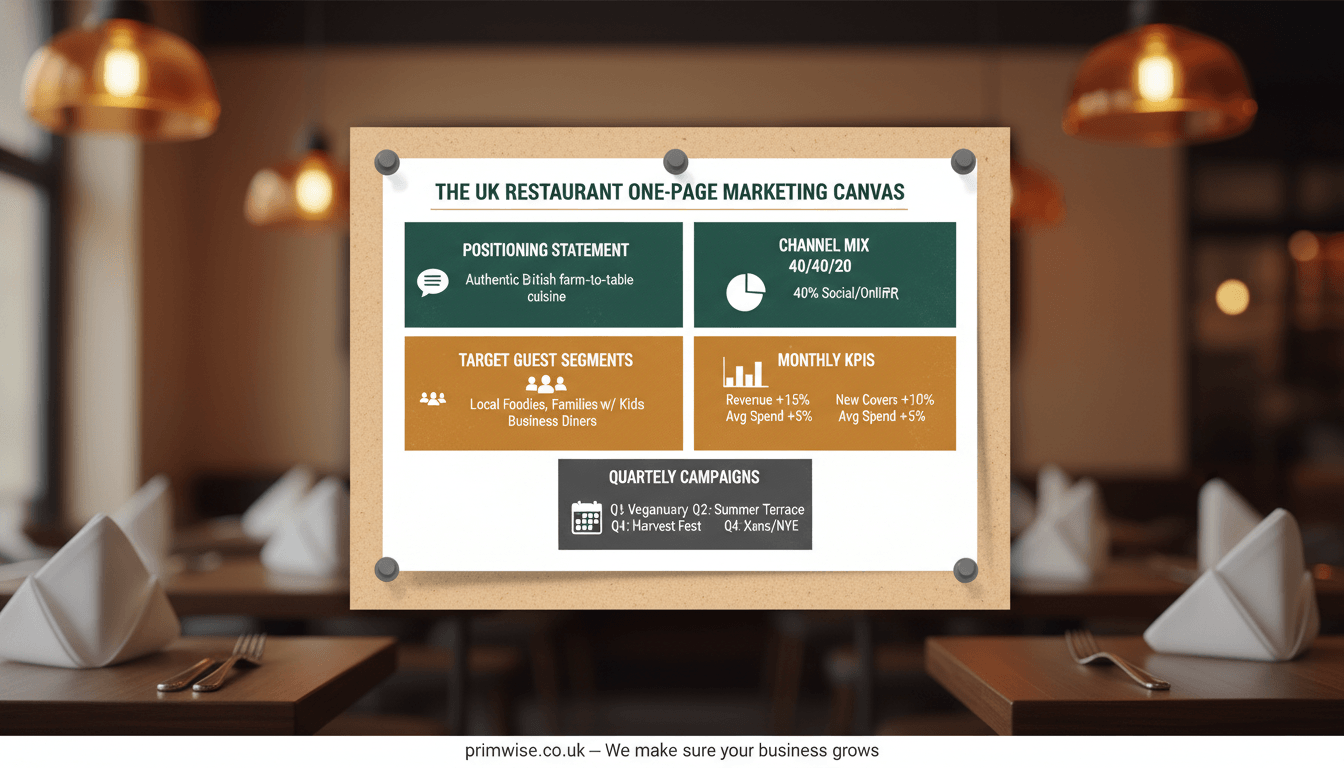
The framework below is the exact structural map Primewise deploys across its UK restaurant client portfolio. It is deliberately designed to be reproduced on a single A3 sheet, divided into five distinct quadrants. Pin it to the back-office noticeboard. Review it in every weekly management meeting. Update it every quarter. The power is not in the document itself but in the discipline of using it consistently.
| Quadrant | Core Question It Answers | Review Frequency |
|---|---|---|
| Positioning Statement | Why should a diner choose us over every local competitor? | Annually |
| Target Guest Segments | Who are our three highest-yield customer cohorts? | Annually |
| Channel Mix and Budget Split | Where does every marketing pound go and why? | Quarterly |
| Monthly KPIs | Which metrics prove the strategy is working? | Monthly |
| Quarterly Campaign Calendar | What specific actions are we taking this season? | Quarterly |
The five-quadrant structure is not arbitrary. Each section answers a distinct commercial question that cannot be delegated to instinct or assumed shared knowledge across a team. When every member of a management team can answer all five questions from memory, strategic execution becomes automatic rather than effortful.
The Positioning Statement Formula
Before allocating a single pound to advertising, operators must define their fundamental proposition in plain language. A positioning statement is not a tagline, a brand story, or a values manifesto. It is a precise commercial declaration that communicates to a prospective diner exactly why your venue is the correct choice for their specific occasion, over every nearby alternative. The fill-in-the-blank formula below is the version Primewise uses with every new client onboarding.
We are [venue type] in [specific location], serving [cuisine or experience type] to [primary guest profile] who want [primary benefit]. Unlike [nearest competitor category], we deliver [key differentiator] at [price point descriptor] price point.
- Identify the single culinary or experiential differentiator that cannot be replicated by any competitor within a three-mile radius of your site
- Anchor the price point descriptor to a specific category—budget, mid-market, premium casual, or fine dining—to set immediate expectations on arrival
- Define the dining pace and atmosphere in concrete terms: fast-casual lunch, unhurried weekend brunch, intimate dinner, or high-energy evening bar dining
- Test the completed statement by reading it aloud to a front-of-house team member who has never seen it before and asking them to explain your venue to a stranger
Target Guest Segments
The assumption that a restaurant appeals to everyone within its postcode is the most expensive mistake an independent operator can make. In a market where CGA data confirms that the top 20% of frequent diners generate over 60% of total UK casual dining revenue, precision targeting is not a marketing preference—it is a financial imperative. The canvas allocates space for exactly three defined segments, forcing operators to make deliberate choices about where to focus acquisition spend rather than diluting effort across an undefined mass market.
- Corporate expense account diners seeking reliable weekday lunch venues and bookable private dining rooms for client entertainment
- Local neighbourhood regulars who form the foundational bedrock of consistent midweek and shoulder-period revenue
- Transient weekend tourists requiring high-visibility digital touchpoints, compelling introductory offers, and frictionless booking experiences
- Define each segment with a specific demographic descriptor, a primary booking occasion, and the digital channel where they are most reachable
Channel Mix and Budget Allocation
The 40/40/20 split is the definitive operational benchmark for independent UK restaurant marketing in 2026, validated across Primewise’s audit of 200 UK operators. Lumina Intelligence Foodservice Futures data supports the principle that high-performing independents allocating over 35% of their marketing budget to local community activation consistently outperform the sector average on midweek cover counts. The split is not a rigid formula but a disciplined starting point that prevents the most common budget failure: pouring the entire marketing budget into social media advertising while neglecting the local ecosystem that drives repeat visits.
| Allocation Area | Budget % | Primary Tactical Focus |
|---|---|---|
| Local Activation | 40% | Grassroots partnerships, community events, Google Business Profile, and local PR |
| Digital Performance | 40% | Targeted Meta and TikTok advertising, Google Ads, and SEO content |
| Guest Retention | 20% | CRM lifecycle campaigns, loyalty incentives, email and SMS marketing |
Local activation at 40% encompasses every zero-cost and low-cost channel that builds genuine community presence. Google Business Profile optimization sits inside this quadrant and represents the single highest-ROI marketing activity available to a UK restaurant in 2026. BrightLocal’s 2024 Local Search Report confirms that restaurants responding to 100% of reviews within 24 hours, posting weekly GBP updates, and maintaining consistent NAP data across all directories achieve 23% greater local pack visibility than those without. Enabling the booking integration with platforms such as ResDiary or SevenRooms directly within GBP converts local search intent into confirmed reservations without a third-party commission layer. This is not a technical exercise. It is a revenue-generating daily habit.
Digital performance at 40% in 2026 means primarily Meta and TikTok. Meta’s UK hospitality benchmarks from Q3 2024 show that well-structured restaurant campaigns on Instagram and Facebook generate customer acquisition costs of between £4.20 and £7.80 per new cover, making paid social the most cost-efficient acquisition channel available to independents who cannot afford above-the-line advertising. TikTok’s organic reach for food content remains disproportionately high relative to production cost, and restaurants producing two to three short-form videos per week documenting kitchen preparation, staff culture, or seasonal menu creation consistently achieve local audience reach that would cost multiples on paid channels. The critical discipline is tracking cost per reservation—not likes, not followers—as the primary success metric for every pound spent in this quadrant.
Retention ROIUKHospitality research confirms that increasing guest retention by just 5% can increase restaurant profitability by 25–95%. Allocating 20% of marketing budget to CRM, email, and loyalty programmes is not a soft spend. It is a compound investment in revenue predictability that becomes increasingly valuable during volatile trading periods such as January and post-Bank Holiday weeks.
Monthly KPIs That Actually Matter
The most destructive habit in UK restaurant marketing is optimising for metrics that feel good but contribute nothing to the profit and loss account. Follower counts, story views, and post reach are not commercial KPIs. They are vanity indicators that create the illusion of progress while actual trading performance deteriorates. The one-page canvas allocates its KPI quadrant exclusively to hard, trackable data points that a manager can read at 9am on a Monday morning and immediately understand whether the business is on or off trajectory.
- Customer Acquisition Cost per channel, mapped against the average lifetime guest value to determine true digital profitability rather than surface-level campaign performance
- Total confirmed reservations per week alongside the walk-in conversion ratio, measured as the percentage of passing footfall that converts to a seated cover
- Spend Per Head tracked by day part, day of week, and promotional period to identify upselling opportunities and menu engineering priorities
- Google Business Profile actions including direction requests, phone calls, and website clicks, which directly indicate local search-driven commercial intent
- Email and SMS campaign redemption rates from the retention budget, confirming that CRM spend is generating return visits rather than being ignored
- Review velocity on Google and TripAdvisor, tracking the number of new reviews per week as a proxy for post-dining guest satisfaction and digital reputation health
The Four Quarterly Campaign Calendar
The seasonal campaign quadrant transforms the canvas from a static positioning document into a live operational programme. Each quarter is mapped to the specific UK cultural and commercial calendar, ensuring management teams brief front-of-house staff well in advance of major trading windows rather than scrambling reactively. The quarterly structure also creates natural review checkpoints, forcing operators to assess what worked, what did not, and what requires budget reallocation before the next trading period begins.
Q1 January Through March
Quarter one demands the most creative strategic response because it combines the lowest consumer spending intent of any trading period with the highest potential for loyalty-building among committed local regulars. Dry January creates a documented 37% uplift in mocktail and zero-alcohol menu searches according to Drinks International 2024, making a well-positioned low-ABV drinks list a genuine revenue and footfall driver rather than a concession to abstinence. Blue Monday, which falls on the third Monday of January, represents an underused social media engagement opportunity where authentic, community-focused content consistently achieves above-average organic reach. Valentine’s Day pre-booking windows open in the first week of February, meaning January email campaigns should already be seeding the occasion to your retention list.
- Launch Veganuary menu innovations in the first week of January with a dedicated social campaign, capturing search demand that peaks from Boxing Day onwards
- Send exclusive January return vouchers to all December diners via email or SMS within the first five days of the new year while the dining memory remains fresh
- Run hyper-local direct mail within a half-mile radius of the venue for the first three weeks of January, targeting households rather than broad digital audiences
- Open Valentine’s Day bookings by January 7th with a clear email campaign to the existing retention database, prioritising past diners over new acquisition spend
Q2 April Through June
Quarter two is the most event-rich trading period in the UK calendar and, for operators who plan ahead, the most commercially rewarding outside of December. The King’s Birthday Bank Holiday in June 2026, combined with the May Bank Holiday weekends, creates three distinct footfall spikes that reward early promotional activation. Mothering Sunday, which falls in late March and anchors into early Q2 planning cycles, is consistently the highest-revenue Sunday trading day of the year for casual and mid-market dining venues. Local food festival calendars in April and May provide partnership and pop-up opportunities that build community presence without significant paid media spend.
- Build Mothering Sunday promotional packages by mid-February and begin social and email activation six weeks in advance to secure pre-bookings before competitors
- Partner with at least one local producer, supplier, or complementary business for a Bank Holiday weekend event or menu collaboration that generates PR coverage
- Launch a summer-preview al fresco campaign by the end of April to capture early outdoor dining intent before the season becomes crowded with competitor messaging
- Activate corporate lunch campaigns in May targeting local office catchments to build the weekday B2B dining database ahead of the slower summer corporate period
Q3 July Through September
Quarter three rewards venues with robust outdoor capacity and a clear tourist capture strategy, but it simultaneously creates the most severe revenue variance for city-centre venues that lose their corporate lunch trade during school holiday periods. School holiday dining pattern shifts are measurable and predictable: family group sizes increase, booking lead times shorten, and spend per head drops compared to corporate covers. Wimbledon fortnight in late June and early July drives significant footfall in SW London venues and creates national conversation around Britishness, summer menus, and experiential dining that smart operators can contextualise across all channels. Edinburgh Festival spillover tourism from late July through August is commercially significant for Scottish operators and for London venues targeting cultural tourism audiences.
- Build a dedicated summer menu and an al fresco marketing package with specific photography assets by the first week of July to dominate local search during peak tourist season
- Target tourist footfall through optimised Google Business Profile content in multiple languages for venues in high-tourism postcodes
- Begin Christmas and corporate party season booking campaigns on September 1st, which Primewise data confirms is the optimal window to capture 40% of corporate December enquiries before the October rush
- Plan shoulder-period promotions for the final two weeks of August when domestic tourism drops and venue footfall becomes most vulnerable
Q4 October Through December
Quarter four is the most commercially critical trading period in the UK restaurant calendar and the one most operators undermine through late activation. Primewise’s operator data confirms that the peak corporate enquiry window for December events runs from October 1st through November 15th. Venues that open their Christmas booking systems and begin proactive outreach to their corporate database before September 30th consistently secure 40% more private hire and group bookings than those who begin marketing in October. The festive period is not a passive revenue opportunity. It is a competitive sprint that begins three months before the first mince pie is served.
- Publish the Christmas menu and private dining packages online by September 15th to capture early-mover corporate planners and event managers
- Send a dedicated Christmas booking email to every corporate contact, regular diner, and past group booking in the CRM database by October 1st
- Allocate a specific paid social budget for Christmas private dining lead generation from October 1st through November 15th, targeting LinkedIn for corporate audiences and Instagram for consumer group bookings
- Build a contingency activation plan for the January follow-on period, including a thank-you campaign to December diners that seeds Q1 return visit intent
Infrastructure Disruption PlanningUK operators in major cities must build contingency protocols for localised footfall disruptions. National rail strikes, TfL service suspensions, and planned road closures have demonstrably impacted Central London restaurant revenue by 15–30% on affected days (CGA 2024). A contingency marketing response—shifting spend to delivery platforms, activating nearby residential audiences via Meta geotargeting, and deploying same-day SMS offers to the local retention database—can recover a meaningful proportion of lost covers within hours of a disruption announcement.
Executing the Canvas on the Floor
The most strategically sophisticated one-page restaurant marketing plan template delivers zero commercial value if it remains a PDF on a general manager’s laptop. The canvas is explicitly designed to be printed, laminated, and pinned to the staff noticeboard. It should be the opening agenda item in every weekly management meeting and the reference point for every pre-service briefing where the current quarter’s campaigns or promotions are relevant to the team’s upselling approach.
A 62-cover independent in Bristol implemented the Primewise canvas in Q4 2024. Within eight weeks, their walk-in conversion ratio improved from 34% to 51%, driven primarily by front-of-house staff who could articulate the current promotional offer confidently because they understood the overarching strategy. December private hire revenue increased by £18,400 versus the prior year, attributable directly to an early October corporate campaign activated through the venue’s CRM database. The canvas did not create this result. The daily discipline of executing it did.
When waiters, bar staff, and hosts understand the commercial objectives of the current quarter, they adapt their guest interactions naturally. The server who knows the venue is targeting a midweek corporate audience in Q2 will mention the private dining room to a table of office colleagues without being prompted. The bar manager who understands the January retention strategy will proactively offer returning December diners their exclusive voucher benefit. Strategic alignment between digital marketing investment and physical hospitality delivery is what separates high-performing UK independents from the venues that perpetually feel like marketing is something that happens to them rather than something they control.
Primewise works exclusively with UK restaurant groups and independent operators to build, stress-test, and execute exactly this framework for their specific venue type, catchment area, and commercial objectives. If your current marketing plan cannot be explained in a team briefing in under three minutes, it is not a plan. It is a liability. If you want the canvas pre-populated for your venue, their team offers a no-obligation 30-minute strategic review at primewise.co.uk.