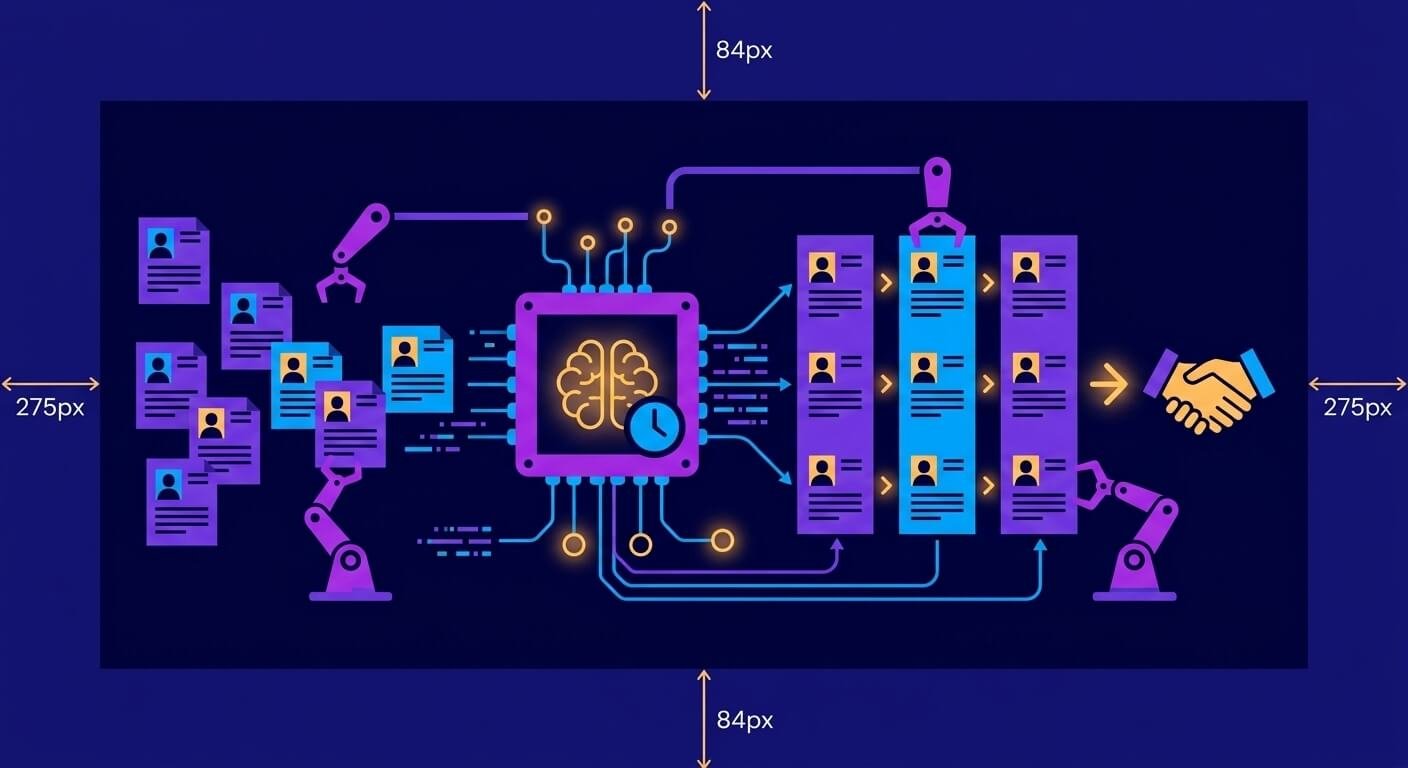

AI agents for lead qualification are transforming how UK B2B teams manage top-of-funnel revenue operations. According to 2025 Gartner and Forrester benchmarks, organisations deploying LLM-powered qualification layers report a 35–60% reduction in SDR triage time and a measurable improvement in pipeline accuracy within the first quarter. But the same research reveals a harder truth: without continuous calibration, these systems degrade within 90 days, silently eroding the very conversion rates they were built to protect. This guide covers the complete architecture how scoring logic actually works, what genuine total cost of ownership looks like in GBP, how to integrate safely into Salesforce or HubSpot without corrupting your CRM, and precisely which failure modes will quietly destroy your ROI after the honeymoon phase ends.
Who This Guide Is ForThis article is written for Sales Directors, RevOps VPs, and Operations Leaders at UK B2B firms actively evaluating AI lead qualification deployment. If you are past the 'what is AI' stage and are now budgeting, scoping architecture, and assessing risk, this is the resource you need before any vendor commitment is made.
What AI Agents for Lead Qualification Actually Do
An AI lead qualification agent is an autonomous conversational system built on a large language model that engages inbound or outbound prospects, extracts qualitative discovery data through structured dialogue, scores buyer intent in real time, and routes high-probability opportunities to human sales representatives with full contextual handoff. Unlike traditional marketing qualified lead and sales qualified lead frameworks that rely on static firmographic filters and basic engagement scoring, these agents perform live semantic analysis on unstructured conversational input interpreting what a prospect actually means, not merely what they clicked or submitted on a form.
The core differentiation lies in Natural Language Understanding (NLU) and intent detection. When a prospect says something indirect for example, expressing operational frustration without naming a specific solution a well-architected LLM agent identifies this as a latent buying signal that a checkbox-based scoring model would classify as low intent and discard. This qualitative discovery capability is the primary reason AI lead qualification is displacing traditional MQL frameworks in revenue-focused organisations.
How the Scoring Logic Works Inside an LLM Qualification Agent
Understanding how artificial intelligence processes unstructured prospect answers is essential for any operations director evaluating these systems. The architecture is fundamentally different from legacy lead scoring, and that difference determines both the system’s power and its risk profile.
From Static MQL Models to Conversational Intelligence
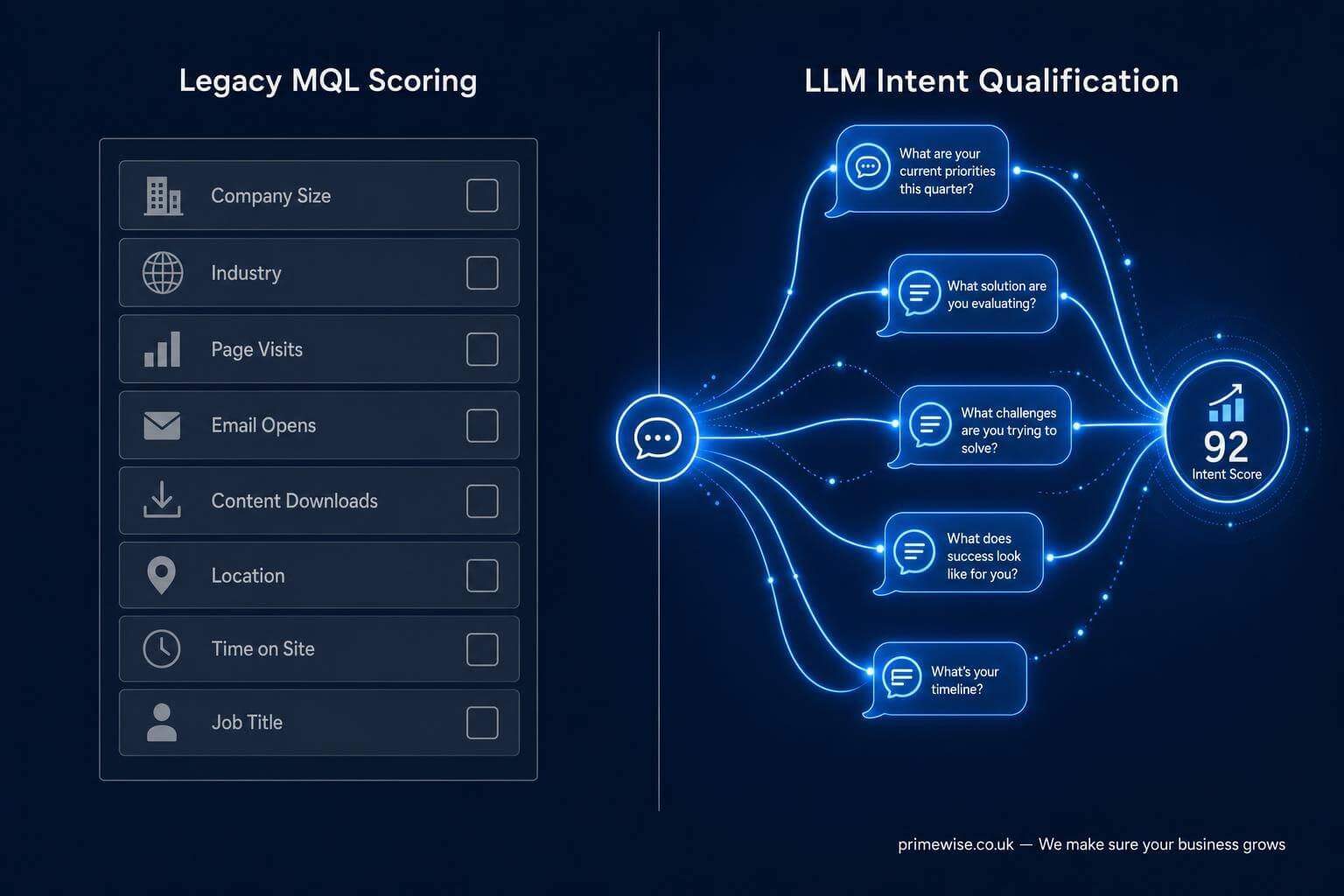
Traditional B2B lead scoring assigns numerical weights to firmographic data points company size, industry vertical, job title, page visits and triggers a qualification threshold when a cumulative score crosses a predefined number. This approach is deterministic, auditable, and brittle. It fails completely when a high-value prospect behaves atypically, enters through an unexpected channel, or uses language that does not match anticipated keyword patterns.
LLM-based qualification agents apply probabilistic reasoning across the full conversational context. When a Series B SaaS CFO mentions they are currently mid-way through a board-mandated cost review while enquiring about your platform’s pricing tier, the agent does not simply log a form submission. It categorises the structural context budget cycle, decision-making authority, urgency signal, and competitive consideration and generates a composite intent score enriched by semantic inference. This represents a genuine paradigm shift in lead qualification techniques, moving the discipline from data aggregation to dialogue interpretation.
Intent Detection and NLU in Practice
Intent detection within a qualification agent operates across three analytical layers. The first is entity extraction identifying named references to budgets, timelines, stakeholders, and competing vendors. The second is sentiment analysis detecting confidence, hesitation, urgency, or resistance in tone and phrasing. The third is contextual coherence assessing whether the overall conversation trajectory aligns with historical buying patterns stored in the agent’s prompt context or fine-tuned training data.
In practical deployment, this means the agent is simultaneously evaluating what is said, how it is said, and whether the conversation arc matches patterns associated with closed-won opportunities. The output is not a simple score but a structured qualification summary: a probability-weighted assessment of budget fit, authority, need, and timeline the conversational equivalent of the BANT framework, executed autonomously at scale.
Designing the Human-in-the-Loop Handoff
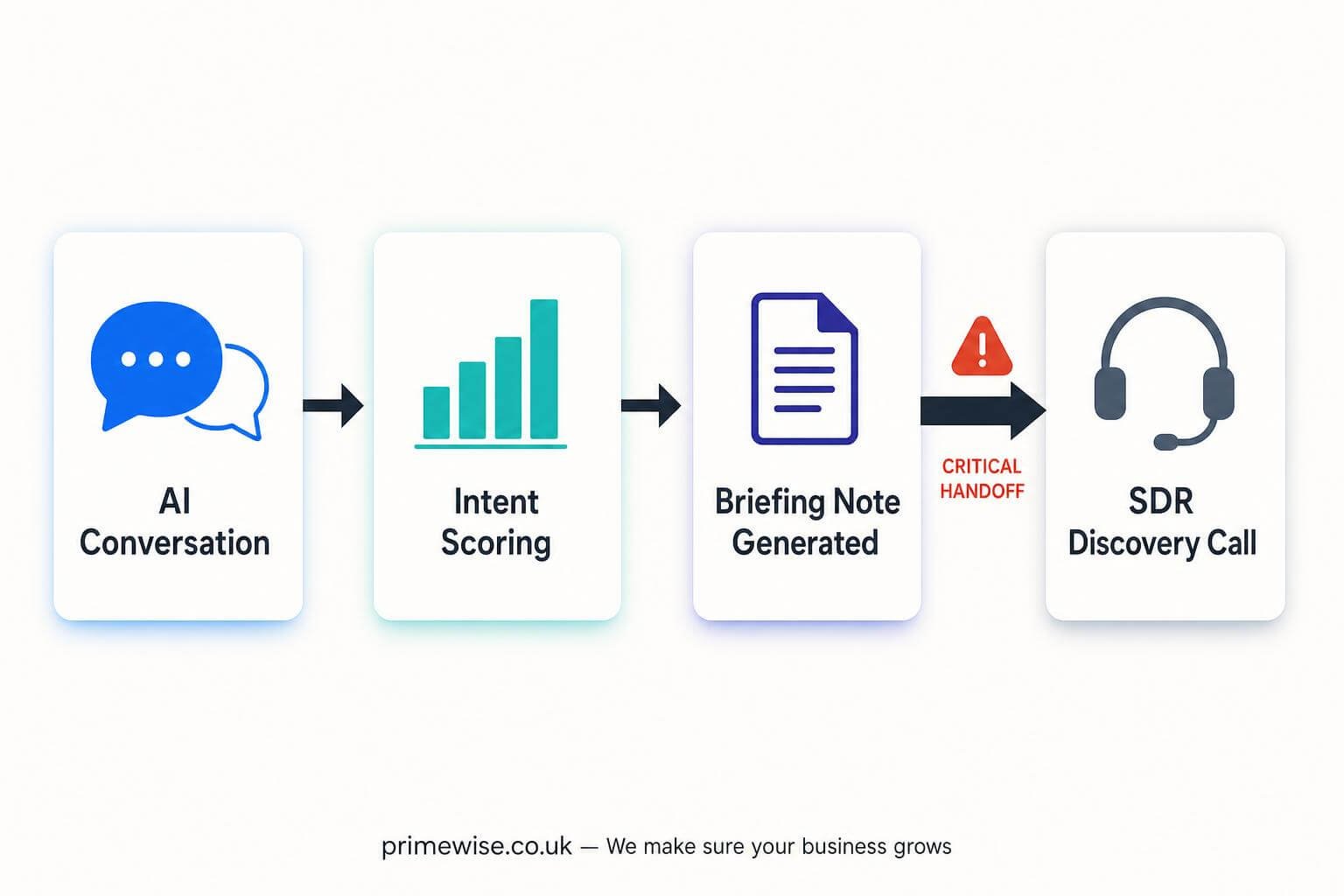
The point at which an AI qualification agent transfers a prospect to a human sales development representative is the highest-risk moment in the entire automated pipeline. Get this transition wrong and you erase every efficiency gain the AI delivered upstream. The data is unambiguous on this: when human SDRs receive unformatted chat transcripts rather than structured briefing notes, contextual continuity collapses, and conversion rates from AI-qualified leads fall to levels comparable to unqualified inbound a phenomenon measurable as the Context Handoff Failure Drop.
Building Synthesised Briefing Protocols
A production-grade human-in-the-loop transition does not hand off a conversation log. It delivers a synthesised briefing note generated by the AI at the moment of handoff, structured to give the receiving SDR immediate command of the engagement. This briefing should contain five defined components: a one-paragraph prospect summary, confirmed budget range or constraints, identified technical prerequisites or integration requirements, primary objections raised during the AI interaction, and the recommended opening approach for the discovery call.
When this protocol is implemented correctly, SDRs enter discovery calls with the same level of contextual authority as if they had conducted the initial qualification themselves. Organisations that have moved from raw transcript handoffs to structured AI briefing notes report discovery-to-demo conversion improvements of 20–40%, depending on deal complexity and industry vertical. The investment required to build this briefing layer typically prompt engineering work estimated at 15–25 hours of specialist time is one of the highest-return activities in the entire deployment.
When to Force a Human Override Immediately
Every qualification agent must include hard escalation triggers that bypass the standard routing logic and connect the prospect to a human immediately. These triggers should include: any expression of a regulatory or legal concern, any mention of a competitor by name in a sensitive context, any indication of a procurement process already underway with another vendor, and any sentiment signal consistent with frustration or distrust of the automated interaction itself.
Failing to define these override conditions results in the agent attempting to qualify prospects who should be in relationship management mode, generating objections that a human could have dissolved in a single exchange. Escalation logic is not a fallback feature it is a core architectural requirement for any deployment targeting high-value enterprise accounts.
CRM Integration Architecture for AI Lead Generation UK
Connecting an AI qualification layer to your existing CRM is where theoretically sound deployments most frequently fracture in practice. Flawed integrations create duplicate records, overwrite historical sales activity, and corrupt the data integrity that every downstream revenue function depends on. A robust integration architecture requires precise object mapping, bidirectional sync logic, and middleware that can handle conditional routing without data loss.
Preventing Duplicate Records and Field Overwrites
When an AI qualification agent creates or updates a lead record, the integration middleware must execute a deduplication check before any write command is issued to the CRM database. For Salesforce deployments, this typically means cross-referencing the incoming record against existing contacts and leads using email domain, corporate registration number, and LinkedIn identifier as primary matching keys. For HubSpot, the native deduplication API handles basic email-level matching but requires supplementary middleware logic for domain-level corporate deduplication at enterprise scale.
Tools commonly used in production UK deployments for this middleware layer include n8n, Make (formerly Integromat), and Zapier Enterprise. Each has distinct capability ceilings: n8n offers the deepest custom logic handling and is preferred for complex conditional workflows; Make provides strong visual workflow management suited to mid-market deployments; Zapier Enterprise is the fastest to implement but has execution limits that become restrictive above approximately 5,000 monthly qualified conversations. The choice of middleware directly affects both your integration cost and your operational ceiling.
Enriching CRM Records Without Overwriting Legacy Data
The integration design must operate on an append-only principle for fields containing historical sales activity. AI-generated qualification data intent score, conversation summary, identified objections, budget range should write exclusively to custom CRM properties designated for AI enrichment output. Under no circumstances should the integration logic overwrite fields populated by human SDRs, including prior meeting notes, negotiated terms, or manually assigned account ownership.
For organisations using Salesforce Einstein or HubSpot AI alongside a third-party qualification agent, the enrichment architecture becomes a two-layer system: the external AI agent handles conversational qualification and writes to custom object fields, while the native CRM AI layer processes the enriched data for predictive scoring and pipeline forecasting. This separation of responsibilities protects data integrity while maximising the intelligence available to the sales team at every stage of the funnel.
A Note on Vendor-Neutral ArchitectureOrganisations working with PrimeWise to architect their AI qualification layer typically establish a baseline CRM integration model during the initial consultation identifying the specific middleware, deduplication logic, and field mapping requirements unique to their sector before any vendor commitment is made. This prevents costly re-architecture after deployment.
UK GDPR and ICO Compliance for Automated Lead Profiling
Deploying automated AI lead profiling systems within UK financial services, professional services, or legal sectors is a regulated activity. The Information Commissioner’s Office is the designated supervisory authority for data protection in the United Kingdom, and its guidance on automated decision-making is directly applicable to AI qualification agents that create prospect profiles, assign intent scores, and determine routing outcomes based solely on automated processing.
Article 22 UK GDPR and Automated Decision-Making
Article 22 of the UK General Data Protection Regulation grants individuals the right not to be subject to decisions based solely on automated processing where those decisions produce legal or similarly significant effects. In a B2B lead qualification context, this provision is most directly relevant when the AI agent’s output determines whether a prospect is entirely excluded from human engagement for example, if a low intent score automatically suppresses all outreach without any human review trigger. Organisations deploying qualification agents must implement a human review pathway for any routing decision that materially affects a prospect’s commercial relationship with the business.
The ICO’s 2024–2025 guidance on AI and data protection further requires that individuals interacting with automated systems are informed of that fact in clear, accessible language at the outset of the interaction. In practical terms, this means every AI qualification conversation whether via chat, web form, or voice must open with an explicit disclosure that the interaction is AI-assisted, alongside a frictionless mechanism to request immediate human transfer or data deletion. Embedding this disclosure within a multi-paragraph terms block does not satisfy the ICO’s transparency standard; it must be presented prominently and in plain language.
Data Residency and API Routing for UK Enterprise Procurement
For enterprise clients in London’s financial and professional services sectors, data residency requirements frequently govern vendor eligibility entirely. API calls made to large language model providers including OpenAI, Anthropic, and Google DeepMind must be demonstrably routed through UK or EU-based data centres to satisfy procurement requirements. In 2025 and 2026, all three major providers offer regional deployment options, but these configurations must be explicitly specified in API settings and contractually confirmed in data processing agreements before deployment.
Voice-based AI qualification agents introduce an additional compliance layer. Platforms such as Retell AI, Bland AI, and Twilio Flex commonly used as the voice infrastructure layer in UK deployments handle real-time transcription, audio processing, and data storage. Each element of this stack requires its own data residency confirmation and a documented data processing agreement to satisfy enterprise procurement due diligence. SIP trunking for UK telephony routing carries its own provider-level compliance obligations and typically adds £0.008–£0.025 per minute to operational costs, depending on provider tier and call volume.
The True Total Cost of Ownership in GBP
Vendor sales cycles for AI qualification tools are optimised to surface subscription fees and minimise total cost of ownership transparency. The commercial reality for UK deployments is considerably more layered than a monthly SaaS fee, and accurate financial modelling before procurement is the single most important risk mitigation step available to a RevOps leader.
The Four-Layer PrimeWise Cost Model
A structured approach to AI lead qualification cost modelling separates expenditure into four distinct layers: infrastructure, integration, compliance, and human oversight. Infrastructure costs encompass LLM API token consumption, voice processing fees, and data storage. Integration costs cover middleware licensing, CRM customisation, and initial development hours. Compliance costs include legal review, DPA documentation, ICO registration where applicable, and ongoing audit activity. Human oversight costs frequently omitted entirely from vendor cost models cover the RevOps AI lead role responsible for prompt maintenance and system health.
At GPT-4o pricing for 2025–2026, processing 10,000 fully qualified conversational interactions per month at an average of 1,500 tokens per conversation across input and output approximates £1,400–£2,200 per month in raw API token costs before any middleware, voice, or integration overhead. For a mid-market UK SaaS business running 2,000–3,000 qualified conversations monthly, realistic all-in operational expenditure sits in the range of £3,500–£7,000 per month at steady state, excluding one-time implementation costs typically ranging from £12,000–£35,000 depending on CRM complexity and compliance requirements.
AI Voice Agent Costs and Telecom Overheads
AI voice agents for lead qualification carry a materially different cost profile from text-based conversational agents. Voice interactions demand real-time speech-to-text transcription, LLM generative processing within sub-400ms latency thresholds to avoid perceptible response gaps, and immediate text-to-speech rendering. Each of these processing stages carries its own API cost, and they compound multiplicatively at scale.
Retell AI and Bland AI, two of the most widely deployed voice agent infrastructure platforms in UK B2B deployments, operate on per-minute pricing models. At current 2025–2026 rates, per-minute costs for voice agent operation excluding telephony range from £0.05–£0.14 per minute depending on the LLM model tier selected. A five-minute average qualification call at the midpoint of this range costs approximately £0.50 per call in platform fees alone, before SIP trunking, transcription storage, and middleware execution costs are added. At 1,000 calls per month, this represents £500–£800 in voice platform fees before the broader stack overhead is applied.
The RevOps AI Lead Role What It Actually Costs
The most consistently underbudgeted element in AI lead qualification deployments is the internal human resource required to maintain system accuracy. AI qualification agents are not set-and-forget infrastructure. They require a dedicated operations function: a RevOps AI lead whose responsibilities span prompt engineering, output quality monitoring, edge-case remediation, and continuous calibration against shifting buyer behaviours and product updates.
This AI lead role carries a hybrid skill profile combining revenue operations knowledge, prompt engineering proficiency, and CRM administration capability. In the UK market for 2025–2026, the salary range for a specialist in this function sits between £45,000 and £70,000 per annum at the mid-senior level, or £350–£600 per day for fractional or consultancy-basis engagements. Organisations that attempt to absorb this function into an existing SDR or marketing operations role without dedicated capacity consistently report measurable performance degradation within four to six months of initial deployment.
ROI Reference PointA UK-based Series B SaaS firm that deployed an LLM qualification layer integrated with Salesforce reduced its SDR headcount requirement by two full-time equivalents after month three, achieving implementation cost payback within 4.2 months. Weekly prompt maintenance averaged 6 hours of specialist time to sustain qualification accuracy above 85%.
The 90-Day AI Degradation Curve
The most operationally significant challenge in AI lead sourcing and the one least represented in vendor documentation is systematic performance degradation after initial deployment. Well-architected agents that deliver strong qualification accuracy in the first four to eight weeks routinely begin to underperform between weeks ten and fourteen. This pattern is sufficiently consistent across deployment types to warrant a named framework: the 90-Day AI Degradation Curve.
Understanding Prompt Drift
Prompt drift occurs when the static instructions governing an AI agent’s behaviour fall out of alignment with the evolving reality of the market it is operating in. Buyer language shifts. New objections emerge. Product updates create qualification criteria that the original prompt did not anticipate. Edge cases accumulate. When these changes interact with unchanged prompt instructions, the agent begins generating responses calibrated to a market reality that no longer exists producing assessments that are systematically overconfident, systematically conservative, or simply irrelevant to current buying conditions.
Prompt drift is insidious because it does not produce obvious system errors. The agent continues to function, continues to score prospects, and continues to route leads. The degradation manifests in lagging conversion metrics discovery-to-demo rates declining, pipeline-to-close ratios softening that are easy to attribute to market conditions or SDR performance rather than agent decay. Identifying prompt drift requires deliberate monitoring: weekly conversation sampling, conversion rate tracking segmented by AI-qualified versus non-AI-qualified pipeline, and a structured prompt review cycle conducted by the RevOps AI lead at minimum every 30 days.
Hallucinations and Unhandled Edge Cases
When a prospect presents a scenario or asks a question that falls outside the agent’s trained context, the system faces a choice determined by its guardrail configuration. A well-configured agent recognises the edge case, acknowledges the limitation, and escalates gracefully to a human. A poorly configured agent or an agent operating with degraded guardrails due to prompt drift attempts to generate a response anyway, producing what the AI research community terms a hallucination: a confident, plausible-sounding answer that is factually or contextually incorrect.
In a lead qualification context, hallucinated responses can include fabricated product capabilities stated to a technical evaluator, invented pricing commitments relayed to a procurement officer, or misrepresented compliance certifications communicated to a regulated sector buyer. Each of these failure modes carries commercial and reputational risk disproportionate to the efficiency gains the agent was deployed to deliver. Preventing them requires explicit fallback parameters in the agent’s prompt architecture and automated anomaly detection that flags conversations containing responses outside a defined confidence threshold for human review.
Calibrating for British Linguistic and Cultural Nuance
UK business communication operates on a register of structured indirectness that out-of-the-box LLM models predominantly trained on American English business corpora frequently misinterpret. A British prospect saying ‘that’s quite interesting, we’ll need to take this back to the team’ is not expressing enthusiasm; in context, this phrasing often signals a polite disengagement or a soft rejection deployed to avoid direct confrontation. An agent calibrated on US buying signal patterns will classify this response as positive intent and route the lead accordingly, wasting SDR time and generating frustration when the human follow-up reveals a cold prospect.
Calibrating for British linguistic nuance requires deliberate training data curation and sentiment analysis refinement specific to UK professional communication styles. This includes building recognition for understatement as a deflection mechanism, indirect objections embedded in polite affirmations, and regional dialect variation across London, Manchester, Edinburgh, and Birmingham markets. For AI lead generation UK deployments targeting high-net-worth individuals or senior decision-makers in financial services and professional services, this calibration work is not optional it is a fundamental determinant of qualification accuracy and, by extension, pipeline quality.
Key Technology Stack Components for UK Deployments
Naming specific tools in context is essential for decision-makers conducting vendor evaluation. The following represents the production stack architecture used in well-executed UK B2B AI lead qualification deployments, with each layer serving a distinct function that generic descriptions of ‘middleware’ and ‘API endpoints’ fail to communicate adequately.
For conversational AI infrastructure, the primary LLM options in UK enterprise deployments are GPT-4o via OpenAI’s API, Claude 3.5 Sonnet via Anthropic’s API, and Gemini 1.5 Pro via Google DeepMind. Each model has distinct strengths in conversational coherence, instruction-following precision, and latency profile. For voice-specific deployments, Retell AI and Bland AI provide the orchestration layer handling speech-to-text, LLM integration, and text-to-speech rendering in a single managed platform, significantly reducing the architectural complexity of building a voice agent from component APIs. Twilio Flex serves as the telephony infrastructure for organisations requiring enterprise-grade call routing, compliance recording, and UK-based SIP trunking.
For middleware and automation, n8n is preferred in deployments requiring complex conditional logic and self-hosted data residency compliance. Make (formerly Integromat) serves mid-market deployments where visual workflow management and rapid iteration are prioritised over deep customisation. For CRM enrichment, Salesforce Einstein and HubSpot AI both provide native predictive scoring that can consume AI-generated qualification data as enrichment input, creating a two-tier intelligence architecture where the external qualification agent feeds the CRM’s native AI layer with structured discovery output rather than raw conversational data.
Implementation Complexity WarningThe combination of voice agent infrastructure, LLM API integration, CRM middleware, and UK GDPR compliance documentation makes AI lead qualification one of the most architecturally complex RevOps investments available in 2026. Attempting to manage this implementation without specialist architecture oversight consistently results in compounding technical debt within the first six months.
Scoping Your AI Lead Qualification Architecture
The decision to deploy AI agents for lead qualification is not a software procurement decision it is a revenue architecture decision with implications across your CRM data integrity, compliance posture, SDR team structure, and long-term cost base. The organisations that extract durable ROI from these systems are not the ones who deployed the most sophisticated technology first. They are the ones who invested in rigorous upfront scoping: establishing a vendor-neutral cost model, mapping their specific CRM integration requirements, confirming their data residency obligations, and defining their prompt maintenance resourcing before any vendor was selected.
PrimeWise has architected AI qualification systems for UK financial services and SaaS businesses managing pipelines exceeding £50M ARR. Our approach begins with a structured scoping engagement that produces a compliance gap assessment, a four-layer total cost model calibrated to your conversation volume and tech stack, and a 90-day implementation roadmap before any vendor commitment is made. If you are at the stage where this guide is the kind of resource you needed, the next logical step is a structured conversation about your specific architecture. Explore our AI lead qualification consultancy to understand exactly what that engagement looks like and what it delivers.