Knowing how to keep business data secure when using AI is now the defining compliance challenge for UK small and medium-sized enterprises in 2026. Every week, business leaders adopt new AI integration and automation service tools without fully understanding that a single unregulated employee prompt could constitute a reportable data breach under UK GDPR, carrying fines of up to £17.5 million or four percent of global annual turnover. According to the UK Government’s DSIT Cyber Security Breaches Survey 2024, 50 percent of UK businesses experienced a cybersecurity breach or attack in the preceding twelve months, a figure that does not yet fully account for the explosion in unsanctioned AI tool usage now sweeping corporate environments. The Information Commissioner’s Office received over 22,000 data breach reports in 2023/24 alone, and regulators have explicitly stated that automated processing workflows present a new and growing vector for accidental exposure. This guide delivers a structured, five-step governance framework that any regulated UK SME can implement immediately, without a dedicated Chief Information Security Officer.
Whether your firm is FCA-regulated, SRA-supervised, or operating in any data-sensitive sector, the operational stakes are identical. Confidential client records, proprietary financial strategies, and legally privileged communications are being routinely fed into consumer-grade AI tools by well-meaning employees who simply do not understand the architectural difference between a free public interface and a commercially contracted enterprise endpoint. Businesses seeking structured governance support are increasingly partnering with specialist UK advisory firms like Primewise to operationalise these frameworks without the overhead of a full-time CISO. The sections that follow translate complex regulatory obligations into precise, executable actions your leadership team can deploy this week.
Executive SummaryUK SMEs face ICO fines of up to £17.5 million for AI-related data breaches. The solution requires three parallel actions: switching to enterprise APIs with zero data retention, training staff in the Classify-Mask-Restrict framework, and deploying a formal AI Acceptable Use Policy before any further AI adoption proceeds.
Defining AI Data Security for UK SMEs
AI data security for UK SMEs means implementing contractually enforceable governance over every automated tool that touches business or client data, ensuring that no personally identifiable information, special category data, or commercially sensitive intelligence is ever absorbed into an external training model without explicit lawful basis. This definition is operational, not aspirational it translates directly into procurement decisions, staff training requirements, and documented compliance evidence.
Establishing this authority over your digital supply chain is not optional for entities processing PII. For firms regulated by the Financial Conduct Authority or the Solicitors Regulation Authority, securing AI workflows is a fundamental licensing requirement, not merely a technical best practice. A breach in these sectors risks not just financial penalties but the suspension of operating licences and irreversible reputational damage with institutional clients. The NCSC’s 2024 guidance on AI cyber risk explicitly warns that threat actors are increasingly targeting the prompts and outputs of AI systems as a new attack surface, making internal governance more urgent than ever. The ICO has also published dedicated guidance titled “Explaining Decisions Made with AI” that regulated entities are expected to have read and operationalised before deployment.
Public AI Versus Enterprise AI APIs
The single most consequential technical decision a UK SME will make in 2026 is choosing between a consumer-grade AI interface and a commercially contracted enterprise API. The architectural difference between these two categories is not cosmetic it is the difference between exposing your business intelligence to a third-party training pipeline and operating within a legally ring-fenced, contractually protected environment. Understanding this distinction is the prerequisite for every other security measure in this guide.
The Hidden Cost of Consumer AI Tools
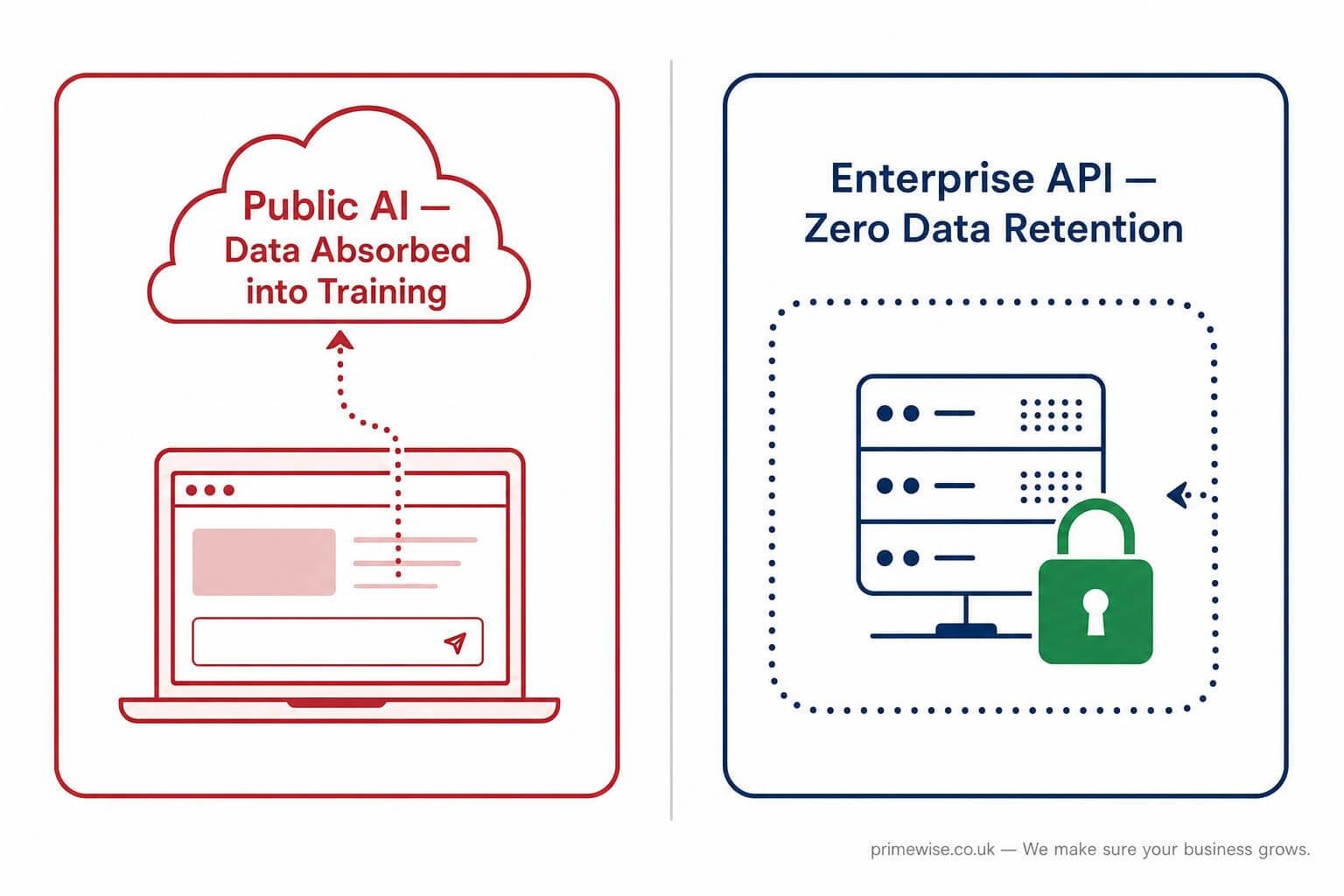
Standard consumer interfaces such as ChatGPT Free, the free tier of Claude.ai, and Gemini Free present a severe and frequently underestimated risk to corporate confidentiality. When employees use these publicly accessible applications to draft client emails, analyse financial spreadsheets, or summarise board meeting notes, the text they input is typically ingested by the provider to improve future model iterations. This dynamic creates a critical vulnerability known as prompt leakage, where internal communications, client account details, or proprietary strategies could theoretically be reproduced in outputs delivered to entirely unrelated external users. This phenomenon shadow AI operating outside any IT oversight has been identified by the NCSC as a leading cause of accidental organisational data exposure. The ICO has confirmed that submitting personal data to a third-party AI system without a lawful basis and appropriate contractual controls can constitute a breach of UK GDPR Article 5, triggering mandatory notification obligations.
The Zero Data Retention Advantage of Enterprise APIs
The definitive technical solution for regulated corporate environments is procuring AI capabilities via commercial enterprise APIs rather than consumer web interfaces. Leading providers including Microsoft Azure OpenAI Service, Google Vertex AI, and AWS Bedrock offer enterprise-grade endpoints that operate under legally binding Data Processing Agreements. These commercial contracts stipulate a zero data retention policy, guaranteeing that inputs and generated outputs are completely siloed, encrypted in transit and at rest, and strictly prohibited from being used to train the vendor’s foundation models. Microsoft Azure OpenAI Service, for example, processes customer data within dedicated Azure regions and offers UK data residency options, meaning your information never leaves a jurisdiction where UK GDPR adequacy is confirmed. Google Vertex AI similarly provides organisation-level data isolation with configurable retention controls and explicit sub-processor transparency. These are the only categories of tool that provide a legally defensible basis for processing client data through automated systems.
| Criterion | Consumer AI (Free Tier) | Enterprise AI API |
|---|---|---|
| Data Retention Policy | Inputs typically retained for model training | Zero data retention, contractually guaranteed |
| Contractual Protection | None governed by consumer terms of service | Full Data Processing Agreement (DPA) |
| UK GDPR Lawful Basis | Not established; high breach risk | Article 28 processor agreement in place |
| Sub-processor Transparency | Limited or not disclosed | Full sub-processor list provided contractually |
| UK Data Residency Option | Not available | Available (Azure UK South, Vertex AI EU) |
| Named Examples | ChatGPT Free, Claude.ai Free, Gemini Free | Azure OpenAI, Google Vertex AI, AWS Bedrock |
The table above demonstrates that the gap between consumer and enterprise AI is not a matter of features but of legal standing. Any SME processing client data through a consumer interface is, in practical terms, operating without a compliant Article 28 processor relationship a direct violation of UK GDPR that the ICO has shown increasing willingness to investigate and prosecute.
Critical WarningUsing ChatGPT Free, Claude.ai Free, or Gemini Free for any task involving client names, financial records, or legally privileged information is a potential UK GDPR breach. Switch to enterprise API equivalents before your next client-facing AI workflow.
The SME AI Safe Data Triad
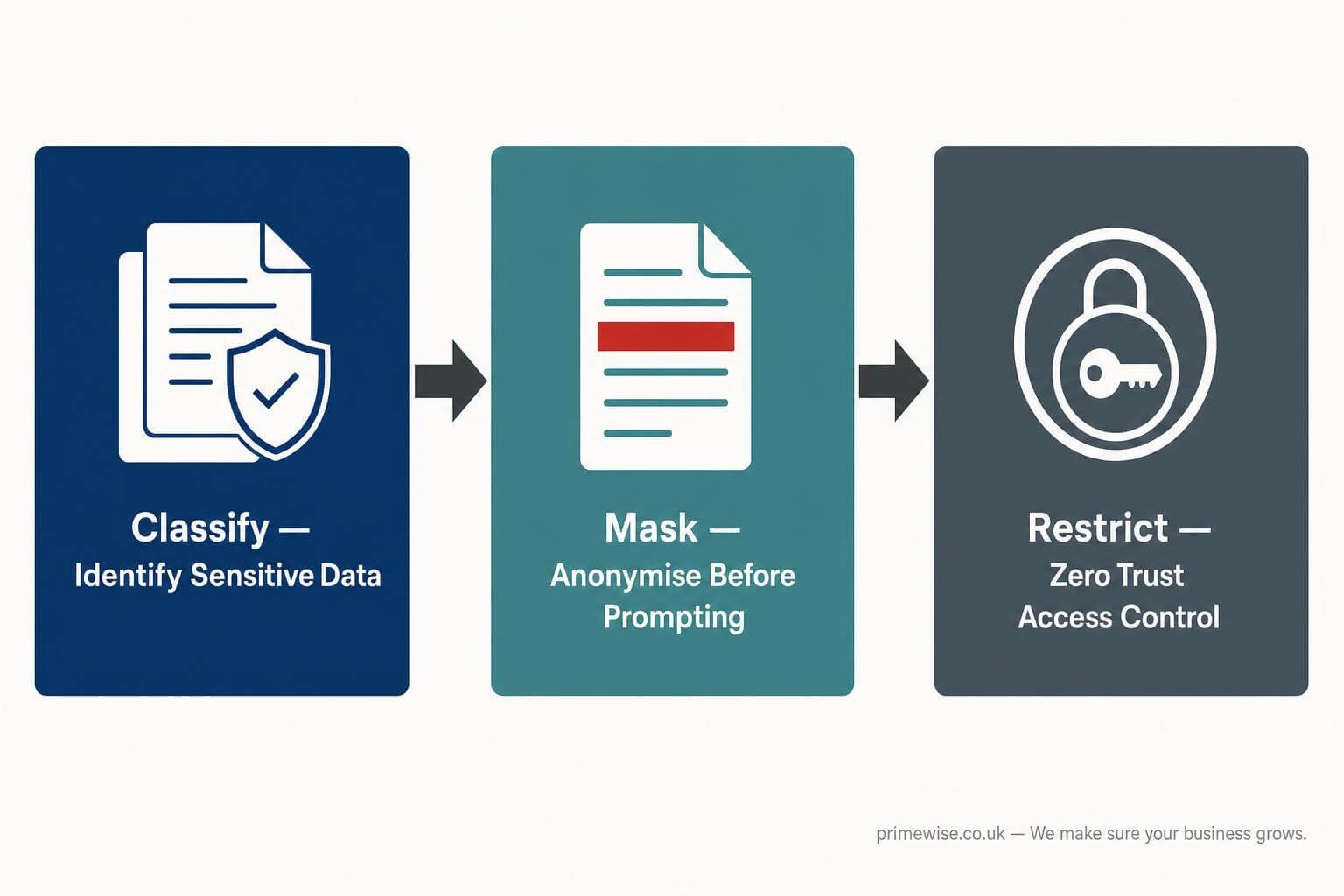
Technology alone cannot secure a business if human behaviour remains unregulated. Even with enterprise APIs in place, an employee who pastes a client’s full name, National Insurance number, and account history into a prompt has circumvented every technical control. Leadership must implement a structured, repeatable framework that governs exactly how staff interact with all automated systems on a daily basis. The Classify, Mask, and Restrict methodology the SME AI Safe Data Triad provides a robust three-layer defence against accidental exposure that any non-technical employee can follow without IT supervision.
Classify Identifying Tier 1 PII and Proprietary Data
Data classification provides your workforce with clear, non-negotiable boundaries around what information must never touch an external server. The classification exercise does not require expensive software it requires a documented policy that staff are trained to apply in under thirty seconds for any given piece of information. Tier 1 data requiring the highest level of protection includes all items listed below.
- National Insurance numbers, bank account details, and individual financial transaction histories.
- Special category data including health records, biometric identifiers, political opinions, and ethnic origins.
- Proprietary trade secrets, unreleased financial reports, and confidential merger or acquisition details.
- Specific legal case notes, settlement figures, and privileged client communications.
- Authentication credentials, API keys, and system access tokens of any kind.
The Golden Rule of SME AI is unambiguous: never process Tier 1 PII through a non-API consumer AI model under any circumstances. This single directive, embedded in staff induction and displayed visibly at workstations, eliminates the most common category of AI-related data exposure before it occurs.
The Golden RuleNever process Tier 1 PII through a non-API consumer AI model. This single directive, applied consistently, eliminates the most common category of AI-related data exposure in regulated UK SMEs.
Mask Practical Data Anonymisation Techniques
When staff need to process documents containing sensitive details even within an enterprise API environment they must employ data anonymisation and pseudonymisation workflows before constructing any prompt. Pseudonymisation involves actively replacing specific identifying details with neutral placeholders before the context is submitted to an automated system. A practical example: rather than prompting an AI system with “Summarise the financial risk profile of John Smith, account number 40271839, of Manchester,” a trained employee would substitute “Summarise the financial risk profile of Client A, account reference ANON-001, of City B.” This technique preserves the analytical value of the software output while ensuring that no real-world identifying context leaves the controlled environment. The ICO’s guidance on anonymisation confirms that properly pseudonymised data carries a significantly reduced risk profile under UK GDPR, provided the key mapping is held securely and separately from the anonymised dataset.
Restrict The Zero Trust AI Prompting Protocol
The Restrict layer of the framework establishes enforceable operational security at the system level. The Zero Trust AI Prompting Protocol mandates that no sensitive personal information is processed through any non-API consumer model, and that all enterprise API access is governed by role-based permissions. Under this protocol, only employees with explicit authorisation and completed AI security training can access enterprise API tools for client-facing work. Output validation is mandatory all AI-generated content touching client data must be reviewed by a human before it is acted upon or shared externally. This zero trust architecture ensures that even if an individual user account is compromised or a system misconfigured, the data exposed lacks any real-world identifying context that could constitute a reportable breach.
Aligning AI Adoption with UK GDPR and Sector Mandates
Deploying automated systems alters your organisation’s risk profile in ways that existing privacy frameworks were not designed to address. A DPIA completed before your digital transformation programme is not a compliant basis for an AI deployment made three years later. Compliance is a continuous operational requirement that must be revisited with every material change to your data processing activities, including the introduction of any new AI tool or workflow.
How to Conduct an AI-Specific DPIA
Before rolling out any new automated processing tool, the ICO requires organisations undertaking high-risk processing to complete a Data Protection Impact Assessment. For AI systems, this requirement is almost always triggered, given the inherent unpredictability of model outputs and the volume of data typically processed. The ICO’s official DPIA template is available directly from ico.org.uk and should be the starting document for every AI deployment. The five-step process below reflects the ICO’s recommended methodology and should be completed and signed off by your designated Data Protection Officer or senior leadership before any staff begin using a new tool with personal data.
- Step 1 Describe the processing: Document exactly what data the AI system will process, how it will be collected, where it will be stored, and which third-party sub-processors will have access.
- Step 2 Assess necessity and proportionality: Confirm that the processing is necessary for a legitimate purpose and that a less privacy-invasive alternative does not exist to achieve the same outcome.
- Step 3 Identify and assess risks: Evaluate the specific risks introduced by automated processing, including prompt leakage, model hallucination producing false client data, and unauthorised access to API endpoints.
- Step 4 Identify measures to mitigate risks: Document the precise technical and organisational controls that will address each identified risk, including data masking protocols, access controls, and contractual safeguards with the vendor.
- Step 5 Sign off and record outcomes: Obtain formal sign-off from the appropriate authority within the organisation and record the assessment outcome in your processing activity register. A DPIA is legally mandatory under UK GDPR where processing is likely to result in a high risk to individuals. Consulting the ICO before proceeding is required where risks cannot be adequately mitigated.
Documenting privacy by design principles within this process not only satisfies regulatory mandates but also serves as a critical defence mechanism that demonstrably reduces the risk of substantial fines during an ICO investigation. Firms that cannot produce a completed DPIA for an active AI deployment are operating in a materially non-compliant state.
Managing Article 22 and Automated Decision Making
Organisations must be acutely aware of UK GDPR Article 22, which protects individuals from decisions made solely by automated processing that produce legal or similarly significant effects on those individuals. If your enterprise uses algorithms to screen employment candidates, approve or decline financial products, assess insurance risk, or verify regulatory compliance status, there must be a demonstrable human in the loop at the point of final determination. Maintaining meaningful human oversight prevents algorithmic bias from producing discriminatory outcomes and ensures your operations remain legally compliant when making consequential decisions about clients or employees. The UK AI Safety Institute and the ICO have both published guidance reinforcing that Article 22 protections apply regardless of whether the underlying system is marketed as AI or simply as automated rules-based processing.
The EU AI Act and UK Firms Trading into Europe
While the UK has not domestically enacted the EU AI Act 2024, British firms providing services to EU-based clients or operating through EU subsidiaries are directly subject to its requirements. The AI Act introduces mandatory risk classifications for AI systems, with high-risk categories including AI used in employment screening, credit scoring, and legal case management all common applications in regulated UK SMEs. Ignoring the EU AI Act on the grounds of post-Brexit jurisdictional separation is a significant strategic error for any firm with European commercial relationships. Legal and compliance teams should map their AI tool inventory against the Act’s risk tiers as a matter of immediate priority.
FCA and SRA Compliance Context
For boutique financial institutions and legal practices operating in regulated UK hubs, the compliance stakes extend beyond the ICO. The FCA’s Operational Resilience framework requires firms to demonstrate that important business services can withstand, adapt to, and recover from operational disruptions a standard that now explicitly extends to digital supply chains including AI vendors. The SRA has similarly signalled that firms using AI tools for client-facing work must ensure those tools do not compromise solicitor-client confidentiality or produce outputs that amount to unsupervised legal advice. Achieving Cyber Essentials certification, the UK government-backed baseline security scheme administered by the NCSC, is an increasingly expected minimum standard for SMEs tendering for public sector contracts or seeking to demonstrate due diligence to institutional clients in these sectors.
The SME Vendor Vetting Protocol
Procuring any new AI software requires rigorous third-party risk management that goes well beyond reading a marketing brochure. Even businesses without a dedicated security officer can confidently assess software vendors by applying a structured set of targeted questions during the procurement phase. The six questions below constitute a minimum viable vetting standard for any AI tool that will process business or client data.
- Does the vendor provide a signed Data Processing Agreement that explicitly prohibits using our data for model training?
- Where are the servers physically located, and can you confirm UK or EEA data residency with documentary evidence?
- What is the complete list of sub-processors that will have access to our data, and what are their contractual obligations?
- What is the data retention period for inputs and outputs, and how is deletion confirmed at the end of a contract?
- Does the vendor hold ISO 27001 certification or equivalent, and can you provide the most recent audit certificate?
- How does the vendor notify clients of a data breach affecting their data, and what is the contractual notification timeline?
Scrutinising Data Processing Agreements
Reviewing the vendor’s Data Processing Agreement in full is the most legally consequential step in the procurement process. Business leaders must verify that the DPA explicitly prohibits the use of corporate inputs for model training, identifies every sub-processor by name and jurisdiction, and specifies deletion timelines that align with your own retention policy. A DPA that defers to the vendor’s standard privacy policy rather than providing organisation-specific contractual commitments is not a compliant Article 28 agreement and should be rejected. Many enterprise AI vendors will negotiate DPA amendments on request this is standard practice, not an unusual demand.
Verifying UK Data Sovereignty Post-Brexit
Knowing the physical jurisdiction of the servers processing your data is a strict legal necessity, not a technical nicety. Post-Brexit, UK data controllers must ensure that any transfer of personal data to a country outside the UK is either covered by an ICO adequacy regulation, governed by International Data Transfer Agreements modelled on standard contractual clauses, or subject to another approved transfer mechanism. If a vendor cannot confirm the geographic location of every server that will handle your data including those of sub-processors that vendor does not meet the minimum standard for processing personal data on behalf of a UK-regulated entity. The concept of data residency UK is increasingly a contractual requirement rather than a preference in regulated sector procurement.
Your Internal AI Acceptable Use Policy
All governance frameworks ultimately depend on documentation that staff can read, sign, and be held accountable to. An AI Acceptable Use Policy bridges the gap between high-level security strategy and daily operational behaviour on the office floor. For SMEs without dedicated legal teams, the policy does not need to be a lengthy legal instrument it needs to be unambiguous, actionable, and enforceable. Below is a lightweight template structure that Primewise recommends as a starting point for any regulated UK SME. Leadership teams requiring a fully drafted, sector-specific version customised for FCA or SRA environments can commission an AI Security Audit with Primewise, which includes a bespoke Acceptable Use Policy as a core deliverable.
Core Clauses for a Lightweight SME AI Policy
A functional compliance policy must address the specific behavioural risks that AI tools introduce without overwhelming staff with technical complexity. The seven clauses below represent the minimum viable structure for a legally defensible internal AI Acceptable Use Policy.
- Clause 1 Approved Tools: A definitive, named list of AI applications authorised for corporate use, updated quarterly by the designated AI governance lead.
- Clause 2 Prohibited Actions: An explicit prohibition against processing any Tier 1 PII, special category data, or legally privileged information through any unapproved consumer AI platform.
- Clause 3 Data Masking Requirement: A mandatory instruction that all prompts involving client or company data must be pseudonymised before submission, following the organisation’s documented masking protocol.
- Clause 4 Output Validation: A requirement that all AI-generated content used in client-facing communications or regulated decisions must be reviewed and approved by a named human authority before use.
- Clause 5 Incident Reporting: Step-by-step procedures for reporting suspected prompt leakage, algorithmic bias, or unintended data exposure, including the name and contact details of the designated reporting officer.
- Clause 6 Training Requirement: A statement that no employee may use an authorised AI tool for client or business data without first completing the organisation’s AI security awareness training module.
- Clause 7 Disciplinary Consequences: A clear statement that breaching any clause of this policy constitutes a disciplinary offence and may result in formal proceedings up to and including termination, consistent with the organisation’s existing disciplinary framework.
Building a Culture of AI Security Awareness
Technology is only as secure as the people operating it. Implementing continuous AI cyber hygiene training transforms your workforce from a security liability into a vigilant human firewall. Regular, non-technical briefings on the evolving risks of prompt leakage, AI-generated phishing attacks, and digital impersonation ensure that your team remains alert to current threat vectors. The NCSC’s Exercise in a Box toolkit provides a free, structured framework for simulating data breach scenarios that can be adapted for AI-specific risk exercises. Fostering a culture where staff proactively report AI security concerns rather than concealing accidental misuse is the single most cost-effective investment a leadership team can make in long-term data protection resilience.
Your Next Step Commission a Business AI Security Audit
For C-suite leaders who have read this guide and recognise gaps in their current AI governance posture, the most efficient next action is a structured external review conducted by specialists who understand both the regulatory landscape and the operational realities of running a data-sensitive SME in the UK. Primewise delivers bespoke AI Security Audits for regulated UK businesses, covering enterprise API migration assessment, DPIA completion support, Acceptable Use Policy drafting, and staff training programme design without the overhead or cost of a full-time CISO engagement. If an employee in your organisation has already used an unapproved AI tool with client data, the time to act is not after the ICO investigation begins. Contact Primewise to schedule your AI governance review before your next compliance deadline.
Quick Win for This WeekBefore your next team meeting, audit which AI tools your staff are currently using informally. If any are consumer-grade free-tier products being used for client work, send a written directive today restricting their use pending a formal procurement review. This single action demonstrates documented due diligence in any subsequent ICO inquiry.