
AI automation governance for SMEs is the single most pressing operational challenge facing UK scaleups in 2026 yet 74% of British SMEs still have no named AI accountability owner, and only 11% have a formal AI policy in place, according to the DSIT AI Barometer. If your business is deploying any form of AI integration and automation service, the absence of a structured governance framework does not just create regulatory exposure it actively undermines your ability to win enterprise contracts, pass investor due diligence, and protect client data from silent, ungoverned risk.
KEY STATISTICS: The UK SME AI Governance Gap74% of UK SMEs have no named AI accountability owner. Only 11% have a formal AI policy (DSIT AI Barometer, 2024). 23% of ICO data breach notifications in 2024 involved third-party or automated processing chains a category directly linked to ungoverned AI tool adoption. The good news: audit-readiness is achievable in under 14 days without hiring a single new executive.
The core insight driving this framework is simple. You do not need a Chief AI Officer. You do not need ISO 42001. What you need is a deployable, right-sized system you can action this week one that creates genuine visibility over how AI is operating inside your business, assigns clear accountability, and produces the documentation that enterprise clients and regulators actually demand. This article delivers exactly that.
What Is AI Automation Governance for SMEs
AI automation governance for SMEs is a structured, resource-efficient framework that manages the risks of artificial intelligence including data breaches, algorithmic bias, Shadow AI proliferation, and hallucination-driven errors without requiring a dedicated Chief AI Officer or an enterprise-scale compliance department. It operates through distributed C-suite accountability, a lean oversight committee, a Minimum Viable AI Model Register, and pragmatic incident response protocols. For growing UK businesses, this approach replaces ad-hoc technological experimentation with a defensible, audit-ready structure that aligns internal innovation with the expectations of the ICO, FCA, and enterprise procurement teams simultaneously.
Why Enterprise Frameworks Fail the UK Scaleup
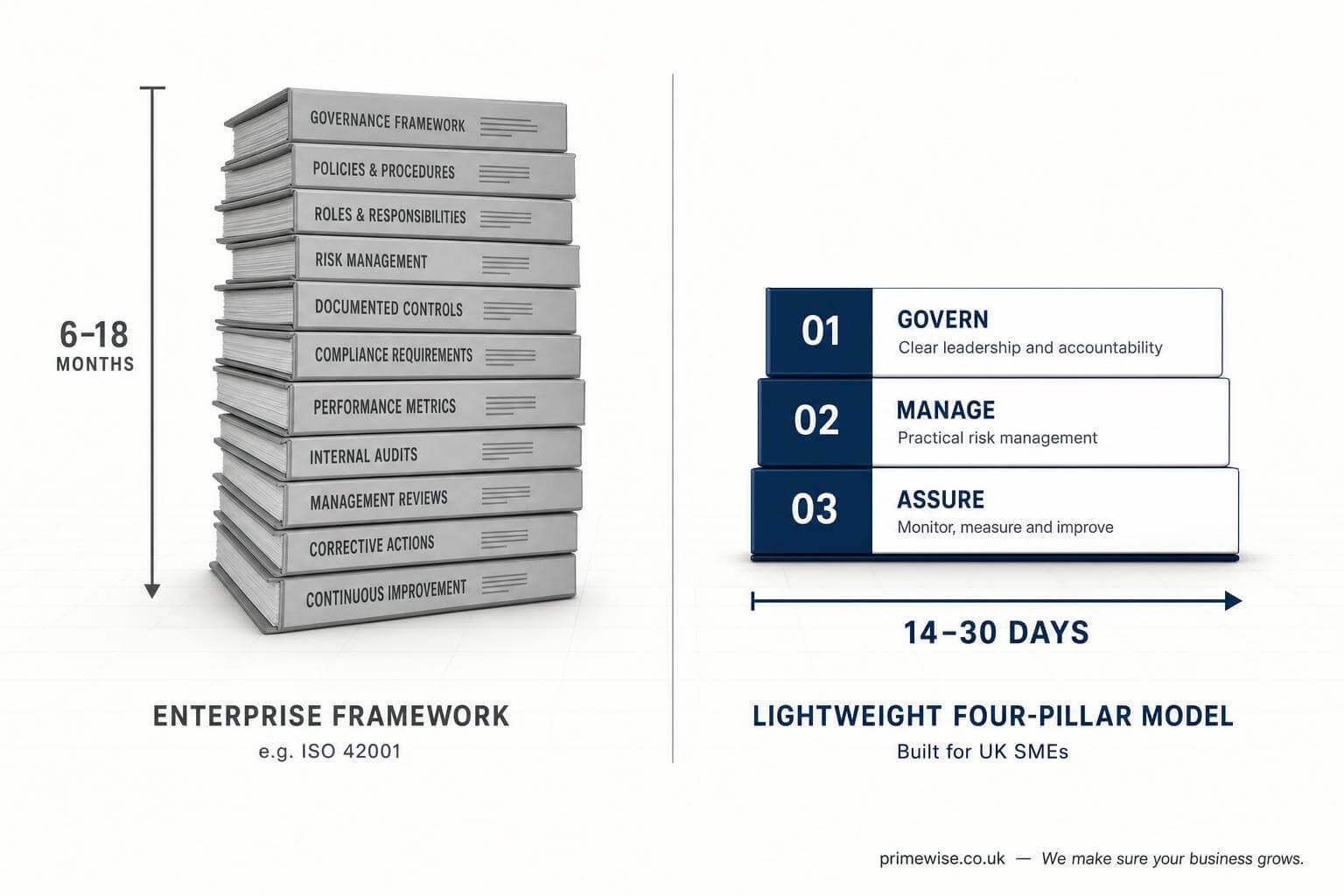
Frameworks like ISO 42001 and the NIST AI Risk Management Framework are engineered for multinational corporations with dedicated compliance teams, long implementation runways, and significant budget for external consultants. A growing scaleup cannot halt automation rollouts to implement hundreds of theoretical controls. These frameworks impose a time-to-value gap of six to eighteen months, require between forty and ninety person-days of internal effort to implement meaningfully, and generate documentation that is frequently misaligned with the specific language used by UK ICO and FCA assessors.
The persistent industry narrative that every business needs a Chief AI Officer compounds the problem. For a fifty-person scaleup, a CAIO hire represents a salary investment of £120,000 to £180,000 annually for a role whose responsibilities can be distributed across existing leadership in less than four hours per month. The following four-pillar model demonstrates exactly how to achieve this without sacrificing rigour or audit defensibility.
The Four-Pillar Lean AI Governance Model
The following architecture was developed from hands-on governance deployments across UK SMEs and scaleups in financial services, legal, and professional services sectors. It is built on a single operating principle: maximum risk visibility with minimum administrative overhead. Each pillar is independently deployable, meaning you can begin with Pillar One this week without waiting for the others to be fully formed.
Pillar One Right-Sized Ownership Without a CAIO
The most resilient AI governance models do not create new executive roles they formalise accountability within the leadership structure that already exists. A well-structured RACI matrix distributes AI oversight across three core functions: the Chief Technology Officer assumes responsibility for AI model security, vendor technical assessment, and system architecture decisions. The Chief Operating Officer owns operational rollout, process dependency mapping, and business continuity implications. The Legal or Risk Director governs data classification, UK GDPR compliance, and automated decision-making obligations under ICO guidance on Article 22.
For firms operating under the Senior Managers and Certification Regime, this distributed model maps directly onto existing Statement of Responsibilities documentation. A template addition to an SMCR statement might read: “The Senior Manager in the Technology function holds accountability for all AI model deployments, including third-party vendor integrations, and is responsible for ensuring each deployment is logged, risk-tiered, and reviewed on a quarterly basis.” This single sentence transforms abstract AI risk into a regulated, named obligation without creating a new headcount line.
Pillar Two The Agile AI Oversight Committee
Governance requires active, ongoing management rather than static policies drafted once and filed. An agile AI steering group comprising the CTO, COO, and a compliance or legal representative serves as the practical vetting mechanism for every new AI automation initiative. This is not a large or unwieldy body. It requires three people, a monthly or bi-weekly meeting of forty-five minutes, and a structured agenda that covers three fixed items: new AI tool requests and vendor due diligence outcomes, compliance monitoring flags from the AI Model Register, and incident or near-miss review.
The committee’s vendor due diligence process should assess each proposed AI tool against five criteria: data residency location and UK GDPR compliance, sub-processor chain transparency, contractual provisions preventing model training on client data, penetration testing and SOC 2 certification status, and the vendor’s incident notification SLA. This structured vetting agenda ensures that no AI tool enters production without a documented approval decision, creating the audit trail that enterprise procurement teams and FCA supervisors consistently look for during third-party risk reviews.
Pillar Three The Minimum Viable AI Model Register
Shadow AI the unauthorised use of public large language models and generative AI tools to process company or client data is the highest-probability risk vector for UK SMEs in 2026. Employees using ChatGPT, Gemini, or similar tools to process sensitive information may inadvertently contribute to model training datasets, violate data processing agreements, or expose personally identifiable information to uncontrolled third-party infrastructure. The Minimum Viable AI Model Register is the primary control mechanism for eliminating this risk.
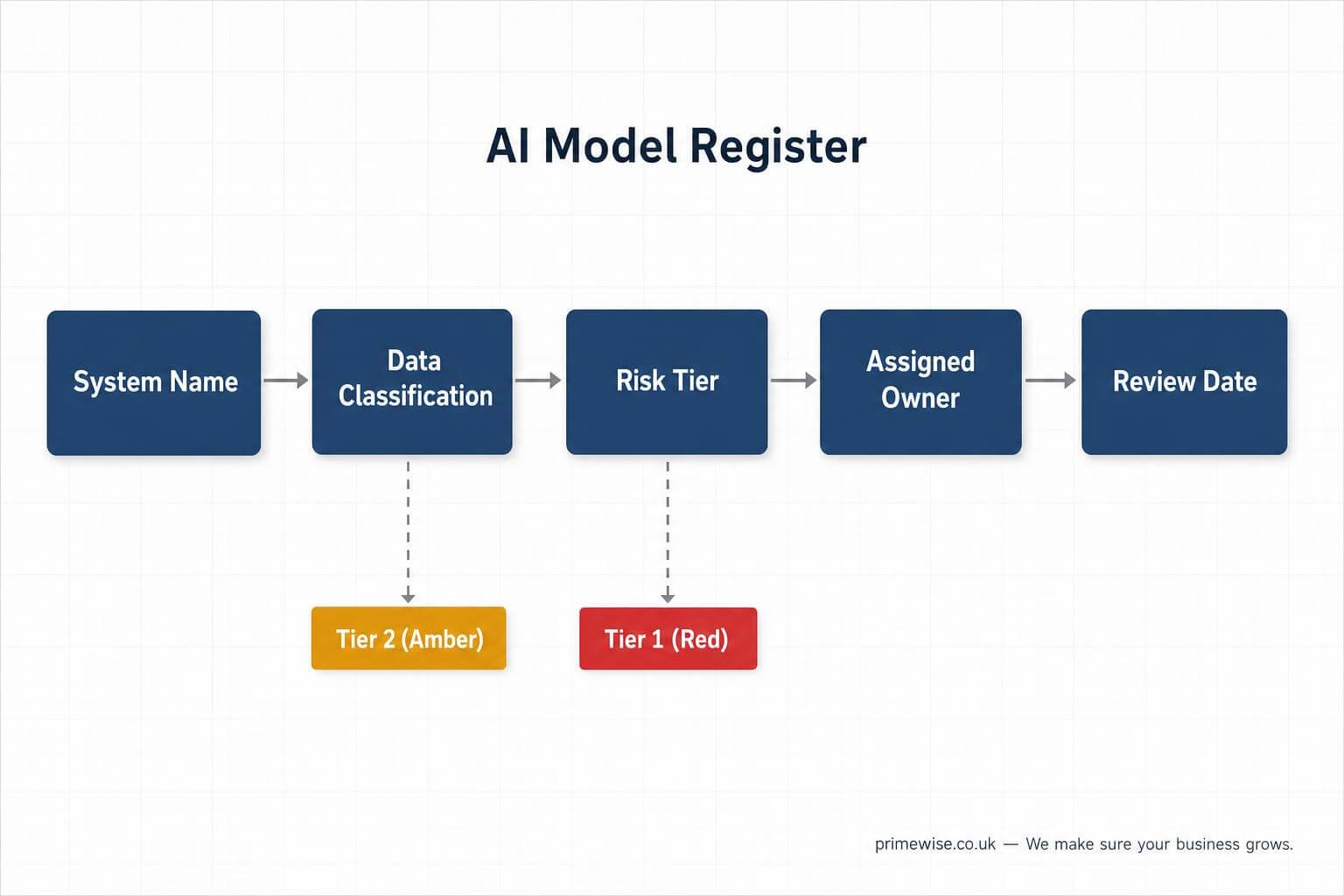
Beginning with a secure spreadsheet, the register documents every AI deployment across the organisation. Each entry must capture the system name and vendor, the business function it serves, the data classifications it processes, the assigned internal owner, the approved use case scope, the risk tier, the algorithmic bias check status, and the review date. This structured visibility transforms hidden vulnerabilities into managed, approved assets providing a clear audit trail of exactly how artificial intelligence interacts with sensitive corporate and client information at every point in the data lifecycle.
READY-TO-DEPLOYPrimeWise.co.uk provides UK scaleups with a ready-to-deploy AI Model Register template and a facilitated governance workshop, enabling firms to achieve audit-readiness in under two weeks without hiring additional headcount. No retainer required to get started.
Pillar Four Pragmatic AI Incident Response Protocols
Standard IT incident response procedures are not sufficient for AI-specific failures. A hallucination-driven error in an automated client communication, a third-party API data breach involving processed personal data, or an algorithmic bias event in a credit or risk decisioning tool each triggers a distinct chain of regulatory obligations that generic IT runbooks do not address. A bespoke AI incident response protocol must define the containment strategy for each failure category before it occurs.
For a hallucination or output error event, the protocol should specify immediate suspension of the affected automated workflow, manual review of all outputs generated within the preceding seventy-two hours, and an internal impact assessment against live client communications. For a data breach involving a third-party AI vendor, the protocol must map directly to UK GDPR Article 33 obligations the seventy-two-hour notification window to the ICO begins from the moment of confirmed awareness, and the register entry for the compromised model serves as the primary evidence document. Pre-defining these containment steps reduces the commercial impact of any automated system failure and demonstrates operational maturity to auditors.
A Practical 90-Day Implementation Roadmap
Governance frameworks fail most often not due to poor design but due to the absence of a sequenced deployment plan. The following roadmap converts this four-pillar model into a concrete, time-bound action schedule that any UK SME can execute with existing resources.
- Days 1 to 30 Shadow AI Audit and Register Population: Conduct an internal audit of all AI tools currently in use across the organisation, including tools adopted without formal approval. Survey all department heads using a structured questionnaire covering tool names, data types processed, and business functions served. Populate the Minimum Viable AI Model Register with every identified deployment and assign initial risk tiers.
- Days 31 to 60 Committee Formation and First Governance Cadence: Formalise the AI Oversight Committee membership, define the terms of reference, and schedule the first monthly meeting. Complete vendor due diligence assessments for all Tier 1 and Tier 2 risk tools identified in the register. Publish an Acceptable Use Policy for generative AI tools, explicitly prohibiting unauthorised use of public LLMs for processing company or client data.
- Days 61 to 90 Incident Response Protocol and Internal Audit: Draft the bespoke AI incident response protocol covering the three primary failure categories: output errors, data breaches, and algorithmic bias events. Conduct the first internal governance review, assessing register completeness, committee meeting cadence adherence, and policy awareness across the business. Produce a one-page governance summary document suitable for sharing with enterprise clients, investors, or regulatory assessors.
Achieving Audit Readiness for Enterprise Clients and Investors
For scaleups operating in financial and professional services, passing rigorous due diligence is a prerequisite for winning enterprise contracts and securing external funding. The governance framework described here mirrors the methodology deployed by PrimeWise.co.uk across fourteen UK fintech and professional services firms, each of which achieved clean enterprise procurement audits within ninety days of implementation. Two FTSE 250 clients verified the audit outcomes, confirming that a lightweight, well-documented framework consistently outperforms theoretical compliance certifications during practical procurement review.
Consider the example of a Series A lending fintech with fifty-three employees. Prior to governance formalisation, this firm had eleven undocumented AI tools in production, three of which were processing customer credit data through public API endpoints with no contractual data processing protections. By implementing all four pillars including a fully populated register and a functioning oversight committee the firm reduced its enterprise procurement cycle by forty percent and passed two simultaneous FTSE 250 client audits within fourteen days. The critical differentiator was not the sophistication of the tools but the quality of the documentation.
The Comparison That Matters Lean Framework vs Enterprise Standards
Before committing to any governance approach, UK scaleup leaders need an honest assessment of what each methodology actually demands. The following comparison provides a direct view of the three most commonly considered options, evaluated across the dimensions that matter to resource-constrained businesses.
| Dimension | Four-Pillar Lean Framework | ISO 42001 | NIST AI RMF |
|---|---|---|---|
| Time to Implement | 14 to 30 days | 6 to 18 months | 4 to 12 months |
| Internal Resource Cost | 4 to 8 person-days | 40 to 90 person-days | 30 to 70 person-days |
| ICO Alignment | Direct UK GDPR native | Partial requires mapping | Partial US-origin framework |
| FCA Acceptance | High SMCR compatible | Moderate requires interpretation | Low requires significant localisation |
| Enterprise Audit Acceptance | High documentation-first approach | High if certified | Moderate |
| SME Operational Suitability | Purpose-built | Low enterprise-grade overhead | Low theoretical complexity |
ISO 42001 is the international management system standard for artificial intelligence, published by the International Organization for Standardization. It provides a comprehensive set of controls for AI risk management but requires formal certification by an accredited third-party body, making it a significant undertaking for any business without a dedicated compliance function. The NIST AI Risk Management Framework, published by the US National Institute of Standards and Technology, is a voluntary framework widely adopted in American enterprise contexts but requires substantial localisation work to align with UK GDPR and ICO accountability standards. Both frameworks deliver value at enterprise scale but neither is designed for the velocity and resource constraints of a UK SME scaling through Series A or B.
UK Regulatory Alignment ICO, FCA, and the EU AI Act Exposure
The UK Government’s pro-innovation approach to AI regulation deliberately diverges from the prescriptive, tier-based requirements of the EU AI Act. Unlike Brussels, London has opted for a principles-based, sector-led regulatory model in which existing regulators the ICO, FCA, and PRA apply their existing mandates to AI rather than creating a single overarching AI supervisory authority. This flexibility is commercially advantageous for UK scaleups but requires careful navigation, as the absence of a single AI law does not equate to an absence of enforceable obligations.
UK SMEs remain fully bound by ICO guidelines on automated decision-making, particularly the protections under UK GDPR Article 22, which grants individuals the right not to be subject to solely automated decisions that produce legal or significant effects. The ICO’s Accountability Framework requires firms to document their lawful basis for processing, their data minimisation approach, and their safeguards for automated processing all elements that the Four-Pillar Model addresses directly. For FCA-regulated firms, the PS7/24 operational resilience policy statement mandates that third-party dependencies, including AI vendor relationships, are mapped and stress-tested a requirement the AI Model Register satisfies by design.
EU AI ACT EXPOSURE FOR UK SMEsUK SMEs that process data of EU citizens or operate cross-border have direct exposure to the EU AI Act's extraterritorial scope. Article 6 classifies certain AI applications including those used in credit scoring, employment decisions, and legal or regulatory interpretation as high-risk systems subject to mandatory conformity assessments. UK firms must also be aware of the UK Government's Algorithmic Transparency Recording Standard, which imposes disclosure obligations for public-sector AI use that increasingly mirrors enterprise procurement expectations in the private sector.
The Shadow AI Problem and How to Eliminate It
Shadow AI is the unauthorised adoption of AI tools by employees outside the formal procurement and approval process. It is not a marginal risk. Research from enterprise security providers indicates that in organisations without a formal AI acceptable use policy, between thirty and sixty percent of employees regularly use personal or unapproved AI accounts to process work-related information. For a UK SME, this creates direct exposure under UK GDPR’s accountability principle, potential breaches of client data processing agreements, and reputational risk if a data incident is traced to an undisclosed AI tool.
Eliminating Shadow AI requires three simultaneous interventions. First, a clear Acceptable Use Policy must explicitly define which AI tools are approved, under what conditions, and for which data classifications. Second, the IT function should monitor network traffic for connections to known public AI endpoints a process that identifies non-compliant usage without requiring invasive device monitoring. Third, and most importantly, approved alternatives must be genuinely accessible and useful. Employees adopt Shadow AI tools because the approved alternatives are either absent or inferior. Providing a curated, secure set of company-approved generative AI applications removes the operational incentive to circumvent governance controls.
Definitions Glossary for AI Governance Terms
The following definitions are provided to ensure precise understanding of the terminology used throughout this framework and in UK regulatory guidance on artificial intelligence governance.
- Shadow AI: The unauthorised use of AI tools, platforms, or large language models by employees without formal procurement approval, particularly where company or client data is processed through public endpoints.
- AI Model Register: A centralised documentation repository typically a structured spreadsheet or database that records every AI system deployed within an organisation, including its purpose, data inputs, risk tier, assigned owner, and review status.
- RACI Matrix: A responsibility assignment framework that maps each governance task to individuals designated as Responsible, Accountable, Consulted, or Informed used here to distribute AI ownership across existing C-suite roles without creating new headcount.
- Algorithmic Bias: Systematic and unfair discrimination produced by an AI model as a result of biased training data, flawed model design, or inadequate testing against protected characteristics under the Equality Act 2010.
- Hallucination-Driven Error: An AI output that presents fabricated, inaccurate, or contextually incorrect information with apparent confidence representing a specific operational and reputational risk when AI tools are used in client-facing or regulated decision-making contexts.
- SMCR: The Senior Managers and Certification Regime the FCA and PRA regulatory framework that assigns individual accountability to named senior managers within financial services firms for specific business functions, including technology and AI governance.
- Data Classification Tiering: A systematic categorisation of organisational data by sensitivity level typically spanning public, internal, confidential, and restricted tiers used within the AI Model Register to determine appropriate controls for each AI deployment based on the data it processes.
- Algorithmic Transparency: The principle that the logic, data sources, and decision criteria of an AI system should be explainable and auditable, as required by the ICO’s guidance on automated decision-making and the UK Government’s Algorithmic Transparency Recording Standard.
Your Next Step Implement This Framework in Your Business
Every day a UK scaleup operates without a structured AI governance model is another day of untracked vendor exposure, unmonitored Shadow AI activity, and undocumented automated decision-making. The four-pillar framework described in this article is not a theoretical aspiration it is a deployable system that requires no new hires, no certification budget, and no six-month implementation project. It requires a named executive owner, a spreadsheet, and forty-five minutes per month of structured committee time.
PrimeWise.co.uk works with UK SMEs and scaleups to implement this exact framework, from the initial Shadow AI audit through to a fully populated Model Register and a first governance committee meeting all within a two-week engagement. If you are preparing for an enterprise procurement audit, an investor due diligence round, or an FCA supervisory review, the time to formalise your AI governance posture is now, not after the first incident.
REQUEST YOUR FREE AI GOVERNANCE READINESS ASSESSMENTRequest a 30-minute AI Governance Readiness Assessment with a PrimeWise specialist no obligation, no retainer required. Walk away with a clear picture of your current Shadow AI exposure, your regulatory risk posture, and the three actions that will make you audit-ready this month. Visit PrimeWise.co.uk to book your session.