
A restaurant turnaround marketing plan is the single most important document an operator in financial distress can possess, yet most never build one. If your covers are down twenty percent or more, your margins are contracting, and your current tactics feel like sticking plasters on a structural wound, you need a restaurant turnaround marketing partner and a precision-engineered recovery framework not another round of reactive discounting. This playbook, developed through over two hundred UK hospitality turnaround engagements by the senior consultants at Primewise, presents a phased, ninety-day methodology designed to stabilise cash bleed, rebuild demand, and systemise long-term profitability without destroying the brand equity you have spent years building.
Who This Playbook Is For
This framework is written specifically for operators experiencing a twenty to forty percent decline in footfall, those with fewer than ninety days of operational runway, and restaurant groups carrying post-pandemic legacy debt. If you are an independent operator watching mid-week covers hollow out or a group finance director trying to justify a structured recovery investment to your board, this is the decision-enabling resource you need. According to UKHospitality’s 2025 Quarterly Tracker, sixty-one percent of UK restaurants reported cover declines exceeding twenty-five percent in Q1 2025, driven primarily by National Insurance contribution hikes and sustained consumer confidence suppression per ONS Consumer Trends data. You are not alone, but you do need a structured response.
The Primewise Cover Recovery Matrix
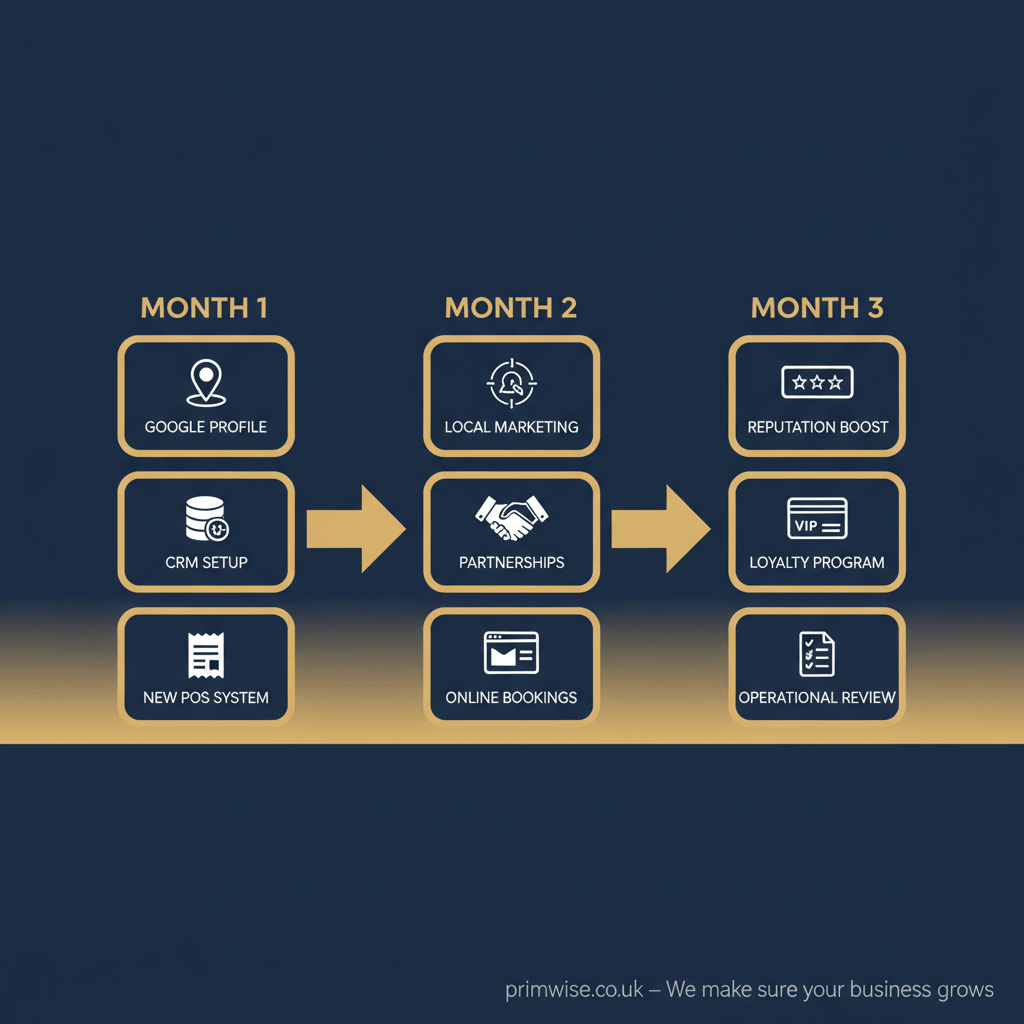
The Primewise Cover Recovery Matrix is the proprietary ninety-day turnaround framework underpinning this entire playbook. It was not built in a boardroom or derived from theoretical modelling. It was forged across real UK hospitality engagements from independent neighbourhood bistros to multi-site casual dining groups and refined against the brutal realities of the current UK operating environment. The matrix operates across three sequential phases: zero-cost digital stabilisation in month one, hyper-local targeted demand generation in month two, and automated retention compounding in month three. Each phase builds on the last, ensuring operators never skip critical foundational steps in pursuit of premature scaling.
- Month One delivers zero-cost digital stabilisation and CRM reactivation with near-zero ad spend.
- Month Two scales hyper-local demand generation through paid and partnership channels, allocating five to seven percent of projected gross revenue.
- Month Three embeds automated retention systems, shifting twenty percent of the ad budget to loyalty, PR, and long-term standard operating procedures.
THE CARDINAL RULENever discount publicly. Every percentage point shaved from your menu price permanently recalibrates customer price anchoring downward. The Eat Out to Help Out programme of 2020 demonstrated this at national scale the demand it created was not retained; it was borrowed from the future at a margin cost operators are still paying. Build perceived value instead.
Why Generic Marketing Fails Distressed Restaurants
Before committing to any recovery strategy, operators must understand why the approaches they have likely already tried have failed. The gap between a generic marketing retainer and a structured turnaround framework is not a matter of budget it is a matter of diagnostic precision. A broad social media agency retainer optimises for reach and engagement metrics rather than covers booked and revenue generated. A one-size-fits-all loyalty platform lacks the UK postcode-level targeting capability required to insulate a neighbourhood restaurant from wider macroeconomic disruptions. A reactive PR-only strategy builds brand awareness without addressing the underlying demand deficit that is the actual crisis.
The implicit question every operator asking about a restaurant turnaround marketing plan is really asking is not what one is it is whether this specific methodology is measurably superior to what they are currently doing. The answer lies in the diagnostic rigour of Phase One, the financial discipline of Phase Two, and the compounding architecture of Phase Three. Platforms like SevenRooms and ResDiary offer powerful operational tools, but they are execution vehicles, not strategic frameworks. Without a structured plan underpinning them, they generate data without direction.
Phase 1 Diagnose and Stabilise
The first thirty days function as a triage phase. The priority is not growth it is stopping the bleeding. Every pound of ad spend committed before this foundation is secured is a pound wasted on a leaking bucket. This phase is deliberately designed to operate at near-zero incremental cost, using existing tools, existing data, and existing relationships to generate immediate, measurable stabilisation.
Week One Digital Footprint Audit
The most immediate, cost-free action available to any UK restaurant operator is the rigorous optimisation of their Google Business Profile. According to OpenTable UK’s 2024 Diner Behaviour Report, restaurants with fully optimised Google Business Profiles received forty-seven percent more walk-in conversions than unoptimised equivalents. This is not a marginal gain it is a foundational competitive advantage that costs nothing beyond an afternoon of focused work. The audit must cover NAP consistency across all local citations, the completeness of menu and service attributes within the profile, the recency and quality of photo assets, and the active management of the Q&A section. Local SEO for UK hospitality is not a long-term play at this stage it is an immediate, high-return intervention.
Week Two CRM Reactivation
Reactivating a lapsed guest costs up to five times less than acquiring a new one, and every UK restaurant operator sitting on an underutilised SMS marketing list or segmented email database is leaving immediate liquidity on the table. The Week Two priority is precise email list segmentation isolating guests who visited within the last twelve months but have not returned in the last ninety days and deploying a three-touch reactivation sequence. The messaging must not offer a discount. It must offer relevance: a new seasonal menu, a chef’s table experience, an exclusive preview event. The sequence should generate a CRM reactivation rate of five percent or higher, which for a database of one thousand lapsed guests translates directly into fifty confirmed covers at zero acquisition cost.
PHASE 1 BUDGET RULEAd spend during Phase 1 must remain at near zero. Reallocate existing software budgets to essential CRM and local SEO tools. Any operator committing paid media budget before completing Phase 1 is accelerating cash bleed, not reversing it.
Week Three POS Data Mining
Restaurant cash flow management in 2026 demands that marketing campaigns are engineered around profitability, not just top-line revenue. The Week Three priority is a deep POS data analytics review that identifies which menu items carry the highest gross profit margin and which are dragging down food cost percentage. UKHospitality’s 2025 guidelines recommend a target GP on food of sixty-five to seventy percent. Any promotional campaign launched in Phase Two must feature items that meet or exceed this threshold. High-margin menu engineering at this stage ensures that every new cover generated in months two and three actively contributes to EBITDA recovery rather than simply inflating revenue while compressing margins further.
Week Four Front of House Data Capture
A marketing ecosystem cannot sustain itself without a continuous feed of first-party data, and walk-in guests represent the most underutilised data capture opportunity in UK hospitality. The GDPR-compliant mechanisms available to operators include QR-code-triggered Wi-Fi login collection, booking confirmation email opt-in sequences compliant with UK PECR regulations, and till receipt QR codes linking to preference capture landing pages. The ICO’s 2024 updated guidance clarifies the distinction between legitimate interest and consent-based email marketing in the hospitality context, and operators must ensure their SMS marketing lists comply with Telephone Preference Service registration check requirements. Front of house training must humanise this process guests should not feel processed while achieving a first-party data capture rate exceeding twenty percent of all walk-ins. UK postcode capture is equally critical, enabling postcode-level demand mapping using tools such as Loqate or Data Cubed to inform the hyper-local targeting strategy in Phase Two.
Phase 1 KPIs
Accountability during the triage phase is non-negotiable. Without clear KPI benchmarks, operators risk mistaking activity for progress. The metrics below define the minimum acceptable performance thresholds before committing to Phase Two investment.
- Achieve a CRM reactivation rate of five percent or higher from the lapsed guest database.
- Maintain a daily walk-in to advance booking ratio that demonstrates improving booking intent.
- Secure a front of house first-party data capture rate exceeding twenty percent of all walk-in covers.
- Confirm Google Business Profile optimisation is complete with verified NAP consistency across all major UK citation directories.
Phase 2 Rebuild Demand
With the foundational leaks sealed and the initial cash bleed halted, Phase Two pivots from defence to controlled offence. The objective is to drive net-new covers safely, targeting high-value local footfall without overexposing the brand or exhausting the budget on broad, untargeted acquisition. The British Chambers of Commerce 2025 SME Hospitality Survey found that mid-week corporate lunch covers fell thirty-eight percent nationally following the normalisation of hybrid working post-2023. Phase Two directly addresses this structural demand vacuum through a combination of hyper-local paid media, B2B corporate outreach, and third-party platform optimisation.
Week Five Hyper-Local Meta Advertising
Meta Ads, when deployed with disciplined geographic constraints, represent the most cost-efficient new-cover acquisition channel available to UK restaurant operators in 2026. The targeting parameters must be strict: a one to three-mile radius from the restaurant, suppressing existing CRM contacts already reactivated in Phase One, and building lookalike audiences modelled on the top twenty percent of highest-spending historical guests identified through POS data mining in Week Three. This approach optimises customer acquisition cost against a clearly defined revenue-per-head benchmark and should deliver a return on ad spend exceeding four hundred percent. CGA Peach UK eating-out market data consistently identifies hyper-local social discovery as the primary pathway to first visit for the twenty-five to forty-four age demographic the most commercially valuable segment for UK casual and premium casual dining.
Week Six Strategic B2B Partnerships
Local B2B partnerships unlock entirely new audiences by piggybacking on the established trust and customer bases of non-competing businesses. Premium independent gyms, local theatres, regional cinemas, and co-working spaces share a high-value, time-poor consumer demographic that maps almost perfectly onto the ideal restaurant guest profile. A cross-promotional arrangement a post-workout recovery menu exclusive to gym members, a pre-theatre set menu promoted via the theatre’s own email list costs nothing beyond the time to negotiate and the margin on the incremental cover, which is far superior to the margin on a publicly discounted cover. These arrangements also generate first-party data capture opportunities embedded within a trusted partner communication, improving opt-in rates significantly.
Week Seven Corporate Lunch Outreach
The hollowing out of mid-week covers is one of the most structurally significant challenges facing UK operators in 2026, and it demands a targeted corporate hospitality strategy rather than a blanket promotional response. The approach is direct: identify local office managers, executive assistants, and procurement leads within a one-mile radius of the restaurant and initiate a personalised B2B outreach sequence proposing a structured corporate lunch account, a standing weekly booking arrangement, or a customised working lunch package that fits within standard UK corporate expense thresholds. Corporate diners using expense accounts are fundamentally price-inelastic, making this the highest-margin new-cover opportunity available to any operator with genuine proximity to office density.
Week Eight Third-Party Platform Optimisation
OpenTable UK and DesignMyNight are not merely booking utilities they are high-intent discovery platforms with their own internal search algorithms that reward profile completeness, recency of reviews, and booking conversion rate. OpenTable UK’s algorithm surfaces restaurants with complete attribute profiles, recent high-volume booking activity, and strong review velocity ahead of incompletely optimised competitors in filtered search results. DesignMyNight holds particular dominance in the London and major UK city market for experience-led dining discovery, making it a critical visibility channel for operators targeting the experience-economy diner. The optimisation priority is ensuring both platforms reflect the current menu, updated photography, accurate event listings, and active solicitation of platform-native reviews without allowing commission dependency to erode gross profit margin benchmarks.
Phase 2 KPIs
Budget discipline during the demand rebuild phase prevents the common failure mode of over-investing in top-of-funnel acquisition before the conversion infrastructure is proven. Allocate five to seven percent of projected gross revenue to Phase Two, directing seventy percent to Meta Ads and thirty percent to partnership collateral and B2B outreach materials.
- Maintain a Meta Ads return on ad spend exceeding four hundred percent throughout the phase.
- Track and report positive mid-week cover growth on a weekly basis against Phase One baseline.
- Monitor and improve the third-party platform booking conversion rate weekly using available analytics dashboards.
- Secure a minimum of three active B2B corporate lunch accounts before concluding Phase Two.
FINANCIAL MODELLING CONTEXTA conservative Phase 2 outcome recovering 20% footfall at an average spend of £32 per head generates approximately £19,200 in incremental monthly revenue for a 100-cover restaurant operating at 50% capacity. A base case recovering 35% at £38 per head generates approximately £40,470. An optimistic scenario recovering 50% footfall at £45 per head approaches £67,500 in monthly incremental revenue. These are illustrative models based on UK hospitality benchmarks, not guarantees. Individual results depend on baseline operational health, market saturation, and execution fidelity.
Phase 3 Compound and Systemise
The most common failure mode in hospitality turnarounds is the temporary spike a six-week surge in covers followed by a reversion to pre-intervention levels once the initial energy dissipates. Phase Three exists to prevent exactly this. Its purpose is to convert the momentum generated in Phases One and Two into compounding, systemised machinery that operates without daily owner intervention. This is the phase that transforms a rescue operation into a sustainable business.
Week Nine Post-Visit Review Automation
A Google review rating of 4.6 or higher is a mandatory baseline for UK hospitality survival in 2026. Restaurants below this threshold face a significant algorithmic penalty in Google Maps local pack rankings and suffer measurably lower walk-in conversion rates from profile visitors. Post-visit automation a triggered SMS or email sent two hours after a dining experience concludes, directing guests to the Google review page via a frictionless direct link guarantees a steady, compounding stream of fresh social proof. The timing and tone of this automation must feel personal rather than transactional. A message that references the specific visit occasion or thanks the guest by first name consistently outperforms a generic review request in both open rate and completion rate.
Week Ten The Dark VIP Loyalty Programme
A dark loyalty programme operating entirely through direct, private communication rather than public promotion is the most margin-protective retention tool available to UK restaurant operators. The mechanic is straightforward: identify the top twenty percent of highest-frequency, highest-spending guests from POS and booking data, and invite them by name into an exclusive programme that rewards their loyalty with genuine experiential value rather than discounts. Private tastings, chef’s table priority access, first-refusal on event reservations, and personalised menu items cost a fraction of a discount programme while generating a dramatically higher perceived value. This approach increases customer retention rate and frequency of visit while protecting gross profit margin benchmarks and preserving the brand perception that attracts full-price guests in the first place.
Week Eleven Localised PR and Influencer Events
Regional hospitality influencer events, when executed with editorial precision, generate disproportionate organic reach relative to their cost. A carefully curated tasting event for ten to fifteen UK-based regional food content creators selected on the basis of authentic local audience alignment rather than raw follower count produces a sustained wave of user-generated content that refreshes the restaurant’s social presence organically across multiple platforms simultaneously. The resulting content updates the digital footprint with current, credible, third-party social proof that no paid campaign can replicate. The briefing for these events must be relaxed and experience-first; overly scripted influencer events produce stilted, low-engagement content that sophisticated audiences immediately discount.
Week Twelve The Turnaround Standard Operating Procedure
The final week of the ninety-day programme is the most strategically important for long-term outcomes. Every tactic, every workflow, every KPI threshold, and every communication sequence deployed across the preceding eleven weeks must be codified into a documented standard operating procedure accessible to the entire management team. This is the mechanism that allows the owner or managing director to step back from daily firefighting and trust that the marketing engine will continue to operate without their constant intervention. A restaurant that exits a turnaround programme without a documented SOP has not been turned around it has been temporarily stabilised. The Primewise Cover Recovery Matrix is designed to produce permanent operational uplift, not a temporary revenue spike.
Phase 3 KPIs
The final phase redirects financial resources toward the highest-value segment the returning guest rather than continuing to invest at the same rate in acquisition. Shift twenty percent of the total ad spend toward retention rewards, VIP programme costs, and PR event investment.
- Achieve a returning customer rate exceeding thirty-five percent by the close of the ninety-day programme.
- Maintain an average Google review rating of 4.6 or higher throughout Phase Three.
- Demonstrate measurable Customer Lifetime Value increase across the full quarter versus the pre-intervention baseline.
- Deliver a fully documented turnaround SOP to the management team before programme close.
The UK Macroeconomic Reality in 2026
No turnaround strategy can be built without a clear-eyed assessment of the external pressures shaping the UK hospitality landscape in 2026. The Spring 2025 Budget’s National Minimum Wage increase to £12.21 per hour has pushed labour cost as a percentage of restaurant revenue to structurally higher levels, directly compressing the EBITDA headroom that operators depend on to fund marketing investment. The HMRC Making Tax Digital for Income Tax mandate, taking full effect in April 2026, imposes a significant operational compliance burden on hospitality operators managing multi-site reporting, diverting management attention and software investment away from revenue-generating activity.
The UK Food Standards Agency’s escalation of Natasha’s Law enforcement in 2025 has material menu engineering implications, requiring operators to maintain fully compliant allergen labelling across both physical and digital menu formats a constraint that must be factored into any menu optimisation strategy. ONS Consumer Price Index data continues to show a widening food-at-home versus food-out price gap, reshaping diner value perception and making the messaging pivot from discount to perceived value not merely advisable but commercially essential. UK Business Rates relief schemes in 2025 have provided partial mitigation for smaller operators, but the net cost pressure remains acute. Against this backdrop, a hyper-local neighbourhood focus redirecting ad spend to specific postcodes and local communities rather than broad regional campaigns is not merely a tactical preference. It is the only structurally sound response to an environment in which commute disruption, transport unreliability, and cost-of-living caution are systematically suppressing destination dining behaviour.
STAFFING AND COVER RECOVERYHospitality staff retention has a direct and measurable impact on repeat cover rates. Regulars return to people as much as to places. Any turnaround programme that optimises marketing without addressing front-of-house continuity is building on an unstable foundation. Factor staff retention strategy into the SOP developed in Week Twelve.
The Financial Case for a Structured Recovery
For a finance director or managing director evaluating whether to commit to a ninety-day structured recovery programme, the financial modelling must be explicit. The three scenarios below are illustrative models based on UK hospitality benchmarks derived from CGA Peach eating-out market data and UKHospitality 2025 operational benchmarks. They are not guarantees. Individual results depend materially on baseline operational health, local market saturation, competitive set, and execution fidelity.
| Scenario | Footfall Recovery | Average Spend Per Head | Estimated Monthly Incremental Revenue | Indicative Break-Even Timeline |
|---|---|---|---|---|
| Conservative | 20% | £32 | ~£19,200 | Month 2 |
| Base Case | 35% | £38 | ~£40,470 | Early Month 2 |
| Optimistic | 50% | £45 | ~£67,500 | End of Month 1 |
These projections assume a one-hundred-cover restaurant operating at fifty percent baseline capacity prior to intervention. The modelling demonstrates that even a conservative execution of the Primewise Cover Recovery Matrix generates incremental monthly revenue that substantially exceeds a typical consultancy investment within the first two months of the programme. For operators carrying post-pandemic legacy debt or operating with a compressed runway, the base case scenario represents a credible path to stabilisation within sixty days, provided Phase One is executed with discipline and Phase Two is initiated only once the foundational KPIs are achieved.
Next Steps for Operators in Distress
If your covers are down twenty percent or more and your current marketing strategy lacks a structured ninety-day recovery roadmap, the appropriate next step is a diagnostic conversation, not another month of tactical experimentation. The senior hospitality turnaround consultants at Primewise offer a free thirty-minute Restaurant Triage Call designed specifically for operators in distress. This is not a sales call. It is a structured diagnostic session that identifies your three highest-priority stabilisation actions based on your current operational data and it is available via primewise.co.uk. The operators who recover fastest are not the ones with the largest marketing budgets. They are the ones who commit earliest to a structured, phased methodology and execute it with discipline.