

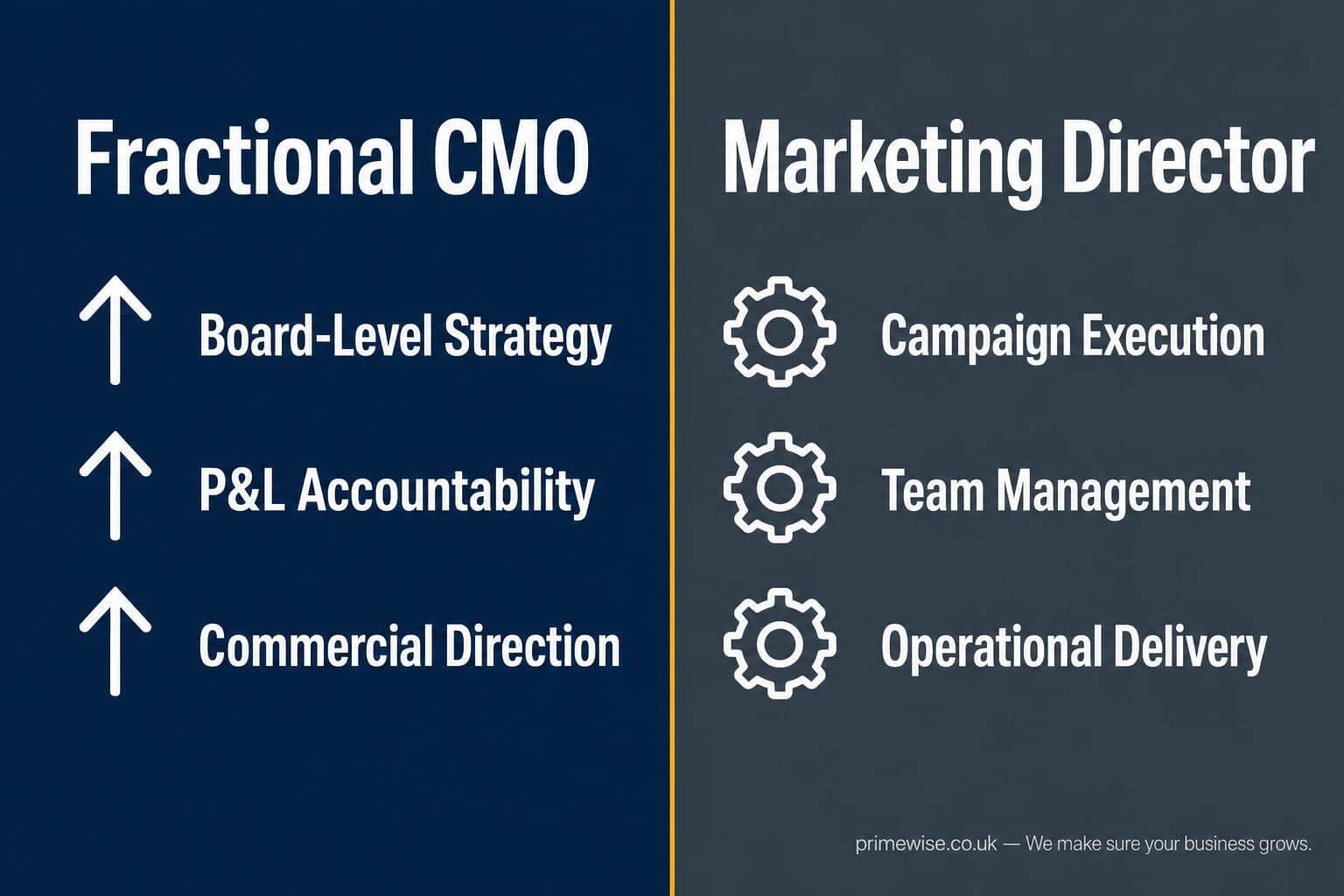
The fractional CMO service debate versus the Marketing Director hire is one of the most consequential and most misdiagnosed decisions a UK founder will make. A fractional CMO sets commercial strategy and owns P&L accountability. A Marketing Director executes that strategy and manages daily delivery. Hiring the wrong one costs UK scaleups an average of six to twelve months of runway and stalls funding rounds at the worst possible moment. This guide is written for UK founders and CEOs of businesses generating between £2M and £20M in annual revenue who are preparing a senior marketing hire and need clarity before they sign a contract.
WHO THIS GUIDE IS FORUK founders and CEOs at businesses generating £2M–£20M in annual revenue who are deciding between a fractional CMO and a Marketing Director. If you are framing this decision around budget rather than bottleneck, you are already asking the wrong question.
The Core Strategic Distinction
The fundamental separation between these two roles is not seniority on a job ladder it is the altitude at which each professional operates inside your business. A fractional CMO functions at board level, partnering directly with the CEO and investors to define market positioning, validate the Go-To-Market strategy, and ensure that every marketing pound generates measurable enterprise value. They are accountable for the commercial direction of the entire business, not just the marketing department. A Marketing Director operates one floor below: once the strategy is defined and validated, they own its execution, manage the internal team, procure and oversee agencies, and maintain output velocity. Understanding this altitude gap is the entire decision framework.
Setting Commercial Direction and Owning the Numbers
A Chief Marketing Officer speaks the language of the board, not merely the language of campaign performance. Their primary mandate is to define market positioning, validate the Go-To-Market strategy, and align commercial activity with the financial targets set by the CEO and investors. They analyse unit economics obsessively Customer Acquisition Cost, Lifetime Value, payback periods, and marketing-sourced pipeline contribution. According to the Heidrick & Struggles 2024 Marketing Leadership Report, CMOs with formal P&L accountability deliver an average revenue contribution 23 per cent higher than those without. When a fractional CMO engages with a UK scaleup, their first obligation is not to launch a campaign it is to determine whether the commercial architecture is structurally sound enough to justify any campaign spend at all.
Running the Daily Marketing Engine
The Marketing Director serves as the operational bridge between strategic intent and tactical output. Once the CMO and board have validated the Go-To-Market strategy, the Marketing Director takes ownership of making it real: managing the content calendar, briefing agencies, running A/B tests, reporting on funnel metrics, and ensuring that the sales team has the pipeline it needs to hit monthly targets. Their expertise is process architecture and people management, not commercial strategy. According to Reed UK Salary Benchmarks 2024, Marketing Director base salaries in the UK range from £65,000 to £110,000 annually depending on sector, team size, and geography, with London roles commanding a significant premium at the upper end of that range.
Diagnosing Your True Growth Bottleneck
The single most expensive mistake observed across UK scaleup engagements is founders defaulting to a cost-minimisation mindset when their real problem is a diagnostic failure. Before you write a job specification, you must conduct an honest bottleneck audit. The question is not whether you can afford a CMO the question is whether your constraint is directional or operational. Every senior marketing hiring decision should begin here.
Symptoms of a Strategy Bottleneck
A strategy bottleneck means your commercial foundation is fractured. Adding more tactical resource at this stage does not accelerate growth it accelerates movement in the wrong direction. If the following symptoms are present, a Marketing Director hire will compound the problem rather than resolve it.
- Leads are generating consistently but closing at unsustainably low rates, indicating a positioning or ICP misalignment rather than a volume problem.
- Sales and marketing teams are fundamentally misaligned on the ideal customer profile, with each function defining the target buyer differently.
- Core messaging and value propositions are indistinguishable from those of market competitors, leaving buyers with no rational reason to choose you.
- Customer Acquisition Cost is rising uncontrollably despite multiple rounds of campaign-level optimisation by existing team members.
- Marketing metrics reported to the board bear no visible correlation to revenue targets, pipeline contribution, or investor KPIs.
- The business is approaching a Series A or Series B raise and investors are questioning the commercial narrative and GTM credibility.
Symptoms of an Execution Bottleneck
An execution bottleneck means the strategy is clear, validated, and commercially sound but the internal machinery is failing to deliver it consistently. In this scenario, deploying a fractional CMO is an expensive over-hire. What the business actually needs is a strong operational conductor who can bring order to the chaos of daily delivery.
- Campaign launches are consistently delayed due to internal workflow breakdowns, unclear ownership, and unresolved agency briefing failures.
- Marketing ROI is declining because daily optimisations bid management, landing page testing, email sequence refinement are being neglected.
- Agencies and freelancers are operating in disconnected silos with no unified management layer holding them accountable to shared KPIs.
- Output velocity is too slow to service the pipeline demands of a sales team that already has clear, validated targets to hit.
- The founder is spending more than five hours per week managing marketing operations personally, acting as an accidental Marketing Director.
THE MISDIAGNOSIS TRAPAcross more than 40 UK scaleup engagements, the most common and costly error is hiring a Marketing Director to fix a Go-To-Market strategy problem. More execution on a broken foundation does not generate growth it generates organised failure.
The Altitude Bottleneck Matrix
To give UK founders a structured diagnostic tool rather than a theoretical framework, the following matrix maps the most common commercial constraints to the correct hiring decision. Identify which row most accurately describes your current situation and follow the recommendation. This is the same diagnostic logic applied at the start of every scaleup engagement.
| Business Constraint | Primary Symptom | Recommended Hire |
|---|---|---|
| Undifferentiated Positioning | High lead volume, near-zero pipeline conversion | Fractional CMO |
| Inconsistent Execution | Strategy is validated but campaigns are chaotic | Marketing Director |
| Board-Level Misalignment | Marketing metrics disconnect from financial targets | Fractional CMO |
| Resource Mismanagement | Bloated agency retainers with poor daily oversight | Marketing Director |
| Series A Readiness Gap | Investors questioning GTM credibility and commercial narrative | Fractional CMO |
| Output Velocity Failure | Sales pipeline starved despite clear strategy existing | Marketing Director |
If you remain uncertain which constraint applies after using this matrix, a qualified practitioner should conduct a 30-minute commercial diagnostic before any hiring decision is finalised. Engaging at the wrong seniority level based on guesswork costs significantly more than investing in a brief advisory conversation upfront. PrimeWise offers a complimentary diagnostic session for UK founders at this decision stage no obligation and no pitch, simply clarity on your bottleneck.
The Real Cost of Hiring at the Wrong Seniority Level
Talent misalignment at the senior marketing level is not merely an inconvenience it is a measurable destruction of runway. Across direct engagements with UK scaleups, two patterns repeat with near-perfect consistency, and both are entirely avoidable with the correct upfront diagnosis.
When a Director Is Asked to Pivot Strategy
A London-based Series A B2B SaaS platform with approximately £1.8M ARR attempted to pivot its entire Go-To-Market strategy using a mid-level Marketing Director. The Director was talented, hardworking, and deeply competent at execution. But without P&L authority, board influence, or the commercial seniority required to challenge the CEO’s assumptions about market positioning, the strategic pivot stalled. The sales leadership continued to pull in a different direction because no single authority figure had the commercial weight to align both functions. Within nine months, investor confidence had eroded, the Series B timeline slipped by over a year, and the business ultimately engaged a fractional CMO to rebuild the commercial architecture from the board level down. The total cost of the misalignment in salary, delayed growth, and lost investor momentum was conservatively estimated at £280,000.
When a CMO Is Paid for Tactical Tasks
The inverse error is equally damaging to a business’s financial position. A Manchester-based SaaS founder hired a fractional CMO at a day rate of approximately £2,800 well within the typical UK market range of £1,500 to £4,500 per day cited by senior marketing placement benchmarks only to immediately task them with Google Ads bid management, social media copywriting, and weekly email newsletter production. The strategic leader was trapped at the execution layer, unable to elevate the conversation to board level, unable to challenge the Go-To-Market assumptions, and generating no meaningful commercial return on a significant daily investment. The fractional CMO’s value is not in their ability to execute tasks it is in their ability to make the right tasks irrelevant by redesigning the commercial engine entirely.
FINANCIAL BENCHMARKFull-time CMO base salaries in London now range from £150,000 to £250,000-plus per annum, excluding bonuses and equity. Fractional CMO retainers for one to two days per week typically range from £6,000 to £15,000 per month delivering board-level commercial direction at a fraction of the annualised cost. Source: Robert Half UK Executive Salary Guide 2024–2025.
UK Market Economics and Compliance
Engaging senior marketing talent in the United Kingdom involves financial and regulatory considerations that are specific to the UK operating environment. Funded scaleups navigating a tightened VC and private equity landscape must balance talent cost with legal compliance, investor scrutiny, and capital efficiency demands.
Navigating IR35 for Fractional Engagements
Understanding HMRC’s off-payroll working rules is critical before engaging any fractional marketing leader. A fractional CMO is typically engaged on a business-to-business service contract they supply strategic deliverables to the client business through their own limited company, operating outside of IR35 as an independent consultancy. The key determining factors under HMRC’s Check Employment Status for Tax (CEST) tool include the absence of direct substitution control, the provision of services to multiple clients simultaneously, and the deliverable-based rather than time-based nature of the engagement. A full-time or deeply embedded Marketing Director who directs internal staff daily, attends all internal team meetings, and works exclusively within one business’s management structure will almost certainly fall under PAYE regulations. Structuring these contracts compliantly from the outset protects the business from unforeseen tax liabilities, HMRC investigations, and the reputational damage of a contested IR35 determination. For definitive guidance, consult HMRC’s official IR35 guidance before finalising any engagement structure.
What UK Investors Demand from Marketing Leadership
In the current macroeconomic environment, UK venture capital and private equity investors scrutinise marketing leadership with greater rigour than at any previous point. They expect marketing to be framed as a capital-efficient investment with clearly defined payback periods, not as an arbitrary operational expense. According to Beauhurst’s 2024 UK Scaleup Investment Report, investor due diligence increasingly includes direct interrogation of the marketing leadership structure, the commercial narrative coherence, and the GTM strategy’s alignment with the financial model. A fractional CMO who has operated at board level across multiple funded UK businesses brings precisely the financial fluency, P&L accountability, and investor communication skills that this scrutiny demands. A Marketing Director, however capable operationally, is rarely positioned to satisfy this requirement in a Series A or Series B board context.
What a Fractional CMO Delivers in the First 90 Days
For founders who have correctly diagnosed a strategy bottleneck and are considering a fractional CMO engagement, the most immediate practical question is: what does this actually look like in practice? The following delivery sequence reflects the standard engagement model applied across UK scaleup mandates.
- Days 1 to 30 Commercial Audit: Stakeholder interviews with CEO, sales leadership, and key investors. Full audit of existing Go-To-Market strategy, ICP definitions, messaging frameworks, competitive positioning, and current CAC and LTV data. Identification of the primary commercial constraint with board presentation.
- Days 31 to 60 Strategy Definition: Revised market positioning and differentiated value proposition development. ICP refinement with sales alignment session. Updated Go-To-Market strategy with channel prioritisation framework and OKRs set for the next two quarters. Revenue operations alignment covering the intersection of sales, marketing, and finance.
- Days 61 to 90 Execution Handover: Marketing team structure assessment with hiring or restructuring recommendations. Agency management framework established with unified KPIs across all external partners. Measurement dashboard built to align marketing metrics with financial targets for investor reporting. Execution ownership formally transitioned to the Marketing Director or in-house team with clear accountability.
This 90-day sequence is designed to deliver a commercially sound foundation, a validated strategy, and an execution-ready team with the fractional CMO then transitioning to a lighter-touch strategic oversight role of one to two days per month, or exiting the engagement entirely if the internal team is sufficiently equipped. The entire model is engineered for capital efficiency and clean knowledge transfer.
How Fractional CMO Relates to Broader C-Suite Trends
The fractional CMO model does not exist in isolation. It sits within a broader structural shift in how UK scaleups are assembling their senior leadership teams. The fractional C-suite encompassing fractional CFOs, fractional CTOs, and fractional Chief Revenue Officers has become a defining feature of capital-efficient growth architecture for businesses that cannot justify full-time executive payroll at every function simultaneously. The Chief Revenue Officer role, in particular, is frequently conflated with the CMO role by early-stage founders. The distinction matters: a CRO typically owns the entire revenue function spanning sales, marketing, and customer success as an integrated commercial unit, whereas a CMO owns the brand, positioning, demand generation, and marketing-led pipeline contribution specifically. For businesses with revenue operations complexity across multiple channels and segments, understanding which fractional executive addresses the precise bottleneck is as important as the fractional versus full-time decision itself.
INVESTOR READINESS SIGNALIf your investors are questioning your GTM strategy or commercial narrative at board meetings, this is a strategy bottleneck signal not a campaign performance problem. A fractional CMO is the structurally correct response. A Marketing Director optimising your existing campaigns will not resolve board-level commercial credibility.
Making the Right Decision for Your Next Growth Phase
Choosing correctly between a fractional CMO and a Marketing Director is not an act of financial modesty or strategic ambition it is an act of diagnostic precision. If your strategic foundation is fractured, a skilled Marketing Director will only build faster on broken ground. If your strategy is robust but your delivery is chaotic, a CMO is an unnecessary and expensive over-hire. The decision must be anchored to an honest assessment of your operational constraint, not to what feels most impressive on an org chart or most palatable to your current payroll budget.
Audit your current marketing function using the Altitude Bottleneck Matrix above. Identify whether your primary constraint is directional or operational. Then resource at the precise seniority level the constraint demands no higher, and no lower. That single act of diagnostic discipline is what separates the UK scaleups that scale efficiently from those that burn runway on talent misalignment and miss their growth targets by a year.
PrimeWise works exclusively with UK scaleups and SMEs to place and operate fractional CMOs and Marketing Directors at the precise seniority level each growth stage demands. If you are preparing a senior marketing hire or reviewing your current commercial leadership structure, the most capital-efficient first step is a 30-minute confidential advisory conversation with a practising senior marketing leader not a recruiter, not a consultant selling a retainer, but a practitioner who has sat in the seat and diagnosed this exact problem across multiple funded UK businesses.
Book your diagnostic call at PrimeWise.co.uk and make your next senior marketing hire the right one, first time.