

Fractional CMO for startups is the capital-efficient answer to one of the most persistent structural failures in venture-backed growth: deploying executive-level marketing leadership before your financial runway can support a full-time hire. At primewise.co.uk, we have built marketing functions from zero across multiple early-stage companies, and the pattern is consistent. Founders who attempt to scale without senior marketing oversight either burn through runway on untargeted paid channels or stall at product-market fit without the messaging clarity to attract their next funding round. This guide is the definitive operational resource for founders, CEOs, and seed-stage investors who need board-ready marketing leadership without the £180,000 to £275,000 annual cost of a permanent CMO appointment.
Is A Fractional CMO Right For Your Startup Right Now?A fractional CMO is the optimal strategic choice if your startup has raised between £500K and £5M, lacks a dedicated marketing director, and requires board-ready unit economics within 90 days. If you are preparing for a Series A raise or managing a Seed-to-A transition, this engagement model is specifically designed to solve your current capital allocation problem.
What Is A Fractional CMO For A Startup
A fractional CMO is a part-time chief marketing officer who provides full-time strategic capability on a retained basis, typically committing between 10 and 20 hours per week at a monthly cost ranging from £5,000 to £15,000 depending on scope and seniority. Unlike a marketing consultant who delivers recommendations, a fractional CMO embeds directly into the leadership team, owns go-to-market execution, reports into the board, and is held accountable to commercial metrics including Customer Acquisition Cost (CAC), Customer Lifetime Value (LTV), and payback period. They build the scalable marketing infrastructure that transforms founder-led sales into a predictable, repeatable revenue engine and they manage their own exit by hiring their full-time replacement when the business reaches financial maturity.
The Financial Case for Fractional Leadership
Venture capital is expensive money, and misallocating it during the critical pre-Series A phase is a primary reason UK startups fail to reach their next funding milestone. According to the British Business Bank’s 2024 Small Business Finance Markets report, approximately 60% of UK startups fail within their first three years, with premature scaling and undisciplined cash burn consistently identified as primary contributing factors. The fractional model directly addresses this structural risk by injecting seasoned financial prudence into the marketing function without the permanent salary obligation.
FTE CMO Versus Fractional CMO Cost in the UK
The London tech talent premium makes full-time executive hiring extraordinarily costly. Based on 2025 and 2026 data from Glassdoor UK and Reed, a full-time CMO in the London technology sector commands a base salary between £150,000 and £220,000. When employer National Insurance contributions (currently 13.8% on earnings above £9,100), pension auto-enrolment obligations, private health insurance, and standard benefits packages are factored in, the total annual employment cost rises to between £180,000 and £275,000 before accounting for equity dilution from options grants, which are standard at this seniority level. A fractional CMO engagement eliminates employer NIC liability, pension contributions, recruitment fees averaging 20% to 25% of first-year salary, and equity pool erosion. The flat monthly retainer is the entire cost. Research across the UK early-stage ecosystem consistently indicates that startups leveraging fractional marketing leadership pre-Series A reduce go-to-market capital burn by up to 40% while accelerating their time to next funding round by an average of four months.
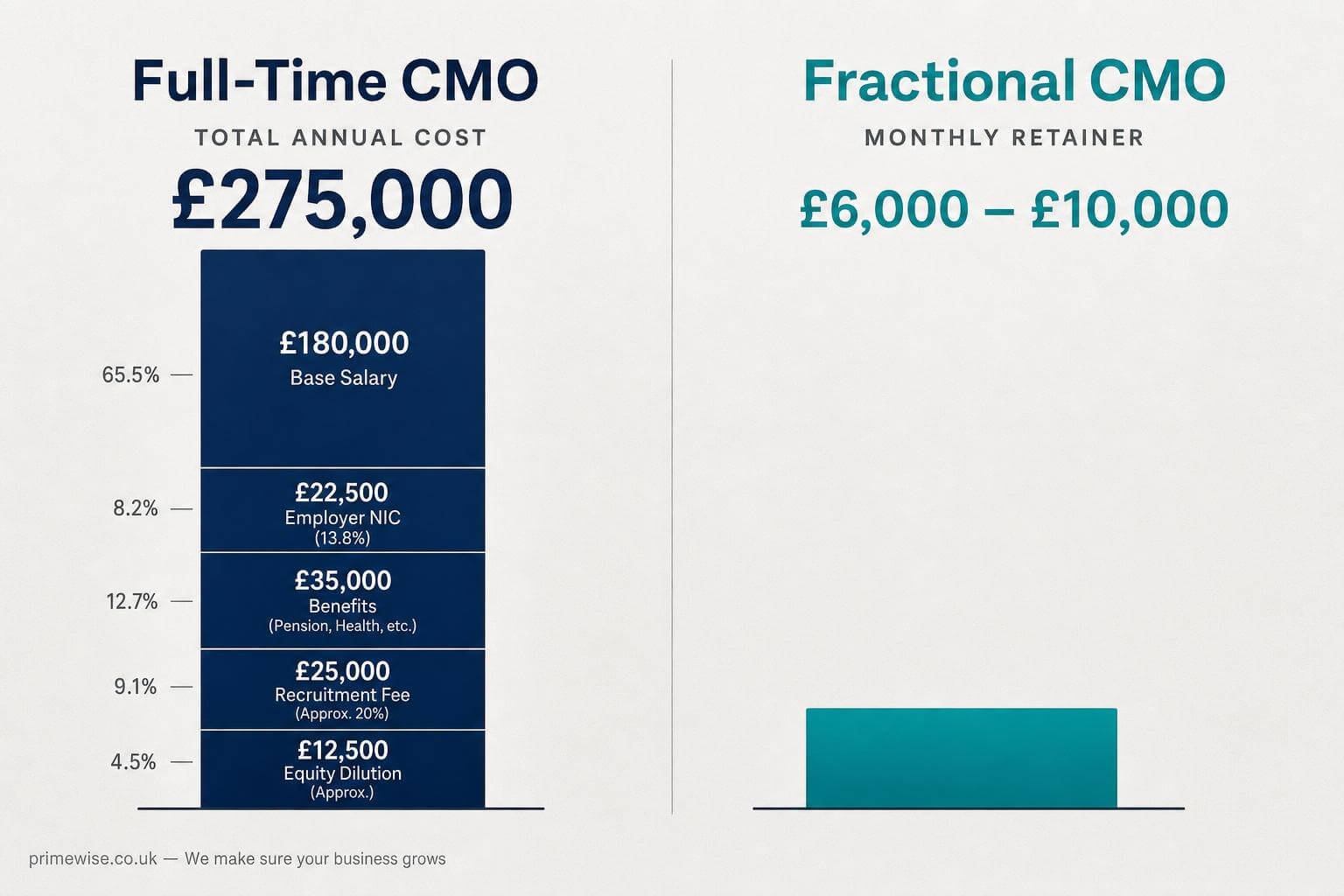
| Cost Dimension | Full-Time CMO (London) | Fractional CMO (UK) |
|---|---|---|
| Annual Base Salary | £150,000 – £220,000 | £60,000 – £180,000 equivalent |
| Employer NIC + Pension | £22,000 – £35,000 | None |
| Benefits Package | £8,000 – £20,000 | None |
| Recruitment Fee | £30,000 – £55,000 (one-off) | None |
| Equity Dilution | 0.5% – 2.0% options grant | Minimal or zero |
| Onboarding Speed | 3 – 6 months to full productivity | 2 – 4 weeks to strategic output |
| Total Annual Cost | £180,000 – £275,000+ | £60,000 – £180,000 |
Aligning Marketing Spend With EIS and SEIS Funding Milestones
For UK startups leveraging the Seed Enterprise Investment Scheme (SEIS) or the Enterprise Investment Scheme (EIS), capital deployment is subject to strict regulatory scrutiny and investor milestone expectations. Under the updated 2023 SEIS limits, companies can raise up to £250,000 under the scheme, while EIS permits up to £12 million in lifetime investment. Critically, HMRC’s qualifying conditions include restrictions on substantial non-qualifying activities, and how marketing expenditure is categorised can affect a company’s advance assurance status. A fractional CMO with direct EIS and SEIS literacy can structure spend velocity and investment categorisation to preserve scheme eligibility a genuinely differentiated capability that the vast majority of junior marketing hires and generalist agencies simply do not possess. This alignment protects your investor base and maintains board confidence through the most capital-constrained phase of company development.
EIS and SEIS Compliance NoteAll EIS and SEIS eligibility decisions should be confirmed with a qualified accountant or legal adviser. The financial benchmarks throughout this article are indicative ranges drawn from UK market data and are not a substitute for professional financial or regulatory advice.
The Capital-Efficient GTM Maturity Model
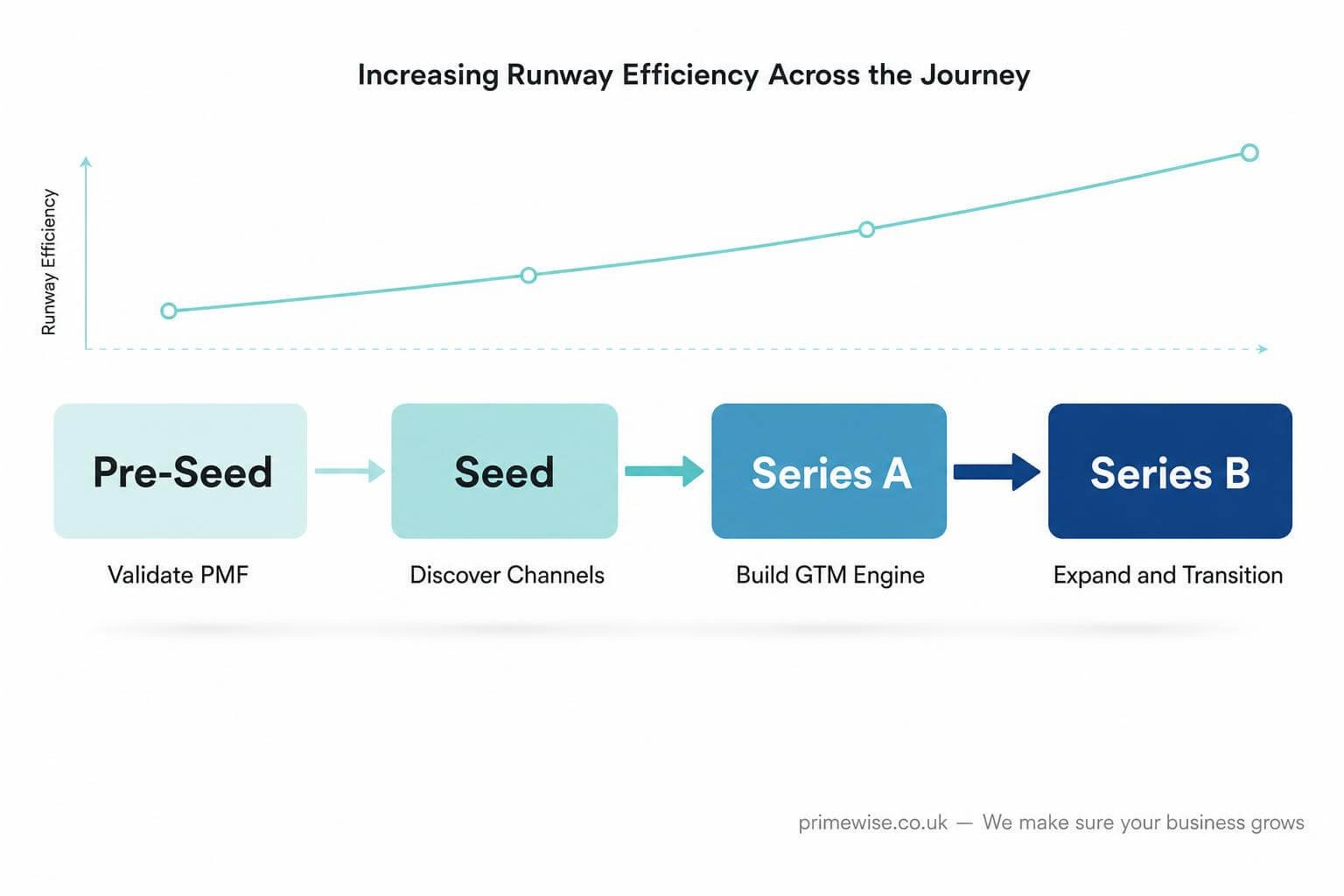
Deploying the wrong marketing infrastructure at the wrong funding stage is as damaging as deploying no infrastructure at all. Attempting to execute Series B growth tactics within a Pre-Seed environment produces disastrous unit economics and destroys investor confidence. At primewise.co.uk, we apply a proprietary framework called The Capital-Efficient GTM Maturity Model, which maps specific marketing mandates directly to venture funding stages. The framework prevents premature scaling, ensures every pound deployed generates measurable progress toward the next milestone, and provides the board with a clear, stage-appropriate performance narrative.
Pre-Seed Stage Validating Product-Market Fit and Core Messaging
At Pre-Seed, the fractional CMO’s singular mandate is preventing founders from burning early capital on paid acquisition channels before the core value proposition genuinely resonates with the target market. This stage is defined by lean validation methodologies. The Jobs-to-be-Done (JTBD) framework is applied to extract qualitative feedback directly from early adopters, uncovering the precise language customers use to describe the problem being solved. This language becomes the foundation for initial positioning. The objective is to achieve the early indicators of product-market fit specifically, a Net Promoter Score above 40 and unprompted referral behaviour before committing budget to scalable channels. Founders working with primewise.co.uk receive a bespoke GTM Stage Assessment within their first engagement week, ensuring marketing infrastructure is precisely calibrated to their current funding stage rather than the aspirational next one.
Seed Stage Channel Discovery and Proving Early Traction
With product-market fit validated, the strategic focus shifts to identifying scalable and repeatable customer acquisition channels. The fractional CMO transitions the company away from purely founder-led sales toward structured inbound and outbound engines. The Pirate Metrics framework Acquisition, Activation, Retention, Referral, Revenue (AARRR) provides the diagnostic lens for evaluating which acquisition levers deliver the most favourable CAC at this stage. Rigorous A/B testing across two to three channels is conducted before any significant budget commitment is made. The output is a channel-attribution data set that becomes a core component of the Series A data room, providing investors with empirical evidence of repeatable, scalable demand generation. This is precisely the commercial rigour that differentiates fundable businesses from those that stall at Seed.
Series A Scaling the GTM Engine and Marketing Infrastructure
Series A funding introduces the critical inflection point where manual, founder-driven processes must be replaced by automated, scalable systems. The fractional CMO at this stage architects the full marketing operations infrastructure. HubSpot is typically implemented as the core CRM and marketing automation platform, enabling lead scoring, lifecycle email sequences, and pipeline attribution reporting that the board and incoming investors expect. Salesforce may replace HubSpot as deal complexity grows, with the decision governed by sales cycle length and integration requirements. Alongside the technology build, the fractional CMO recruits a small team of mid-level specialists typically a content lead, a paid acquisition manager, and a marketing operations analyst creating an internal capability that does not depend on the fractional leader’s continued presence. The goal is to build a marketing engine capable of absorbing significantly increased spend without a proportional increase in CAC.
Series B Market Expansion and the Transition to a Full-Time Team
By Series B, the startup has proven its economic model and possesses the financial maturity to support a permanent, fully resourced marketing department. The fractional CMO’s role transitions from builder to director of expansion strategy. This includes evaluating new vertical opportunities, adapting the core proposition for adjacent segments, and for UK startups specifically navigating the hyper-localised complexity of post-Brexit European market entry. Crucially, the fractional CMO manages their own exit with operational discipline: leading the executive search process for their full-time replacement, ensuring the incoming CMO inherits a fully functioning commercial engine with documented processes, established unit economics, and a clear growth mandate validated by the board.
What Boards and Founders Should Actually Expect
The conversation about fractional marketing leadership must move from theoretical strategy to tangible, commercial outputs. A high-calibre fractional executive does not arrive to offer recommendations from a safe distance. They embed into the fabric of the business, own the commercial outcomes, and deliver concrete assets that immediately enhance enterprise valuation and investor confidence.
Board-Level Reporting CAC, LTV, and Payback Periods
Modern marketing leadership is an exercise in financial modelling as much as brand strategy. A fractional CMO implements rigorous reporting standards tailored for venture capital boards, moving decisively away from vanity metrics social media impressions, email open rates, website traffic and toward the unit economics that determine a company’s investability. In UK B2B SaaS, a healthy CAC-to-LTV ratio of 1:3 or better is the standard Series A benchmark, with a payback period under 18 months considered investable. In FinTech, investor expectations are considerably tighter, with payback periods often required to be under 12 months. The fractional CMO tracks, reports, and continuously optimises these metrics at board level, ensuring the marketing narrative is always expressed in the financial language that VC partners respond to.
The 90-Day Fractional CMO Onboarding Framework
One of the most common founder misconceptions is that strategic clarity takes months to achieve. A seasoned fractional CMO operating within a structured methodology delivers meaningful commercial output within the first quarter of engagement. The primewise.co.uk 90-Day Fractional CMO Onboarding Framework is a proprietary sequenced methodology applied across every engagement.
- Days 1 to 14 Audit Phase: Full audit of the existing technology stack to identify redundant subscriptions and fragmented tools. Review of all live marketing channel performance data. Stakeholder interviews with founders, sales leadership, and key customers to map messaging gaps and commercial friction points.
- Days 15 to 42 Strategy Design Phase: Development of the go-to-market strategy aligned to the current GTM maturity stage. Positioning framework creation using JTBD-derived customer language. Board-ready marketing metrics dashboard established with CAC, LTV, and payback period as primary KPIs. Capital-efficient hiring roadmap designed.
- Days 43 to 90 Execution and Reporting Phase: Live activation of priority acquisition channels with full attribution tracking. First board deck marketing slides delivered with performance benchmarks against UK sector averages. Technology stack consolidation completed, with estimated monthly software cost savings identified. Recruitment brief issued for first internal marketing hire if stage-appropriate.
Tech Stack Consolidation and Hiring Roadmaps
Startups accumulate software bloat rapidly. Unused HubSpot seats, redundant project management tools across Notion and Asana, disconnected analytics platforms, and overlapping social scheduling subscriptions create both financial waste and operational fragmentation. The fractional CMO conducts an immediate technology audit to consolidate the stack to its highest-value core, typically generating between £1,500 and £8,000 in monthly savings that are immediately redeployable as acquisition budget. Alongside this, they design a capital-efficient hiring roadmap that precisely identifies when to bring capability in-house versus when to leverage specialist agency partners on a project basis preventing the expensive recruitment errors that disproportionately damage early-stage companies operating on tight runways.
Key DeliverableA fractional CMO engagement at primewise.co.uk delivers three immediate commercial assets: a consolidated technology stack audit with cost savings identified, a board-ready marketing metrics dashboard, and a capital-efficient hiring roadmap aligned to your next funding milestone.
How to Evaluate and Select a Fractional CMO
For a founder ready to act, the selection process for a fractional CMO is as commercially consequential as any senior hire. The wrong appointment typically a generalist consultant rebranded as a fractional executive will consume retainer budget and board attention without delivering the commercial infrastructure you require. The following criteria separate genuine fractional marketing leadership from expensive advisory noise.
- Demonstrable CAC Improvement: Require specific, quantified evidence of CAC reduction in prior fractional or executive roles. If a candidate cannot articulate the before-and-after unit economics of their previous engagement, they are not operating at the commercial depth your board requires.
- VC-Side Credibility: The fractional CMO should be fluent in the language of venture capital data rooms, due diligence packs, cap table implications of equity grants, and board-level reporting cadences. Ask them to describe how they would present marketing performance at your next investor update.
- Sector Relevance: B2B SaaS, FinTech, and DeepTech each carry distinct CAC benchmarks, sales cycle dynamics, and buyer psychology. A fractional CMO with direct vertical experience shortens the diagnostic phase significantly and arrives with pre-validated channel hypotheses.
- Engagement Structure Clarity: Understand the precise hours per week committed, the retainer versus equity structure, and how scope creep is managed. A professional fractional executive will have a defined engagement contract, not a loosely worded consulting agreement.
- Team Compatibility: The fractional CMO must earn trust within the founding team rapidly. Request an introductory call that includes your sales lead or product director interpersonal friction at this level is extraordinarily costly in an early-stage environment.
- Red Flags to Avoid: Absence of measurable prior outcomes, over-reliance on brand awareness metrics, inability to describe their own exit strategy from a previous engagement, and retainer structures that do not include defined deliverables.
Navigating Post-Brexit European Expansion
Scaling across fragmented European markets presents a structurally unique challenge for post-Brexit UK startups that is frequently underestimated at board level. Attempting a simultaneous pan-European launch will drain Series A cash reserves with a speed that collapses runways. A fractional CMO mitigates this risk through hyper-localised, sequenced expansion strategy rather than broad-market bets. Individual EU territories are evaluated across four dimensions: GDPR and local regulatory alignment, competitor density and white space analysis, cultural readiness for the specific proposition, and the cost of localised content and channel activation. This forensic prioritisation ensures cross-border traction is capital-efficient and that each new market entry builds the proof point required to justify the next territory investment to your board.
Case Study Halving CAC and Extending Runway by Six Months
The following engagement, facilitated through the primewise.co.uk fractional leadership model, illustrates the measurable commercial impact of structured fractional CMO deployment in a capital-constrained environment.
A UK-based FinTech platform at the late Seed stage a payments infrastructure business founded in 2021 and backed by a London-based Seed fund was experiencing a soaring Customer Acquisition Cost driven by heavy, untargeted investment in broad paid social media campaigns. Their financial runway stood at eight months when the fractional CMO engagement was initiated. The business lacked attribution infrastructure, had no lifecycle email automation in place, and was allocating over 70% of marketing budget to top-of-funnel brand awareness with no measurable conversion pathway.
Within the first 90 days of engagement, the fractional CMO paused three underperforming paid social channels, consolidated a bloated technology stack that was generating £4,200 in monthly software waste, and pivoted the primary acquisition strategy toward high-intent search and automated lifecycle email marketing built within HubSpot. Board reporting was restructured around CAC, LTV, and payback period, replacing a vanity-metric dashboard that had obscured the true cost of customer acquisition for over six months. The outcome: aggregate CAC was reduced by 52%, unit economics stabilised to a CAC:LTV ratio of 1:3.4, and the startup’s financial runway was extended by a full six months providing sufficient time to close a highly favourable Series A round at a valuation reflecting the improved commercial fundamentals.
Engage Fractional Marketing Leadership for Your Next Funding RoundIf your startup is preparing for a Series A raise, managing a Seed-to-A transition, or navigating post-Brexit European expansion, primewise.co.uk offers a no-obligation GTM Audit Call with a senior fractional marketing executive. This session defines your marketing maturity baseline and identifies the three highest-ROI growth levers available to your business today. Book your session at primewise.co.uk.