

Fractional CMO for law firms is the strategic model quietly reshaping how partner-led practices across the UK compete, grow, and protect their reputations in an increasingly digital legal marketplace. Rather than committing to a full-time board-level salary, forward-thinking managing partners are engaging senior marketing executives on a part-time retainer basis, securing genuine commercial leadership, SRA-compliant campaign oversight, and firm-wide BD alignment at a fraction of the cost. This guide, informed by active practitioner experience at primewise.co.uk, is the definitive resource for any equity partner or practice manager evaluating this model in 2026.
What Is a Fractional CMO for a Law Firm
A fractional CMO for a law firm is a senior marketing executive who provides board-level strategic leadership on a part-time or retainer basis, specifically within the regulated environment of UK legal services. Unlike a generalist consultant or a junior in-house hire, a fractional marketing director brings deep familiarity with partnership structures, billable hour dynamics, SRA compliance obligations, and the prestige sensitivities of the legal brand. The engagement is structured, accountable, and outcome-driven, typically spanning one to four days per week, depending on the firm’s growth ambitions.
The model is particularly well-suited to mid-tier regional firms, boutique London practices, and specialist niche solicitors who require strategic horsepower without the overhead of a permanent C-suite appointment. The SRA’s 2024 Regulated Firms Report recorded over 10,600 authorised firms competing across England and Wales, many of them vying for the same shrinking pool of transactional work as AI continues to commoditise lower-complexity legal services. In that climate, senior marketing intelligence is no longer a luxury it is a competitive necessity.
MARKET REALITY CHECKResearch by the Legal Services Board found that 67% of SME clients now begin their lawyer search online before making any referral contact. Firms without a coherent digital strategy are invisible at the precise moment a prospective client is choosing their adviser.
The Strategic Case for Fractional Leadership
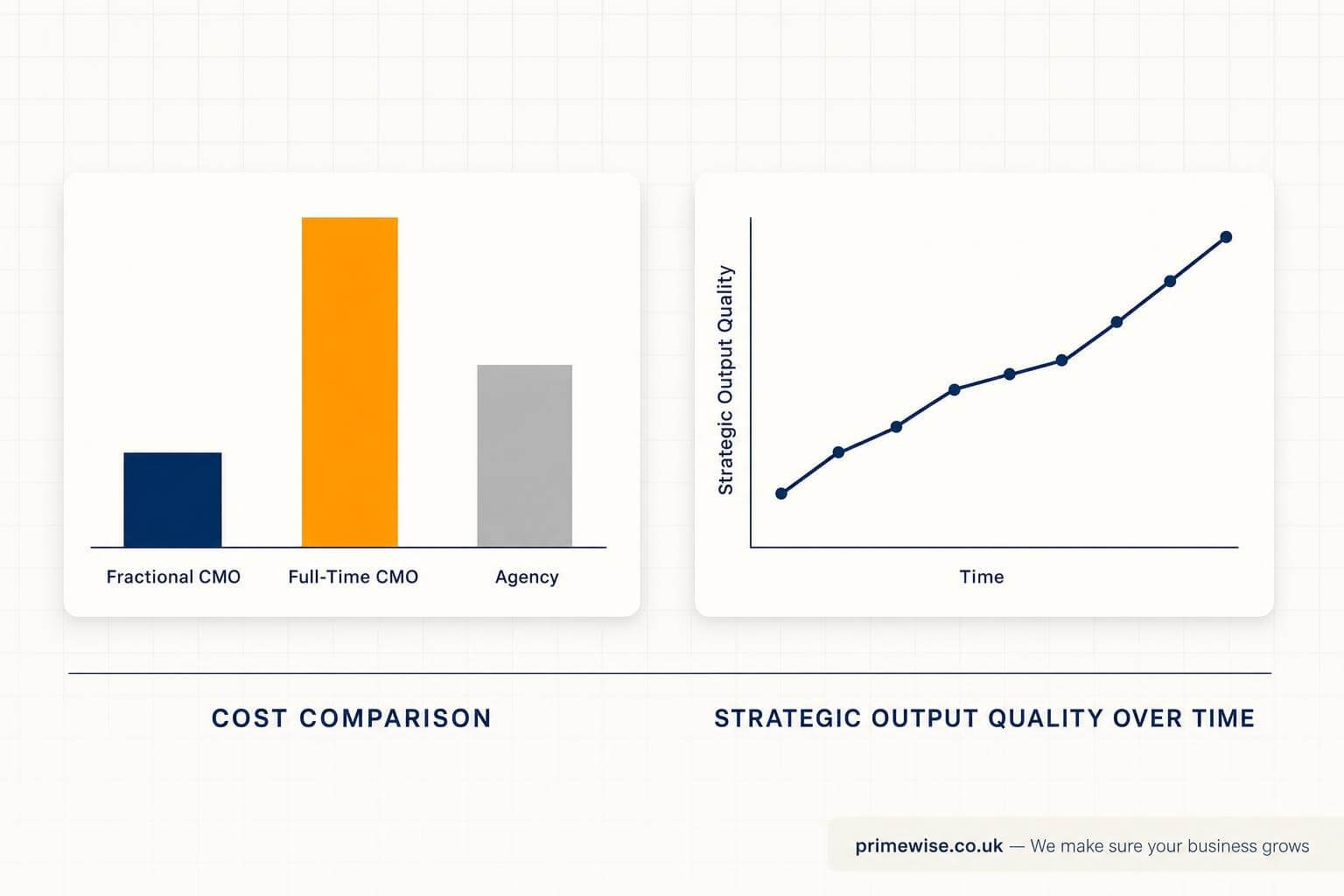
The commercial argument for engaging a fractional marketing director rather than hiring a full-time CMO or outsourcing to a generalist agency is compelling when examined against real cost structures. According to the Robert Half UK Legal Salary Guide 2024, a senior in-house Marketing Director at a mid-tier UK law firm commands a base salary of between £90,000 and £140,000 per annum, exclusive of employer National Insurance contributions, pension obligations, benefits, and recruitment fees. A fractional arrangement covering two to three days per week typically represents a total annual investment of £40,000 to £65,000, delivering a demonstrable overhead reduction of between 40% and 55% whilst maintaining equivalent strategic output.
Beyond raw cost savings, the fractional model eliminates the risk of misalignment that frequently plagues permanent CMO appointments in law firms. A full-time director hired from a consumer brand background may understand digital channels but struggle to navigate partnership politics, manage Chambers UK submission cycles, or interpret SRA publicity guidance. A specialist fractional leader arrives with that competence pre-built, compressing the ramp-up period from months into weeks.
Fractional CMO vs Full-Time CMO vs Generalist Agency
To give managing partners a clear decision-making framework, the comparison below maps the three most common marketing leadership options against the criteria that matter most to a partner-led practice. This is not a simple cost exercise; regulatory expertise, legal sector experience, and strategic seniority are equally critical variables when evaluating how marketing leadership is structured.
| Criteria | Fractional CMO | Full-Time CMO | Generalist Agency |
|---|---|---|---|
| Estimated Annual Cost | £40,000 – £65,000 | £90,000 – £140,000+ | £30,000 – £80,000 |
| SRA Compliance Expertise | High | Variable | Low |
| Legal Sector Specialism | High | Variable | Low to Medium |
| Partner BD Alignment | High | Medium | Low |
| Directory Submission Capability | High | Medium | Low |
| Availability | Part-Time / Flexible | Full-Time | Account-Managed |
| Scalability | High | Low | Medium |
This comparison consistently demonstrates that for firms generating between £3 million and £25 million in annual fee income, the fractional model delivers superior strategic value per pound invested. The agency route frequently falters on regulatory expertise and the gravitas required to influence senior fee earners, whilst the full-time appointment carries overhead that smaller partnerships cannot sustain during growth phases.
KEY STATISTICSUK law firms engaging fractional marketing leadership reduce executive marketing overhead by an average of 40%. Firms with a dedicated BD strategy aligned across partners report referral pipeline growth of 25–35% within the first 12 months of structured implementation.
Why Generalist Agencies Fail in Legal Services
The failure mode of generalist agencies within law firms is well-documented and consistently rooted in two structural problems. The first is a credibility gap: junior account managers presenting to rooms of equity partners with fifteen years of client-facing legal experience do not command the respect required to shift ingrained behaviours or secure meaningful budget allocation. The second is a knowledge gap: generalist marketers rarely understand the intersection of billable hour economics, SRA publicity obligations, and the nuanced reputational calculus that governs every public-facing claim a law firm makes.
This is not a criticism of generalist agencies in other sectors. It is a recognition that legal services marketing operates under a distinct regulatory and cultural framework that demands specific expertise. A fractional marketing director who has operated within partnership structures understands that a single non-compliant LinkedIn post by an equity partner can trigger a regulatory complaint, and that a misleading price transparency page exposes the firm to SRA enforcement action under Chapter 8 of the Code of Conduct. Generalist agencies rarely carry this awareness, and the consequences of that gap fall entirely on the firm.
Unifying Partners Behind One Growth Strategy
The most persistently complex challenge in law firm marketing is not digital it is human. Autonomous equity partners, each protecting their own client relationships and rainmaking methodologies, frequently resist firm-wide marketing initiatives as intrusions on their independence. A fractional CMO resolves this by approaching the challenge as a change management exercise rather than a marketing campaign.
The SRA-Compliant Partner BD Alignment Matrix
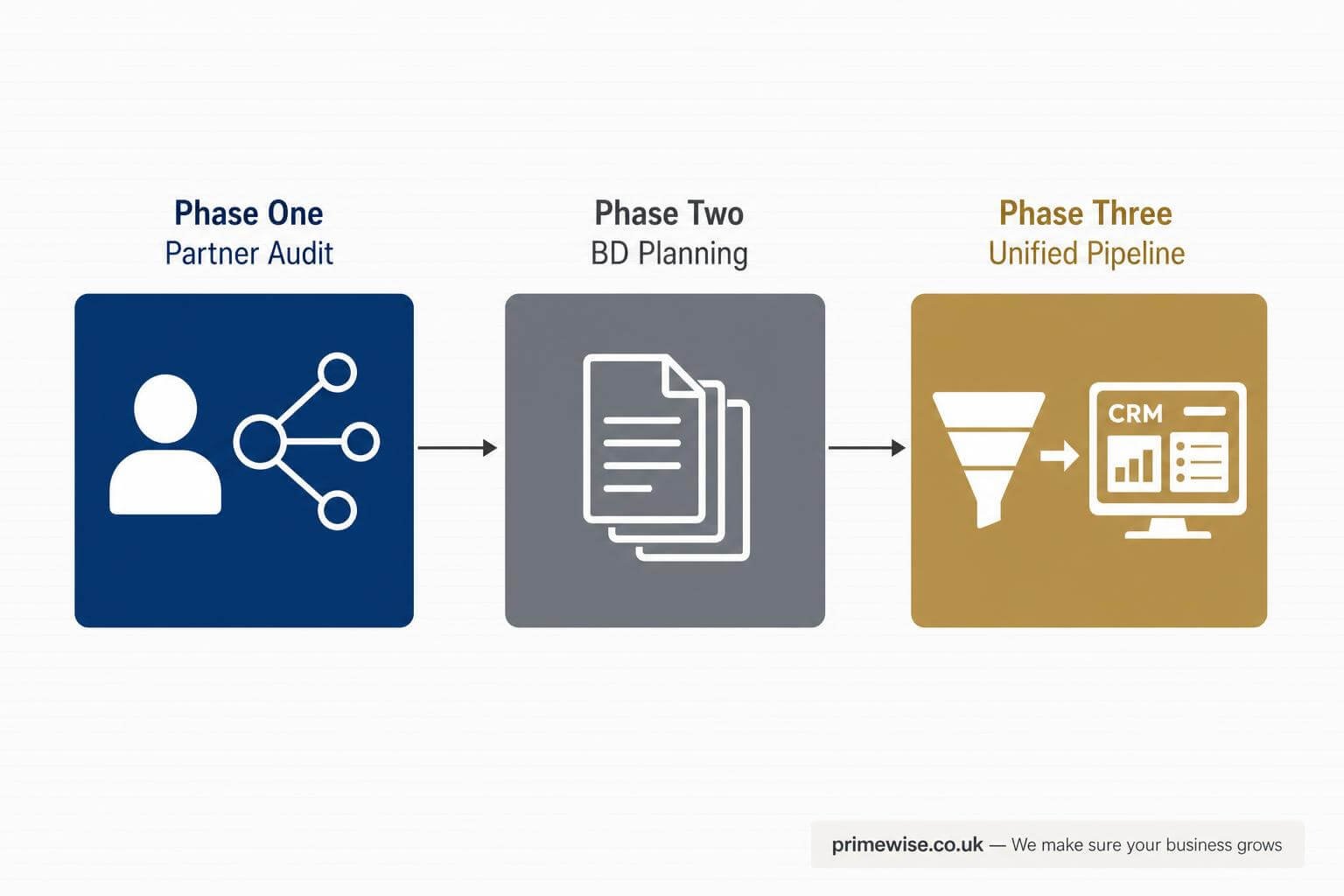
The SRA-Compliant Partner BD Alignment Matrix, developed and deployed by the team at primewise.co.uk, is a structured methodology for mapping individual partner business development strengths against the firm’s strategic growth priorities. The framework operates across three phases. In Phase One, the fractional director conducts confidential one-to-one partner BD audits, mapping each fee earner’s existing network, sector expertise, referral sources, and content comfort level. In Phase Two, individual BD plans are created for each partner that align their natural strengths whether that is conference speaking, LinkedIn thought leadership, or direct client entertainment with specific practice area growth targets. In Phase Three, all individual activities feed into a centralised CRM pipeline, typically built within HubSpot for Legal Services or a sector-specific platform, providing the management board with a real-time view of the firm’s collective commercial pipeline for the first time.
This approach is transformative precisely because it respects partner autonomy whilst creating firm-wide accountability. Fee earners are not asked to abandon their preferred BD methods. They are given strategic structure, compliance guardrails, and measurable targets that connect their individual efforts to collective firm growth. The result is a unified pipeline management system that converts decades of fragmented relationship capital into a visible, scalable asset.
Transitioning Legacy Referral Networks into Digital Pipelines
Many prestigious UK practices have built their entire client base on offline referral relationships cultivated over decades. These relationships represent enormous value, but they carry a critical commercial vulnerability: they are invisible, unmeasured, and entirely dependent on the continued presence of the individual partner who holds them. A fractional marketing director bridges this gap by systematically converting informal referral relationships into structured, CRM-tracked lead generation pipelines.
This transition involves identifying the firm’s top twenty referral sources by practice area, creating structured touchpoint programmes for each, and developing digital content typically compliance-vetted thought leadership distributed via LinkedIn that keeps the firm visible and authoritative between in-person meetings. The objective is not to replace relationship-based BD. It is to amplify it with digital infrastructure that ensures continuity, measurability, and resilience when individual partners change roles or retire.
Navigating SRA Compliance in Legal Marketing
Legal marketing occupies the highest tier of regulated commercial communication in the UK. The consequences of non-compliance ranging from SRA investigation and financial penalties to reputational damage and client complaints make regulatory expertise a non-negotiable qualification for any marketing leader in this sector. A fractional CMO operating in legal services must function simultaneously as a growth driver and a compliance guardian.
SRA Code of Conduct Chapter 8 Obligations
Chapter 8 of the SRA Code of Conduct for Solicitors (the publicity rules, specifically Rule 8.8) requires that all firm communications are accurate, not misleading, and do not make unsolicited approaches to members of the public in an inappropriate manner. In practical marketing terms, this governs every element of the digital estate: website service descriptions, price transparency pages, Google Ads copy, LinkedIn posts by fee earners, directory profiles, press releases, and email marketing campaigns. A fractional director implements a structured editorial approval workflow a compliance gate through which all public-facing content passes before publication. This process eliminates the risk of inadvertent breaches caused by well-intentioned but under-briefed marketing executives or partners acting independently on social media.
The SRA’s own compliance guidance, available at sra.org.uk, provides the authoritative reference framework for this editorial process. Any law firm marketing strategy that does not explicitly reference and operationalise these obligations is structurally incomplete and commercially exposed.
COMPLIANCE ALERTAll public-facing legal marketing content must comply with SRA Code of Conduct Rule 8.8 on publicity. A single misleading service description or unsubstantiated claim on your website is sufficient grounds for a formal SRA complaint. Your marketing leader must treat compliance as a prerequisite, not an afterthought.
UK GDPR and AML Considerations in Digital Lead Generation
Digital lead generation for law firms operates under two additional regulatory frameworks that generalist marketers routinely underestimate. The first is UK GDPR, as administered by the Information Commissioner’s Office (ICO), which governs every data capture touchpoint on the firm’s digital estate contact forms, gated content downloads, email subscription mechanisms, and live chat functions. Consent must be explicit, granular, and purpose-specific. Client intake data must be stored securely, with documented retention policies and subject access request procedures in place. The ICO’s direct marketing guidance provides the definitive reference for compliant email campaign practice.
The second consideration is Anti-Money Laundering (AML) compliance. Whilst AML is primarily a client due diligence obligation, the design of digital lead generation funnels must not inadvertently create risk. Forms that collect unusually detailed transactional information before an initial consultation, or marketing campaigns targeting sectors with elevated AML risk profiles, must be reviewed against the firm’s AML policy. A fractional marketing director with legal sector experience carries this awareness as standard. Their generalist counterpart, almost without exception, does not.
Dominating UK Legal Directories
Achieving and maintaining rankings in Chambers UK and the Legal 500 UK is one of the highest-value marketing activities available to any ambitious law firm. A top-tier directory ranking operates as a long-duration trust signal, influencing procurement decisions by general counsel, institutional clients, and high-net-worth individuals for the twelve months between publication cycles. Yet the submission process is consistently under-resourced and poorly managed across the mid-market, representing a significant competitive opportunity for firms with strategic oversight in place.
Strategic Directory Submission Management
A fractional CMO provides end-to-end management of the Chambers UK and Legal 500 UK submission cycles. This involves identifying the strongest case studies across each target practice area, structuring narratives that demonstrate market prominence rather than simply listing work completed, managing referee identification and briefing processes, coordinating partner-level responses to researcher questionnaires, and tracking submission deadlines across multiple practice areas simultaneously. The strategic dimension understanding what the directory researchers are looking for and how to present the firm’s work in the context that maximises ranking likelihood is precisely where law firms without dedicated marketing leadership consistently leave competitive ground on the table.
Chambers UK and Legal 500 ranking decisions are increasingly influenced by a firm’s digital presence and thought leadership visibility, with researchers now routinely cross-referencing submission claims against the firm’s public profile. A firm with a coherent content marketing strategy and active LinkedIn presence from its senior fee earners will always present more credibly than an equivalent firm whose digital estate is static and whose partners are invisible online.
Building Partner Personal Brands and Legal Thought Leadership
Individual solicitor personal branding on LinkedIn has emerged as one of the most commercially effective business development tools available to mid-tier UK law firms in 2026. The LinkedIn algorithm disproportionately rewards content from individual professionals over firm pages, meaning a single well-crafted post from a senior partner reaches a wider and more relevant audience than an equivalent post from the firm’s corporate account. A fractional marketing director operationalises this insight at scale, building a structured legal thought leadership programme across the partnership.
This programme typically includes a compliance-vetted content calendar for each participating partner, ghostwriting or editorial support for technical legal commentary, strategic coaching on LinkedIn engagement to build sector-specific audience growth, and integration with the firm’s CRM to capture inbound enquiries generated through individual partner content. The result is a measurable digital pipeline fed by genuine expertise, precisely the kind of authentic, authority-driven content marketing that both Google’s Helpful Content system and AI discovery engines prioritise as primary citation sources in 2026.
STRATEGIC INSIGHTLinkedIn content from individual partners consistently outperforms firm page content by a factor of 5 to 8 in organic reach within professional networks. A structured partner thought leadership programme, compliance-gated and CRM-integrated, is among the highest-ROI digital investments available to a mid-tier UK law firm.
How Primewise Delivers This in Practice
The team at primewise.co.uk specialises exclusively in fractional marketing leadership for regulated professional services, with a primary focus on UK law firms across commercial, private client, employment, and litigation practice areas. The engagement model is designed to integrate seamlessly with existing partnership structures, delivering board-level strategic oversight without disrupting the cultural fabric of the firm. Every engagement begins with a complimentary overhead audit that quantifies the firm’s current marketing expenditure against measurable outcomes, identifies the highest-priority growth levers, and provides a clear financial case for the fractional model before any retainer commitment is made.
Firms currently supported range from six-partner boutique practices in the City to thirty-partner regional firms managing multi-practice marketing functions. The common thread is a recognition that marketing strategy at this level of specialisation and regulatory complexity requires a specific type of leader one who has operated inside partnership structures, understands the commercial and compliance pressures of legal practice, and can translate that understanding into growth strategies that fee earners will actually adopt and execute.
If you are a managing partner or practice director evaluating whether fractional marketing leadership is the right model for your firm, the most productive first step is a thirty-minute confidential strategy conversation not a sales presentation, but a peer-level discussion about your firm’s specific growth objectives, competitive positioning, and the marketing infrastructure currently in place. Request your complimentary overhead audit and strategy consultation at primewise.co.uk.