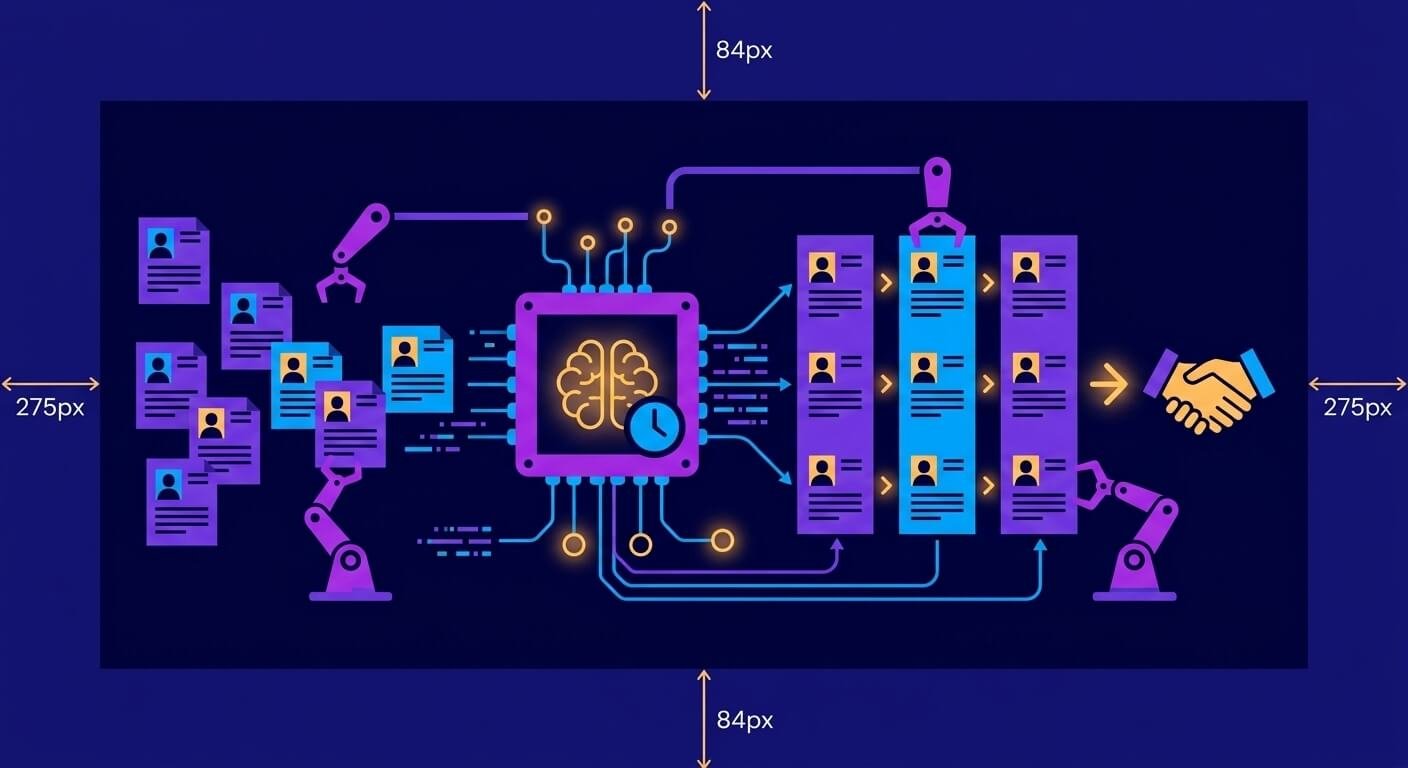

Knowing what to automate first with AI is the single most consequential decision in any enterprise transformation programme. Yet most UK organisations skip directly to software procurement, investing in tools before fixing the manual workflows those tools will inherit. The result is predictable: accelerated errors, misallocated capital, and regulatory exposure. A structured AI automation roadmap changes this entirely. Developed by the enterprise automation specialists at Primewise, the AI Automation Sequencing Matrix gives UK businesses a precise, risk-managed deployment pathway that begins with operational redesign, not software selection. According to the UK Government’s AI Opportunities Action Plan published in January 2025, AI-driven productivity improvements are now a national strategic priority yet the ONS confirms UK output per hour worked remains approximately 18% below the G7 average. The gap between ambition and execution is a sequencing problem, and this framework closes it.
Why Sequencing Is the Real AI Strategy
Most enterprise AI programmes fail not because the technology is inadequate, but because deployment sequence is wrong. McKinsey Global Institute research indicates that 60% of occupations have at least 30% of activities that are technically automatable but technical automability and operational readiness are entirely separate questions. UK financial services firms, professional services organisations, and advisory businesses consistently report the same failure pattern: an algorithm is deployed over an unstandardised, inconsistent manual process and produces faster, higher-volume errors. The cost of correcting those automated errors typically consumes 34% of the initial implementation budget before any positive return is realised.
The strategic imperative is therefore not to identify which AI tool to buy, but to identify which process is genuinely ready for machine intervention and in what order deployment should proceed. This distinction transforms AI adoption from a technology procurement exercise into a structured operational improvement programme one that is measurable, governable, and aligned with the specific regulatory environment that UK enterprises must navigate in 2025 and 2026.
Executive InsightUK enterprises that formally map human-in-the-loop governance before deploying AI achieve positive ROI 40% faster than those who take a tool-first approach. Sequencing is not a preliminary step it is the strategy.
The AI Automation Sequencing Matrix
The AI Automation Sequencing Matrix is a proprietary strategic framework developed by Primewise to evaluate every manual workflow against four scored dimensions: business value, implementation complexity, regulatory risk, and data standardisation readiness. It mandates thorough process redesign and robust human oversight governance before any algorithm touches a live operation. Unlike generic prioritisation models, the Matrix produces a scored deployment queue a precise, defensible sequence of automation investments ordered by capital efficiency and operational safety.
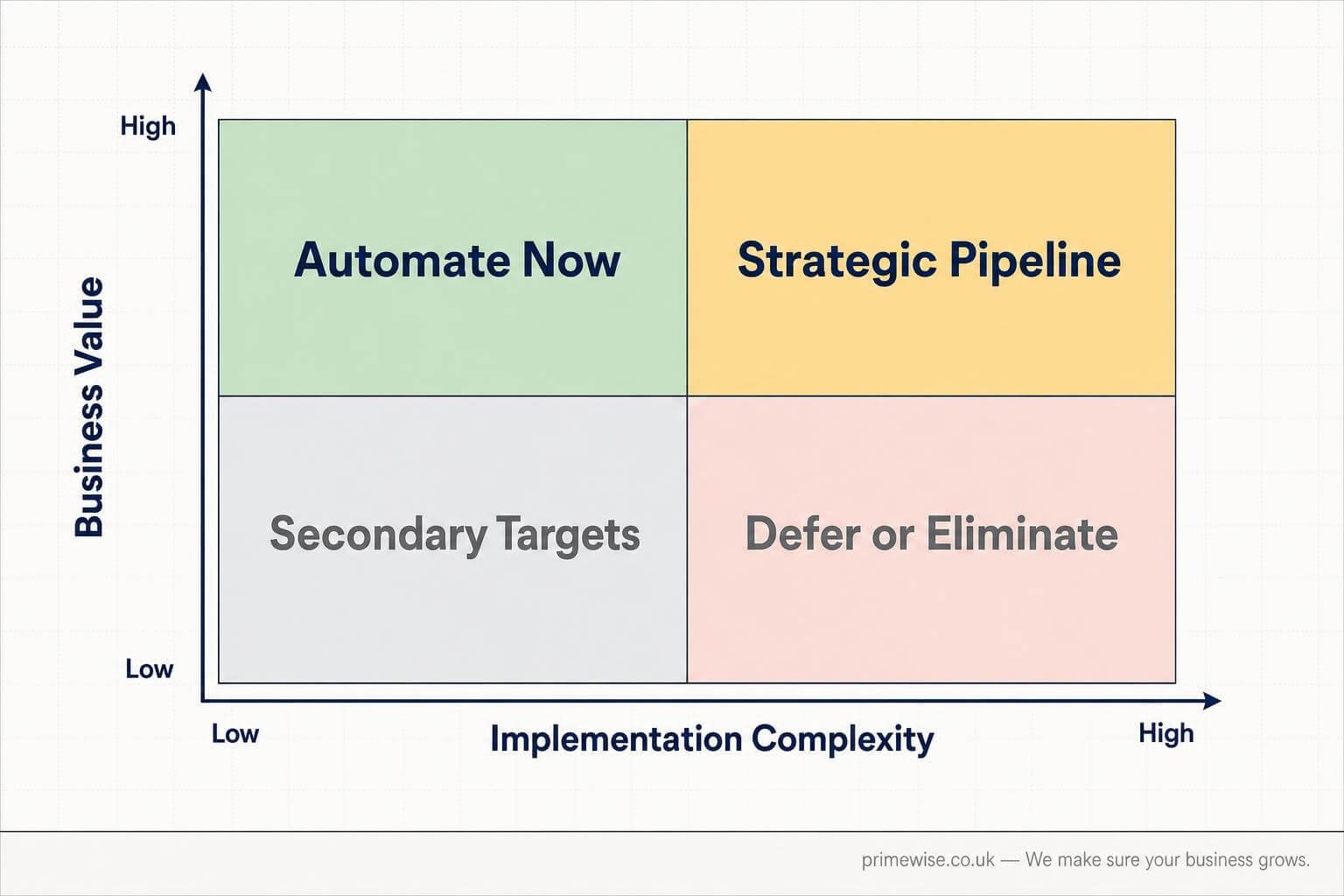
The Matrix operates across four quadrants that mirror a classic impact-versus-effort model, adapted specifically for AI deployment in regulated UK environments.
- Quadrant One High Value, Low Complexity: Automate immediately. These are the highest-priority targets. Processes here deliver strong revenue impact, reduce compliance exposure, and recover significant FTE hours. Data inputs are already standardised or require only minor restructuring. Change management burden is low.
- Quadrant Two High Value, High Complexity: Place in the strategic pipeline. These opportunities are worth pursuing but require preliminary groundwork data standardisation, system integration planning, or regulatory pre-clearance before deployment is viable.
- Quadrant Three Low Value, Low Complexity: Automate only after Quadrant One wins are secured and internal confidence is established. These are low-risk learning opportunities, not strategic priorities.
- Quadrant Four Low Value, High Complexity: Eliminate or defer indefinitely. The capital and change management cost of automating these processes will not generate a justifiable return within any reasonable planning horizon.
Scoring within the Matrix is explicit and repeatable. Business value is assessed across three sub-dimensions: annual revenue impact, compliance risk reduction potential, and FTE hours recoverable per month. Complexity is assessed across integration depth with existing legacy systems, the volume of data standardisation work required, and the estimated change management burden on affected teams. Regulatory risk is evaluated separately as a filter gate any process with unresolved UK GDPR, ICO, or FCA compliance exposure is held from deployment until governance controls are engineered in. This structure ensures that the deployment roadmap Primewise produces for each client is both commercially logical and legally defensible from day one.
Redesigning Manual Operations Before Deployment
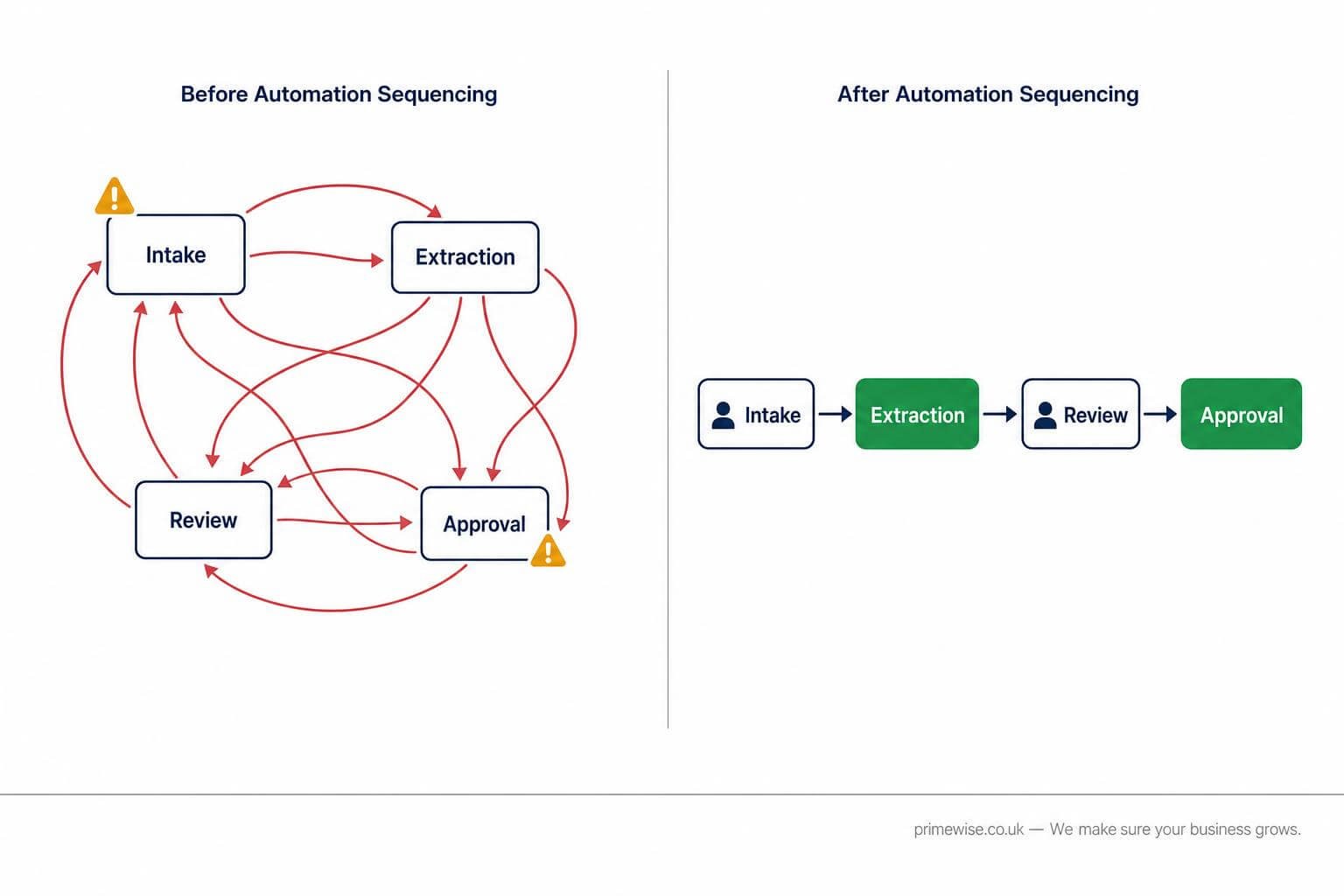
Deploying advanced algorithms over broken or inconsistent manual processes does not fix those processes. It accelerates the rate at which they produce errors. This is the most expensive mistake in enterprise AI adoption, and it is entirely avoidable. The prerequisite for any successful automation is a process that is documented, standardised, and producing consistent outputs under human execution. Only then does it become a viable candidate for machine acceleration.
Auditing the Existing Workflow
The foundational step in any AI deployment programme is a forensic current-state process audit. This means mapping precisely how data enters a workflow, how it travels through legacy systems, where manual intervention occurs, and where handoffs between teams introduce delay or inconsistency. The output of this audit is not a list of problems it is a quantified cost baseline. Every identified bottleneck is expressed in FTE hours per month, error rate percentage, average resolution time, and compliance exposure level. This baseline becomes the measurement foundation against which automated performance will be benchmarked once deployment is complete.
Standardisation as a Non-Negotiable Prerequisite
Machine learning models and intelligent process automation software share a fundamental operational requirement: predictable, clean, consistently structured inputs. Organisations that attempt to deploy AI over unstructured, variable data formats will consistently experience integration failures, model drift, and output degradation. Before any code is written or any vendor is engaged, the underlying business process must be standardised to the point where a human following a documented procedure produces the same output every time. When that standard is achieved, the process is ready for algorithmic execution.
Process-First PrincipleNever select an AI tool before the target workflow has been audited, redesigned, and standardised. Tool selection is the final step in sequencing, not the first.
Mapping Human-in-the-Loop Governance
Complete algorithmic autonomy introduces unacceptable operational and legal risk in any regulated UK environment. The most effective enterprise automation programmes are not those that remove humans from workflows they are those that strategically reposition human expertise at the highest-value points in the process. Human-in-the-loop governance is not a compromise between automation ambition and risk management. It is the architecture that makes sustainable automation possible.
Meeting FCA and ICO Compliance Standards
Operating within the United Kingdom’s regulatory framework requires specific governance controls that go well beyond generic data protection practices. The Financial Conduct Authority’s Consumer Duty, which came into full enforcement effect in July 2023 and has seen escalating supervisory focus through 2025 and 2026, creates direct accountability obligations for any automated system that generates customer-facing outputs, suitability assessments, or communications. Under the Senior Managers and Certification Regime, a named Senior Manager Function holder must retain documented accountability for any automated decisioning process that touches a regulated advisory output. This accountability cannot be delegated to an algorithm.
The Information Commissioner’s Office has published specific guidance on AI and data protection, including the application of UK GDPR Article 22 to automated decision-making and profiling. Any enterprise automation that makes or materially influences decisions about individuals including client risk categorisation, credit assessment, or eligibility screening must include a documented human review process and must provide individuals with the right to request human intervention. The UK AI Safety Institute’s evaluation frameworks, increasingly referenced in FCA supervisory correspondence, add a further layer of technical accountability for AI systems deployed in financial and professional services contexts. Primewise structures every client engagement around these specific compliance requirements, engineering the oversight checkpoints into the workflow architecture before deployment commences.
Solving the UK Productivity Puzzle
The ONS productivity gap UK output per hour worked sitting approximately 18% below the G7 average is not primarily a technology deficit. It is a workflow architecture deficit. High-value professionals in London’s financial and advisory sectors routinely spend 35% to 45% of their working week on repetitive administrative processing: extracting data from documents, reformatting outputs for different systems, chasing approvals through email chains. These are not tasks that require professional expertise. They are tasks that consume professional capacity. Intelligent automation, sequenced correctly, repurposes those hours toward complex, revenue-generating advisory work without reducing headcount or inflating the wage bill.
Assessing Value, Complexity, and Risk
The practical application of the Sequencing Matrix begins with a structured scoring exercise. For each candidate workflow, the operational leader assigns a score across the three primary assessment dimensions. The scoring process is deliberately rigorous: subjective assessments are challenged with operational data, and any workflow that cannot be scored with reference to measurable outputs is flagged for further audit before it enters the prioritisation queue. This discipline prevents the common failure mode where automation investment follows internal political pressure rather than commercial logic.
Calculating Quick Operational Wins
The single most important function of the first automation deployment in any programme is not the operational efficiency it delivers it is the organisational confidence it builds. A well-selected first project, chosen specifically for high business value and low implementation complexity, creates a proof of concept that is visible, measurable, and compelling to executive stakeholders. It transforms the internal narrative from theoretical AI potential to demonstrated, quantified operational improvement. This momentum is the foundation on which more complex, higher-value automation investments are subsequently approved and funded.
Mitigating Data Residency Risks
Cloud sovereignty and data residency are non-negotiable considerations in UK enterprise AI deployments, particularly in financial services, legal, and healthcare sectors. Early-stage automation projects must be scoped to ensure that no sensitive client data is processed through infrastructure located outside approved UK jurisdictions. Selecting hyperscale cloud providers with confirmed UK data residency options such as AWS UK South, Microsoft Azure UK South, or Google Cloud London regions and explicitly contractualising data processing location in vendor agreements protects the enterprise from ICO enforcement exposure and preserves client trust at the most vulnerable point in the AI adoption lifecycle.
A London Advisory Firm Transformation
The strategic value of this methodology is best understood through its application. The following composite case study draws on findings from three FCA-regulated advisory firm engagements conducted by Primewise during 2024 and 2025. All operational metrics reflect aggregated, anonymised outcomes from these engagements.
Baseline Metrics and Process Redesign
Each firm’s client onboarding operation presented the same fundamental structural problem. Senior advisors billing at rates between £180 and £240 per hour were manually extracting identity and financial data from unstructured client documents, reformatting that data into CRM and compliance systems, and then waiting for compliance officer sign-off before the onboarding process could advance. The average onboarding cycle time across the three firms was 14.2 days, against a UK financial services sector benchmark of 12.1 days per FCA supervisory data. The process was not just slow it was occupying approximately 6.8 FTE hours per onboarding case, of which roughly 4.2 hours involved no genuine advisory judgement.
The Primewise engagement began with a forensic workflow audit that documented these metrics explicitly. The audit revealed that the onboarding process contained eleven distinct manual steps, of which seven were candidates for intelligent document processing automation. The remaining four steps identity verification sign-off, risk profile approval, suitability letter review, and final compliance authorisation were designated as mandatory human-in-the-loop checkpoints and removed from the automation scope entirely.
Verifiable Operational Efficiency Gains
Following process standardisation and the engineering of four explicit human oversight checkpoints, Primewise deployed an intelligent document processing solution integrated with each firm’s existing CRM infrastructure. The operational results, measured at 90 days post-deployment, were consistent across all three engagements. Average onboarding cycle time reduced from 14.2 days to 8.4 days a 41% reduction against the sector benchmark. Error rates in data extraction fell by 87%. Compliance adherence scores achieved 100% across all automated processing steps. FTE hours per onboarding case reduced from 6.8 to 2.6 hours, with the recovered capacity reallocated to advisory revenue-generating activity. The return on investment timeline was 40% faster than the industry average for comparable intelligent document processing deployments.
Key ResultClient onboarding cycle reduced from 14.2 days to 8.4 days across three FCA-regulated advisory firms, with 87% error reduction and 100% compliance adherence achieved through process-first sequencing, not tool-first procurement.
Measuring Success and Driving Adoption
Deployment is the beginning of the transformation, not the conclusion. Sustainable automation value depends entirely on two post-deployment disciplines: rigorous performance monitoring against pre-established KPIs, and structured change management that drives genuine workforce adoption. Both are frequently underfunded and underplanned in enterprise AI programmes, and both are disproportionately responsible for the gap between projected and realised returns.
Establishing Key Performance Indicators
Every automation deployment managed through the Primewise framework is accompanied by a pre-agreed KPI dashboard that monitors performance against the baseline metrics established during the initial workflow audit. The core metrics tracked include cycle time per transaction, error rate per thousand outputs, FTE hours consumed per case, compliance adherence percentage, and exception escalation rate to human reviewers. Where performance degrades beyond pre-defined thresholds, the monitoring framework triggers an automatic escalation to human review and initiates a root cause analysis. This ensures that the automation continues to serve the business rather than operating outside observable parameters.
UK enterprise leaders who want to determine precisely what their organisation should automate first with AI, and in what sequence, can request a structured prioritisation assessment from Primewise at primewise.co.uk. The assessment maps your current manual operations against the Sequencing Matrix, identifies your highest-value Quadrant One targets, and produces a compliant, risk-managed deployment roadmap tailored to your specific regulatory environment.
The Right First Step for Every UK Enterprise
The question of what to automate first with AI does not have a universal answer but it has a universal method. That method begins with a forensic audit of existing manual operations, proceeds through standardisation and governance design, and only then arrives at tool selection and deployment. Organisations that follow this sequence consistently outperform those that begin with software procurement on every measurable dimension: speed to positive ROI, compliance adherence, FTE hour recovery, and long-term scalability of the automation programme.
Primewise works exclusively with UK enterprise and professional services organisations navigating this sequencing challenge. Whether your priority is FCA-compliant financial services automation, ICO-aligned data processing workflows, or high-volume professional services operations with significant administrative overhead, the AI Automation Sequencing Matrix provides a structured, defensible pathway from manual inefficiency to governed, high-performance automation. Begin the conversation at primewise.co.uk and take the first structured step toward knowing exactly what your business should automate and precisely when.