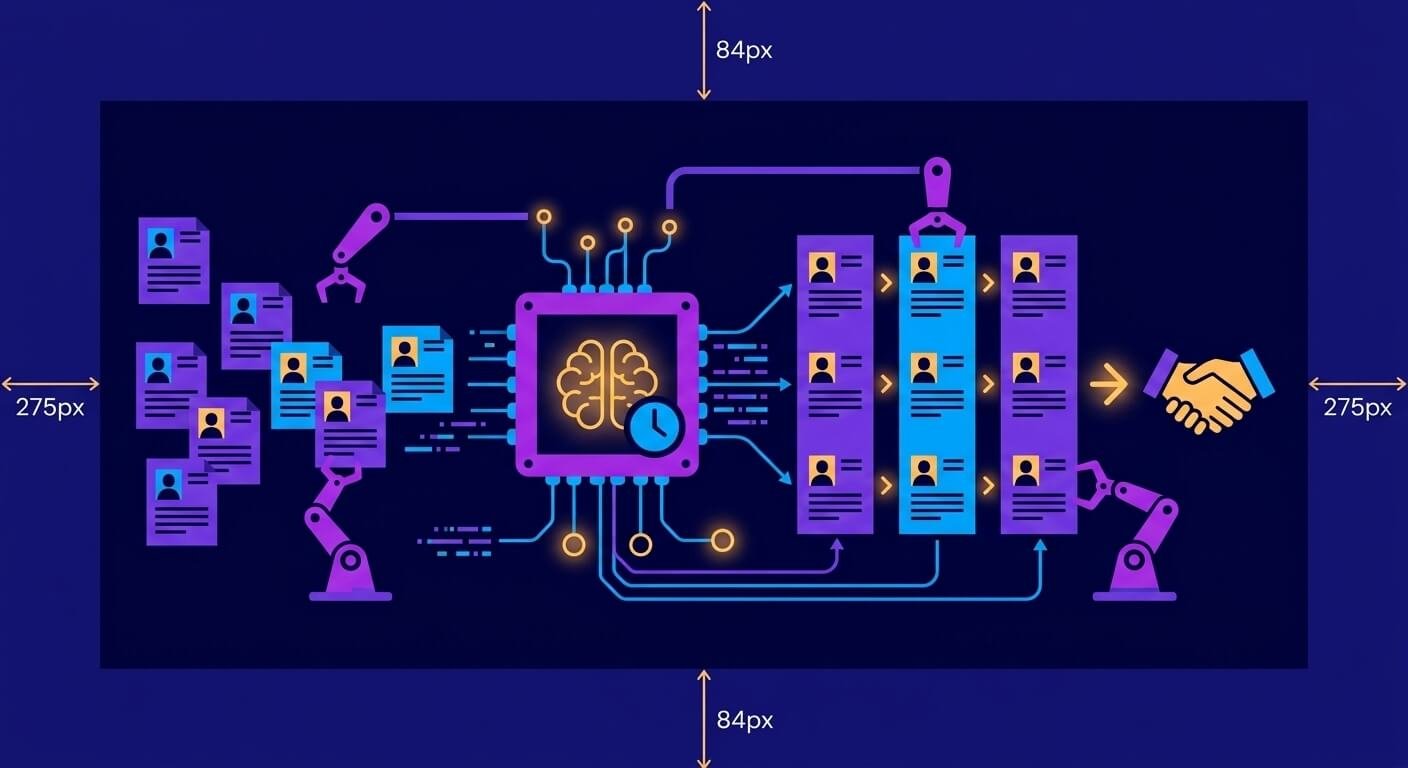

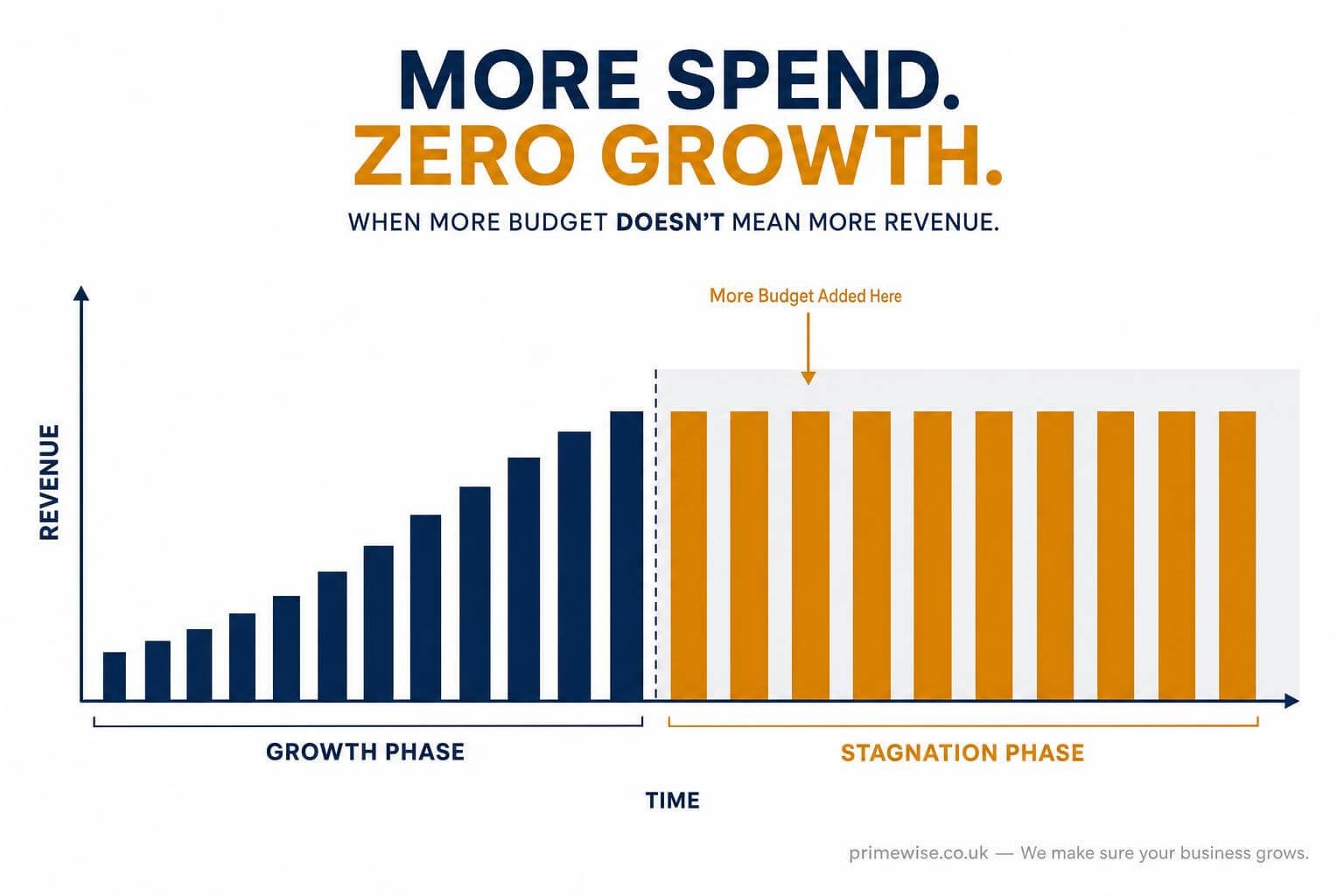
A fractional CMO consultancy engagement is the intervention most UK mid-market businesses need long before they realise it. When a business hits a fractional cmo revenue plateau, the instinctive board response is to increase marketing budget, hire another agency, or demand higher content volume. That response is almost always wrong and it is quietly making the problem worse. UK businesses that increase marketing spend during a revenue plateau experience a measurable rise in customer acquisition cost without generating net-new revenue, according to CIM’s Mid-Market Growth Research. The problem is never the agency. The problem is the absence of the executive who should be directing the agency.
Executive Summary
Revenue stagnation between £2M and £10M is one of the most common and least-discussed commercial crises in the UK SME landscape. It is structural, not executional. Fixing it requires a strategic reset delivered at executive level, not a new set of marketing tactics.
- Increasing tactical marketing spend without repositioning raises customer acquisition cost by up to 22% for UK mid-market businesses in the £2M–£5M band, without yielding net-new revenue.
- The five growth killers behind every revenue plateau are positioning drift, wrong ideal customer profile, commoditised messaging, channel dependence, and sales-marketing friction.
- A Fractional CMO provides the same executive-level strategic reset as a full-time CMO at a monthly retained cost of £3,000–£8,000, compared to a London-based full-time CMO salary exceeding £150,000 per year.
- Pipeline recovery typically begins within 30 days by eliminating wasted spend and refining lead qualification criteria, with measurable conversion improvements materialising within 90 days.
What a Revenue Plateau Actually Means
A revenue plateau is not a temporary dip. It is a structural ceiling a stagnant revenue band, typically between £2M and £10M, where increasing marketing expenditure and tactical activity yields severely diminishing returns. Businesses in this band are often highly active: running paid campaigns, publishing content, attending trade events, and briefing agencies. Yet revenue refuses to move. The ceiling is not a reflection of effort. It is a reflection of strategy.
According to the ScaleUp Institute’s UK Scaling Report, fewer than one in ten UK SMEs successfully breaks through the £5M revenue threshold. The majority stall because the strategies that generated initial growth founder-led sales, opportunistic targeting, broad-brush messaging are fundamentally incompatible with the precision required to scale beyond it. Transitioning from activity-based growth to strategy-led growth is the defining challenge of the middle market.
The Middle Market Trap
The strategies that carried a business to its first £2M rarely carry it to £10M. Founders and managing directors fall into what strategists call the middle market trap: doing more of the same with greater intensity, assuming volume will eventually convert into momentum. It does not. Sheer output without strategic direction produces bloated pipelines full of unqualified prospects, inflated cost-per-lead figures, and a sales team that has quietly stopped trusting marketing-generated opportunities. The trap is self-reinforcing. The worse results become, the more activity is demanded and the worse results become.
The Activity TrapUK mid-market businesses that increase marketing activity without first fixing their strategic foundation consistently see customer acquisition costs rise, pipeline quality fall, and sales-marketing tension escalate. More execution is not the answer. A different strategy is.
The Revenue Plateau Diagnostic Matrix
Before any strategic reset can begin, the precise cause of the plateau must be identified. A structured diagnostic matrix functions as an objective mirror for internal operations, surfacing the specific growth killers that tactical teams are too close to the work to see clearly. There are five root causes that account for the overwhelming majority of mid-market revenue flatlines in the UK.
Positioning Drift and Commoditisation
In the UK’s saturated post-Brexit B2B market, positioning drift is endemic. It occurs gradually a business that once held a distinct market position begins softening its messaging to appeal to a broader audience, removing the friction that actually qualified buyers. Corporate language becomes generic. Value propositions become interchangeable with competitors. Once messaging commoditises, a business can only compete on price, which destroys margin and attracts price-sensitive buyers with high churn rates. Positioning drift is rarely noticed internally until its damage is already embedded in the pipeline.
Target Audience Misalignment
Poor lead quality is almost never an execution failure. It is a targeting failure. When a business generates high volumes of unqualified prospects, the root cause is an ideal customer profile (ICP) that is either outdated, too broad, or never properly defined. Operational resources drain rapidly as sales teams work through irrelevant enquiries. MQL-to-SQL conversion rates collapse. The ICP must be rebuilt with precision defined by firmographic, behavioural, and intent-based criteria rather than broad demographic assumptions. Businesses that narrow their ICP consistently report lower cost-per-lead and dramatically higher pipeline velocity.
Dependence on Saturated Acquisition Channels
Over-reliance on a single acquisition channel is a growth ceiling in itself. Paid search, LinkedIn advertising, and email outreach each have saturation thresholds. Once a channel reaches diminishing returns, cost-per-acquisition escalates and pipeline quality deteriorates. A resilient mid-market growth engine requires a diversified demand generation mix combining inbound content, account-based marketing, partner channels, and organic search so that no single channel failure creates a pipeline crisis. Channel diversification is not a tactical decision. It is a strategic one that must be designed at executive level.
Sales and Marketing Friction
Weak market positioning does not stay in the marketing department. It migrates directly into the revenue operations function, where it manifests as persistent conflict between sales and marketing. Sales teams dismiss marketing-generated leads as unqualified. Marketing teams blame sales for poor conversion. Both are partially right, and neither has the authority to fix the structural cause. This friction slows pipeline velocity to a crawl, increases average deal cycle length, and erodes team morale. Resolving it requires executive-level intervention that sits above both functions and holds both accountable to a unified revenue strategy.
Absence of Strategic Oversight
A fragmented team of junior marketers and siloed external agencies can execute instructions. They cannot design a market strategy, rebuild a value proposition, or align a sales function. They are not resourced, empowered, or positioned to do so. The absence of executive-level marketing leadership is the single most common hidden cause of revenue stagnation in UK SMEs. It is also the most expensive absence to ignore, because every month without strategic direction compounds the cost of misaligned activity.
Key InsightThe five growth killers positioning drift, wrong ICP, commoditised messaging, channel dependence, and absent strategic leadership rarely appear in isolation. Most businesses experiencing a revenue plateau are managing three or more simultaneously.
Why Agencies and Junior Teams Cannot Break the Plateau
This distinction is critical and consistently misunderstood at board level. A marketing agency’s mandate is executional. They build campaigns, manage budgets, produce content, and report on performance metrics. They are not hired to question the strategic direction of the business, challenge the value proposition, or mediate between sales and marketing leadership. Asking an agency to fix a structural strategic problem is like asking a contractor to redesign the building they were hired to paint.
Similarly, a junior Head of Marketing or Marketing Manager however talented operates without the organisational authority to enforce cross-functional alignment, challenge the C-suite on ICP decisions, or rebuild a go-to-market strategy from first principles. The capability gap is not one of effort or intelligence. It is one of experience, seniority, and mandate. The only role that bridges this gap is a Chief Marketing Officer and for most UK SMEs in the £2M–£10M band, the full-time version is economically inaccessible.
The UK Strategic Reset Protocol
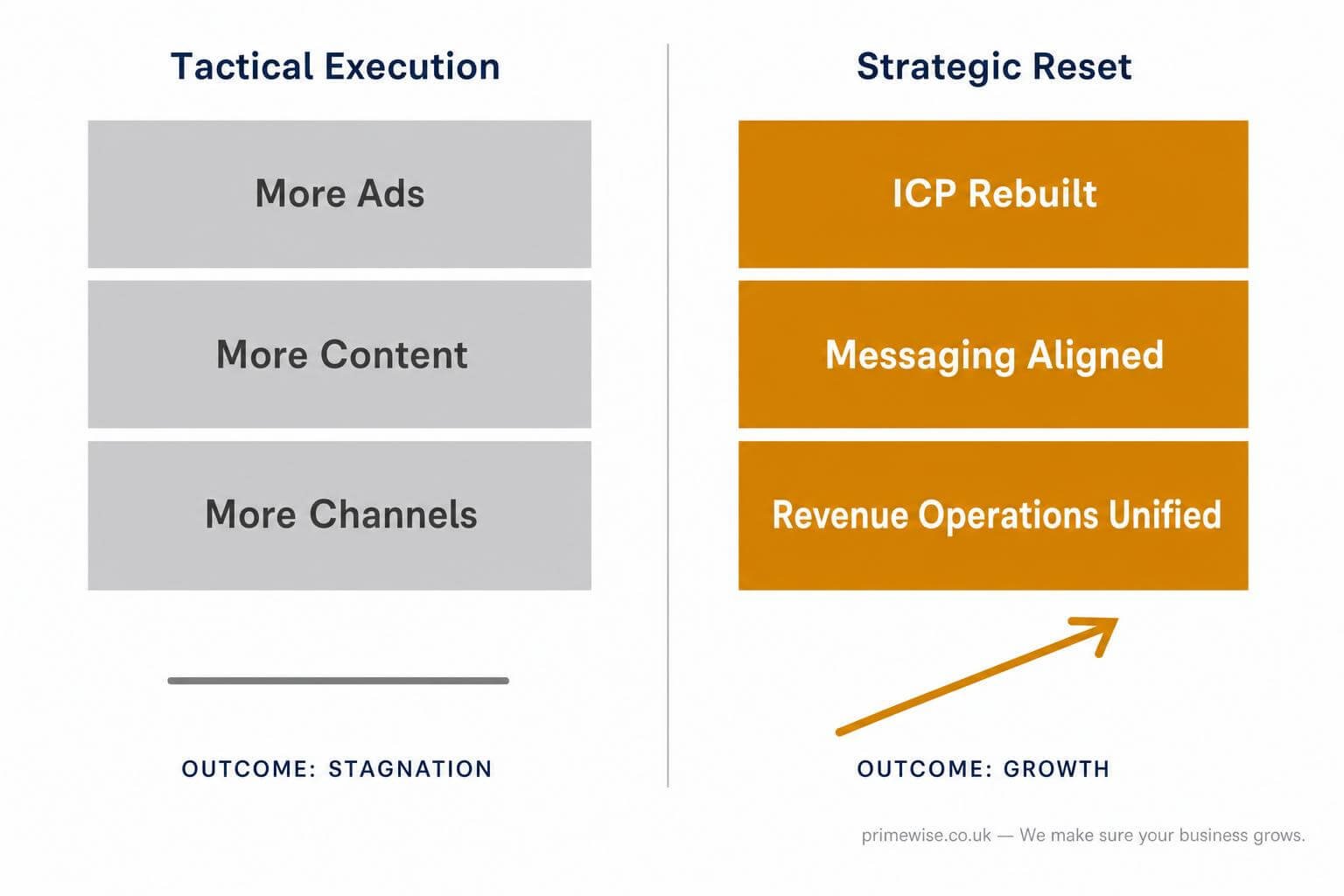
The UK Strategic Reset Protocol is the structured methodology a Fractional CMO applies when engaging a business stuck at a revenue plateau. It is not a new campaign plan. It is a forensic commercial intervention across four interdependent phases, each designed to eliminate waste, restore strategic clarity, and rebuild a growth engine capable of sustaining momentum beyond the £10M threshold.
Phase One: The Diagnostic Audit
Within the first 30 days, the Fractional CMO conducts an uncompromising audit of every active marketing programme, channel investment, and commercial assumption. No budget is sacred. No channel is assumed effective because it has always been used. The audit surfaces the precise financial cost of current misalignment often revealing that 30–50% of active marketing spend is producing zero qualified pipeline contribution. The immediate redirection of that spend frequently covers the cost of the engagement within the first billing cycle.
Phase Two: ICP Rebuild and Messaging Architecture
The rebuilt ideal customer profile is the foundation on which everything else is constructed. Using a combination of win-loss analysis, customer lifetime value modelling, and sales conversation data, the Fractional CMO defines the precise firmographic, psychographic, and behavioural profile of the customers most likely to convert, retain, and grow. Against this rebuilt ICP, a differentiated messaging architecture is developed one that articulates specific, defensible value in the language buyers actually use, not the language internal teams prefer.
Phase Three: Channel Strategy and Demand Generation Design
With a clear ICP and differentiated positioning in place, the demand generation mix is designed to reach, educate, and convert precisely that audience. This typically involves a deliberate reduction in the number of active channels concentrating investment in two or three high-performing platforms rather than distributing budget thinly across six combined with a content strategy built around buyer intent signals rather than keyword volume alone. B2B pipeline velocity, MQL-to-SQL conversion rates, and customer lifetime value become the governing metrics.
Phase Four: Revenue Operations Alignment
The final phase closes the gap between marketing-generated pipeline and sales execution. The Fractional CMO establishes clear service-level agreements between marketing and sales, defines the precise criteria for a marketing-qualified lead versus a sales-qualified lead, and implements a shared reporting framework that holds both functions accountable to the same revenue outcome. This alignment transforms internal friction into collaborative momentum often the most commercially significant outcome of the entire engagement.
The Economics of Fractional Leadership
For any board evaluating this model, the financial case is straightforward. A seasoned full-time CMO in London commands a base salary of £120,000–£180,000 per year, alongside employer National Insurance contributions of approximately 13.8%, performance bonuses, equity demands, and a notice period risk that makes strategic pivots costly and slow. The total employment cost of a senior CMO hire routinely exceeds £220,000 in year one. For a business generating £3M–£7M in annual revenue, that commitment is existentially significant.
A retained Fractional CMO engagement through PrimeWise provides the same executive strategic capability for a flexible monthly cost of £3,000–£8,000 scaled to the specific number of days required and the depth of the strategic reset needed. There is no equity dilution, no employer NI liability on the full salary, and no six-month notice period creating strategic paralysis when circumstances change. For UK mid-market businesses navigating a revenue plateau, this is not a compromise. It is a structurally superior model.
| Criteria | Full-Time CMO (London) | Fractional CMO (UK Retained) | Junior Marketing Manager |
|---|---|---|---|
| Typical Annual Cost | £150,000–£220,000+ | £36,000–£96,000 | £28,000–£45,000 |
| Onboarding Timeline | 3–6 months | 1–2 weeks | 1–3 months |
| Strategic Capability | High | High | Low |
| Equity Requirements | Often required | None | None |
| Notice Period Risk | 3–6 months | Typically 30 days | 1–3 months |
| Sector Experience Breadth | Variable | Cross-sector practitioner | Limited |
The comparison above illustrates why the fractional model has become the preferred route for UK scaling businesses post-2023. LinkedIn Workforce Insights UK data confirms a significant rise in interim and fractional executive appointments among businesses in the £2M–£15M revenue band, reflecting a structural shift in how growth-stage companies access senior commercial leadership without committing to the cost architecture of a permanent hire.
Case Study: Breaking a Three-Year Revenue Ceiling
A Leicester-based B2B professional services firm serving the legal technology sector had been generating approximately £4M in annual revenue for three consecutive financial years. Marketing activity was substantial paid search, LinkedIn campaigns, and a regular content programme but pipeline quality was poor and sales cycle length was increasing. MQL-to-SQL conversion had fallen to 12%, and cost-per-lead had risen to £340. The sales director and marketing manager were operating in a state of persistent low-grade conflict.
Following a PrimeWise Fractional CMO engagement, the firm paused 40% of active marketing channels within the first 30 days, redirecting that budget toward a rebuilt ICP-aligned content and ABM programme targeting mid-size legal technology vendors in the UK and Irish markets. Core messaging was rebuilt around a specific commercial outcome not the firm’s capabilities and the lead qualification criteria were redesigned in collaboration with the sales director. Within 11 weeks, cost-per-lead had reduced from £340 to £194. Within six months, MQL-to-SQL conversion had increased from 12% to 29%, and the firm exceeded its annual revenue target for the first time in four years. The plateau was not broken by doing more. It was broken by doing less, more precisely.
Strategic NoteThis outcome was not achieved by hiring a new agency, increasing the paid media budget, or producing more content. It was achieved by redirecting existing resources toward a rebuilt strategy the defining difference between tactical execution and executive-led commercial intervention.
How PrimeWise Delivers the Strategic Reset
PrimeWise works with UK mid-market businesses at exactly this commercial inflection point providing retained Fractional CMO oversight without the overhead of a full-time hire. The engagement model is designed for businesses generating between £2M and £20M in annual revenue that require executive-level strategic direction to break a growth plateau and build a scalable demand generation engine.
- Month one is dedicated entirely to the diagnostic audit, ICP rebuild, and elimination of wasted marketing spend with the immediate budget savings often covering the engagement cost within the first billing cycle.
- The Fractional CMO acts as the strategic lead across all marketing, aligning internal teams and external agencies to a single, measurable revenue framework.
- Engagements are structured on a flexible retained basis, typically two to four days per month, scaling up or down as the strategic reset progresses.
- PrimeWise clients receive a clear 90-day roadmap with defined milestones, pipeline recovery targets, and a reporting framework that connects marketing activity directly to revenue outcomes.
If your business has been generating consistent revenue activity without consistent revenue growth, the strategic foundation not the execution is where the problem lives. A PrimeWise Fractional CMO engagement begins with a 45-minute Revenue Plateau Diagnostic: a focused, no-obligation commercial conversation that identifies the precise growth killers in your current strategy and outlines the reset required to break through your ceiling. Book your Revenue Plateau Diagnostic at primewise.co.uk trusted by UK businesses scaling from £2M to £20M.