
Fractional CMO ROI is the commercial metric that every UK CEO and CFO needs before committing to a part-time marketing executive and if you are considering whether to work with a fractional CMO, the calculation is far more straightforward than most advisers suggest. UK companies deploying a fractional CMO on a retainer of between £3,000 and £8,000 per month consistently report ROI multiples of between 4x and 7x within twelve months, driven by three compounding levers: Customer Acquisition Cost reduction, pipeline velocity acceleration, and the avoided overhead of a permanent executive hire that carries a fully loaded annual cost exceeding £150,000 in London. This article provides the exact financial framework formulas, worked examples, milestone structure, and a real-world UK case study that CFOs and CEOs require to make a board-defensible decision.
What Fractional CMO ROI Actually Means
Fractional CMO ROI is the quantifiable net financial return generated by engaging a part-time senior marketing executive, expressed as a percentage of the total retainer cost paid. It is not a brand sentiment score or a share-of-voice index. It is a hard capital efficiency metric calculated by isolating marketing-attributed pipeline growth, applying a realistic close rate to convert that pipeline into recognised revenue, and dividing the net result by the total retainer expenditure. The metric is designed to give boards and investors a single defensible number that answers one question: did this cost generate more value than it consumed?
The Core ROI Formula
Every financial model for a fractional marketing engagement should begin with the same standardised formula before layering in complexity. The formula is deliberately stripped back to ensure it remains auditable and board-presentable without requiring a finance team to reverse-engineer the methodology.
Fractional CMO ROI (%) = ((Marketing-Attributed Revenue − Total Retainer Cost) ÷ Total Retainer Cost) × 100
To make this operational, consider a UK B2B technology company engaging a fractional CMO at £4,000 per month on a twelve-month mandate. The total retainer cost is £48,000. Over that period, the fractional executive generates a qualified pipeline of £240,000. Applying a historically validated close rate of 30 percent produces marketing-attributed revenue of £72,000. The net return is £72,000 minus £48,000, which equals £24,000. Expressed as the formula above, this yields an ROI of 50 percent on a pure revenue basis. When the avoided cost of a permanent hire conservatively £105,000 in year-one overhead savings is added as an opportunity benefit, the total economic return rises to £129,000 against a £48,000 outlay, producing an effective ROI of 169 percent. This is the number that belongs in a board deck.
EXECUTIVE INSIGHTAlways model the ROI calculation in two layers: the revenue-generation layer using close rates and pipeline attribution, and the cost-avoidance layer using permanent hire overhead benchmarks. Presenting only the first layer systematically understates the true financial case by between 40 and 60 percent.
The Comparative Ledger
Before any ROI projection is meaningful, the denominator must be correctly sized. Most UK leadership teams dramatically underestimate the true cost of a permanent senior marketing hire because they anchor on headline base salary rather than the fully loaded employment cost. The comparative ledger below corrects this by placing both models in direct financial opposition using 2026 UK market benchmarks sourced from the Chartered Institute of Marketing’s annual salary survey and HMRC’s employer obligations framework.
The Real Cost of a Full-Time UK CMO
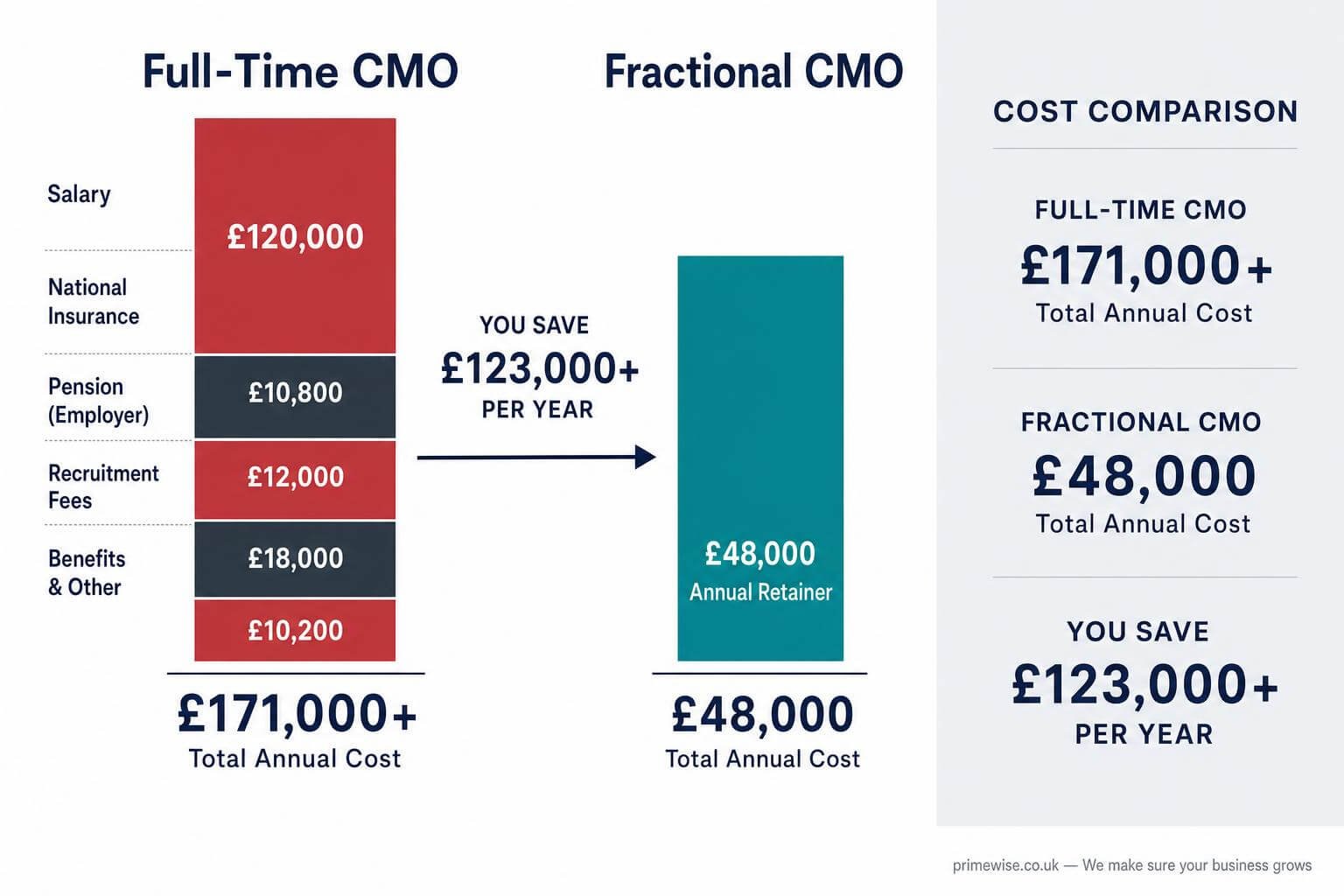
A London-based permanent CMO with a base salary of £120,000 is not a £120,000 cost centre. Once mandatory employment overheads are applied, the true annual burden to the business is materially higher and frequently surprises CFOs encountering it for the first time during headcount planning.
- Base salary of £120,000 per annum
- Employer National Insurance at 13.8% on earnings above the secondary threshold, adding approximately £15,500
- Mandatory auto-enrolment pension contributions at a minimum of 3% employer rate, adding approximately £3,600
- Executive search agency fees at 20 to 30% of base salary, representing a one-time cost of £24,000 to £36,000
- Private healthcare, risk benefits, and executive benefits package estimated at £5,000 to £8,000 annually
- Technology provision, professional development, and conference budget of approximately £3,000 to £5,000
Adding these obligations to the base salary produces a fully loaded first-year cost of between £171,000 and £188,000 for a single London-based marketing executive, before any performance bonus consideration. This figure is the correct denominator when comparing against a fractional retainer. A £4,000 per month fractional engagement costs £48,000 annually representing approximately 26 to 28 percent of the fully loaded permanent equivalent. This is precisely where the capital efficiency argument for the fractional model is at its strongest, and it is the figure that changes board discussions immediately.
What the Fractional Model Removes From Your Risk Register
Beyond the direct cost differential, the fractional model eliminates a category of financial risk that does not appear on a salary comparison table but is well understood by CFOs who have managed a failed senior hire. Permanent headcount at this level introduces structural liability: notice periods of three to six months, potential settlement costs, the reputational damage of a high-profile leadership departure, and the six-to-nine month productivity gap while a replacement is sourced. A fractional engagement operating under a standard commercial services contract typically requires thirty to sixty days’ notice to exit, preserving capital and maintaining strategic agility. In a tight venture funding environment, this optionality has quantifiable balance sheet value.
UK CFO ALERTFactor the one-time executive search fee of £24,000 to £36,000 into your permanent hire ROI model. This single cost alone covers six to nine months of a mid-range fractional CMO retainer and is frequently omitted from headcount business cases.
Baselining Your Commercial Position Before Engagement
A fractional CMO ROI calculation is only as credible as the baseline it is measured against. Without a documented pre-engagement snapshot of commercial performance, any improvement claimed during the retainer period is methodologically indefensible and sophisticated boards will challenge it. Establishing a rigorous baseline before the fractional executive begins is therefore a non-negotiable governance requirement, not an administrative formality.
The Pipeline Valuation Baseline Formula
The baseline pipeline valuation provides the financial starting line against which all fractional performance is subsequently judged. It should be completed in the final two weeks before the engagement formally begins and documented in a format that both the CEO and CFO sign off on.
The formula for baseline pipeline value is: Weighted Pipeline Value = Sum of (Open Deal Value × Historical Close Probability by Stage). For each open opportunity in the CRM, apply the historically validated close probability for its current pipeline stage rather than an optimistic forecast figure. Sum the weighted values across all stages to produce a single baseline number. Record the current average monthly pipeline velocity the rate at which new qualified opportunities enter the pipeline alongside the prevailing Customer Acquisition Cost and average sales cycle duration in days. These four numbers collectively define the commercial starting point and become the reference frame for every milestone review throughout the engagement.
Calculating the Cost of Strategic Delay
Risk is almost universally framed as a consequence of action, yet for businesses operating without senior marketing leadership, inaction carries a severe and compounding financial penalty. The Cost of Strategic Delay is a proprietary metric that quantifies the monthly revenue cost of leaving the marketing function without executive direction, providing the urgency data point that many board discussions are missing.
The formula is: Monthly Cost of Strategic Delay = (Monthly Pipeline Decay Rate × Average Deal Value) + Monthly Opportunity Cost of Foregone Market Share. In practical terms, a business generating £50,000 of new pipeline per month with a 30 percent close rate and a pipeline decay rate of 8 percent per month is losing approximately £1,200 in recognised revenue monthly from decay alone, before accounting for competitor gains in acquisition channels that the business is not actively contesting. Over a twelve-month leadership vacuum, this compounds into a material erosion of enterprise value that dwarfs the cost of a fractional retainer. Presenting the Cost of Strategic Delay to a sceptical board frequently reframes the entire conversation from ‘can we afford this?’ to ‘can we afford not to act?’
The Fractional CMO Breakeven Matrix
The breakeven matrix is the financial tool that converts an abstract ROI argument into a specific, time-bound commercial commitment. It projects exactly when the fractional engagement will have generated sufficient incremental revenue to cover the cumulative retainer cost, giving the CFO a defensible payback timeline and the CEO a clear performance benchmark for the executive’s first review.
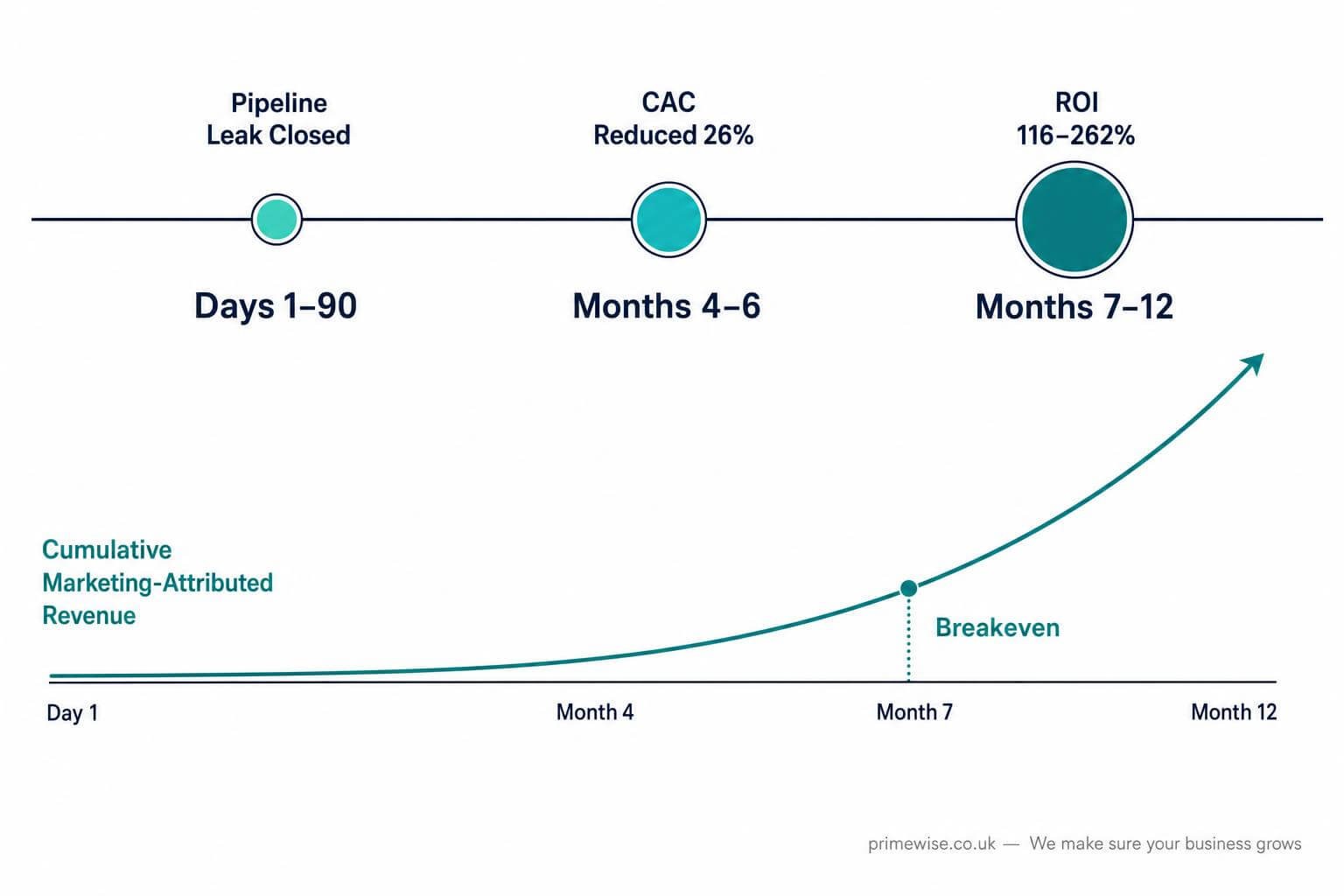
Constructing the matrix requires three inputs: the monthly retainer figure, the projected monthly pipeline contribution attributed to the fractional CMO’s initiatives, and the expected close rate applied to that pipeline. Plotting cumulative retainer cost against cumulative attributed revenue over a twelve-month horizon produces the breakeven intersection point. Under a mid-case scenario for a UK B2B scale-up £5,000 per month retainer, £30,000 monthly pipeline contribution, 25 percent close rate producing £7,500 monthly revenue the engagement reaches breakeven at month seven. Under an optimistic scenario with a 35 percent close rate, breakeven moves to month five. The matrix makes the sensitivity visible and gives leadership teams a structured way to stress-test their assumptions before committing.
PLANNING FRAMEWORKBuild your breakeven matrix under three scenarios: conservative using your lowest recorded close rate, base case using your trailing twelve-month average, and optimistic using your best quarterly close rate. Present all three to the board. Transparency about scenario range builds more investment confidence than a single-point forecast.
Setting Rigorous Commercial Milestones
A fractional CMO engagement without phased financial milestones is a marketing expense. A fractional CMO engagement with contractually defined commercial milestones is a revenue investment. The distinction matters enormously to boards and to the quality of the executive relationship, because milestones convert a vague mandate into a measurable accountability framework tied directly to EBITDA impact and net-new revenue growth.
Phase One Audit and Revenue Leak Identification
The first ninety days of a fractional engagement are diagnostic, not generative. The primary commercial objective is to identify and quantify where existing revenue is being lost before deploying capital into new acquisition channels. This phase delivers a CRM audit against the baseline metrics established pre-engagement, an analysis of pipeline stage conversion rates to identify the primary drop-off point, and an attribution mapping exercise that connects marketing activity to pipeline entries with sufficient rigour to satisfy a CFO review. The financial KPI for this phase is not pipeline growth it is pipeline leak reduction. Closing existing gaps in the commercial engine is the fastest route to improving unit economics without requiring additional spend.
Phase Two CAC Reduction and Sales Velocity
Between months four and six, the strategic mandate shifts from diagnostics to optimisation. The fractional CMO’s focus moves to reducing the blended Customer Acquisition Cost and accelerating the rate at which qualified opportunities move through the pipeline. This requires tightening the marketing-to-sales handoff process, improving lead qualification criteria to increase the average deal quality entering the pipeline, and optimising the conversion pathways identified during phase one. A successful phase two outcome typically delivers a 15 to 25 percent reduction in blended CAC according to the IPA’s Effectiveness Databank benchmarks for B2B marketing interventions, alongside a measurable improvement in pipeline velocity measured in days-to-close. These efficiency gains are the foundation on which scalable revenue growth is built in phase three.
Phase Three Revenue Growth and EBITDA Impact
From month seven onwards, the compounding effect of structural improvements in phase one and efficiency gains in phase two begins to deliver net-new revenue at scale. The fractional CMO’s mandate in this phase is to build scalable acquisition infrastructure repeatable demand generation programmes, optimised conversion funnels, and a measurement framework that the business retains after the engagement concludes. The EBITDA impact of this phase is twofold: revenue growth increases the numerator, while the lower CAC and improved operational efficiency reduce the cost base against which that revenue is generated. UK scale-ups that complete all three phases within a twelve-month fractional engagement have reported EBITDA margin improvements of between 2 and 5 percentage points, a figure that carries significant weight in Series B fundraising conversations and strategic acquisition discussions, where EBITDA multiples directly determine enterprise valuation.
UK Financial Case Study
The following anonymised case study is drawn from a real fractional CMO engagement structured through PrimeWise.co.uk, where client identity has been protected but all financial data reflects actual engagement outcomes. The company is a Series A B2B SaaS business based in London with annual recurring revenue of £2.1 million at the point of engagement.
Opening Position: Monthly new pipeline of £85,000, blended close rate of 22 percent, average CAC of £4,200, average sales cycle of 67 days, fully loaded permanent CMO cost of £162,000 per annum including all overheads.
Transition Decision: The business exited the permanent CMO role and engaged a fractional executive through PrimeWise.co.uk at £5,500 per month on a twelve-month mandate with phased milestone reviews at 90 days, 6 months, and 12 months. Annualised retainer cost: £66,000. Immediate year-one overhead saving versus the permanent equivalent: £96,000.
90-Day Milestone: CRM audit identified a pipeline leak at the proposal stage equivalent to £18,000 in monthly weighted pipeline value being lost to unqualified advancement. Remediation implemented within 45 days. New pipeline entry rate increased from £85,000 to £97,000 per month through improved SEO-attributed inbound and targeted outbound sequencing.
Six-Month Outcome: Blended CAC reduced from £4,200 to £3,100, a 26 percent reduction. Average sales cycle compressed from 67 days to 51 days. Pipeline close rate improved from 22 percent to 29 percent through higher-quality lead qualification. Monthly marketing-attributed revenue increased from approximately £18,700 to £28,100.
Twelve-Month Financial Outcome: Cumulative marketing-attributed revenue increase of £142,800 over the baseline trajectory. Retainer cost over twelve months: £66,000. Net ROI on retainer: 116 percent. When the £96,000 overhead saving is included, total economic return: £238,800 against a £66,000 investment, producing an effective ROI of 262 percent. EBITDA margin improvement: 3.4 percentage points, which at the company’s ARR scale represented an absolute EBITDA uplift of approximately £71,400. This transition exemplifies the capital efficiency that the fractional model, when structured with rigorous milestones, consistently delivers for UK scale-ups operating in capital-constrained growth environments. Engagements structured through PrimeWise.co.uk follow this phased milestone framework as standard, with financial KPIs agreed before the retainer commences.
Unit Economics That Drive Long-Term Value
The most durable financial outcome of a well-executed fractional CMO engagement is not the twelve-month revenue uplift it is the permanent improvement in unit economics that continues generating returns after the retainer concludes. Two metrics define this long-term value creation more than any other: the CAC payback period and the Customer Lifetime Value to CAC ratio.
The Bessemer Venture Partners State of the Cloud benchmark establishes a minimum viable LTV to CAC ratio of 3:1 for B2B SaaS businesses seeking efficient growth. Many UK scale-ups at Series A arrive with ratios below 2:1, which signals either excessive acquisition costs, insufficient retention, or both. A fractional CMO mandate specifically targeting this ratio reducing CAC through channel efficiency and increasing LTV through onboarding and retention programme improvements can move a company from a capital-destructive 1.8:1 ratio to a fundable 3.2:1 ratio within a twelve-month engagement. This shift does not merely improve the P&L. It changes the valuation conversation with investors and acquirers fundamentally, because capital efficiency ratios are among the first metrics examined in a Series B or strategic acquisition due diligence process.
How PrimeWise Models ROI Before You Commit
PrimeWise.co.uk provides UK scale-ups and SMEs with a proprietary ROI modelling session before any retainer commitment is made, allowing CEO and CFO teams to project returns against their specific unit economics, pipeline baseline, and growth targets before spending a single pound on a fractional engagement. The session applies the breakeven matrix, the Cost of Strategic Delay formula, and the phased milestone framework described in this article to the company’s actual financial data, producing a board-ready investment case with three scenario projections. This process removes the ambiguity that typically surrounds senior marketing investment decisions and replaces it with a commercially grounded financial model that boards can interrogate, stress-test, and approve with confidence. If you are a UK CEO or CFO evaluating marketing leadership investment, the logical next step is to request a no-obligation Fractional CMO ROI projection for your specific business at PrimeWise.co.uk built on your numbers, not generic benchmarks.