
AI integration for small businesses turning over under £5 million is no longer a speculative luxury reserved for enterprise boardrooms. UK businesses at this revenue tier collectively lose billions annually to manual administrative processes that targeted automation can resolve for under £5,000 per deployment, yet fewer than 12 percent have made their first integration move. The barrier is rarely technical. It is strategic paralysis: an inability to separate genuine commercial utility from the noise of enterprise-grade AI marketing. This guide is written specifically for founders, CFOs, and operations directors who need a financially disciplined, MVP-first roadmap that pays back within 90 days and does not jeopardise cash flow.
Executive Summary
Enterprise-grade AI investments carry unnecessary capital risk for sub-£5M operations. The only commercially viable path is an isolated, use-case-first integration philosophy that targets administrative bottlenecks, delivers measurable ROI within 90 days, and strictly caps initial project spend under £5,000.
- SMEs that deploy targeted administrative automation report measurable reductions in operational bottlenecks within 60 days, according to adoption benchmarks across UK professional services sectors.
- Initial integrations must cap costs under £5,000 to ensure rapid 60-to-90-day payback periods and avoid board-level capital restructuring.
- UK GDPR compliance and seamless integration with Xero, Sage, and Open Banking APIs are non-negotiable requirements for lawful, secure deployment.
- Current UK funding routes, including Innovate UK Smart Grants and HMRC R&D tax relief, can substantially offset first-deployment costs.
WHO THIS GUIDE IS FORThis playbook is designed for UK business owners and senior leaders at companies turning over between £500K and £5M. If you are evaluating your first AI deployment and need a financially grounded, risk-managed entry point, every section below is written directly for your situation.
What AI Integration Actually Means at This Revenue Tier
Understanding the precise scope of artificial intelligence within a smaller commercial environment is critical to avoiding scope creep and technological bloat. Many independent businesses conflate AI with expensive bespoke development projects or assume they need a dedicated data science team before beginning. Neither is true at sub-£5M scale.
AI integration for small businesses means embedding cost-effective, off-the-shelf or lightly customised automation into daily operations to resolve specific, high-friction administrative bottlenecks. For sub-£5M UK SMEs, this means prioritising MVP projects between £2,000 and £5,000 such as automated credit control or intelligent client inquiry routing that deliver a measurable, attributable return within 90 days.
This definition deliberately excludes generative novelties with no operational anchor. Treating AI as a procurement decision rather than a transformation initiative is what separates the 27 percent of UK SMEs that achieve lasting adoption from the majority who stall after pilot. Every tool, integration, or subscription evaluated through this lens must answer a single question: which specific task is it replacing, and what is the hourly cost of that task today?
The Sub-£5M AI MVP Matrix
The MVP Matrix is a decision framework designed to filter genuine commercial utility from technology hype before a single pound of budget is committed. It operates on two axes: the administrative cost of the current manual process, and the implementation risk of the proposed automation. Only integrations that score high on cost elimination and low on implementation complexity qualify for Phase 1 deployment.
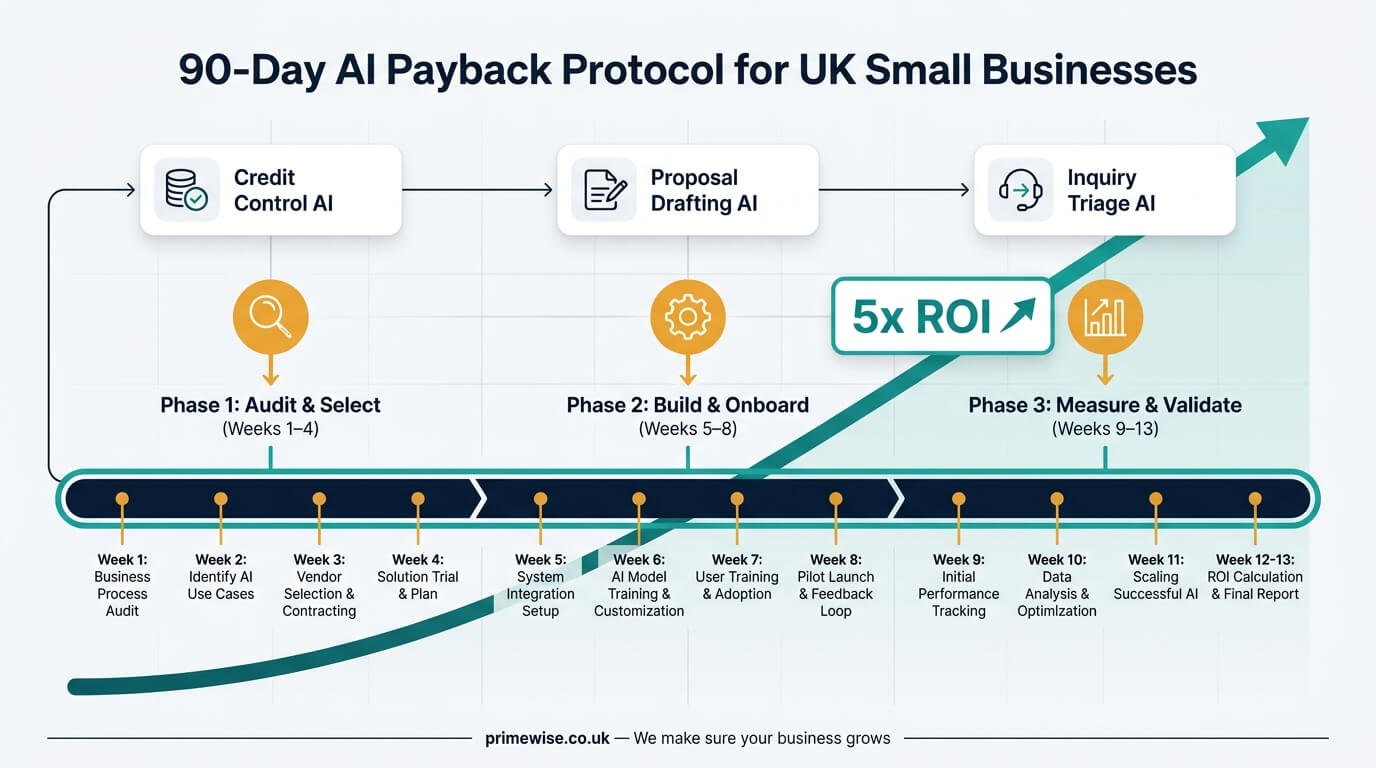
The 90-Day AI Payback Protocol
ROI timelines for sub-£5M businesses must be aggressively managed. The 90-Day AI Payback Protocol dictates that any initial integration must generate enough measurable operational efficiency or hard revenue to cover its full implementation cost within three months. This framework forces decision makers to reject sprawling digital transformation projects in favour of singular, highly targeted process improvements with a clear financial baseline established before go-live. If a proposed integration cannot articulate a specific cost saving or revenue protection mechanism within 90 days, it does not proceed to build.
Capping Initial Builds Under £5,000
Setting definitive cost boundaries protects cash flow and enforces strategic clarity. By firmly capping initial AI builds at £5,000, SMEs mitigate the risk of severe capital loss while establishing a realistic testing environment. This budget parameter accommodates robust API connections, targeted automation software subscriptions, data processing agreement legal reviews, and essential staff onboarding without demanding external debt financing. It also creates a repeatable proof-of-concept model: once one integration delivers its payback, the recovered operational cost funds the next deployment from within the P&L rather than from reserves.
FINANCIAL DISCIPLINE RULENever approve an AI integration without first documenting the current manual cost in hours per week multiplied by the fully-loaded hourly rate of the staff performing it. If that annual cost does not exceed the implementation fee by a factor of three, deprioritise the project.
The Four Fastest-Payback AI Use Cases for UK SMEs
Selecting the correct initial project determines the long-term cultural and commercial success of AI adoption across the workforce. The most effective Phase 1 deployments target high-friction, low-value administrative tasks that consistently drain senior staff bandwidth and carry a quantifiable hourly cost.
Automated Credit Control and Accounts Receivable
Late payment remains one of the most acute threats to UK SME financial continuity. The Federation of Small Businesses consistently reports that late payment costs UK small businesses billions in cash flow disruption annually. AI-driven credit control platforms such as Chaser and Fluidly integrate natively with Xero and Sage to automate staggered payment reminder sequences, predict default risk based on historical ledger behaviour, and dynamically adjust outreach tone based on client payment history. Chaser, for example, allows businesses to create personalised, automated AR workflows that escalate intelligently from friendly reminders to formal notices without human intervention, directly reducing Days Sales Outstanding and strengthening the balance sheet without hiring a dedicated credit controller.
Frontline Client Inquiry Triage and CRM Enrichment
Human capital costs in the UK, particularly in London and the South East, make it commercially unsustainable to use senior or even mid-level staff for basic administrative sorting of inbound inquiries. Natural language processing tools integrated as a triage layer connecting inbound email or web form submissions to a CRM such as HubSpot can automatically categorise inquiry type, enrich contact records with publicly available business data, assign urgency scores, and route the conversation to the appropriate fee earner. This intelligent routing improves first-response times, protects staff utilisation rates, and eliminates the manual administrative overhead that accumulates invisibly across a working week. For professional services firms billing by the hour, this is one of the highest-leverage first integrations available.
AI-Assisted Proposal and Document Drafting
Drafting standard commercial proposals, scope of work documents, or operational compliance templates consumes significant billable time across most sub-£5M professional services businesses. Deploying a generative AI model trained strictly on internal company templates using platforms such as Jasper or a privately hosted GPT-4 instance via the OpenAI API allows teams to produce structured first drafts in minutes rather than hours. The critical security requirement here is isolation: the model must operate on company data only, under a zero-data-retention agreement, ensuring that proprietary pricing structures, commercial methodologies, and client-specific terms never enter a public training dataset. When configured correctly, this use case alone can recover between three and six billable hours per week across a team of five.
Meeting Intelligence and Action Tracking
Platforms such as Otter.ai and Fireflies.ai automatically transcribe, summarise, and extract action items from client and internal meetings, integrating directly with calendar tools and CRM systems to log follow-ups without manual data entry. For account management-heavy businesses, this eliminates one of the most consistently underestimated administrative drains: the post-meeting write-up. At an average of 30 to 45 minutes per meeting across a team holding eight meetings per week, the recovered time is substantial and immediately quantifiable.
Comparing the Leading AI Tools for UK SMEs
The tools market for SME-grade AI automation has matured significantly. The following comparison covers the platforms most relevant to sub-£5M UK businesses, selected for their GDPR compliance posture, native UK accounting integrations, and realistic payback profiles at this revenue scale.
| Tool | Primary Use Case | Approx UK Monthly Cost | Xero or Sage Integration | GDPR Compliant | Typical Payback Period |
|---|---|---|---|---|---|
| Chaser | AI credit control and AR automation | £45 to £199 | Native Xero and Sage | Yes UK data hosted | 30 to 45 days |
| Fluidly | Cash flow forecasting and AR | £49 to £149 | Native Xero and QuickBooks | Yes | 45 to 60 days |
| Dext Precision | Bookkeeping data quality and automation | £30 to £75 | Native Xero and Sage | Yes ICO registered | 30 to 60 days |
| Fireflies.ai | Meeting transcription and CRM logging | £8 to £19 per user | Via Zapier or HubSpot | Yes EU/UK servers available | 30 days |
| Jasper | AI proposal and content drafting | £29 to £59 | Via workflow tools | Yes SOC 2 certified | 45 to 90 days |
| Make (formerly Integromat) | Multi-app workflow automation | £9 to £29 | Via API connectors | Yes GDPR-ready | 30 to 60 days |
Each of these platforms offers a free trial or freemium entry point, which aligns with the MVP testing principle. The recommendation is to pilot one tool against a clearly defined administrative task for 30 days before committing to an annual subscription. Avoid the temptation to stack multiple tools simultaneously. In the first phase the primary objective is a single validated proof of concept with a measurable ROI baseline, not a transformed tech stack.
UK GDPR and ICO Compliance for AI Deployments
Deploying artificial intelligence introduces distinct legal obligations under the UK GDPR and the Data Protection Act 2018. The Information Commissioner’s Office has issued increasingly specific guidance on automated decision-making, and any sub-£5M business processing personal data through a third-party large language model must address three non-negotiable requirements before going live.
First, a Data Processing Agreement must be signed with every AI vendor that touches personal data. This agreement must explicitly prohibit the vendor from using your client or employee data to train public models, a clause that some consumer-grade AI tools do not include by default. Second, if your AI integration makes or influences a decision with a legal or similarly significant effect on a data subject, Article 22 of the UK GDPR mandates that a human review mechanism must remain in place. Third, your Privacy Policy must be updated to describe the automated processing activity with sufficient transparency to satisfy ICO standards. Failure on any of these three points does not merely represent a compliance risk; it creates a material liability that could result in regulatory investigation under ICO enforcement action, which has accelerated significantly since 2024.
COMPLIANCE PRIORITYBefore connecting any AI tool to a dataset containing client names, email addresses, financial records, or any other personally identifiable information, ensure a signed Data Processing Agreement is in place and that your Privacy Policy reflects the new processing activity. This is not optional, it is a legal obligation under UK GDPR Article 28.
The Week-by-Week 90-Day Implementation Timeline
The 90-Day AI Payback Protocol only delivers results when paired with a structured operational timeline. The following week-by-week breakdown converts the strategic framework into a genuinely executable plan for a business owner or operations lead managing implementation alongside a full workload.
- Weeks 1 to 2 Process Audit: Map every recurring administrative task consuming more than two hours per week across the team. Assign a fully-loaded hourly cost to each. Rank by cost-elimination potential and implementation simplicity. Select one use case to proceed.
- Weeks 3 to 4 Vendor Selection and Legal Review: Shortlist two to three tools against the selected use case. Review Data Processing Agreements with a GDPR-aware legal advisor. Confirm UK data residency or adequacy requirements are satisfied. Select vendor and initiate free trial or pilot agreement.
- Weeks 5 to 8 MVP Build and Staff Onboarding: Configure the tool against live business data within a sandboxed environment. Conduct a two-hour staff onboarding session covering the tool’s function, limitations, and escalation protocol. Establish a performance baseline by recording the manual process output for the same period.
- Weeks 9 to 10 Performance Measurement: Compare automated output against the manual baseline. Track time saved, error rates, and any revenue or cash flow impact directly attributable to the integration. Document findings in a simple one-page ROI summary.
- Weeks 11 to 13 ROI Validation and Scale Decision: If the integration has returned its implementation cost in demonstrable savings or revenue protection, the proof of concept is validated. Present the ROI summary to the board or decision-making team and initiate planning for the Phase 2 use case. If ROI is below target, diagnose the shortfall before scaling.
This timeline is deliberately conservative. Running a 90-day pilot before committing to enterprise-wide deployment protects the business from the operational disruption that derails most SME technology adoption projects. It also creates an internal case study a documented proof of commercial impact that builds organisational confidence and secures leadership buy-in for future phases.
AI Readiness Self-Assessment for Sub-£5M Businesses
Before committing to any vendor conversation, completing an honest internal audit significantly increases the probability of a successful first deployment. The following diagnostic covers the five operational dimensions that most directly determine AI integration readiness at this revenue scale.
- Software Stack Compatibility: Are your core operational platforms accounting, CRM, project management cloud-based with accessible APIs? On-premise legacy systems require additional integration architecture that can push costs above the £5,000 cap.
- Administrative Overhead Volume: Does your team collectively spend more than 15 hours per week on repetitive manual tasks such as data entry, report generation, or client follow-up? If yes, the ROI case for automation is commercially robust.
- GDPR Compliance Maturity: Do you have a current Data Protection Register, a signed DPA with your existing software vendors, and an up-to-date Privacy Policy? If not, this must be addressed before any AI deployment begins.
- Cash Flow Cycle Stability: Is your DSO above 45 days? If yes, AI-driven credit control is almost certainly your highest-return first integration and should be prioritised above all other use cases.
- IT Budget Headroom: Can the business allocate between £2,000 and £5,000 to a technology investment without impacting operational reserves? If this requires board approval or creates cash flow tension, explore the UK funding routes outlined in the section below before proceeding.
Businesses that score positively across all five dimensions are in an optimal position to proceed immediately with vendor selection. Businesses with gaps in one or two areas, particularly GDPR maturity or legacy software, should address those specific constraints first. A structured AI readiness review, such as the SME AI Readiness diagnostic offered through primewise.co.uk, can identify these gaps precisely and sequence resolutions to avoid implementation delays.
Case Study 5x ROI in UK Professional Services
A UK-based management consulting firm operating in the North West of England, with an annual turnover of £2.1 million and a team of eleven, identified proposal generation as its single largest administrative bottleneck. Senior consultants were spending an average of four hours producing each commercial proposal from scratch, drawing on a fragmented library of templates held across shared drives. With a total implementation cost of £2,800 covering OpenAI API configuration, template standardisation, staff training, and a DPA legal review, the firm deployed a privately hosted AI drafting assistant trained exclusively on their internal methodology documents and proposal library.
Within the first financial quarter, the integration reduced average proposal production time from four hours to 45 minutes. Across a team generating approximately 22 proposals per month, this recovered over 70 senior consulting hours per month. At a fully-loaded internal cost of £200 per hour, the integration returned over £14,000 in recovered billable capacity within 90 days, a fivefold return on the £2,800 implementation investment. Critically, this was achieved without replacing a single member of staff. The recovered hours were redeployed to client delivery work, directly expanding gross margin. The methodology used in this deployment mirrors the structured framework applied by primewise.co.uk advisors when working with professional services clients at this revenue scale.
KEY INSIGHTThe highest-ROI AI integrations at sub-£5M scale do not eliminate staff they eliminate the low-value administrative tasks that prevent those staff from doing the work that actually generates revenue. Framing AI to your team as a capacity tool, not a replacement threat, is essential for adoption and retention.
UK Funding and Tax Relief for AI Integration Costs
Offsetting the initial investment in AI automation is highly achievable through targeted government and HMRC support. Note that the Help to Grow: Digital scheme closed in February 2023 and should not be cited as a current option. The following routes are active and accessible to qualifying sub-£5M UK businesses in 2025 and 2026.
- Innovate UK Smart Grants: Innovate UK runs quarterly open calls for businesses developing or adopting innovative technology, with grants typically ranging from £25,000 to £500,000. Eligibility is competitive but sub-£5M businesses with a clear commercial AI deployment rationale have a strong application case. Applications are submitted via the Innovate UK portal and assessed against innovation merit and economic impact criteria.
- Made Smarter Adoption Programme: Targeted specifically at manufacturing and engineering SMEs in England, the Made Smarter programme provides co-funded technology adoption grants of up to £20,000, alongside free expert advisory support. Businesses qualifying as manufacturing SMEs with fewer than 250 employees and under £50M turnover are eligible to apply through regional Made Smarter hubs.
- UK Shared Prosperity Fund Growth Hubs: Local Enterprise Partnerships and Growth Hubs funded through the UK Shared Prosperity Fund offer business support vouchers and subsidised advisory services for digital transformation, including AI readiness assessments. Availability and value vary by region, but most Growth Hubs operate a free diagnostic session as an entry point.
- HMRC R&D Tax Relief Merged Scheme: Effective from April 2024, HMRC consolidated the SME R&D relief and RDEC schemes into a single merged scheme. Qualifying AI development costs, including staff time spent on designing, testing, and integrating novel AI solutions, may qualify for a 20 percent R&D expenditure credit. Sub-£5M businesses should assess qualifying expenditure with an R&D-specialist accountant before year-end.
Engaging with even one of these funding routes can materially reduce the net cost of a first AI deployment, in some cases to zero. The Made Smarter programme in particular, has a strong record of approving co-funding applications from SMEs deploying AI for the first time, provided the application clearly articulates the operational problem being solved and the productivity impact being targeted.