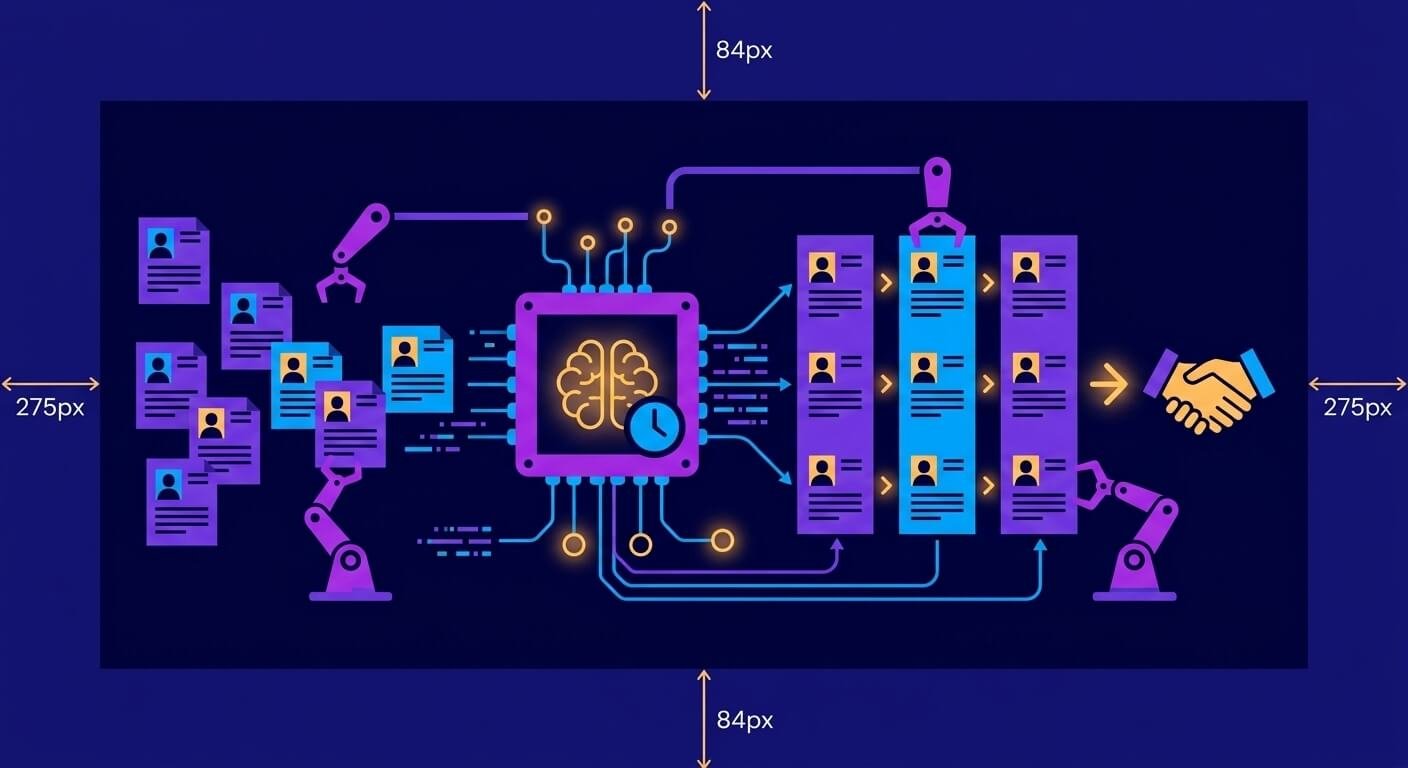

AI integration pricing in the UK has reached a pivotal maturity point in 2026, where the cost of embedding artificial intelligence into your business operations is no longer speculative it is quantifiable. This guide delivers precise, Sterling-denominated benchmarks for every project scope, from isolated single-workflow automations starting at £15,000 to full enterprise transformation programmes exceeding £750,000. Whether you are a CIO building a board-level business case or a CFO stress-testing a capital expenditure forecast, the figures and frameworks below are structured to eliminate vendor opacity and give your organisation a defensible financial baseline.
2026 Executive SummaryUK AI integration costs range from £15,000 (single workflow) to £750,000+ (enterprise transformation). The average mid-market departmental rollout sits at £50,000 to £150,000. Critically, ongoing operational costs licensing, token consumption, and retainers account for approximately 60% of total lifecycle expenditure. Ignoring this split is the single most common cause of AI project budget failure.
What AI Integration Actually Means in 2026
AI integration is the structured process of embedding artificial intelligence capabilities including machine learning models, large language models, predictive algorithms, and agentic workflow automation into existing corporate systems and processes. It is not the purchase of a software licence. It is an architectural and operational transformation that touches data infrastructure, security protocols, compliance frameworks, and human workflows simultaneously.
In the UK market, the 2026 average cost for enterprise AI integration sits at approximately £285,000, while single-workflow deployments begin at £15,000. These figures, consistent with data from KPMG UK technology investment benchmarking and the UK Government’s Department for Science, Innovation and Technology AI adoption surveys, reflect a market that has professionalised rapidly. The gap between those two figures is not arbitrary it is driven entirely by project scope, legacy infrastructure complexity, and the regulatory burden specific to each sector.
The UK AI Consultant and Agency Rate Card
Consultant and agency day rates are the primary cost driver in any AI integration project. Unlike general IT implementation, deploying machine learning models and custom LLMs requires a rare combination of data science expertise, systems architecture knowledge, and commercial acumen. The 2026 UK tech talent market is characterised by a structural shortage of qualified machine learning engineers, which applies direct upward pressure on specialist day rates relative to traditional software development.
Understanding the Three Consultant Tiers
The UK AI consultancy market stratifies into three clearly defined tiers. Aligning your project complexity with the correct tier is the most efficient lever available to procurement directors seeking to optimise capital expenditure without compromising on technical delivery quality.
- Junior implementers and automation technicians: £450 to £700 per day, suited to templated integrations with well-defined scopes and minimal legacy complexity.
- Senior AI strategists and machine learning engineers: £900 to £1,400 per day, appropriate for bespoke model deployment, API architecture, and departmental rollouts requiring original engineering.
- Partners and directors at top-tier consultancies: £1,800 to £3,000 per day, reserved for enterprise transformation leadership, LLM fine-tuning oversight, and board-level AI governance advisory.
The London Premium and the Regional Opportunity
Geography continues to exert a measurable and often underestimated influence on total project cost. London-based top-tier consultancies consistently apply a 15 to 25 percent rate premium over their regional counterparts, reflecting higher operational overheads and brand positioning rather than a commensurate difference in technical capability.
High-growth regional technology hubs including Manchester, Leeds, Edinburgh, and Bristol now house engineering teams of equivalent technical calibre delivering AI integration services at meaningfully lower day rates. For procurement directors managing fixed budgets, regional vendor shortlisting is not a compromise; it is a commercially rational strategy that can redirect tens of thousands of pounds from agency margin into model development and testing.
Fixed Fee Benchmarks by Project Tier
Establishing project cost boundaries before entering vendor negotiations requires a clear understanding of what each tier of AI integration actually involves. The following benchmarks reflect 2026 UK market rates and should be used as a validated reference framework during internal budget approval processes.
Tier 1 Single Workflow Automation
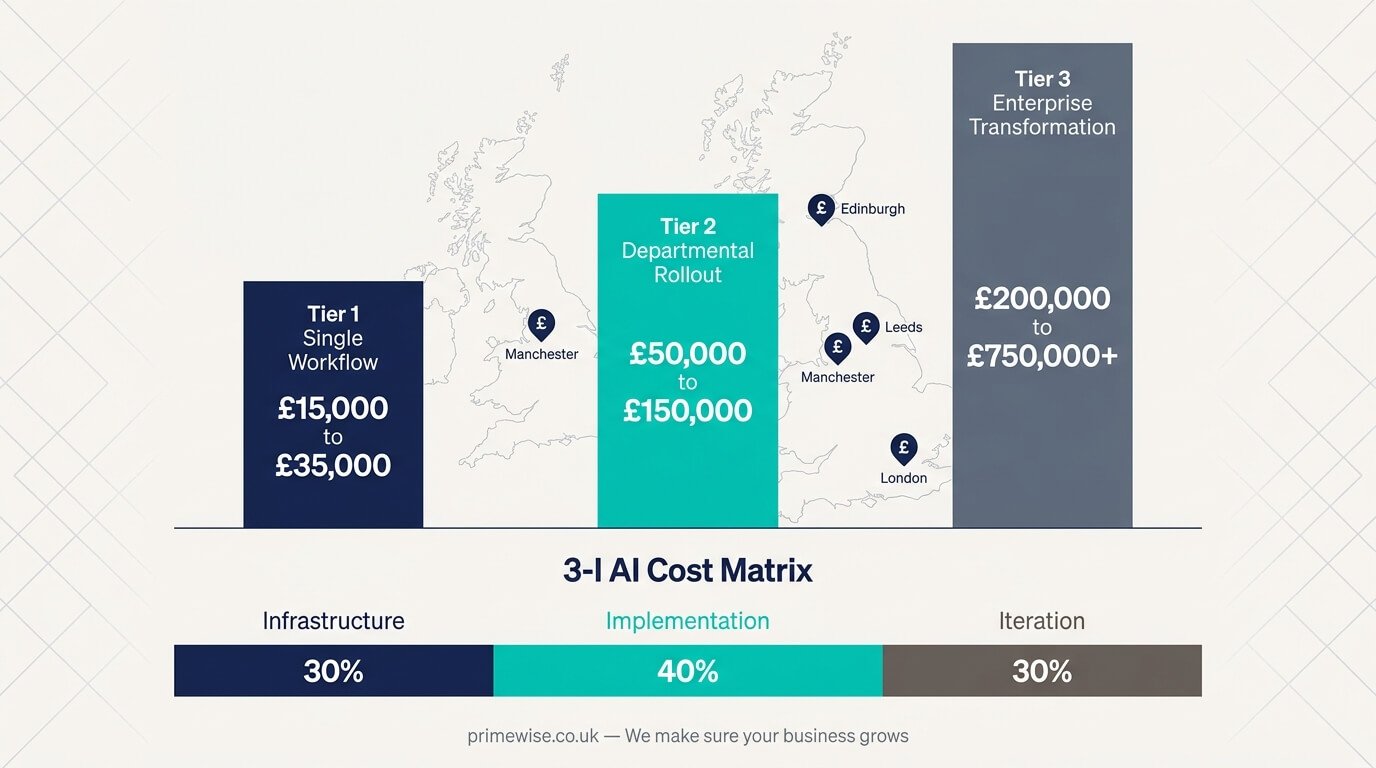
Entry-level AI integration targets an isolated, well-defined business process. These projects are typically delivered within a ring-fenced scope, producing a single functional output such as a customer service chatbot, an automated invoice processing pipeline, or a natural language reporting tool for a finance team. Fixed-fee ranges for this tier sit between £15,000 and £35,000.
The lower end of this range assumes clean, accessible data and a modern API-compatible technology stack. The upper end reflects additional data formatting work, custom UI requirements, or integration with legacy CRM and ERP systems. Post-launch, organisations should budget for lightweight support retainers of £1,500 to £3,500 per month to maintain output accuracy and manage incremental model updates.
Tier 2 Departmental Rollout
Mid-tier AI integration transforms the operational workflows of an entire business unit typically within human resources, marketing, legal operations, or finance. These projects introduce AI-driven decision support, automated document processing, or predictive analytics across a team of ten to one hundred users. Budget benchmarks for this tier range from £50,000 to £150,000.
A substantial portion of this budget often 25 to 35 percent is consumed not by model development but by the prerequisite work of restructuring and cleansing the data the AI will operate on. Financial controllers must also allocate budget for middle-management change management programmes and workflow orchestration design, both of which are frequently underestimated in initial vendor proposals. A real-world reference point: a mid-sized UK legal firm deploying NLP-powered contract review across its litigation department in 2025 invested £40,000, with £14,000 of that budget allocated exclusively to historical document digitisation and data normalisation before a single model was trained.
Tier 3 Enterprise Transformation
Large-scale enterprise AI integration represents a fundamental organisational restructuring rather than a discrete technology project. Budgets for this tier scale from £200,000 to well over £750,000 and encompass bespoke open-source model fine-tuning, rigorous multi-layer security testing, legacy infrastructure remediation, and AI governance framework implementation aligned with the UK Government’s pro-innovation AI regulatory approach.
A useful sector benchmark: a UK multinational bank undertaking enterprise-wide AI integration in 2025 committed a £400,000 budget, of which 30 percent approximately £120,000 was dedicated exclusively to data hygiene, cloud infrastructure migration, and compliance architecture before any predictive algorithm was deployed. This figure aligns with Gartner’s UK enterprise AI data readiness research, which consistently identifies data preparation as the single largest hidden cost category in complex deployments. ROI forecasting must be completed with rigour before deployment begins, as the payback period for enterprise transformation typically ranges from 18 to 36 months.
Platform Cost ConsiderationWhether your organisation deploys Microsoft Copilot licensing, Salesforce Einstein, Google Vertex AI, or a fully custom-built solution materially affects your total budget. Off-the-shelf platforms reduce initial build cost but introduce per-seat licensing and token consumption overhead. Custom builds carry higher upfront investment but provide greater long-term cost control and competitive differentiation. Primewise advisors can model both scenarios against your specific technology stack.
The 3-I AI Cost Matrix
The most effective framework for capturing total cost of ownership across an AI integration project is the 3-I AI Cost Matrix: Infrastructure, Implementation, and Iteration. This proprietary model provides financial controllers and procurement directors with a structured methodology to forecast every cost category across the full project lifecycle, not just the initial build phase.
Infrastructure Data Readiness and Legacy Remediation
Infrastructure costs cover every investment required to make your data and technical environment AI-ready. This includes cloud infrastructure upgrades, API connectivity architecture, data lake construction or migration, and the remediation of legacy systems that cannot natively interface with modern machine learning pipelines. For enterprise projects, this pillar frequently consumes 25 to 35 percent of total budget and is the category most consistently absent from early vendor proposals.
Data hygiene is non-negotiable. AI models trained on incomplete, inconsistent, or poorly structured data produce unreliable outputs that erode organisational confidence in the technology and extend the time to value. Investing in data readiness before model selection is not a preparatory formality it is the most commercially decisive step in the entire integration process.
Implementation Build, Licensing, and Compliance
Implementation costs encompass the direct hard costs of the build phase: developer and consultant time at the day rates outlined above, software licensing for platform-specific tools such as Microsoft Azure OpenAI Service or Google Vertex AI, API integration fees, and enterprise-grade security deployment. In 2026, UK organisations must also factor in dedicated compliance costs associated with UK GDPR, data sovereignty legislation, and emerging AI governance requirements, particularly in regulated sectors such as financial services and healthcare where FCA or NHS Digital framework procurement constraints apply additional overhead.
Implementation typically represents approximately 40 percent of total lifecycle cost. This is the figure most prominently cited in vendor proposals and, without visibility of the full 3-I matrix, the one most likely to mislead budget holders into underestimating total financial commitment.
Iteration Ongoing Operations and Model Maintenance
The Iteration pillar captures the perpetual operational expenditure that begins the moment a model goes live. This includes continuous LLM API token consumption, model retraining costs following data drift (industry benchmarks suggest £8,000 to £25,000 annually for mid-market deployments), ongoing optimisation retainers with external specialists, and the emerging cost of UK AI liability insurance, which is now appearing as a distinct line item in enterprise risk budgets.
Iteration costs account for approximately 60 percent of total lifecycle expenditure when aggregated across a standard three-year operational horizon. This split 40 percent implementation, 60 percent ongoing operations is the most commercially important single data point in this guide. Organisations that budget exclusively for the build phase and treat operational costs as a future problem consistently experience avoidable budget crises within the first 12 months of deployment.
AI Integration Costs by UK Industry Sector
Project scope and vendor tier establish a baseline, but sector-specific regulatory overhead and data complexity create meaningful cost variation that generic pricing guides consistently fail to capture. The table below presents 2026 benchmark ranges by industry, reflecting the additional compliance architecture, procurement framework constraints, and data sensitivity considerations unique to each sector.
| Sector | Typical Integration Budget | Primary Cost Driver |
|---|---|---|
| Financial Services | £180,000 £500,000 | FCA compliance architecture and fraud model validation |
| Legal | £75,000 £120,000 | NLP model training on proprietary case data and data sovereignty |
| NHS and Healthcare | £120,000 £250,000 | NHS Digital framework procurement and patient data governance |
| Retail and E-Commerce | £40,000 £120,000 | Personalisation engine integration with legacy POS and ERP systems |
| Manufacturing | £60,000 £180,000 | Predictive maintenance model deployment on operational technology |
| Professional Services | £35,000 £95,000 | Workflow automation and document intelligence deployment |
Financial services organisations face the highest average integration cost in the UK market, driven primarily by the FCA’s requirements for model explainability, bias testing, and audit trail architecture. NHS and healthcare deployments sit in the mid-range but carry significant procurement timeline overhead due to NHS Digital framework requirements, which frequently extend project timescales by three to six months compared to private sector equivalents.
Hidden Costs UK Businesses Consistently Underestimate
Vendor proposals are constructed to win mandates, not to surface uncomfortable financial realities. The following cost categories are routinely absent from initial commercial proposals and are disproportionately responsible for AI project budget overruns in the UK market.
- Model retraining after data drift: £8,000 to £25,000 annually for mid-market deployments, triggered when real-world data patterns diverge from training data over time.
- UK AI liability insurance premiums: an emerging and increasingly mandatory budget line for organisations deploying AI in customer-facing or regulated decision-making contexts.
- Employee resistance and shadow IT remediation: the cost of structured change management programmes and the technical debt generated when staff bypass approved AI tools.
- Third-party API deprecation risk: emergency redevelopment costs when external model providers alter or retire API endpoints, a risk that materialised for multiple UK enterprises following OpenAI and Google model versioning changes in 2024 and 2025.
- Post-Brexit data localisation costs: additional infrastructure and legal overhead for organisations processing data across UK and EU jurisdictions, particularly relevant for multinational operations.
- Agentic AI governance overhead: as autonomous AI agents replace rule-based automation, the cost of monitoring, auditing, and governing agent behaviour introduces a new operational cost category absent from earlier integration budgets.
Budget Protection RecommendationBefore finalising any AI integration contract, require your vendor to provide a complete 36-month total cost of ownership model that itemises all three pillars of the 3-I AI Cost Matrix. Any proposal that presents only build-phase costs without a detailed operational cost projection should be treated as commercially incomplete.
ROI Timelines and When to Expect Returns
Return on investment timelines vary significantly by project tier and the operational efficiency gains specific to each business function. The following benchmarks provide a practical planning framework for financial controllers constructing board-level investment cases.
- Tier 1 single workflow automations typically achieve full operational ROI within 6 to 12 months, driven by immediate labour cost reduction and throughput improvement in the automated process.
- Tier 2 departmental rollouts averaging £50,000 to £150,000 reach ROI within 8 to 14 months, reflecting broader efficiency gains across a business unit offset by the longer adoption curve.
- Tier 3 enterprise transformation programmes carry payback periods of 18 to 36 months, with value accruing progressively as adoption matures, model accuracy improves, and operational processes are redesigned around AI capability.
Accelerating ROI requires disciplined post-launch optimisation. Organisations that invest in ongoing model monitoring retainers and structured user adoption programmes consistently outperform those that treat deployment as the finish line. The advisory team at Primewise specialises in transparent UK enterprise AI budgeting, and organisations seeking a validated cost model tailored to their specific technology stack and sector can commission a structured AI investment scoping engagement to establish defensible ROI forecasts before committing capital.
How to Calculate Your AI Integration Budget
Rather than accepting a vendor’s opening proposal as your budget baseline, procurement directors should construct an independent cost model using the following methodology before entering commercial negotiations.
- Define project scope precisely: single workflow, departmental, or enterprise and resist scope expansion during the discovery phase without a corresponding budget revision.
- Audit your data estate before engaging vendors: identify cleansing requirements, legacy system dependencies, and cloud readiness gaps, as these directly determine your Infrastructure pillar cost.
- Request itemised day-rate breakdowns from all vendors: establish the seniority mix of the proposed delivery team and benchmark it against the rate card tiers published in this guide.
- Model all three pillars of the 3-I AI Cost Matrix: refuse to approve a budget that presents only implementation costs without a 36-month operational expenditure projection.
- Apply a 15 to 20 percent contingency reserve: specifically allocated to data remediation overruns and compliance architecture revisions, the two most common sources of scope creep in UK AI projects.
- Evaluate the London premium: assess whether geographic proximity to your vendor is a genuine operational necessity or a habit that is costing your organisation 15 to 25 percent in avoidable rate inflation.
Sector-Specific AdviceIf your organisation operates in financial services, healthcare, or a regulated professional services environment, budget a minimum of 15% of your total integration cost for compliance architecture, regulatory audit preparation, and legal review of AI model outputs. This figure rises to 20% or above for FCA-regulated entities deploying AI in credit decisioning or customer vulnerability assessment.
Vendor Selection Criteria for UK AI Projects
Day rates and fixed fees are necessary but insufficient criteria for vendor selection. The following evaluation framework helps procurement teams identify partners capable of delivering sustainable commercial value rather than technically impressive but commercially unviable deployments.
- Demonstrated experience with UK regulatory frameworks: specifically UK GDPR, the ICO’s AI guidance, and sector-specific requirements such as FCA model risk management or NHS Digital data governance standards.
- Transparent total cost of ownership modelling: vendors who volunteer 36-month operational cost projections without being asked are demonstrating the commercial maturity your project requires.
- Named delivery team with verifiable credentials: the partner who sells the engagement and the engineer who builds the model are frequently different people; ensure your contract specifies the seniority of the individuals who will work on your project.
- Post-deployment retainer structure: a vendor without a coherent model maintenance and optimisation offering is positioning your organisation for degraded performance within 12 months of go-live.
- Reference clients in your industry sector: sector-specific experience materially reduces the risk of unforeseen compliance and data complexity costs that generic AI vendors fail to anticipate.