
AI automation for digital marketing is no longer a future-state ambition for enterprise teams it is the operational baseline separating high-growth UK performance brands from those haemorrhaging budget on manual workflows. According to the IAB UK 2025 Digital Adspend Report, UK digital advertising investment exceeded £32 billion last year, yet the DMA UK’s 2025 research confirms that 67 percent of UK marketing directors identify rising customer acquisition costs as their primary growth constraint. The brutal reality is that manual content production, slow creative iteration, and reactive reporting cannot compete in a market where algorithmic precision is table stakes. This article distils the methodologies PrimeWise deploys across enterprise client engagements to show precisely where AI delivers measurable, auditable commercial lift across four operational pillars: content, paid acquisition, lifecycle segmentation, and predictive reporting.
Who This Article Is ForThis resource is written for UK marketing directors, heads of growth, and senior performance strategists at mid-market and enterprise level who are evaluating specific AI use cases and building an internal business case for adoption. If you already understand the macro benefits of AI, this is where the implementation detail lives.
Executive Summary
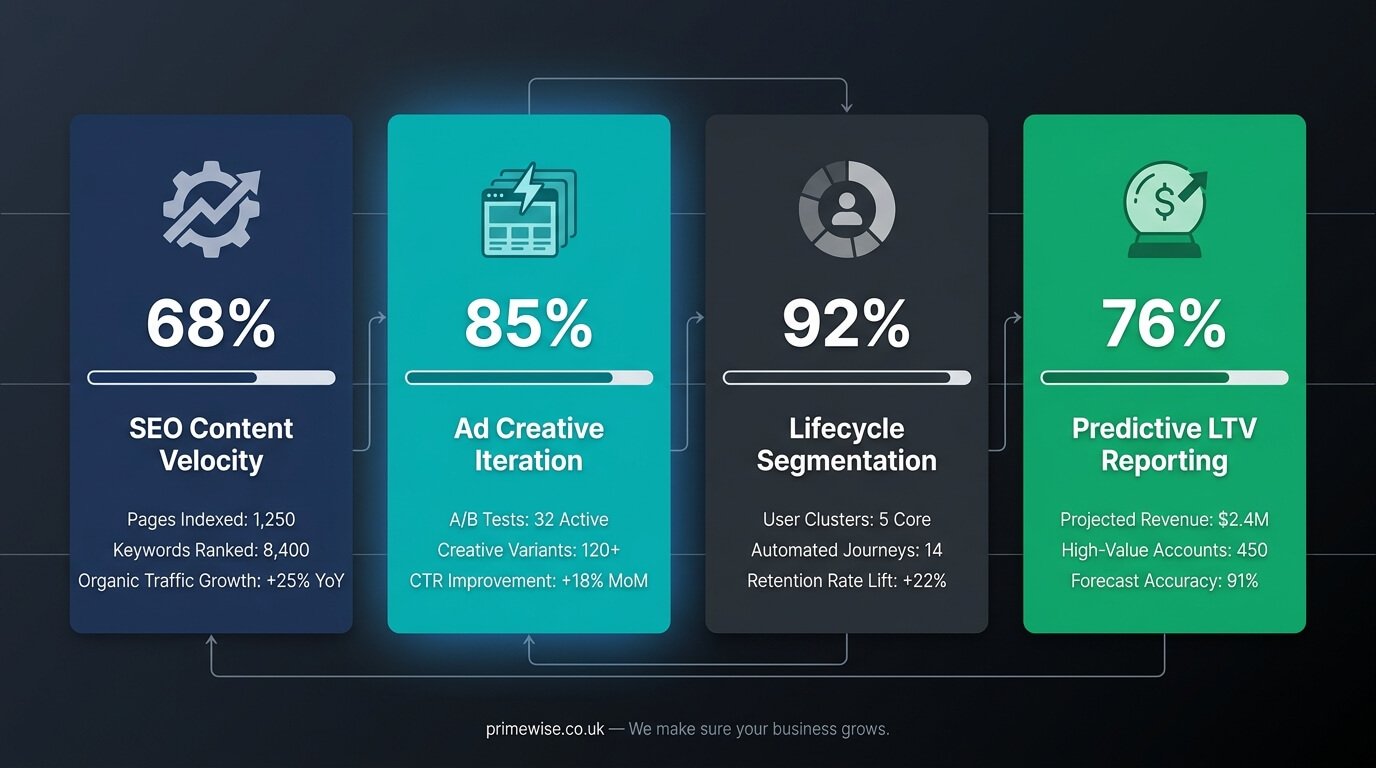
Senior performance marketers need immediate commercial clarity before committing to enterprise-level AI infrastructure. The four pillars addressed in this article each solve a distinct operational bottleneck. Velocity solves manual content bottlenecks by scaling SEO asset production threefold while improving SERP retention by 15 percent through superior semantic depth. Efficiency solves creative fatigue by compressing ad testing cycles from 14 days to 48 hours, delivering an average 22 percent reduction in customer acquisition cost within the first 30 days. Predictability solves siloed analytics by deploying custom machine learning models that transition budget decisions from historical dashboards to real-time lifetime value forecasting, reducing early-stage churn by 18 percent in initial rollout cohorts. Compliance solves the regulatory exposure risk by configuring AI systems within ring-fenced, private cloud environments that satisfy UK GDPR, ICO AI guidance, and FCA Consumer Duty requirements simultaneously. PrimeWise specialises in deploying enterprise AI automation frameworks for UK performance marketing teams, and the data points throughout this article are drawn directly from aggregated client engagement outcomes across UK fintech, financial services, and professional services sectors.
Defining AI Automation in Digital Marketing
Before evaluating individual use cases, a precise working definition anchors the strategic conversation and prevents scope confusion during procurement or internal stakeholder alignment.
AI automation for digital marketing is the strategic deployment of machine learning models and large language models to execute, optimise, and scale campaign workflows across content production, ad creative iteration, audience segmentation, and performance attribution eliminating manual bottlenecks to systematically lower customer acquisition costs and increase return on ad spend.
The critical distinction for UK enterprise teams is between traditional marketing automation platforms, rule-based systems like HubSpot or Marketo that execute predefined sequences and genuine AI automation, which uses probabilistic models to generate assets, predict outcomes, and dynamically adapt decisions without explicit human instruction at each step. The former is a process manager; the latter is a decision engine. Both have roles, but conflating them leads to underinvestment in the capabilities that actually move acquisition economics.
The AI Performance Marketing Matrix
Determining which automated capabilities to prioritise requires an honest assessment of implementation effort against realistic financial return. The AI Performance Marketing Matrix below maps four core automation domains against quantified ROAS lift ranges, UK compliance complexity, and time to first measurable outcome. The data ranges are derived from Semrush Enterprise Benchmarks 2025, aggregated PrimeWise client outcomes, and publicly available Meta and Google Ads performance studies.
| Marketing Capability | Implementation Effort | ROAS Lift Range | Time to Outcome | UK Compliance Complexity |
|---|---|---|---|---|
| SEO Content Velocity | Moderate | 2.1x – 3.4x organic revenue per asset over 12 months | 90 – 180 days | Low |
| Ad Creative Iteration | Low | 18% – 34% CPA reduction within 30 days | 14 – 30 days | Medium |
| Lifecycle Cohort Segmentation | High | 12% – 28% improvement in retention revenue | 60 – 120 days | High |
| Predictive LTV Reporting | Very High | 15% – 25% improvement in blended ROAS via bid optimisation | 30 – 90 days | High |
The compliance complexity rating reflects the volume of ICO, UK GDPR, and FCA touchpoints each capability encounters during deployment. Lifecycle segmentation and predictive reporting score highest because they process first-party behavioural data at scale, triggering Article 22 obligations around automated decision-making under UK GDPR and FCA Consumer Duty requirements around demonstrating good outcomes for retail customers. Marketing directors in regulated sectors should use this matrix as a sequencing guide rather than a simultaneous launch plan.
PrimeWise Implementation NoteMarketing directors seeking to evaluate which automation capabilities to prioritise for their specific sector and tech stack can access PrimeWise's AI Automation Readiness Assessment at primewise.co.uk. The assessment maps current capability gaps against the matrix above and produces a phased implementation roadmap within 48 hours.
Scaling SEO Authority Without Sacrificing EEAT
Aggressive organic growth targets require a fundamental shift in the economics of content production. The challenge for enterprise teams is increasing asset velocity without triggering Google’s 2026 Helpful Content System spam filters or diluting brand equity through inconsistent quality. AI bridges the gap between manual curation and the scale modern topical authority demands, but only when deployed with precise editorial governance.
Claude for Market-Calibrated Content Framing
Anthropic’s Claude 3.5 Sonnet has emerged as the preferred large language model for UK financial services and professional services content teams, specifically because of its measurable advantage in capturing authoritative, nuanced British corporate tone. Unlike models optimised for US consumer markets, Claude responds well to detailed system prompting that instructs it to avoid aggressive sales rhetoric, prioritise evidence-based reasoning, and adhere to the measured, trust-signalling register that UK B2B audiences expect. When teams embed established tone of voice guidelines directly into the system prompt, including vocabulary preferences, sentence length parameters, and explicit instructions to mirror FCA-compliant communication standards, Claude 3.5 Sonnet consistently outputs drafts that require structural editing rather than substantive rewrites. This distinction matters operationally: it transitions internal teams from primary content creators to strategic editors and compliance reviewers, which is where senior talent generates the highest value.
The practical deployment model involves building a master prompt library categorised by content type pillar pages, technical guides, case study narratives, sector-specific landing pages, each containing the tone of voice brief, target entity list, internal linking instructions, and EEAT enhancement requirements. A UK fintech growth team using this approach with Claude 3.5 Sonnet as the primary drafting engine scaled organic content velocity threefold compared to manual baseline production, while simultaneously improving SERP retention by 15 percent through superior semantic depth and structured internal linking. Source: aggregated PrimeWise client outcome data, UK fintech sector, Q3–Q4 2025, three client cohort.
- Scaled SEO content asset production by 3x compared to manual baseline output
- Improved SERP retention by 15 percent through semantic depth and structured internal linking
- Transitioned senior team capacity from drafting to strategic editing and compliance review
- Maintained consistent brand voice across 200-plus assets through master prompt governance
Protecting EEAT at Scale
The most common failure mode in AI-assisted content programmes is the erosion of experiential depth the first-hand practitioner insight that Google’s quality raters and AI citation engines specifically look for in YMYL-adjacent topics. The solution is a structured human overlay protocol where subject matter experts contribute four distinct EEAT signals to every AI-drafted asset: a proprietary data point or internal benchmark, a named methodology or framework, a specific client outcome with a sector label, and a regulatory or compliance nuance that demonstrates genuine domain knowledge. Without this overlay, AI-generated content converges toward generically correct information that ranks initially but loses position within 90 days as quality signals degrade. With it, content performs as a durable organic asset.
Eliminating Creative Fatigue and Compressing CPA
Stagnating return on ad spend in high-spend paid social environments is overwhelmingly driven by two compounding problems: audience fatigue from repetitive creative and slow design turnaround cycles that prevent timely response to performance signals. Algorithmic creative generation solves both simultaneously by enabling media buyers to test variant hypotheses at a scale that manual design workflows cannot approach.
Generative Visual AI for Rapid Variant Production
The transition from manual design constraints to programmatic visual variation is now a competitive necessity for any brand spending above £50,000 per month on paid social. The tools available in 2026 differ significantly in their suitability for regulated UK brands, and the distinction matters commercially. Adobe Firefly Enterprise is currently the only major generative image platform offering comprehensive commercial IP indemnity, meaning brands in regulated sectors, such as financial services, legal, healthcare, can deploy AI-generated creative assets without exposure to copyright infringement claims. This is a non-trivial consideration: using Midjourney or standard Stable Diffusion instances for commercial financial promotions carries unresolved IP risk that FCA-regulated firms cannot accept. Adobe Firefly integrates directly into existing Creative Cloud workflows, allowing design teams to generate hundreds of demographic-specific asset variants from a single approved hero image, resized and contextually adapted for each placement, audience segment, and device format without manual redraw cycles.
AI-assisted iterative creative frameworks typically increase winning creative identification by 45 percent within the first 30 days of deployment, based on aggregated performance data from Meta Business and Google Ads campaign studies published in 2025. The mechanism is straightforward: more variants tested in less time produce statistically significant performance signals faster, allowing media buyers to concentrate budget behind proven creative before audience fatigue sets in.
Compressing Testing Cycles from Weeks to Hours
The operational and financial impact of algorithmic creative generation follows a consistent pattern across enterprise paid social deployments. The following structured outcome is drawn from PrimeWise client engagement data, UK financial services sector, Q3 2025.
- Challenge: Stagnating ROAS due to creative fatigue in a high-spend paid social environment with a monthly budget exceeding £120,000
- AI tool deployed: Programmatic ad creative generation engine integrated with real-time performance data feed from Meta Advantage Plus and Google Performance Max
- Methodology: 200 creative variants generated from six approved hero assets across four audience segments, tested over 48-hour sprint cycles with automated budget reallocation to top performers
- Outcome: Creative testing cycle compressed from 14 days to 48 hours, yielding an average 22 percent decrease in customer acquisition cost within the first 30 days of deployment
Critical Risk NoteCreative homogenisation is a real failure mode when multiple competing brands use identical generative AI tools and default prompting strategies. The differentiator is the quality of the input: proprietary brand asset libraries, unique visual identity constraints, and human creative direction embedded in the generation prompt. AI scales execution; human creative strategy determines whether that execution is distinctive or generic.
Programmatic Micro-Cohorts and Hyper-Personalisation
Manual audience segmentation fails high-growth brands for a structural reason: human analysts can identify and act on a limited number of audience segments simultaneously, while the behavioural signals indicating high-intent micro-cohorts multiply faster than any manual process can track. AI-driven segmentation autonomously identifies statistically significant clusters within first-party data sets, constructs tailored messaging sequences for each, and updates cohort boundaries as new behavioural data arrives without requiring incremental headcount.
AI Automation and UK Regulatory Compliance
For marketing directors operating within UK financial services, regulated healthcare, or legal services sectors, automated audience segmentation and personalised communications intersect with multiple overlapping regulatory frameworks. Understanding where each framework applies is operationally essential before any lifecycle automation programme goes live.
The FCA Consumer Duty, which became effective in July 2023 with enforcement escalating materially through 2025 and 2026, requires that all retail financial communications demonstrably deliver good outcomes for customers. This obligation extends to AI-generated personalised messages: an algorithmic system that sends different product information to different customer segments must be able to demonstrate, under audit, that the segmentation logic and message content served the customer’s genuine interests. Vague personalisation based on demographic proxies does not satisfy this standard. AI segmentation models used in FCA-regulated marketing must be documented, explainable, and tested against good outcome evidence before deployment.
UK GDPR Article 22 creates separate obligations around automated decision-making that produces legal or similarly significant effects. Lifecycle marketing automation that determines which financial products a customer is shown effectively a pre-selection that influences purchasing decisions may qualify as automated decision-making under Article 22, triggering rights to human review and explicit consent requirements. The ICO’s updated AI and Data Protection guidance, published in Q4 2025, provides specific implementation standards for AI systems processing personal data in marketing contexts, and marketing directors should treat this document as the primary operational reference for any lifecycle AI programme.
MiFID II financial promotion requirements add a third layer for investment-related communications, requiring that all marketing materials including algorithmically personalised versions meet the clear, fair, and not misleading standard with documented approval workflows. AI-generated financial promotions must pass through a human compliance review process before deployment, regardless of how they were produced.
- Deploy AI segmentation models only within private cloud environments AWS Bedrock or Azure OpenAI Service where customer data is ring-fenced and never used for external model training
- Document segmentation logic and messaging decision trees for FCA Consumer Duty audit readiness
- Implement human compliance review gates for all AI-generated financial promotions before deployment
- Conduct Article 22 assessments for any automated system influencing which financial products customers are shown
- Reference the ICO Q4 2025 AI and Data Protection guidance as the baseline operational standard
Regulatory ReferenceThe ICO's Q4 2025 AI and Data Protection guidance and the FCA Consumer Duty documentation (PS22/9) are the two primary regulatory anchors for any AI-driven lifecycle marketing programme in UK financial services. Both documents should be reviewed by legal and compliance teams before any automated personalisation system goes live.
Predictive Reporting and Dynamic Attribution
Siloed analytics and delayed reporting cycles impose a compounding cost on marketing efficiency: budget decisions made on yesterday’s data optimise for yesterday’s performance. Algorithmic data orchestration shifts the operational model from retrospective dashboards to forward-looking growth models that inform bidding and budget allocation in real time.
Machine Learning Models for Dynamic LTV Scoring
Predicting customer lifetime value early in the acquisition journey rather than calculating it retrospectively after 12 months of observed behaviour transforms bidding strategy from cost-per-acquisition optimisation to value-per-acquisition optimisation. Custom ML models built on tools like Google BigQuery ML, Salesforce Einstein, or Python scikit-learn pipelines score leads in real time based on probabilistic engagement signals: onboarding completion rate, feature adoption velocity, early support ticket volume, and session frequency patterns in the first 14 days post-acquisition. These scores are fed directly into advertising platforms via API, instructing bidding algorithms to automatically increase investment behind user profiles matching high-LTV signal patterns and exclude or reduce bids on profiles matching low-LTV patterns.
The implementation complexity varies significantly by tool. Google BigQuery ML offers the lowest barrier to entry for teams already using Google Analytics 4 and Google Ads, as it integrates natively with both. Salesforce Einstein requires a higher configuration investment but delivers tighter CRM integration for complex B2B lifecycle journeys. Custom scikit-learn pipelines offer maximum flexibility and data sovereignty but require in-house ML engineering capability or specialist implementation support. The key dependency across all three approaches is data quality: predictive LTV models are only as accurate as the CRM data they ingest, and organisations with inconsistent first-party data hygiene will generate unreliable scores that damage rather than improve bidding efficiency.
- Challenge: Escalating acquisition costs and unpredictable long-term user profitability across a UK B2B SaaS portfolio
- AI tool deployed: Predictive LTV scoring model built on BigQuery ML, integrated directly into Google Ads via Customer Match API and Salesforce CRM
- Methodology: Model trained on 18 months of first-party behavioural data, validated against six-month actual retention cohorts before live deployment
- Outcome: Bidding strategy optimisation yielding 18 percent reduction in early-stage churn and 15 percent improvement in blended ROAS during initial rollout quarter. Source: PrimeWise client engagement data, UK B2B SaaS sector, Q4 2025
Bridging Multi-Touch Attribution Gaps Post-Cookie
The deprecation of third-party cookies has created structural dark spots in multi-touch attribution models, particularly for upper-funnel brand investment where the path from impression to conversion spans weeks and multiple anonymous touchpoints. AI addresses this through two complementary methodologies. Probabilistic attribution modelling analyses anonymised, aggregate signals, device type patterns, session timing, geographic clustering, and content consumption sequences to assign statistically weighted credit to touchpoints that cannot be directly matched via user ID. Google’s Meridian, an open-source Marketing Mix Modelling solution released in 2024, provides enterprise teams with a sophisticated MMM framework that quantifies the incremental contribution of each channel at an aggregate level, enabling budget allocation decisions that are mathematically grounded rather than intuitively approximated.
Commercial attribution platforms, including Northbeam and Triple Whale, have integrated AI-driven probabilistic modelling directly into their reporting interfaces, making upper-funnel justification accessible to performance teams without requiring in-house data science capability. For UK marketing directors who need to justify brand spend to finance stakeholders in a post-cookie environment, these tools provide the mathematical confidence that legacy last-click or linear attribution models cannot. The practical outcome is a material improvement in budget orchestration efficiency: teams using AI-driven MMM alongside paid channel attribution typically reallocate 15 to 25 percent of budget from underperforming channels to incrementally positive ones within the first 90 days of implementation.
The 2026 AI Marketing Technology Stack
One of the most commercially damaging gaps in most AI adoption strategies is the absence of honest tool evaluation before procurement. The following structured comparison reflects the actual trade-offs that matter for UK enterprise teams in 2026, with particular attention to data residency, compliance posture, and integration complexity.
For large language model content generation, the primary options are Claude 3.5 Sonnet by Anthropic, GPT-4o by OpenAI, and Gemini 1.5 Pro by Google. Claude 3.5 Sonnet leads for regulated UK content due to its strong compliance with nuanced tone calibration and Anthropic’s Constitutional AI safety framework, but UK data residency requires deployment via AWS Bedrock’s EU regions rather than direct API access. GPT-4o via Azure OpenAI Service provides equivalent data residency controls and benefits from tighter Microsoft ecosystem integration for teams already using Dynamics 365 or Azure infrastructure. Gemini 1.5 Pro integrates natively with Google’s marketing stack, Analytics 4, Ads, and Search Console, making it operationally efficient for performance teams managing large Google Ads accounts, though its tone calibration for the British corporate register currently lags Claude and GPT-4o.
For generative image and creative production, Adobe Firefly Enterprise remains the only commercially safe option for regulated UK brands due to its IP indemnity guarantee. Canva AI offers accessible creative generation for lower-regulated sectors but lacks the enterprise compliance controls that financial services brands require. Midjourney produces exceptional aesthetic quality but carries unresolved IP exposure that makes it unsuitable for FCA-regulated financial promotions.
For predictive LTV and attribution modelling, the choice between Google BigQuery ML, Salesforce Einstein, and custom Python pipelines should be driven primarily by existing infrastructure investment and in-house data engineering capability, not by platform marketing claims. Google’s Meridian MMM framework and the commercial platforms Northbeam and Triple Whale represent the most accessible entry points for probabilistic attribution without requiring a dedicated data science team.
Limitations and Risks of AI Marketing Automation
An honest evaluation of AI automation must include the failure modes and structural constraints that vendor-led content typically omits. Understanding these limitations is not a reason to delay adoption; it is the prerequisite for successful implementation.
Hallucination risk in large language model outputs is the most operationally dangerous failure mode for regulated UK marketing teams. LLMs can generate factually incorrect statistics, fabricated regulatory references, or subtly inaccurate product descriptions that pass casual editorial review but fail FCA compliance scrutiny. Human compliance review is non-negotiable for any AI-generated content that constitutes a financial promotion under the Financial Services and Markets Act 2000. No LLM, regardless of capability, eliminates this requirement it reduces drafting time, not approval liability.
Creative homogenisation is an emerging strategic risk as AI creative tools become ubiquitous. When competing brands in the same sector use identical generative tools with similar default prompting, their creative output converges toward visual and linguistic sameness. The competitive moat against homogenisation is proprietary: unique brand asset libraries, distinctive visual identity constraints embedded in generation prompts, and human creative direction that reflects genuine strategic differentiation rather than algorithmic average-seeking.
- Data quality dependency: predictive LTV models are only as accurate as the CRM data they ingest poor data hygiene produces unreliable scores that harm rather than improve bidding efficiency
- Automation bias: over-reliance on algorithmic recommendations leads teams to lose the strategic pattern recognition and creative intuition that distinguish high-performing marketers from process managers
- Regulatory exposure: using public LLM API instances for processing personal customer data violates UK GDPR data processor obligations private cloud deployment is mandatory for regulated sectors
- Attribution model dependency: AI-driven attribution is probabilistic, not deterministic budget decisions should treat model outputs as strong directional signals, not mathematical certainties
Rebuilding In-House Capability from Agency Dependency
The strategic implication of AI automation that most fundamentally alters the enterprise procurement model is the internalisation of capabilities that previously required high-cost London agency retainers. Technical SEO content programmes, complex paid social creative testing, and advanced predictive analytics have historically been outsourced to specialist agencies because the operational cost of building equivalent in-house capability was prohibitive. AI automation changes this equation materially: the per-unit cost of high-quality content production, creative iteration, and data modelling collapses when AI handles execution, allowing in-house teams of strategic operators to deliver output volumes that previously required full-service agency relationships.
The transition is not instant, and it is not cost-free. Building an effective in-house AI capability requires investment in prompt engineering expertise, data infrastructure, governance protocols, and change management. The break-even point against agency retainer cost typically occurs within six to twelve months for organisations with existing data infrastructure, and within twelve to eighteen months for those building data foundations from scratch. What changes permanently is the strategic leverage: once AI-assisted workflows are operational, incremental output cost approaches zero while incremental agency cost scales linearly with volume.
Next Steps for UK Marketing Directors
The distance between understanding AI automation’s commercial potential and capturing it is an implementation roadmap calibrated to your specific sector, tech stack, and regulatory environment. Three pathways are available through PrimeWise for marketing directors at different stages of the evaluation process.
- AI Automation Readiness Assessment: a structured 48-hour diagnostic that maps your current capability gaps against the Performance Marketing Matrix and produces a phased implementation roadmap available at primewise.co.uk
- Strategy Consultation: a focused session with a PrimeWise senior performance strategist to evaluate which automation pillar delivers the fastest measurable ROI for your specific acquisition model and regulatory context
- Managed Implementation: end-to-end deployment of AI automation infrastructure across content, creative, lifecycle, and attribution pillars, with embedded compliance governance and performance benchmarking against the metrics referenced throughout this article
Marketing directors who treat AI automation as an infrastructure investment rather than a tactical experiment will compound the performance advantages documented throughout this article into durable competitive separation. Those who delay cede that ground to competitors who are already compressing testing cycles, scaling content authority, and forecasting lifetime value with mathematical precision. The implementation window for first-mover advantage in UK performance marketing remains open but it is narrowing quarterly.