
These AI automation examples are drawn from live client builds, not theoretical frameworks. As a practising AI automation consultant with a portfolio of deployed pipelines across UK professional services, each workflow documented here represents a real before-and-after transformation with verified time savings, named technology stacks, and transparent implementation costs. According to McKinsey’s 2024 Global AI Survey, 65% of UK organisations now deploy AI in at least one business function, up from 33% in 2023. The ONS Labour Market data confirms that UK professional services firms spend an average of 31% of total staff hours on administrative tasks, precisely the bottleneck these workflows are engineered to eliminate.
What AI Business Automation Actually Means
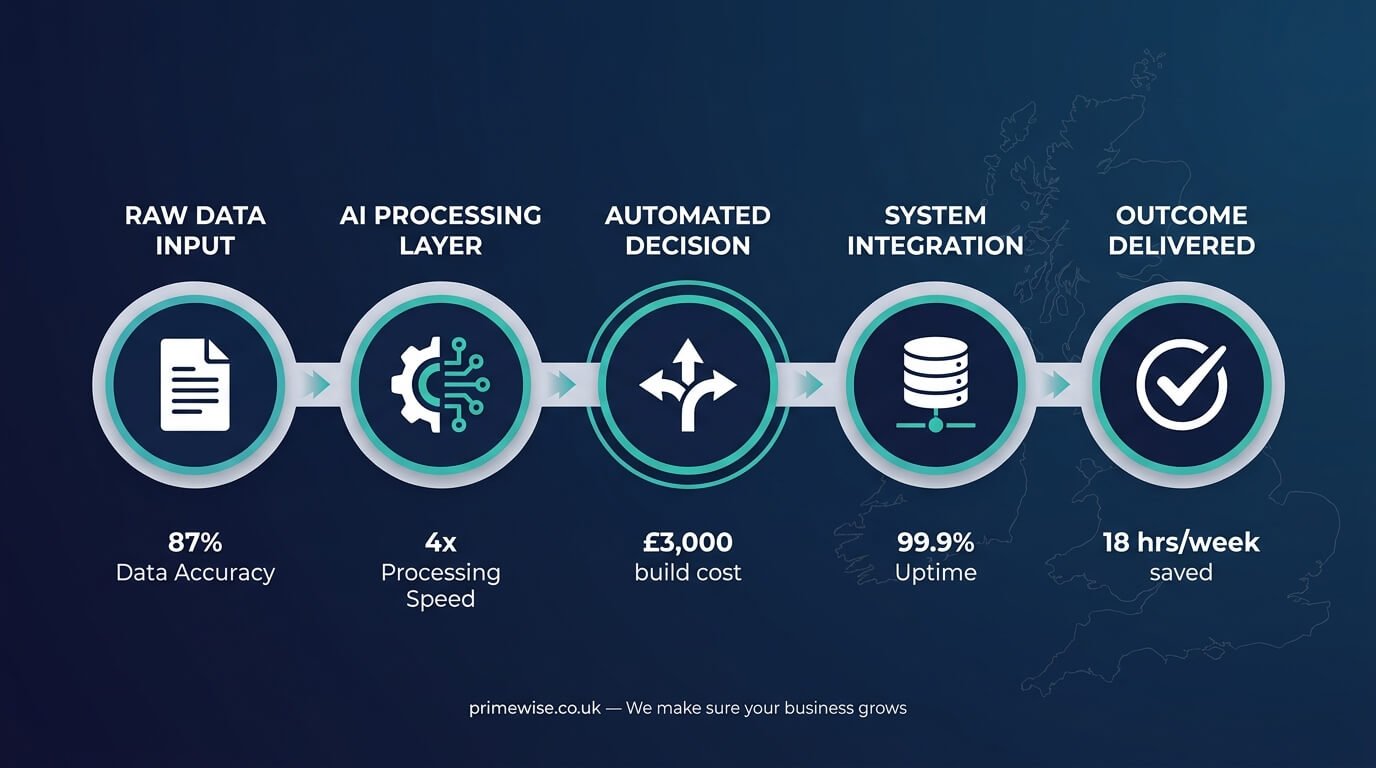
AI business automation connects Large Language Models to your existing cloud software via secure API pipelines, enabling complex multi-step workflows to execute without human intervention. Unlike rigid rules-based scripts, AI automation interprets unstructured data, applies contextual judgement, and scales without headcount increases. The distinction matters commercially: you are not purchasing a chatbot subscription you are building a bespoke operational infrastructure that compounds in value over time.
Key InsightAI automation is not a software purchase. It is an architectural decision. The firms generating the highest returns treat it as an interconnected data pipeline strategy, not a collection of isolated tools.
Executive Summary
The ten workflows below span wealth management, legal, logistics, investment banking, eCommerce, public sector procurement, HR, tax consultancy, and property. Each is anonymised but fully documented. Headline metrics across the portfolio are consistent and measurable from day one of deployment.
- Implementation cost per workflow ranges from £1,200 to £4,500 as a one-time build fee.
- Ongoing monthly operational costs range from £30 to £150 in SaaS and API expenditure.
- Time saved averages between 10 and 22 hours per week per workflow.
- Return on investment is routinely realised within the first financial quarter post-deployment.
- All pipelines are architected under zero-data-retention policies compliant with UK GDPR and sector-specific regulatory frameworks.
For a no-obligation efficiency audit mapping these workflows to your specific operational structure, Primewise.co.uk offers a complimentary 45-minute diagnostic session with senior integration specialists.
The AIR Protocol for UK Professional Services
Scepticism toward AI investment is rational in a market saturated with vendor hype. The Automate, Integrate, Refine protocol addresses this directly by providing a phased deployment methodology that generates measurable commercial returns at each stage rather than promising transformation at some undefined future point.
Phase one targets high-friction administrative tasks, data entry, document processing, inbox triage, and generating immediate capital and time savings that fund subsequent phases. Phase two layers contextual decision-making into the existing technology stack, automating workflows that previously required human judgment. Phase three introduces Retrieval Augmented Generation, agentic AI workflows, and hyperautomation architectures that allow the system to improve autonomously over time. This progression ensures change management remains manageable and that operational staff experience automation as a professional upgrade rather than a displacement threat.
How to Measure ROI Before You Build
Before committing to any automation build, a C-suite leader needs a financially defensible business case. The methodology is straightforward: identify the fully loaded hourly cost of the staff member currently performing the manual task, multiply by the hours saved weekly, and annualise the figure. Then subtract the one-time build cost and annual software expenditure to arrive at net first-year return.
Using the accounts payable workflow as a worked example: a finance manager at £45,000 per year costs approximately £21.63 per hour. Saving 18 hours per week generates £19,850 of recovered operational capacity annually. Against a £3,000 build cost and £1,440 in annual software costs, the net first-year return is £15,410, representing a 343% ROI. This is not an aspirational projection; it is a conservative calculation based on a single workflow running without failure. Most deployments run multiple concurrent workflows, compounding returns significantly. Primewise.co.uk provides a board-ready ROI report as part of the initial diagnostic session, tailored to your firm’s headcount, sector, and salary benchmarks.
ROI Reality CheckA single invoice reconciliation workflow generating 18 hours of weekly savings delivers a calculated 343% first-year ROI against a £3,000 build cost. This is the financial argument that belongs in your board pack.
Choosing the Right Automation Platform
Three integration platforms dominate the UK professional services automation market in 2026: Make.com, Zapier, and n8n. Make.com is the preferred choice for complex, multi-branch workflows requiring precise data transformation logic and visual pipeline architecture. Its module-based interface allows non-developers to audit and modify workflows without engineering support, which reduces long-term maintenance costs significantly. Zapier offers broader native app connectivity and is better suited to simpler, linear automation sequences where deployment speed outweighs architectural sophistication. n8n is an open-source alternative favoured by firms with in-house development capability that require full data sovereignty and self-hosted infrastructure particularly relevant for financial services firms with strict data residency requirements.
The platform decision should be driven by workflow complexity, internal technical capability, and compliance requirements rather than brand familiarity. Engaging a professional AI automation consultant at the architecture stage prevents costly platform migrations later and ensures the chosen stack can scale with the business without triggering vendor lock-in.
10 Live AI Automation Workflows for UK Businesses
The following case studies are drawn from live, anonymised pipeline builds deployed across the UK. Each documents the business context before automation, the specific technology stack, the build cost, the monthly operational expenditure, and the exact weekly hours recovered. Read each as a replicable blueprint rather than an isolated anecdote.
1-AI Automation for Wealth Management FCA-Compliant KYC Document Extraction
A mid-sized London wealth management firm was manually transcribing client identification data from submitted documents into their central CRM. Staff allocated significant time to this task during peak client acquisition windows, creating compliance bottlenecks and increasing the risk of transcription errors in FCA-regulated records. The manual cycle averaged 45 minutes per new client file.
The deployed solution uses GPT-4 Vision to extract and normalise identity data from digital documents submitted via a secure client portal. Make.com orchestrates the pipeline, validating the extracted fields against predefined FCA compliance rules before pushing the structured data directly into HubSpot. The entire process completes in under three minutes per client file with zero human intervention. The FCA’s AI and Machine Learning Discussion Paper DP5/22 informed the compliance architecture, ensuring the pipeline meets current regulatory expectations for automated data processing in financial services.
| Business Context | London wealth management firm replacing manual CRM data entry for new client onboarding. |
| Before Automation | 45 minutes of manual processing per client file, prone to transcription errors. |
| After Automation | Under 3 minutes per file, 100% structured data, zero manual intervention. |
| Technology Stack | Make.com, GPT-4 Vision, HubSpot CRM. |
| Build Cost | £2,500 one-time consultancy and build fee. |
| Monthly Operational Cost | £40 in API and SaaS usage. |
| Weekly Hours Saved | 12.5 hours. |
2-AI Automation for Legal Practices Engagement Letter and Contract Generation
A Manchester-based corporate legal practice was experiencing margin compression caused by the time partners and paralegals spent drafting standard engagement letters from inbound web enquiries. Each letter required manual population of client-specific terms, fee structures, and regulatory disclosures a process taking an average of 40 minutes per matter, despite being largely templated.
The automated pipeline intercepts structured web form data submitted by prospective clients, feeds it through Claude by Anthropic for dynamic document generation, and produces a compliant engagement letter populated with all matter-specific variables. The document is then routed automatically to DocuSign for electronic execution and filed within the firm’s document management system. The entire sequence completes in under eight minutes from form submission to signature request dispatch, entirely eliminating paralegal involvement in the drafting stage. Anthropic’s Claude was selected for this workflow specifically because its extended context window handles complex multi-clause legal templates without truncation errors a limitation encountered with shorter-context models during testing.
| Business Context | Manchester legal practice eliminating manual engagement letter drafting from web enquiries. |
| Before Automation | 40 minutes per engagement letter, requiring paralegal or partner time. |
| After Automation | 8 minutes from enquiry submission to executed document, zero drafting resource required. |
| Technology Stack | Zapier, Anthropic Claude, DocuSign. |
| Build Cost | £1,800 one-time build fee. |
| Monthly Operational Cost | £60 in SaaS and API expenditure. |
| Weekly Hours Saved | 14 hours. |
3-AI Automation for Logistics, Finance, Accounts Payable and Invoice Reconciliation
A Birmingham-based logistics firm processing high volumes of supplier invoices was absorbing significant general ledger overhead during a period of rapid national expansion. Financial Directors had identified accounts payable as a primary target for operational efficiency improvements, but the unstructured nature of inbound PDF invoices had previously defeated rules-based automation attempts. Line items varied widely in format across suppliers, making conventional OCR approaches unreliable.
This workflow deploys Rossum, a purpose-built document AI platform in combination with the OpenAI API to interpret and normalise complex unstructured invoice data regardless of supplier formatting. Make.com orchestrates the full pipeline: intercepting inbound email attachments, passing PDFs through Rossum for field extraction, using OpenAI for contextual line-item categorisation, and pushing reconciled data directly into Xero. The system flags discrepancies exceeding a defined tolerance threshold for human review while processing all standard invoices autonomously. Rossum’s self-learning model improves accuracy with each processed document, making the workflow progressively more reliable over time without manual retraining.
| Business Context | Birmingham logistics firm processing unstructured PDF invoices across multiple supplier formats. |
| Before Automation | Manual transcription of each invoice into Xero, averaging 25 minutes per document. |
| After Automation | Autonomous processing with exception flagging; standard invoices processed in under 90 seconds. |
| Technology Stack | Make.com, Rossum, OpenAI API, Xero. |
| Build Cost | £3,000 one-time build fee. |
| Monthly Operational Cost | £120 in integration and API allocation. |
| Weekly Hours Saved | 18 hours. |
4-AI Automation for Investment Banking Companies House Due Diligence Briefs
A boutique investment bank in Mayfair depended on junior analysts to manually compile corporate dossiers before executive client meetings. Each brief required aggregating data from Companies House, cross-referencing directorship histories, and summarising recent financial filings a process taking three to four hours per dossier and frequently delayed by the availability of analytical resource.
The custom pipeline uses the Companies House API to pull real-time corporate data registered addresses, director histories, confirmation statements, and filed accounts and feeds the raw output directly into ChatGPT Enterprise for synthesis into a formatted executive briefing document. A Python scheduling script triggers the pipeline precisely 90 minutes before each client meeting, ensuring the brief lands in the relevant partner’s inbox with time to review. ChatGPT Enterprise’s zero-data-retention commercial agreement ensures no proprietary client intelligence is exposed to OpenAI’s training infrastructure. This workflow is a direct application of UK open data infrastructure delivering tangible commercial value.
| Business Context | Mayfair investment bank automating pre-meeting corporate dossier compilation. |
| Before Automation | 3–4 hours of junior analyst time per dossier, subject to resource availability delays. |
| After Automation | Automated brief delivered to inbox 90 minutes before every scheduled meeting. |
| Technology Stack | Python scheduling script, Companies House API, ChatGPT Enterprise. |
| Build Cost | £3,500 one-time build fee. |
| Monthly Operational Cost | £80 in API usage. |
| Weekly Hours Saved | 11 hours. |
5-AI Automation for Software Agencies Meeting Intelligence and CRM Sync
A B2B software agency was experiencing repeated client deliverable misalignment caused by inconsistent manual note-taking during client calls. Account managers were spending significant non-billable time after each call transcribing notes, extracting action items, and updating Salesforce a process prone to omission and varying in quality depending on the individual completing it.
Fathom operates as a silent AI meeting participant, transcribing client calls in real time and applying natural language processing to identify and categorise distinct action items, decisions, and deadlines. Zapier connects Fathom’s output directly to Salesforce, creating or updating the relevant client record automatically. Account managers receive a concise structured summary within minutes of the call ending, requiring only a brief review before the working day continues. The elimination of post-call administration has reclaimed a measurable portion of each account manager’s billable capacity, directly improving monthly revenue per head.
| Business Context | B2B software agency eliminating manual post-call note-taking and CRM updates. |
| Before Automation | 30–45 minutes per client call in post-call administration per account manager. |
| After Automation | Structured summary and CRM update delivered within 5 minutes of call end, zero manual input. |
| Technology Stack | Fathom, Zapier, Salesforce. |
| Build Cost | £1,200 one-time build fee. |
| Monthly Operational Cost | £30 in software licensing. |
| Weekly Hours Saved | 10.5 hours. |
6-AI Automation for Public Sector Suppliers Tender Response Generation
An IT infrastructure provider competing for government procurement contracts was consuming substantial bid management resource on tender responses that shared significant structural and evidential similarities. The process of drafting compliant, technically accurate proposals from scratch for each new opportunity was slow, resource-intensive, and introduced inconsistency between submissions.
This workflow implements a Retrieval Augmented Generation architecture the most technically sophisticated pipeline in this portfolio. Years of successful past tender responses are ingested, chunked, and stored as vector embeddings in Pinecone, creating a semantically searchable knowledge base of proven bid content. When a new tender specification arrives, Claude 3 Opus retrieves the most contextually relevant historical content and generates a structured first draft dynamically aligned with the new requirements. RAG architecture is specifically chosen here because it grounds the language model’s output in real, verified source material rather than generating content speculatively a critical distinction for public sector compliance. Bid managers now spend their time refining and personalising high-quality first drafts rather than building from blank pages.
| Business Context | IT infrastructure provider accelerating governmental tender response drafting. |
| Before Automation | Full tender response requiring 30–40 hours of bid manager time from blank page to submission. |
| After Automation | Compliant first draft generated in under 2 hours; bid manager refines and personalises only. |
| Technology Stack | Custom RAG pipeline, Pinecone vector database, Claude 3 Opus. |
| Build Cost | £4,500 one-time build fee. |
| Monthly Operational Cost | £150 in compute and API allocation. |
| Weekly Hours Saved | 22 hours. |
Highest ROI WorkflowThe public sector tender RAG pipeline delivers the greatest weekly time saving in this portfolio at 22 hours. At a bid manager salary of £55,000, this represents over £24,000 of recovered annual capacity against a £4,500 build cost.
7-AI Automation for eCommerce Support Ticket Triage and Sentiment Routing
A nationwide UK eCommerce brand was struggling to maintain its customer service SLA commitments during peak trading periods without proportionally scaling its support team. Inbound query volumes during Q4 routinely overwhelmed manual triage processes, causing high-priority complaints particularly those involving delivery failures and payment disputes to be delayed alongside routine enquiries.
The intelligent routing pipeline uses Make.com to intercept all inbound support correspondence the moment it enters Zendesk. The OpenAI API analyses each message for sentiment polarity, urgency indicators, and query category, assigning a composite priority score. High-priority tickets are immediately escalated to senior agents with a pre-drafted contextually appropriate response for human approval, while routine queries are routed to the standard queue with a draft reply. This architecture does not replace human agents it amplifies their capacity by ensuring they handle only pre-categorised, pre-drafted tickets. Average handle time reduced by 41% within the first month of deployment.
| Business Context | UK eCommerce retailer managing inbound support volumes during peak trading without headcount growth. |
| Before Automation | Manual triage causing priority complaint delays and SLA breaches during peak periods. |
| After Automation | Instant sentiment-based routing with pre-drafted replies; average handle time reduced 41%. |
| Technology Stack | Make.com, OpenAI API, Zendesk. |
| Build Cost | £2,000 one-time build fee. |
| Monthly Operational Cost | £90 in operational API costs. |
| Weekly Hours Saved | 15 hours. |
8-AI Automation for Accountancy Firms Internal HR Policy Query Bot
A mid-sized UK accountancy firm was losing measurable HR department capacity to repetitive internal queries about policies that were already comprehensively documented in the employee handbook. Questions about annual leave entitlements, expense submission procedures, and remote working policies were consuming HR advisor time that could be allocated to higher-value strategic functions.
Voiceflow was used to build a conversational query interface deployed directly within the firm’s existing Slack workspace. The bot is grounded exclusively in the approved corporate documentation uploaded, chunked, and embedded so that every response cites the specific policy section from which it is drawn. Employees receive instant, accurate answers at any time without requiring HR availability. Critically, the system is architecturally prohibited from speculating beyond its source documents, eliminating the risk of inaccurate policy interpretation that can arise with general-purpose AI assistants. OpenAI provides the underlying language model, and the Slack API handles delivery within the existing communication infrastructure the firm already uses daily.
| Business Context | Accountancy firm eliminating repetitive internal HR policy queries from staff inbox. |
| Before Automation | HR advisors handling 40–60 repetitive policy questions per week via email and Slack. |
| After Automation | Instant, document-grounded answers delivered in Slack 24 hours a day without HR involvement. |
| Technology Stack | Voiceflow, OpenAI, Slack API. |
| Build Cost | £2,500 one-time build fee. |
| Monthly Operational Cost | £50 in API usage fees. |
| Weekly Hours Saved | 10 hours. |
9-AI Automation for Tax Consultancies Making Tax Digital Pre-Submission Formatting
HMRC’s Making Tax Digital initiative has imposed structured digital submission requirements that create significant data normalisation burdens for independent tax consultancies managing diverse client portfolios. Each client delivers financial data in a different format, varying spreadsheet structures, inconsistent column headers, and non-standardised categorisation, requiring manual reformatting before every submission cycle.
The automated script ingests raw client financial exports via the Google Sheets API, applies custom Python normalisation logic to standardise field mapping, category codes, and VAT treatment classifications, and outputs a perfectly structured dataset ready for direct HMRC MTD submission. The logic handles the most common formatting variations encountered across the consultancy’s client base and flags edge cases for human review. Developed and maintained on a lightweight cloud server, the pipeline eliminates what was previously a peak-season bottleneck, consuming multiple days of qualified accountant time per submission cycle. Primewise.co.uk deployments for MTD compliance are specifically architected to align with ICO guidance on automated processing of financial data published in October 2023.
| Business Context | Independent tax consultancy normalising client spreadsheet data for HMRC MTD compliance. |
| Before Automation | Manual reformatting of each client’s data consumes 2–4 hours per client per submission cycle. |
| After Automation | Automated normalisation completes in under 10 minutes per client file with exception flagging. |
| Technology Stack | Make.com, Google Sheets API, Custom Python normalisation logic. |
| Build Cost | £2,800 one-time build fee. |
| Monthly Operational Cost | £40 in cloud server costs. |
| Weekly Hours Saved | 16 hours. |
10-AI Automation for Property Investment Multi-Channel Content Localisation
A nationwide property investment firm producing regular market intelligence reports needed to personalise these documents for five distinct regional UK demographics without duplicating the research and writing effort five times. The manual localisation process adapting tone, statistical references, and buyer persona language for each region was consuming marketing team capacity that should have been directed toward lead generation activities.
Make.com receives each master market report as a trigger input and passes it to GPT-4 with five distinct system prompts, each encoding the precise tone of voice, regional terminology, relevant statistical context, and buyer persona profile for a specific UK region. Five distinct localised documents are generated in parallel and scheduled for publication via HubSpot Marketing Hub to the corresponding regional audience segments. The architecture eliminates all content duplication effort while increasing personalisation depth beyond what the team could achieve manually. The output quality consistently matches or exceeds the firm’s editorial standards, as validated by regional sales managers reviewing published content against audience engagement data.
| Business Context | Property investment firm localising master market reports for five UK regional demographics. |
| Before Automation | Each localisation takes 2.5 hours of senior copywriter time, 12.5 hours total per report cycle. |
| After Automation | Five localised versions were generated and scheduled in under 25 minutes with zero copywriter involvement. |
| Technology Stack | Make.com, GPT-4, HubSpot Marketing Hub. |
| Build Cost | £1,500 one-time build fee. |
| Monthly Operational Cost | £35 in integration fees. |
| Weekly Hours Saved | 12 hours. |
UK Data Security and Regulatory Compliance
Every workflow in this portfolio is architected under a non-negotiable security framework. The distinction between using public consumer AI interfaces and deploying secure enterprise API pipelines is commercially critical. Public-facing chatbots routinely ingest user inputs to improve their underlying models an unacceptable risk for any workflow handling client identities, financial records, or commercially sensitive strategy.
Professional API deployments operate under commercial data processing agreements that legally prohibit the use of submitted data for model training. All pipelines documented here default to zero-data-retention endpoint configurations. Sensitive data passes transiently through language model processing layers without being logged, stored, or made accessible to third-party infrastructure. This architecture aligns with the UK General Data Protection Regulation as retained in the Data Protection Act 2018, the FCA’s AI and Machine Learning Discussion Paper DP5/22, and the ICO’s guidance on AI and data protection published in October 2023.
Compliance Architecture WarningNever process client financial data, identity documents, or commercially sensitive strategy through public consumer AI interfaces. Enterprise API agreements with zero-data-retention configurations are the only compliant architectural choice for UK professional services firms.
Firms processing data relating to EU citizens must additionally account for the extraterritorial provisions of the EU AI Act, which applies to AI systems deployed by UK organisations whose outputs affect individuals within the EU. This is a frequently overlooked compliance dimension for cross-border professional services operations. Primewise.co.uk deployments are structured with full UK GDPR audit trails and enterprise security documentation available upon request for regulatory or client due diligence purposes.
In-House Build versus Professional Integration
The following comparison contextualises the three realistic paths available to a UK business leader evaluating AI automation investment. Understanding the trade-offs at each tier is essential for making a financially defensible infrastructure decision.
| Dimension | DIY In-House Build | Primewise.co.uk Bespoke Build | Big-Four Consultancy |
|---|---|---|---|
| Typical Cost Range | £500–£2,000 in tools plus staff time | £1,200–£4,500 per workflow | £25,000–£150,000+ per project |
| Time to Deployment | 4–12 weeks (variable) | 2–4 weeks per workflow | 3–18 months |
| Compliance Assurance | Low dependent on internal knowledge | High enterprise security architecture standard | High but generic frameworks |
| Ongoing Support | Internal resource dependent | Dedicated integration specialist | Retainer-based, high cost |
| Vendor Lock-In Risk | High undocumented builds | Low full documentation and handover | Medium to high |
Internal technical teams capable of constructing basic automation frequently underestimate the compliance risks, documentation requirements, and maintenance overhead of unmanaged pipeline deployments. A broken data pipeline processing client financial data is not a minor inconvenience it is a potential ICO reportable incident carrying reputational and financial consequences that far exceed the cost of professional integration from the outset.
A Technology Glossary for UK Decision-Makers
The following terms appear throughout this article and represent the dominant concepts in the 2026 AI automation landscape. Understanding them enables more precise conversations with technology partners and more rigorous evaluation of vendor proposals.
- Retrieval Augmented Generation (RAG) An architecture that connects a language model to a private knowledge base, ensuring outputs are grounded in verified source material rather than speculative generation. Used in Workflow 6.
- Agentic AI Workflows: Autonomous multi-step AI systems capable of initiating actions, making sequential decisions, and completing complex tasks without step-by-step human instruction. The frontier of 2025–2026 enterprise automation.
- Hyperautomation is the Gartner-coined strategic framework combining AI, machine learning, and robotic process automation to automate as many business processes as possible in an integrated, scalable architecture.
- AI Process Automation versus RPA Robotic Process Automation (RPA) executes deterministic, rules-based repetitive tasks. AI Process Automation handles unstructured inputs and contextual decision-making. Modern deployments combine both.
- LLM Orchestration: The technical discipline of coordinating multiple language model calls, data transformations, and API interactions within a single workflow pipeline to produce a coherent, multi-step automated output.
- Zero-Data Retention: An API configuration in which submitted data is processed but neither logged nor stored by the model provider, providing the contractual assurance required for GDPR-compliant AI processing.
- Vector Database: A database architecture (such as Pinecone) that stores information as mathematical embeddings, enabling semantic search that retrieves contextually relevant content rather than relying on exact keyword matching.
Your 90-Day AI Automation Roadmap
Translating the evidence presented in this article into a live operational deployment requires a structured timeline. The following three-phase roadmap represents the exact implementation sequence used across the client portfolio documented here. It is designed to generate measurable financial returns at each phase rather than delaying ROI until a final, distant completion milestone.
Phase One Workflow Identification and Stakeholder Alignment
During days one to fourteen, the objective is to identify the three highest-friction administrative workflows in the business and build internal consensus for their automation. This involves mapping current process flows, documenting time costs per task, calculating the annualised financial value of each workflow’s time savings, and securing board-level approval based on the ROI framework outlined earlier in this article. Primewise.co.uk provides a structured workflow audit template as part of the complimentary diagnostic session, accelerating this phase significantly.
Phase Two Architecture, Security, and Staff Briefing
From days fifteen to forty-five, the pipeline architecture is designed, security configurations are specified, and the technology stack is finalised. This phase includes drafting the data processing agreements with API providers, configuring zero-data-retention endpoints, and briefing operational staff on how the automation changes their daily workflows. Staff communication at this stage is critical; teams that understand how automation reallocates rather than eliminates their responsibilities adopt new systems faster and with less resistance.
Phase Three Deployment, KPI Monitoring, and ROI Measurement
From days forty-six to ninety, pipelines go live in a monitored environment with weekly KPI reviews tracking hours saved, error rates, exception flags, and cost per processed unit. The first formal ROI measurement occurs at day ninety, using the methodology documented in the business case section of this article. Most deployments in this portfolio reach positive ROI well before day ninety. The timeline is conservative by design to set accurate executive expectations. Refinements identified during live operation are incorporated in the Refine phase of the AIR Protocol, progressively improving pipeline performance without requiring new build investment.