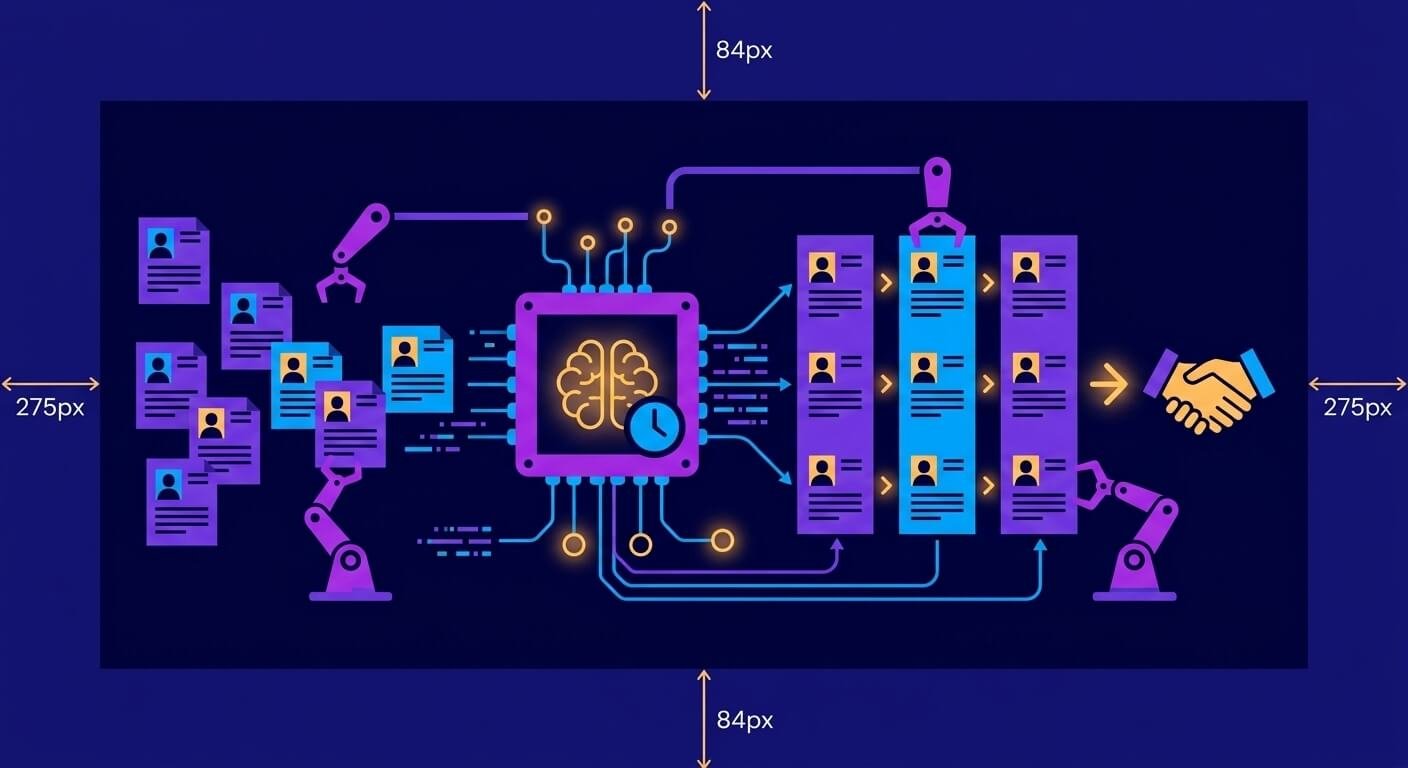

AI agents for document processing have moved decisively beyond proof-of-concept territory, yet most enterprise deployments still fail because leaders conflate what these systems can do with what they should do unsupervised. If your firm is evaluating custom AI agent integration for extraction, classification, or routing workflows, the single most important distinction is not which vendor has the best demo it is understanding precisely where autonomous operation is commercially safe and where it is not. This article delivers that framework, grounded in real deployment data from UK-regulated environments.
Executive SummaryAI agents for document processing reduce manual verification time by up to 73% on standardised workflows and cut cost-per-document from pounds to pence at scale. However, autonomous operation is only safe for Tier 1 documents such as invoices and KYC forms. Legal contracts and M&A due diligence files require structured human checkpoints. UK deployments must satisfy FCA DP24/1 guidelines, ICO automated decision-making rules under UK GDPR Article 22, and Bank of England SYSC 35 operational resilience requirements. Skipping these compliance steps is not a calculated risk it is a regulatory liability.
What AI Agents for Document Processing Actually Do
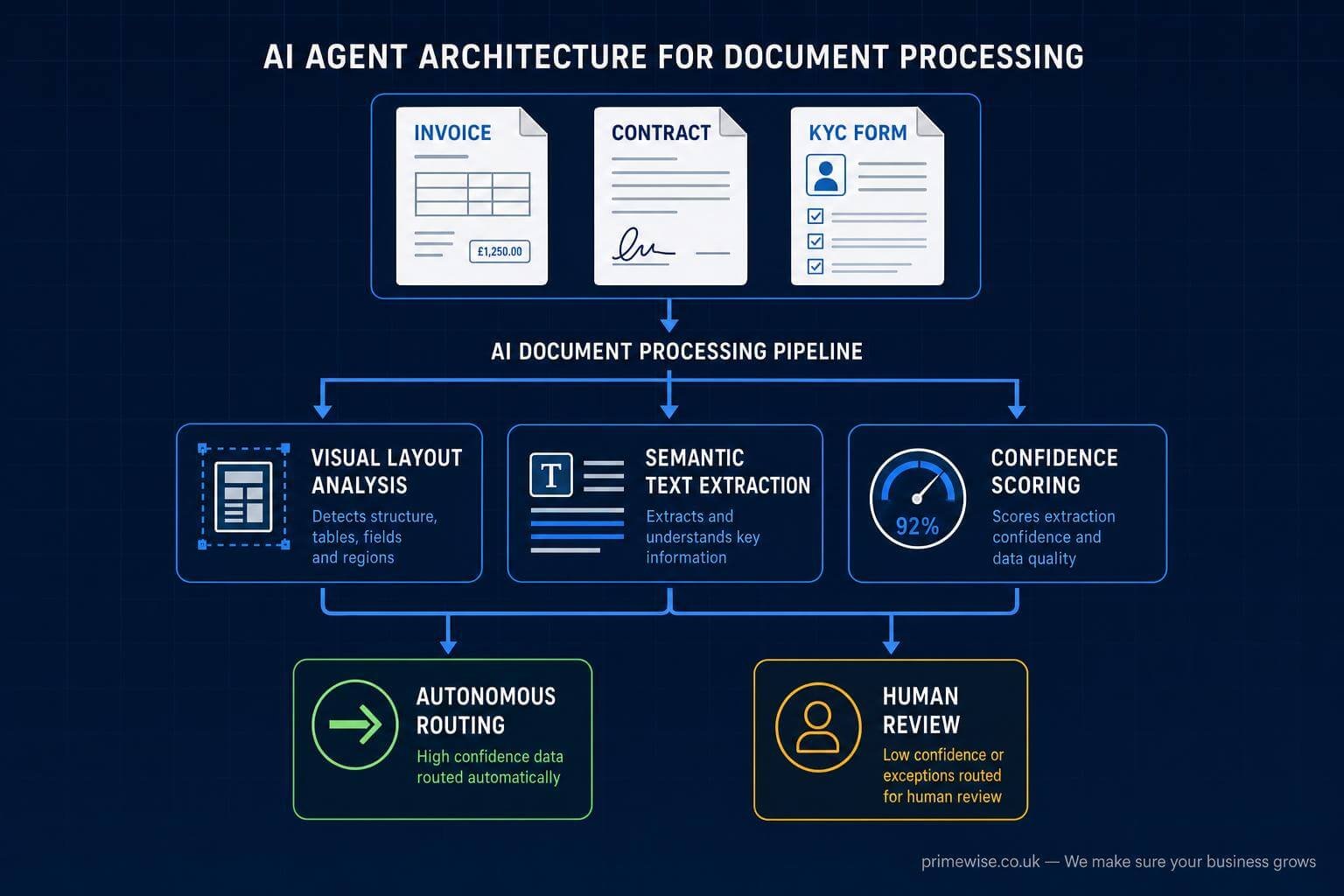
An AI agent for document processing is an autonomous software system that combines multimodal large language models, business logic orchestration, and confidence-scoring mechanisms to ingest, classify, extract, and route unstructured data without continuous human instruction. Unlike a simple OCR pipeline that reads characters from a page, a true agentic system understands the structural and semantic relationship between a signature block, a liability clause, and an appended financial schedule simultaneously. The agent then decides based on its own confidence score against predefined thresholds whether to complete the task autonomously or escalate to a human reviewer. This self-directed decision loop is what separates genuine document intelligence from glorified text extraction.
According to Gartner’s 2025 analysis, 80% of enterprise document workflows will involve agentic AI components by 2027. McKinsey research consistently places document-intensive processes as consuming between 20% and 30% of total enterprise operational cost. These figures explain the executive urgency but they do not explain where the technology breaks down, which is the more commercially critical question for any regulated UK institution.
Why Standard OCR-Plus-LLM Pipelines Fail
The enterprise software market remains saturated with vendors selling optical character recognition layered on top of a large language model and labelling the result an AI agent. This architecture is architecturally insufficient for complex document environments. When a pipeline strips raw characters from a page, it destroys the spatial metadata the precise positional relationship between a figure in a table header, the footnote qualifying it, and the clause that references both. That lost spatial context is exactly what generates hallucinations in financial extraction tasks.
The specific failure modes matter for procurement decisions. Standard OCR-plus-LLM pipelines consistently fall over when processing nested financial tables within annual reports, heavily formatted legal addendums where clause numbering resets across sections, redacted wealth management documents where critical data is deliberately obscured, and multi-column regulatory filings such as FCA Form A submissions where column boundary detection errors cascade into systematic data misattribution. Recognising these failure points allows technology leaders to make intelligent decisions about which workflows to automate and which to protect with oversight protocols.
True agentic workflows resolve this through Retrieval-Augmented Generation (RAG) architecture combined with multimodal vision models that process the visual layout of a document concurrently with its semantic text content. Frameworks such as LangChain, AutoGen, and CrewAI provide the orchestration layer that allows individual AI agents to pass document segments between specialised sub-agents one handling visual table extraction, another handling clause-level semantic reasoning before a final confidence-scoring agent determines the routing decision. This is the architectural baseline that enterprise deployments in regulated UK environments should demand from any vendor.
The UK Regulatory Framework for AI Document Deployments
Enterprise buyers operating in the United Kingdom cannot treat regulatory compliance as a post-deployment consideration. The FCA’s October 2024 Discussion Paper DP24/1 on AI in financial services establishes clear expectations around algorithmic transparency, model auditability, and the governance structures firms must have in place before deploying AI in decision-adjacent workflows. Any AI agent processing documents that inform credit decisions, client onboarding outcomes, or transaction approvals falls within the scope of this guidance.
The Information Commissioner’s Office guidance on automated decision-making under UK GDPR Article 22 adds a further layer of obligation. Where an AI agent’s output has a significant effect on an individual including routing a client file toward rejection or approval firms must ensure that a meaningful human review mechanism exists and is documented. This is not optional. The Bank of England’s SYSC 35 operational resilience rules extend these obligations to third-party AI vendors, meaning that a firm’s responsibility for the agent’s behaviour does not transfer to the vendor simply because the software is licensed rather than built in-house.
Cross-Border Compliance WarningUK firms operating cross-border M&A or multi-jurisdictional client relationships must also account for the EU AI Act's extraterritorial provisions. If your AI agent processes documents for EU-based counterparties, the Act's transparency and human oversight requirements apply regardless of where your servers are located. Legal technology teams should review the Law Society's 2025 practice note on AI use in legal document review as a baseline compliance reference.
Data residency is a parallel concern that Magic Circle law firms and City institutions consistently underestimate at the procurement stage. Personally identifiable information processed by an AI agent must remain within compliant geographic boundaries under UK GDPR. This architectural requirement mandates private cloud infrastructure or strictly gated on-premise deployments for any document containing client financial data, beneficial ownership information, or HMRC SA302 tax records. Cloud-native vendor solutions that route data through US or EU processing nodes require explicit data transfer impact assessments before deployment approval.
The Document Tiering Model
The most actionable framework for any operations director evaluating AI document production and management tools is a clear classification of which document types suit autonomous processing, which require supervised automation, and which must never be handed to an agent without intensive human oversight. The following tiering model reflects deployment realities across UK professional services and financial institutions not vendor marketing claims.
| Tier | Document Types | Automation Level | Accuracy Benchmark | Human Oversight |
|---|---|---|---|---|
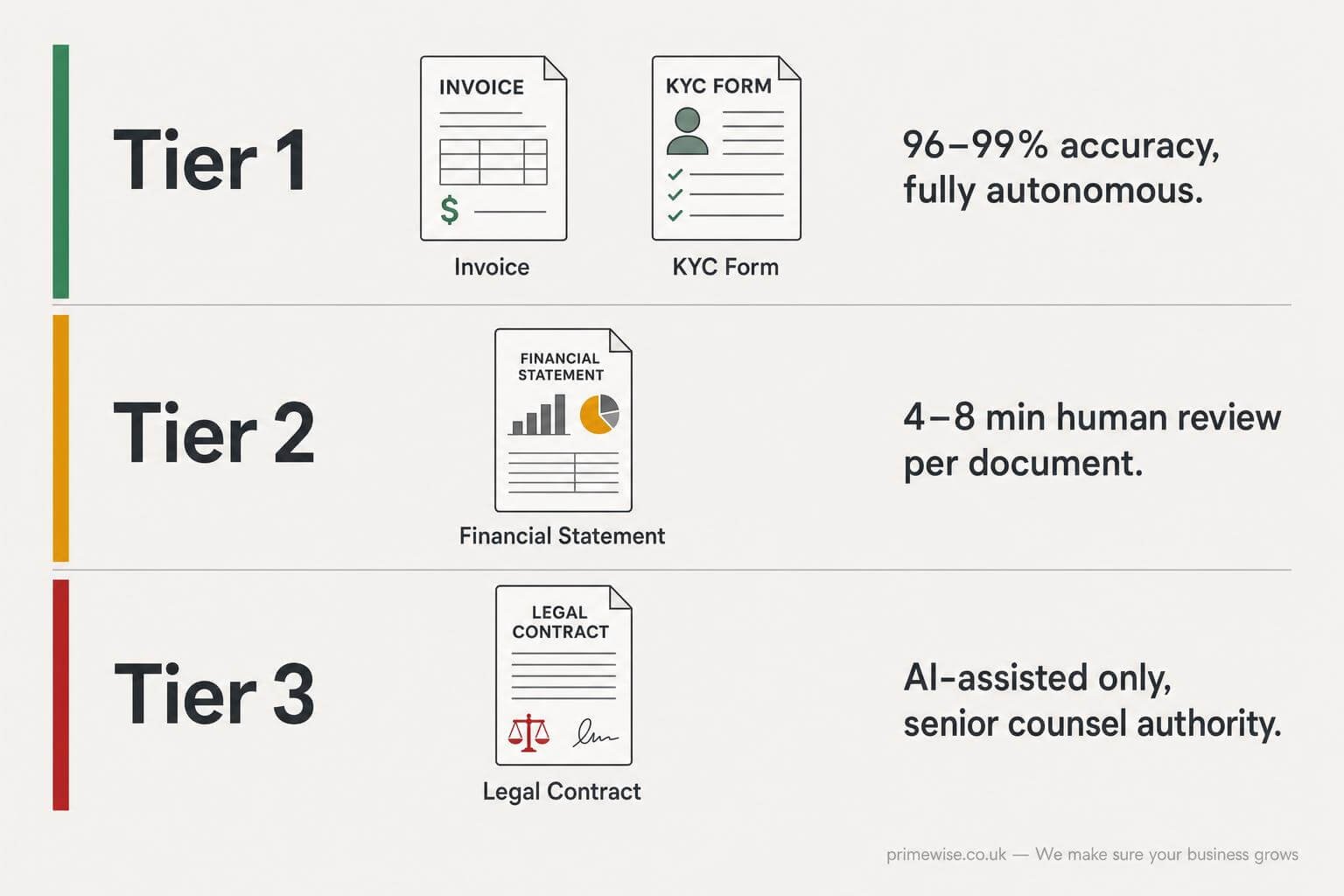
| Tier 1 | Standard invoices, KYC forms, supplier receipts, Companies House confirmation statements | Fully autonomous (straight-through processing) | 96–99% extraction accuracy | Exception-only review when confidence score drops below threshold |
| Tier 2 | Financial statements, tax returns, standard supplier agreements, HMRC SA302 forms | AI-led with mandatory human sign-off | 88–95% extraction accuracy | Reviewer spends 4–8 minutes per document versus 45–90 minutes fully manual |
| Tier 3 | Bespoke legal contracts, ISDA Master Agreements, M&A due diligence files, FCA Form A submissions | AI-assisted research only | Variable agent reduces preliminary review time by ~60% | Senior legal counsel retains full analytical authority |
Tier 1 Safe for Autonomous Extraction
High-volume, low-complexity documents including standard invoices, supplier receipts, and basic Know Your Customer forms are the ideal candidates for fully autonomous straight-through processing. At this tier, AI agents for document management consistently achieve extraction accuracy between 96% and 99% with zero human intervention required during normal operation. The standardisation of these templates allows multimodal models to extract structured data rapidly and push verified outputs directly into enterprise resource planning systems such as SAP S/4HANA or Oracle NetSuite, or into document management platforms including iManage and NetDocuments, without manual data entry at any stage. Cost-per-document at scale falls to between £0.08 and £0.25 a reduction of 85–92% versus fully manual processing benchmarks.
Tier 2 Supervised Automation
Moderate-complexity files including financial statements, corporate tax returns, and standard supplier agreements introduce variable formatting and contextual dependencies that demand a higher degree of agentic reasoning. An AI agent analyzing documents at this tier can ingest a set of annual accounts formatted across five different corporate layouts, map the reconciliation figures correctly, flag statistical anomalies against prior-period comparators, and deliver a structured summary to a human reviewer. What the agent cannot safely do is certify that summary without a qualified person checking it. The human sign-off time at this tier is 4–8 minutes per document, compared to 45–90 minutes for a fully manual equivalent a meaningful efficiency gain without compromising the quality assurance chain.
Tier 3 The Danger Zone
Bespoke legal contracts, ISDA Master Agreements, and complex M&A due diligence files occupy the highest-risk category for autonomous AI document production and analysis. At this tier, the agent functions as an extraordinarily capable research assistant rather than a decision-maker. Deployed correctly, it can reduce the time a senior associate spends on preliminary document review by approximately 60%, surfacing relevant clauses, identifying definitional inconsistencies, and cross-referencing schedules against the master agreement. What it must never do is finalise a liability position, approve a warranty clause, or sign off on a risk assessment without the senior lawyer reading the source material. Treating Tier 3 documents as Tier 1 candidates is the single most commercially dangerous misapplication of this technology.
Deployment InsightFirms that attempt to skip the tiering classification step and deploy a single automation policy across all document types consistently report accuracy failures, regulatory breaches, or both within the first 90 days. The tiering model is not optional infrastructure it is the foundation of every safe production deployment.
The Human-AI Checkpoint Matrix for Financial Document Processing
Safe deployment of AI agents across regulated professional environments requires a formally designed failsafe architecture rather than an informal assumption that the AI will flag its own errors. The Human-AI Checkpoint Matrix is a structured protocol that defines precisely when autonomous processing must pause, what triggers escalation to a human reviewer, and how exception decisions are recorded for regulatory audit purposes.
The matrix operates on three primary trigger mechanisms. The first is the confidence score threshold: if an AI agent’s internal confidence metric for a given extraction falls below 92%, the document is automatically suspended from autonomous processing and routed to a named human reviewer with a flagged summary of the uncertain fields. The second is the anomaly detection trigger: if the agent identifies a figure, clause, or data point that deviates materially from the established baseline for that document type for example, an invoice line item 340% above the supplier’s historical average the entire document is escalated rather than partially approved. The third is the document classification override: if the initial classification agent cannot place an incoming file within an established tier with high confidence, it defaults to Tier 3 treatment regardless of superficial formatting similarity to lower-risk document types.
Every escalation event is logged with a timestamp, the specific trigger condition, the reviewing human’s credentials, and the final decision outcome. This audit trail is not merely good operational hygiene it is the documentation that satisfies FCA DP24/1’s algorithmic transparency requirements and ICO Article 22 obligations simultaneously. Firms that design this logging architecture before deployment rather than retrofitting it afterward save considerable compliance remediation cost at their first regulatory review.
Real ROI Building the Commercial Case
Securing executive buy-in for an AI document processing deployment requires moving beyond percentage efficiency claims and into the specific financial and operational metrics that a CFO or Chief Operating Officer will interrogate. The commercial case rests on four quantifiable pillars.
The first pillar is cost-per-document reduction. For Tier 1 workflows, agentic processing reduces cost-per-document from a typical manual benchmark of £1.80–£3.50 to £0.08–£0.25 at operational scale. For a firm processing 50,000 invoices annually, this equates to a direct overhead reduction of between £77,500 and £162,500 per year on that single workflow category alone. The second pillar is turnaround time compression. Agentic routing reduces manual verification time by up to 73% during initial legal triage, compressing document processing timelines from days to minutes for Tier 1 and Tier 2 assets. The third pillar is headcount reallocation. Full-time equivalent resources previously dedicated to manual data entry can be redeployed toward higher-value client advisory work without redundancy costs, improving both firm profitability and staff retention metrics. The fourth pillar is error-cost elimination. Manual document processing error rates in financial services typically run between 1% and 4% of processed documents. At scale, a 2% error rate on 50,000 documents generates 1,000 correction events annually each carrying remediation cost, potential client relationship damage, and regulatory risk.
Tech Stack Integration with Legacy Architectures
The practical barrier to entry for City of London institutions and UK law firms is rarely the AI capability itself it is the integration challenge of connecting modern agentic systems with legacy mainframe architectures and established document management workflows. This concern is legitimate but frequently overstated by vendors who benefit from full infrastructure replacement projects.
Modern enterprise-grade AI agents are specifically engineered to interface with existing software ecosystems through secure application programming interfaces and bespoke middleware layers. An agent deployed for invoice processing can pull incoming documents from a Microsoft SharePoint repository, process them through the multimodal extraction layer, push verified outputs into an SAP system of record, and flag exceptions into a Microsoft Teams channel for human review all without requiring the firm to migrate its document management platform or replace its ERP. Integration with iManage, NetDocuments, and legacy on-premise repositories follows the same API-first pattern, ensuring that AI document production capabilities are additive to existing infrastructure rather than disruptive to it. Firms operating IBM or Unisys mainframe environments for core transaction processing can deploy AI agents at the document ingestion layer without touching the systems of record that regulators and auditors scrutinise.
Evaluating the Best AI Agent for Document Processing
Selecting the appropriate solution for a UK-regulated institution demands a rigorous technical assessment that goes beyond vendor demo performance. The evaluation criteria that separate production-ready platforms from sophisticated prototypes include multimodal vision accuracy on complex visual layouts, zero-shot and few-shot learning capability for rapid deployment without months of annotated training data, transparent confidence scoring with configurable threshold controls, and native audit logging that satisfies FCA and ICO documentation requirements out of the box.
Scalability from a controlled proof of concept to a firm-wide deployment is a non-negotiable requirement. Many platforms perform exceptionally in demo conditions with clean, well-formatted documents and degrade significantly when exposed to the volume, variety, and quality variation of a real enterprise document ingestion pipeline. Chief Technology Officers should demand performance benchmarking on the firm’s own document corpus not vendor-supplied test sets before committing to a production contract.
Firms such as Primewise specialise in designing vendor-agnostic agentic document architectures for UK-regulated institutions, mapping deployment tiers against existing compliance obligations before a single line of code is written. This practitioner approach grounding technology selection in regulatory reality and existing infrastructure constraints rather than capability marketing is what distinguishes deployments that deliver measurable ROI from those that stall at the pilot stage.
Next Steps for Enterprise LeadersOperations directors seeking a structured deployment assessment can request a confidential ROI scoping session at primewise.co.uk. The evaluation benchmarks your current document overhead against agentic workflow projections within 48 hours, giving your leadership team the financial and compliance data needed to brief procurement with confidence.
Author
This article was written by a specialist in intelligent document processing with direct experience designing AI extraction, classification, and routing architectures for professional services, finance, and legal firms across the United Kingdom. Deployment experience spans FCA-regulated financial institutions, Magic Circle law firm engagements, and multinational corporate services groups.