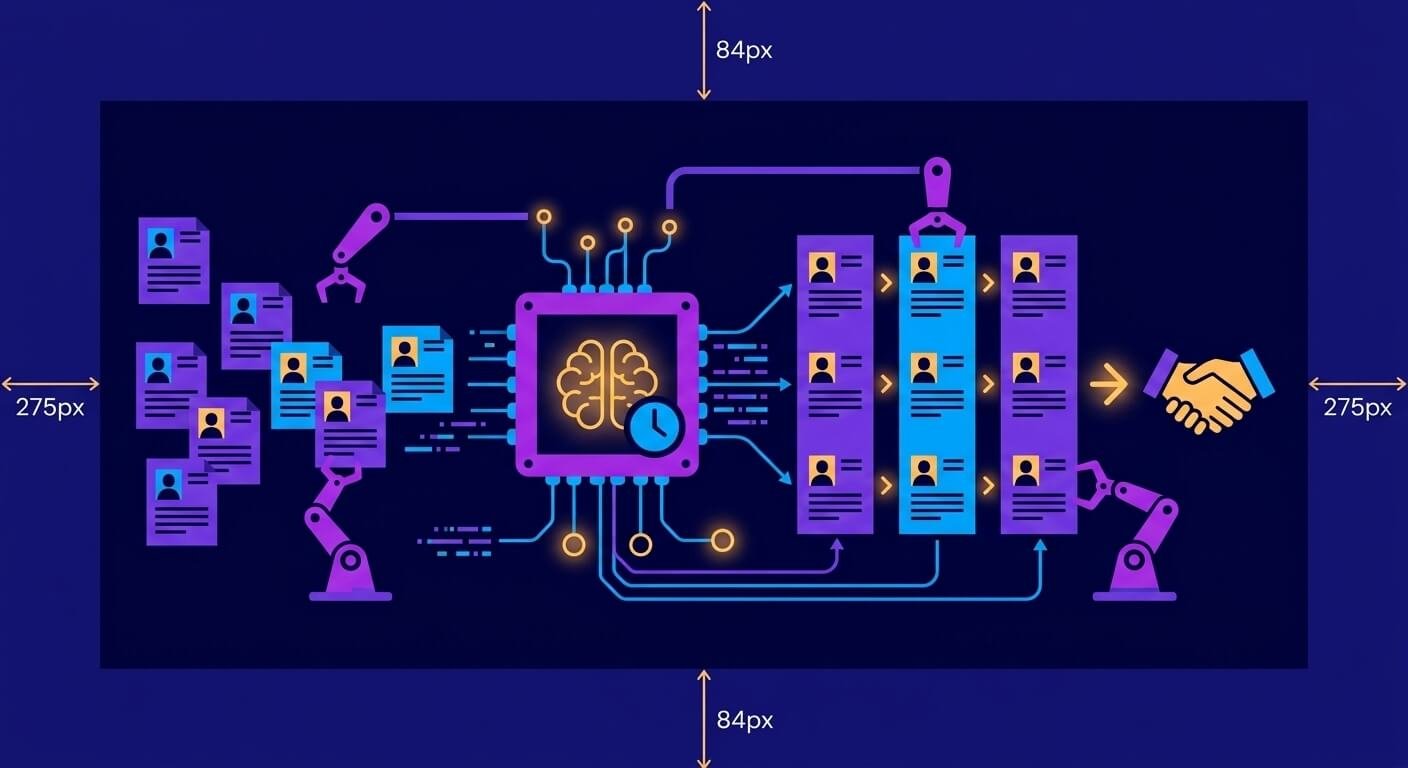
AI automation for recruitment agencies in the UK now encompasses five proven workflow categories CV parsing and CRM enrichment, compliance-gated candidate screening, hyper-personalised outreach sequencing, dynamic interview scheduling, and AI-assisted reporting that collectively reclaim between eight and fourteen fee-earning hours per consultant every month. I spent eleven years as a recruitment operations director before pivoting to building AI workflows exclusively for UK staffing firms, and the pattern I observe repeatedly is the same: agencies invest in off-the-shelf platforms, generate more administrative friction than they remove, and declare AI a failure. The problem is never artificial intelligence itself. The problem is deploying generic tools against bespoke operational environments without a compliance-first architecture underpinning every automated touchpoint.
The UK staffing sector generated approximately £42.6 billion in turnover in 2025 according to the REC’s UK Recruitment Industry Status Report, yet margin compression continues to tighten. Consultant attrition driven by administrative overload is eroding the very productivity gains agencies need to compete. APSCo research consistently highlights that UK recruiters spend between thirty and forty percent of their working week on non-billable administrative tasks. The operational imperative is no longer whether to automate it is which workflows to automate first, and how to do so without triggering an ICO enforcement action.
What AI Automation for Recruitment Agencies Actually Means
AI automation for recruitment agencies means deploying machine learning models and large language models to systematically eliminate repeatable administrative tasks CV formatting, CRM data entry, candidate outreach, and interview coordination while preserving human consultant judgment at every commercially or legally significant decision point. It is not about replacing recruiters. It is about removing the low-value processing work that prevents recruiters from doing the high-value relationship and commercial work that generates fees. The critical distinction separating successful deployments from expensive failures is integration depth: automation that operates natively within your existing ATS and CRM infrastructure delivers measurable return on investment, while automation that creates parallel data environments destroys it.
EXECUTIVE SUMMARYUK recruitment agencies using compliant AI automation across five core workflow categories reclaim up to 14 fee-earning hours per consultant monthly, report a 35% increase in candidate response rates, and can scale mandate volume threefold without linear headcount growth provided every deployment satisfies Article 22 of the UK GDPR through enforced Human-in-the-Loop oversight.
Why Off-the-Shelf AI Fails London Recruitment Desks
The London market particularly in finance, technology, and legal recruitment operates at a pace and specialisation level that generalised large language models simply cannot serve effectively. A generic AI tool trained on broad internet data lacks the sector-specific vocabulary, the nuanced candidate evaluation criteria, and the regulatory sensitivity that a financial services desk or a legal practice management placement requires. When these tools are bolted onto legacy applicant tracking systems without native API integration, data silos emerge immediately. Consultants find themselves duplicating entry across platforms, which destroys any projected return on investment and accelerates the very burnout the technology was meant to address.
The RPA distinction matters here. Robotic Process Automation handles deterministic rule-based tasks moving data between fields, triggering email templates based on status changes while generative and predictive AI handles probabilistic judgement tasks such as candidate matching, outreach personalisation, and pipeline forecasting. Conflating the two leads to misapplied solutions. A Bullhorn-native automation that uses RPA to update candidate records when a CV status changes is a fundamentally different technical intervention than deploying a large language model to generate personalised outreach copy from CRM profile data. Both are valuable. Neither replaces the other. Understanding the distinction is the foundation of a coherent technology stack.
The Human-in-the-Loop Imperative
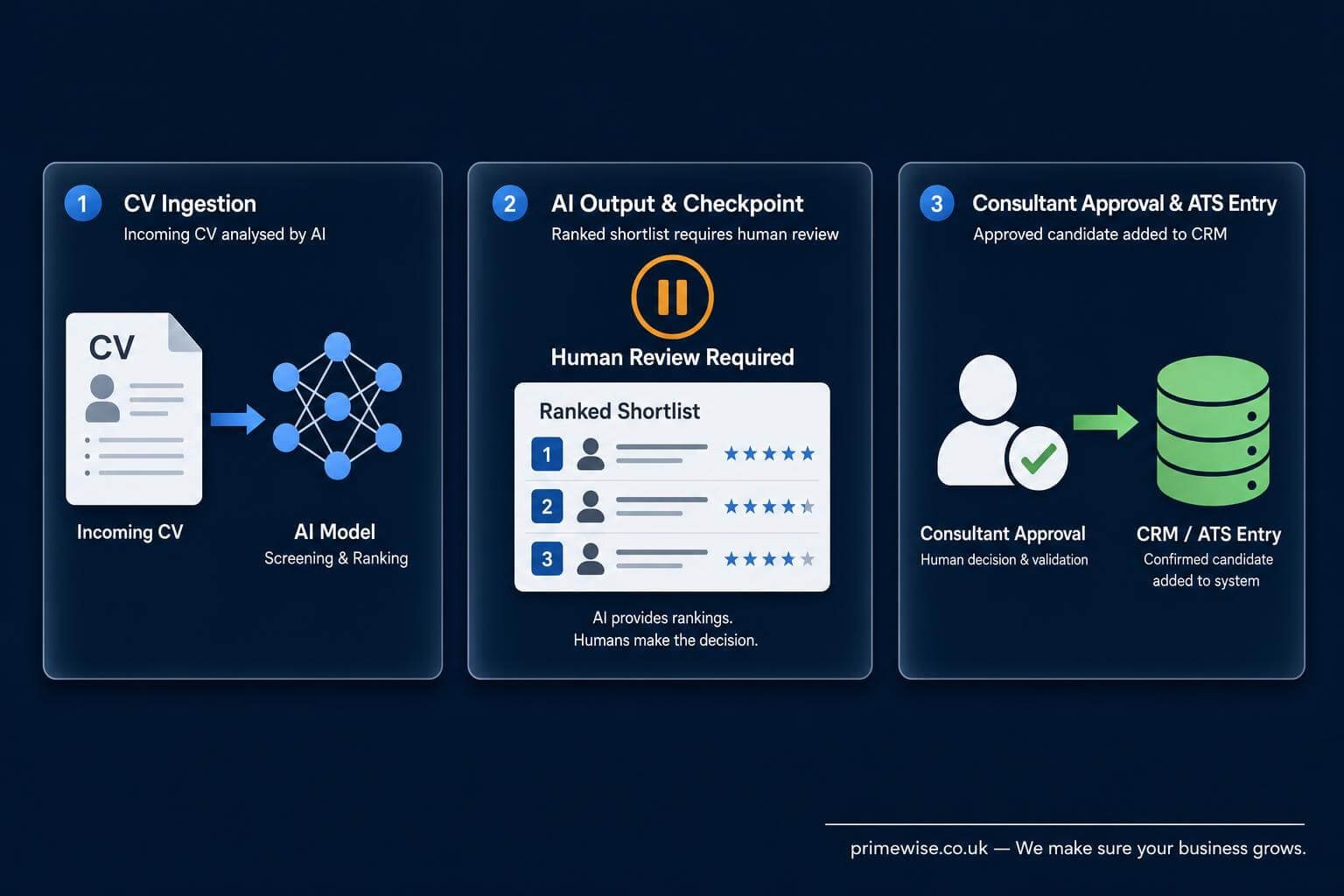
Algorithmic decision-making in recruitment carries explicit legal risk under UK GDPR that operations directors cannot afford to treat as an advisory concern. The Human-in-the-Loop methodology positions every algorithmic output as a recommendation rather than a decision. The consultant reviews, validates, and approves before any outcome affecting a candidate is actioned. This single architectural principle neutralises the Article 22 exposure that has already resulted in ICO enforcement notices against organisations using automated screening without documented human oversight. It also builds consultant trust in the technology, which is the single biggest adoption barrier I encounter in practice.
The Five Core AI Automation Workflows
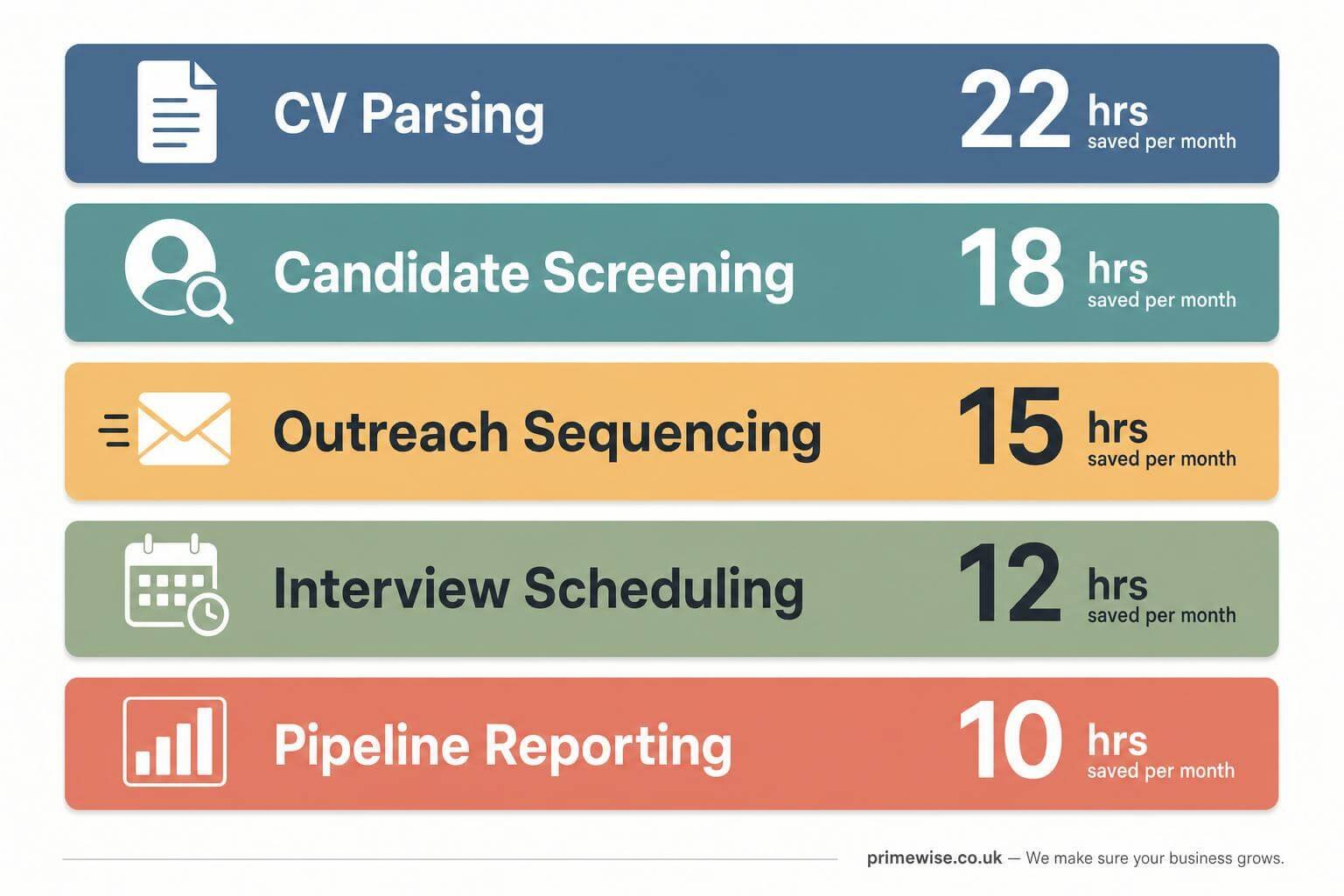
The following table maps the five proven workflow categories against the metrics that matter to operations directors. These figures are drawn from aggregated implementation data across UK recruitment clients deploying CRM-native AI automation, and are presented as practical operational benchmarks rather than vendor marketing claims.
| Workflow | Monthly Hours Saved Per Consultant | Primary Compliance Consideration | Recommended Integration | Implementation Complexity |
|---|---|---|---|---|
| CV Parsing and CRM Enrichment | 4 to 5 hours | Article 5 UK GDPR data minimisation | Bullhorn, Vincere, Idibu | Low |
| Compliance-Gated Candidate Screening | 2 to 3 hours | Article 22 UK GDPR automated decisions | Bullhorn AI, SourceBreaker | Medium |
| Hyper-Personalised Outreach Sequencing | 2 to 3 hours | PECR electronic communications consent | Vincere, LinkedIn Recruiter AI | Medium |
| Dynamic Interview Scheduling | 3 to 4 hours | Article 6 UK GDPR lawful basis for processing | Calendly AI, Microsoft Copilot | Low |
| AI-Assisted Pipeline Reporting | 1 to 2 hours | Article 35 UK GDPR high-risk processing DPIA | Bullhorn Analytics, Power BI | Low to Medium |
Workflow One CV Parsing and CRM Enrichment
Manual CV formatting and CRM data entry consume thousands of fee-earning hours annually across a mid-sized UK agency. A consultant processing thirty CVs per week at an average of eight minutes per CV is losing four hours every week to a task that a parsing algorithm can complete in seconds with greater structural consistency. Deploying CV parsing integrated natively with platforms like Bullhorn or Vincere eliminates this bottleneck entirely. The AI extracts skills, employment history, qualifications, and contact data, maps them against your existing CRM taxonomy, and executes the enrichment without manual intervention.
Bullhorn’s native AI features, expanded significantly through their Bullhorn Automation suite, allow agencies to trigger parsing workflows at the point of application receipt, automatically assign candidates to relevant job categories, and flag profile gaps for consultant review. Vincere’s AI matching engine performs similar enrichment while cross-referencing the candidate profile against open mandates in real time. Idibu, widely used by UK agencies for multi-posting, integrates with both platforms to consolidate inbound applications from multiple job boards into a single parsed feed, eliminating the manual aggregation step that typically accounts for a significant portion of the administrative overhead.
COMPLIANCE NOTEUnder Article 5(1)(c) of the UK GDPR, CV parsing workflows must apply data minimisation principles extract only what is demonstrably necessary for the specific recruitment purpose. Storing parsed data indefinitely without a documented retention schedule constitutes a breach. Establish a maximum retention period and automate deletion triggers within your ATS before going live.
The Zero-Bias Automated Sourcing Protocol
Systematic bias in CV screening is both a legal liability under the UK Equality Act 2010 and a commercial liability in terms of the talent pool quality you present to clients. Advanced blind hiring AI applies an information gain framework to strip protected characteristics age indicators, names with ethnic associations, addresses in demographically distinct postcodes, and graduation year proxies from parsed CVs before human consultant review. This protocol does not remove human judgment from the evaluation process; it ensures that human judgment operates on professional merit signals rather than protected characteristic proxies.
For agencies holding preferred supplier agreements with enterprise or public sector clients, documented algorithmic fairness is increasingly a contractual requirement. Maintaining a bias audit trail logs showing which fields were redacted, when, and by which model version provides the evidential foundation needed during supplier panel reviews and external audits. SourceBreaker, used widely by UK finance and technology recruitment desks, offers sourcing filters that can be configured to enforce these parameters during Boolean search construction, reducing the risk of biased sourcing before a CV is ever reached.
Workflow Two Compliance-Gated Candidate Screening
This is the workflow where the most significant regulatory risk concentrates, and therefore where the most rigorous Human-in-the-Loop architecture is non-negotiable. AI can shortlist, rank, and annotate candidate profiles against job requirements with impressive accuracy. What AI cannot legally do, under Article 22 of the UK GDPR, is autonomously reject an applicant producing a legally significant effect on that data subject without explicit consent or documented human review. The ICO has been explicit in its guidance: automated profiling that results in exclusion from a recruitment process requires either the data subject’s explicit consent or falls under a legitimate interests assessment that can withstand scrutiny.
In practice, the compliant architecture looks like this: the AI generates a ranked shortlist with annotated reasoning for each candidate’s position. A consultant reviews the shortlist, can override any ranking, and must actively confirm progression or rejection decisions within the ATS. The AI never writes to the candidate record without consultant approval. This workflow, when properly implemented in Bullhorn using their workflow automation rules, reduces the time a consultant spends on initial shortlist review from two hours to approximately twenty-five minutes for a role with fifty applicants, while creating a complete, timestamped audit trail of every human decision point.
Workflow Three Hyper-Personalised Automated Outreach
Passive candidate sourcing in competitive sectors like London finance and technology requires outreach precision that generic messaging cannot achieve. High-value candidates in these markets receive multiple approaches weekly. The only outreach that generates a response is outreach that demonstrates genuine understanding of the individual’s career trajectory, the specific opportunity, and the reason the match is contextually relevant to that person at this point in their career.
AI outreach automation powered by large language models enables consultants to generate this level of personalisation at scale. By directing the model to synthesise a candidate’s CRM profile data including previous interactions, skills taxonomy, last contacted date, and placement history against the live job specification, the system generates a first-draft message that reads as individually authored rather than templated. UK agencies deploying this approach within Vincere’s messaging module, or via LinkedIn Recruiter AI’s personalised InMail generation, report response rate improvements of approximately thirty-five percent compared to standard templated sequences.
Outreach Sequences That Convert Without Spamming
Volume-based outreach strategies trigger spam filters, damage sender reputation, and generate ICO complaints under PECR. The compliant, high-converting alternative is a precision sequence: an initial personalised message, a single contextually relevant follow-up referencing a specific market development in the candidate’s sector, and a graceful close that preserves the relationship regardless of immediate response. Prompt engineering discipline is the differentiator here. The AI instructions must specify tone parameters, length constraints, the specific CRM fields to reference, and the compliance boundaries no references to salary ranges not explicitly shared by the client, no implied exclusivity claims about opportunities. Consultants who master prompt engineering for their specific sector typically reclaim two to three hours weekly from outreach composition alone.
Workflow Four Dynamic Interview Scheduling
Calendar coordination between candidate, consultant, and hiring manager is one of the most disproportionately time-consuming tasks in the recruitment process. A single interview slot confirmation can involve eight to twelve email exchanges across three or more parties over two to three days. Dynamic calendar syncing eliminates this entirely. AI scheduling tools cross-reference all parties’ calendars in real time, propose three optimal interview slots, issue automated confirmation emails, and send SMS reminders to both candidate and hiring manager twenty-four hours before the interview.
Microsoft Copilot, integrated with Microsoft 365 environments common across UK finance recruitment operations, can handle this coordination autonomously once the consultant initiates the process with a single workflow trigger. Calendly’s AI scheduling features offer a platform-agnostic alternative for agencies whose clients use diverse calendar systems. Operational benchmarks from agencies implementing dynamic scheduling consistently show a reduction of three to four hours of administrative overhead per consultant per week, alongside a measurable improvement in candidate experience scores a metric increasingly tracked by enterprise clients during preferred supplier panel assessments.
Workflow Five AI-Assisted Pipeline Reporting
Reporting and forecasting consume consultant and operations director time that compounds invisibly. Building weekly pipeline reports from ATS data, formatting activity dashboards for client reviews, and generating compliance documentation for supplier audits represent a collective drain that AI-assisted reporting can reduce to near-zero manual effort. Bullhorn Analytics, combined with natural language query interfaces, allows operations directors to generate detailed pipeline reports through conversational prompts rather than manual data extraction and spreadsheet formatting. Power BI integrations extend this capability across the broader business intelligence environment.
The UK Recruitment AI Compliance Matrix
Navigating the intersection of talent acquisition technology and UK data protection law requires a structured compliance matrix rather than reactive legal checks. Every AI deployment in a recruitment context must be mapped against the following framework before go-live, and audited at minimum annually thereafter. This is the framework I implement with every client before a single automation is activated.
- Establish the lawful basis for processing under Article 6 of the UK GDPR for most recruitment AI workflows, legitimate interests is the most operationally practical basis, but requires a documented Legitimate Interests Assessment balancing your interests against candidate rights
- Complete a Data Protection Impact Assessment under Article 35 for any high-risk processing activity CV parsing at scale, automated candidate ranking, and outreach profiling all qualify as high-risk under ICO guidance
- Document the Human-in-the-Loop checkpoint for every workflow that produces an output affecting a candidate’s progression this is your Article 22 safeguard and must be enforced architecturally within the ATS, not reliant on consultant discretion
- Implement secure API governance all candidate data passed to external large language models must be redacted of personally identifiable information before transmission, with processing agreements in place with every third-party model provider
- Apply data minimisation and retention scheduling under Article 5 parsed candidate data must have a documented maximum retention period with automated deletion triggers built into the ATS workflow
- Maintain immutable audit logs of every automated and human decision point these logs are your evidential defence during ICO investigations and client supplier audits
- Review the EU AI Act’s extraterritorial implications if your agency places candidates based in EU member states the Act’s high-risk AI classification for recruitment systems applies regardless of where the deploying agency is headquartered
LEGAL NOTICEThe ICO's 2024 guidance document on AI and data protection explicitly states that organisations deploying AI for recruitment must conduct a DPIA before processing begins, not after. Retrospective DPIAs do not satisfy the Article 35 requirement. If your agency has already deployed AI screening tools without a completed DPIA, this represents an active compliance gap requiring immediate remediation.
Navigating Article 22 of the UK GDPR in Practice
Article 22 restricts solely automated individual decision-making that produces legal or similarly significant effects on a data subject. In recruitment, rejecting an applicant from a process constitutes exactly such an effect. The practical compliance architecture requires three documented elements: a clear lawful basis for the automated processing, a Human-in-the-Loop checkpoint that is architecturally enforced rather than procedurally advised, and a mechanism by which candidates can request human review of any automated assessment. Agencies that build this architecture natively into Bullhorn or Vincere workflow rules rather than relying on consultant compliance can confidently demonstrate regulatory alignment during ICO investigations and enterprise client due diligence reviews.
Maintaining Audit Trails and Fairness Reporting
Enterprise and public sector clients at the preferred supplier level now routinely request evidence of algorithmic transparency during panel renewal reviews. Immutable audit logs timestamped records of every automated action, every human decision point, and every candidate communication provide the evidential infrastructure needed to satisfy these requests. Algorithmic fairness reports, showing the demographic distribution of candidates progressed versus screened at each stage, demonstrate active bias monitoring. Agencies that can produce this documentation on request occupy a materially stronger commercial position than competitors who cannot.
Scaling Without Headcount An Illustrative Operational Model
The following scenario is an illustrative operational model based on aggregated outcomes from multiple client implementations, presented transparently as a composite rather than a single named engagement. A premier London financial services recruitment desk eight consultants, predominantly placing mid-to-senior finance professionals across asset management and private equity was generating consistent mandate volume but experiencing stagnant gross profit growth. Consultant attrition was running at forty percent annually, driven primarily by administrative overload. The average consultant was spending fourteen hours per week on CV formatting, CRM data entry, interview coordination, and manual outreach composition.
Following a structured workflow audit, five automation interventions were deployed natively within their Bullhorn instance: CV parsing with CRM enrichment, compliance-gated screening with documented HITL checkpoints, AI-generated personalised outreach via a secure LLM integration with PII redaction, dynamic scheduling through a Calendly-Bullhorn integration, and automated pipeline reporting. Total administrative overhead per consultant dropped from fourteen hours to under three hours weekly. Consultant attrition in the twelve months following implementation fell to fifteen percent. The existing team handled a sixty-five percent increase in active mandates without adding headcount, and two senior consultants used the reclaimed time to develop client relationships that resulted in retained assignment agreements the highest-margin commercial outcome available to a recruitment firm.
KEY INSIGHTThe most commercially significant outcome of AI automation is not the hours saved directly. It is what experienced consultants do with those reclaimed hours. Senior recruiters redirecting eight hours per week from administration to business development consistently generate disproportionate fee revenue increases within two to three billing cycles of implementation.
Building Your Technology Stack for Compliant AI Automation
A coherent recruitment AI technology stack in 2026 combines CRM-native automation at the foundation with specialist AI layers for specific workflow categories. Bullhorn remains the dominant ATS in the UK mid-market, and its Automation suite now handles a significant portion of the rule-based workflow triggers that previously required manual consultant initiation. Vincere, popular among boutique specialist agencies, offers tighter AI matching integration and a cleaner UX for consultants managing niche talent pools. SourceBreaker’s AI-powered sourcing augments both platforms with Boolean search intelligence and market mapping capabilities that compress candidate identification time significantly.
For outreach personalisation, the most effective deployments use a secure LLM integration layer typically GPT-4 class models accessed via enterprise API with strict data processing agreements and PII redaction middleware rather than the generic AI features bundled within LinkedIn Recruiter. LinkedIn Recruiter AI’s InMail assistance is useful for volume outreach but lacks the depth of CRM profile synthesis available through a purpose-built integration. Microsoft Copilot for Microsoft 365, increasingly adopted across UK finance recruitment operations, provides scheduling intelligence, email drafting assistance, and meeting summary generation that collectively reduce consultant administrative time across multiple workflow categories without requiring new platform adoption.
From AI Fatigue to Operational Leverage with Primewise
Agencies that have successfully moved from AI fatigue to genuine operational leverage share one characteristic: they built bespoke workflow architecture rather than subscribing to another platform. The difference between a successful implementation and a failed one is rarely the technology itself it is whether the automation was designed around the agency’s specific CRM infrastructure, compliance obligations, sector specialisation, and consultant workflow patterns.
The team at Primewise specialises exclusively in designing and deploying compliant, CRM-native AI automation systems for UK recruitment agencies from initial workflow audit through ICO-aligned implementation and ongoing optimisation. If your consultants are still losing hours to administrative tasks that intelligent automation could eliminate, a structured workflow audit is the logical starting point. Agencies that engage at the audit stage consistently identify between six and ten hours of recoverable consultant time per week before a single automation is deployed. Request a compliant AI automation audit for your recruitment agency and establish exactly where your operational leverage opportunity sits.