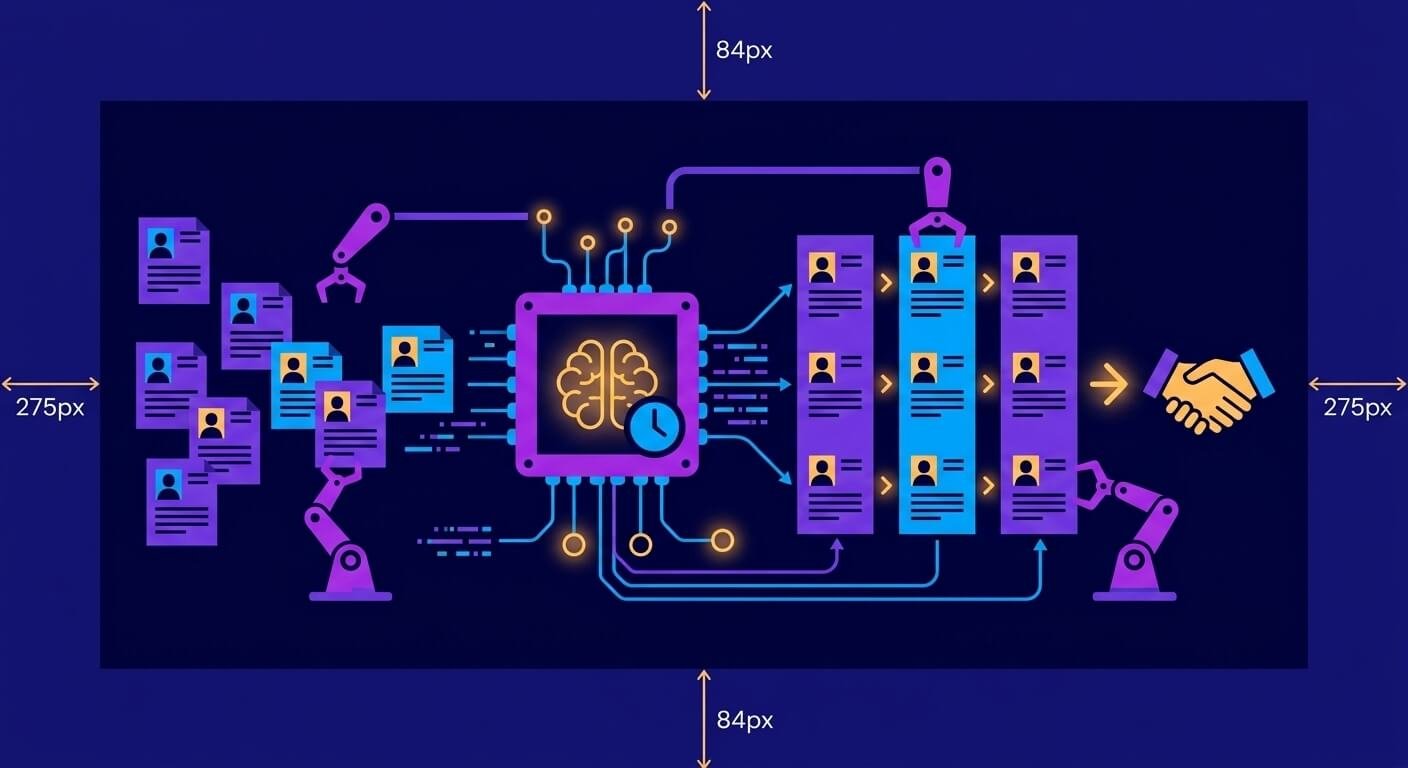

AI automation for law firms is no longer a future-facing ambition it is an operational reality reshaping UK legal practice right now. Senior partners and legal operations leads face a dual pressure: modernise workflows to protect profitability, while maintaining the rigorous supervision and confidentiality standards the Solicitors Regulation Authority demands. This guide cuts through the noise. It maps exactly which processes deliver the highest return when automated, identifies the non-negotiable red lines that must remain under qualified human control, and provides a structured compliance framework that satisfies partner scrutiny and survives SRA inspection. If your firm is evaluating intelligent automation, this is where your due diligence begins.
Executive SummaryUK law firms can legally automate client intake, conflict checking, document drafting, and matter management workflows. However, the SRA's Standards and Regulations 2019 mandate qualified solicitor review at every output stage. Firms without a documented AI governance policy face regulatory censure. Bespoke legal advice, fiduciary decisions, and client fund authorisations must remain entirely human.
What AI Automation Actually Means for UK Law Firms
AI automation for law firms is the strategic deployment of artificial intelligence to execute routine legal operations document extraction, intake triage, matter management, and conflict checking under continuous qualified human supervision, with the explicit goal of recapturing non-billable hours whilst maintaining full regulatory compliance. The definition matters because it draws a precise boundary: these systems are advanced administrative instruments, not autonomous legal advisors. Every output they generate enters a controlled validation queue before it reaches a client, opposing counsel, or court. That architectural principle is what makes intelligent automation legally and professionally defensible under UK standards.
From Hype to Hard Commercial Reality
The legal AI conversation has matured considerably since 2022. Magic Circle firms including Clifford Chance, Linklaters, and Allen and Overy have each publicly committed to enterprise-grade AI deployments focused on document review, due diligence acceleration, and knowledge management not autonomous advice generation. Mid-tier and High Street practices face a different constraint set: tighter budgets, leaner IT infrastructure, and a more direct exposure to SRA inspection without the compliance architecture that large firms maintain. For these practices, the commercial case for automation is equally compelling, but the implementation path must be proportionate, documented, and partner-approved from day one. The firms winning in 2026 are those treating AI not as a technology project but as an operational restructuring programme with measurable efficiency targets.
The Legal AI Triage Matrix
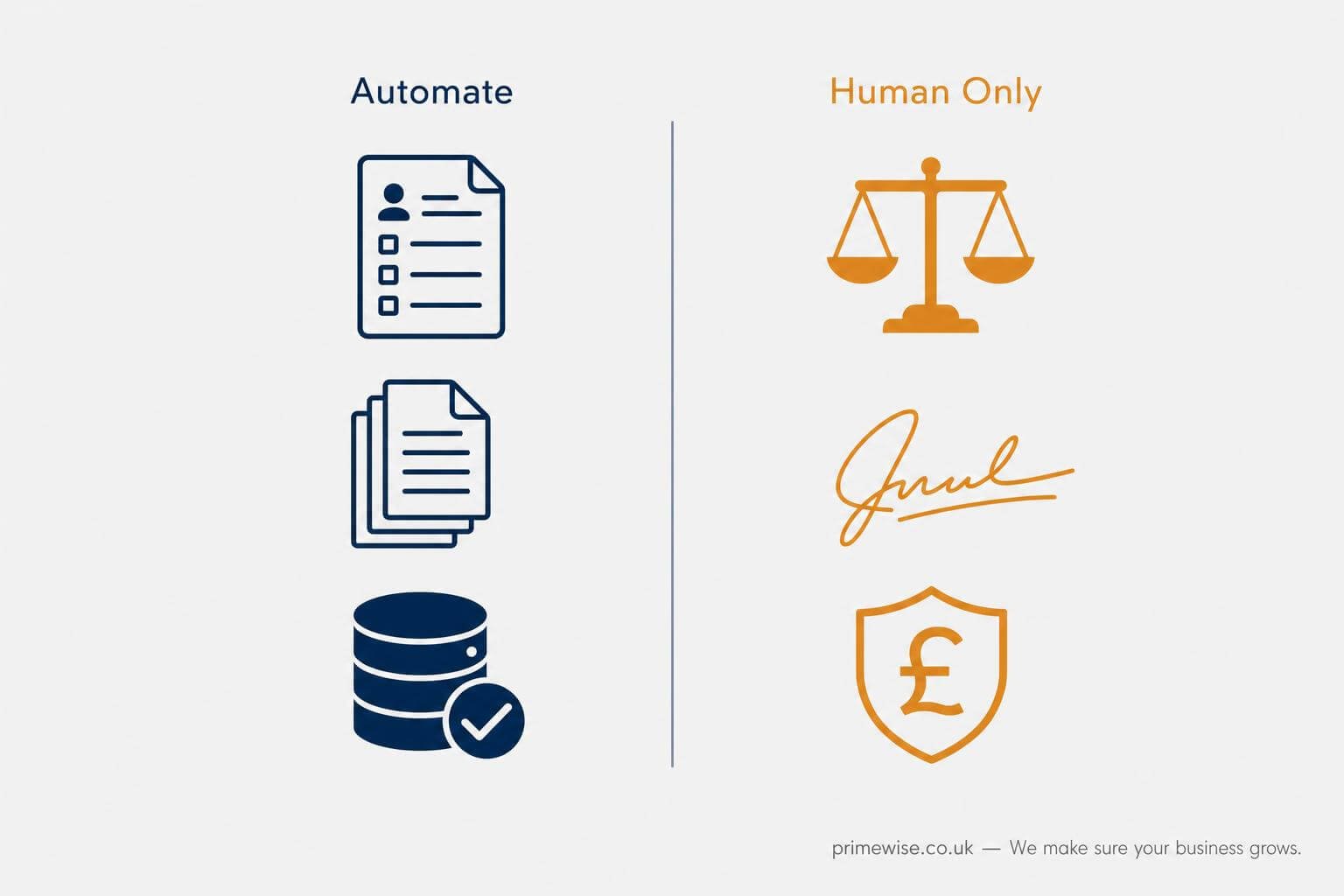
Determining where to deploy intelligent automation requires a disciplined framework that maps each workflow against two variables: operational volume and regulatory exposure. High-volume, low-complexity tasks with minimal bespoke judgement requirements represent the safest and most commercially rewarding entry points. Low-volume tasks requiring significant professional discretion, emotional intelligence, or fiduciary authority must remain under uninterrupted human control. The Legal AI Triage Matrix below operationalises this logic across the full spectrum of UK legal practice.
High ROI Processes Ready for Automation Now
Client intake triage is the single most impactful starting point for the majority of UK practices. Intelligent extraction tools can parse incoming enquiry emails, web forms, and uploaded documents, identify key entities party names, matter type, jurisdiction, urgency indicators and cross-reference them against conflict databases in seconds rather than hours. According to the Law Society’s 2024 Legal Technology Report, firms deploying AI-assisted intake processing reported an average 38 to 42 percent reduction in administrative processing time, with full auditability maintained throughout. That recaptured capacity translates directly into additional billable hours without increasing headcount.
- Conflict of interest checking against internal client and matter databases using entity extraction algorithms
- New client onboarding document population including engagement letters, terms of business, and AML verification checklists
- Matter management timeline tracking and automated deadline reminder workflows within practice management systems
- NDA and standard commercial contract review for defined clause extraction including liability caps, termination triggers, and governing law
- Medical record summarisation and schedule of loss drafting in personal injury matters
- Lease abstraction and key obligation extraction in commercial property transactions
- Employment tribunal ET1 document population based on structured client input data
- Billing narrative generation and time-recording assistance for fee-earner productivity
Practice Area Automation Readiness
Automation readiness varies significantly across UK legal disciplines, and a firm-wide deployment strategy must account for the distinct risk profiles of each practice area. The table below maps five major disciplines against their realistic automation potential and primary regulatory constraint, giving Managing Partners and Heads of IT a clear prioritisation framework.
| Practice Area | Automation Potential | Primary Constraint | Best Entry Point |
|---|---|---|---|
| Personal Injury | High | Liability assessment requires human judgement | Medical record extraction, schedule of loss drafting |
| Commercial Property | High | Title complexity in non-standard transactions | Lease abstraction, title report pre-population |
| Employment Law | Medium | Advice heavily fact and jurisdiction sensitive | ET1 document population, grievance chronology |
| Family Law | Low | Emotional complexity, judicial discretion, welfare considerations | Form E financial disclosure pre-population only |
| Criminal Defence | Minimal | Advocacy requirements, Legal Aid compliance, PACE obligations | Case file indexing and disclosure scheduling |
The Non-Negotiable Red Lines
Regardless of technological capability, certain legal functions must remain exclusively under qualified human authority. The SRA is unambiguous on this point: professional accountability cannot be delegated to software, and the consequences of attempting to do so extend from disciplinary proceedings to civil negligence claims and professional indemnity insurance complications. Algorithmic hallucinations where a language model fabricates a case citation, misrepresents a statutory provision, or generates factually incorrect contractual terms represent a category of risk that supervision controls must be designed to eliminate, not merely mitigate.
- Providing bespoke legal advice on any matter requiring professional judgement or strategic recommendation
- Executing or authorising client fund transfers under any circumstance
- Making binding representations on behalf of the firm to courts, tribunals, or opposing counsel
- Discharging fiduciary duties or making final decisions on client strategy
- Certifying the accuracy of any document submitted to a regulatory body or court without individual solicitor review and sign-off
Critical Risk WarningUsing public generative AI tools such as consumer-facing ChatGPT or Google Gemini to process client matter details constitutes a severe breach of legal professional privilege and UK GDPR. These platforms may use submitted data to train future models. No client information should ever pass through a public large language model under any circumstances.
SRA Compliance and the Specific Rules That Govern AI Use
Understanding the SRA’s regulatory position on AI requires engaging with specific provisions rather than general principles. The SRA Standards and Regulations 2019 do not prohibit AI adoption but they impose enforceable obligations that directly govern how automated tools must be deployed within a regulated practice. Firms that treat compliance as an afterthought to technology procurement are operating in an untenable risk position.
The Supervision Mandate Under SRA Standards 2019
Chapter 3 of the SRA Code of Conduct for Firms, specifically the obligation at Paragraph 3.1, requires that firms maintain effective governance structures ensuring compliance with all regulatory obligations. In practical terms, this means every piece of AI-generated output whether a drafted clause, a summarised case file, or a populated onboarding document must be reviewed, validated, and approved by a named qualified solicitor before it is acted upon or distributed. The SRA’s 2024 Technology and Innovation in Law thematic review reinforced this position explicitly, noting that the regulator had identified firms where automated tools were generating client-facing documents with insufficient human oversight, constituting a supervision failure. The review further noted that fewer than a third of regulated firms had a documented AI usage policy at the time of assessment a gap the SRA described as a systemic governance concern.
Client Confidentiality Under SRA Code Paragraph 6.3
The confidentiality obligation under Paragraph 6.3 of the SRA Code of Conduct for Solicitors requires that firms keep client affairs confidential unless disclosure is required or permitted by law. This obligation extends directly to the technological infrastructure used to process client data. A firm that routes privileged client information through a vendor whose data processing architecture is unclear, whose retention policies are undocumented, or whose servers are located outside approved jurisdictions is in breach of this obligation regardless of whether a data incident actually occurs. The ICO’s AI Auditing Framework, published under the UK GDPR regime, further requires that firms deploying AI systems processing personal data conduct documented Data Protection Impact Assessments before deployment. These are not optional best-practice recommendations they are enforceable compliance requirements.
The SRA Warning Notice on AI Tools
The SRA’s Warning Notice on the use of AI tools, issued in 2024, marked the regulator’s first formal direct communication on the subject. It identified three primary risk categories: accuracy failures where AI-generated content contained factual or legal errors presented without adequate disclaimer; confidentiality failures where firms used public AI platforms to process privileged information; and competence failures where reliance on AI output substituted for rather than supplemented solicitor analysis. The notice made clear that existing professional obligations fully apply to AI-generated work product, that ignorance of a tool’s limitations is not a defence, and that firms should be prepared to demonstrate their AI governance arrangements to the regulator on request. This notice is now the baseline document against which all firm AI policies should be benchmarked.
Regulatory InsightThe SRA does not prohibit AI in legal practice. It mandates documented supervision, provable confidentiality safeguards, and individual solicitor accountability for every AI-generated output. Firms with a structured governance policy are in a significantly stronger regulatory position than those operating informally.
Building a UK Legal AI Governance Framework
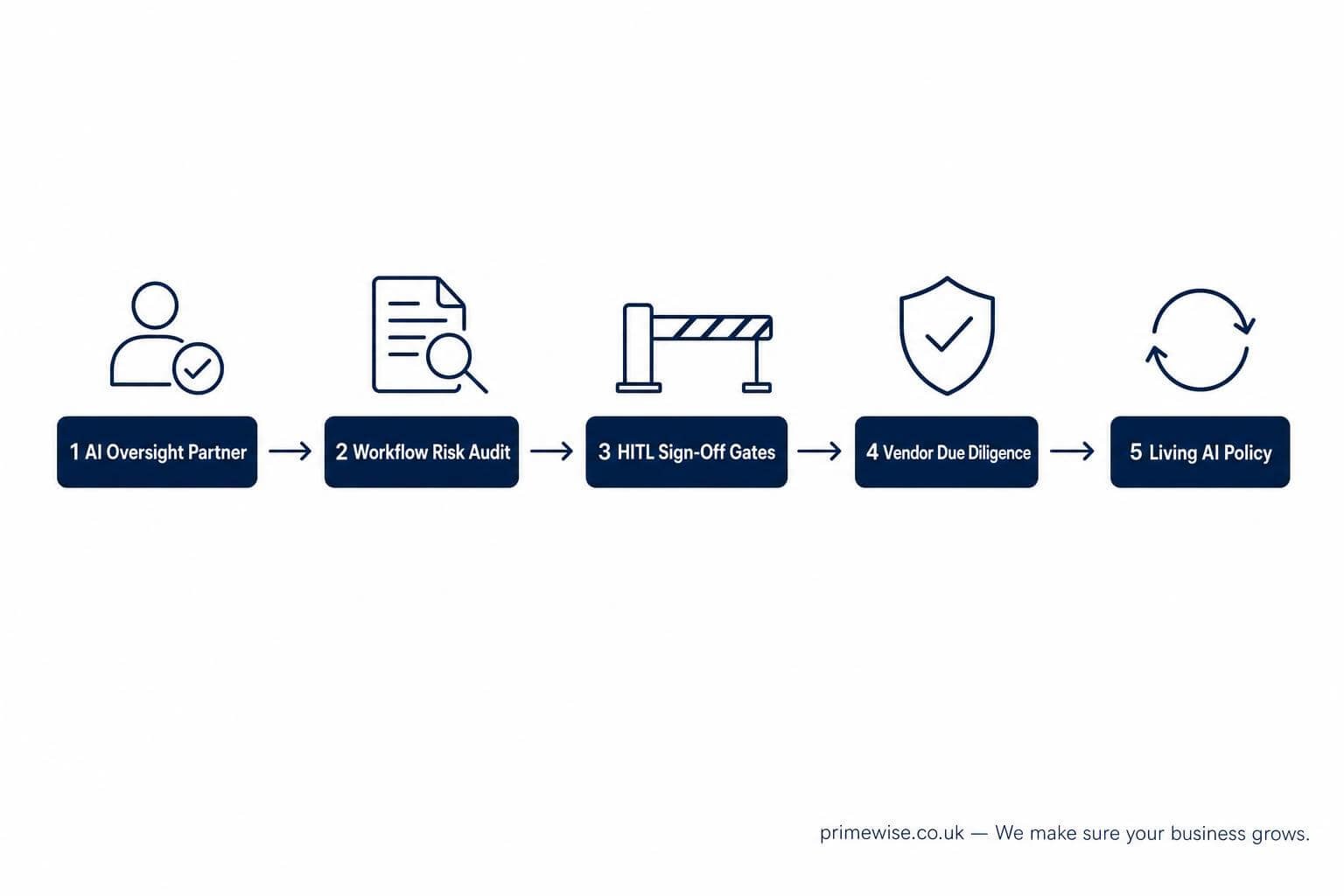
A governance framework is the operational infrastructure that transforms AI adoption from a compliance liability into a defensible, auditable practice. It does not need to be bureaucratically complex but it does need to be documented, board-approved, and reviewable on demand. The following five-step blueprint is designed for UK practices of any size and maps directly against the SRA’s stated expectations.
Step One: Appoint a Designated AI Oversight Partner
Every firm deploying AI tools must designate a named partner with board-level mandate and explicit responsibility for AI governance. This individual owns the AI policy document, chairs the periodic review process, serves as the primary point of contact for any SRA enquiry regarding technology use, and has the authority to suspend any automated workflow pending investigation. Designating this role does not require a technology background it requires seniority, regulatory literacy, and the organisational authority to enforce policy. In smaller practices, this role typically sits with the COLP or a senior equity partner with oversight responsibilities.
Step Two: Conduct a Workflow Risk Audit
Before deploying any tool, the firm must map its existing workflows against the SRA Standards and Regulations 2019, identifying each process’s regulatory exposure level, data sensitivity classification, and supervision requirement. This audit produces a prioritised implementation roadmap that the AI Oversight Partner can approve and the Risk Partner can validate. Workflows handling personally identifiable information or privileged matter content must be flagged for mandatory Data Protection Impact Assessment under UK GDPR Schedule 1 conditions and the ICO’s guidance on AI and automated decision-making. This step prevents deployment errors that no amount of subsequent monitoring can remediate.
Step Three: Implement Human-in-the-Loop Sign-Off Controls
The gold standard for AI deployment in regulated legal environments is a mandatory review gate architecture. Every automated workflow must terminate in a human decision point before any output is acted upon, distributed, or filed. Workflow orchestration platforms whether integrated within practice management systems like Clio, LEAP, or Osprey Approach, or deployed as standalone automation layers must be configured so that AI-generated content enters a named solicitor’s validation queue rather than routing directly to a client or case file. The sign-off must be logged with a timestamp, the reviewer’s identity, and a confirmation that the content was independently assessed rather than passively approved. This is not a technical default it must be an explicitly configured workflow requirement.
Step Four: Establish a Vendor Due Diligence Protocol
Legal technology procurement in 2026 requires a structured vetting process that goes significantly beyond standard software evaluation criteria. Every prospective vendor must be assessed against a defined set of non-negotiable data governance requirements before any trial or deployment is authorised. The questions below represent the minimum threshold for responsible procurement.
- Where are data centres physically located, and do they sit exclusively within the UK or approved EEA jurisdictions?
- Does the vendor operate a strict zero-retention policy ensuring client data is not stored after session completion?
- Is client data used at any point to train, fine-tune, or improve the vendor’s models, and can this be contractually prohibited?
- Can the vendor provide a current ISO 27001 certification and a completed Data Processing Agreement aligned with UK GDPR requirements?
- What is the vendor’s documented process for responding to a data breach, and what are the contractual notification timelines?
- Has the platform been independently security-tested, and are penetration test reports available for review?
Clio, LEAP, and Osprey Approach are the three most widely deployed practice management platforms among UK mid-market firms, and each has expanded its native AI feature set significantly in the last 24 months. Clio’s AI tools include automated time-capture suggestions and document drafting assistance operating within its closed, encrypted infrastructure. LEAP’s integrated document assembly uses matter data already stored within its UK-hosted environment, eliminating the data residency risk associated with third-party integrations. Osprey Approach offers workflow automation and document generation with configurable approval routing suited to smaller practices. When evaluating any of these or competing platforms, the due diligence questions above apply regardless of brand reputation.
Procurement WarningNever trial an AI tool using live client matter data. All vendor testing must be conducted using anonymised or synthetic datasets. Passing real privileged information through an unapproved platform even in a trial context constitutes a potential UK GDPR breach and may trigger confidentiality obligations under the SRA Code.
Step Five: Maintain a Living AI Policy Document
The AI governance policy must be a live document updated at least quarterly to reflect changes in deployed tools, regulatory guidance, and organisational structure. It must identify all approved AI systems by name and version, specify the workflows each system is authorised to support, document the human review requirements for each workflow, and record the outcomes of periodic audits. Critically, it must be structured for SRA inspection clear, navigable, and demonstrably connected to the firm’s existing compliance infrastructure. Firms that have completed this governance architecture are materially better positioned for both regulatory scrutiny and commercial AI deployment. Primewise.co.uk works exclusively with UK legal practices to design bespoke AI automation programmes that are pre-engineered for SRA compliance, UK GDPR alignment, and measurable ROI delivery. A structured discovery consultation for senior leadership teams is available to qualified practices.
Professional Indemnity Insurance and AI Liability
The professional indemnity insurance implications of AI use represent one of the most under-discussed commercial risks in UK legal technology adoption. Insurers operating in the SRA-regulated PI market are beginning to ask direct questions about AI governance during renewal cycles. Firms that cannot demonstrate documented supervision controls, an approved vendor list, and a traceable audit trail for AI-generated work product are presenting an elevated risk profile that may affect premium calculations or coverage terms. More critically, a professional negligence claim arising from an AI-generated error a hallucinated case citation, an incorrectly extracted liability clause, a missed deadline caused by an automated scheduling failure will be assessed against whether the firm had adequate oversight systems in place. The existence of a documented Human-in-the-Loop framework is the primary defence. Its absence is not a mitigating factor.
The Regulatory Horizon for Legal AI in the UK
The compliance landscape governing AI use in UK legal practice will evolve materially over the next 24 months, and firms that engage with emerging frameworks now will be significantly better positioned than those reacting to change after it arrives.
The UK AI Safety Institute and High-Risk Designations
The UK AI Safety Institute, established under the previous government and maintained under current policy, is developing sector-specific guidance for AI applications in high-stakes professional domains. Legal advice systems that influence significant decisions particularly those affecting individual rights, financial outcomes, or liberty are under active consideration for elevated risk classification. Firms using AI in areas such as immigration, criminal defence support, or financial remedy proceedings should monitor UKAIS outputs closely and ensure their governance frameworks are sufficiently flexible to incorporate new requirements as they are formalised.
EU AI Act Extraterritorial Reach
UK firms advising EU-domiciled clients, operating through EU-registered entities, or deploying AI tools developed by EU-headquartered vendors face meaningful extraterritorial exposure under the EU AI Act. The Act classifies AI systems used in the administration of justice and legal proceedings as high-risk applications subject to mandatory conformity assessments, transparency obligations, and human oversight requirements. While UK firms operating solely in domestic markets are not directly regulated by the Act, those with cross-border mandates should treat EU AI Act compliance as a procurement filter favouring vendors who can demonstrate conformity assessment readiness over those who cannot.
Law Commission Review and Liability Frameworks
The Law Commission’s ongoing examination of AI and automated systems is likely to produce recommendations that affect how liability is allocated when AI-generated work product contributes to a client loss. Current doctrine attributes liability to the firm and the supervising solicitor regardless of the tool’s role a position that reinforces the Human-in-the-Loop imperative. Future frameworks may create more nuanced attribution models, but firms should not anticipate regulatory relief in the near term. Building robust supervision architecture now ensures compliance with both the existing framework and any successor regime.
Frequently Asked Questions
The questions below address the highest-frequency queries from UK legal operations teams evaluating AI adoption. Each answer is structured for clarity and direct operational applicability.