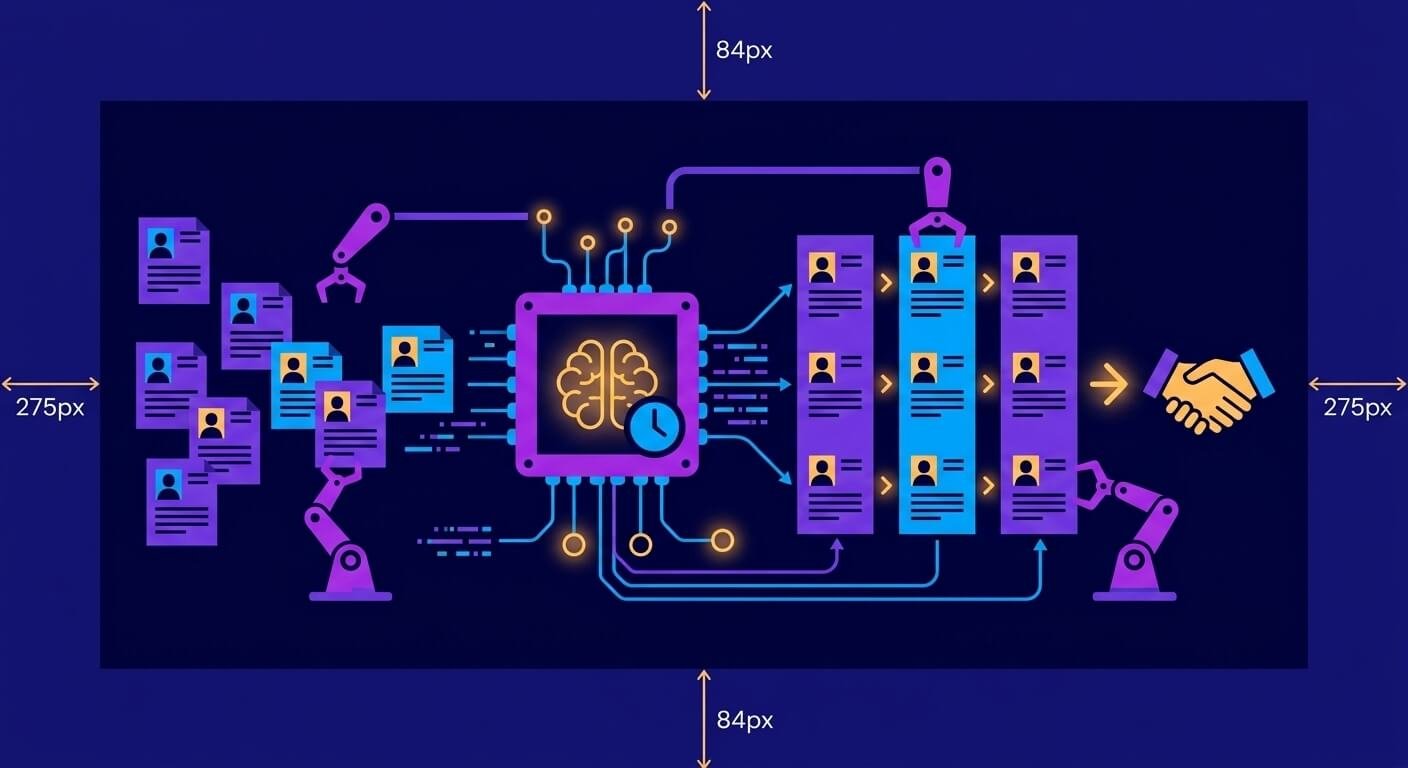

AI automation for customer support is now the defining operational decision for UK financial services contact centres, yet most deployments fail not from lack of technology but from lack of judgement about where automation should stop. According to Gartner’s 2025 Customer Service Technology Report, firms that implement structured AI triage frameworks reduce cost-per-ticket by an average of 28 to 42 percent, yet those that push deflection rates beyond their optimal threshold see customer satisfaction scores fall by up to 19 points within two quarters. The gap between a high-performing AI customer support solution and a brand-damaging chatbot loop comes down to one thing: a disciplined, data-anchored demarcation between what machines handle and what humans must own. This article delivers that framework, calibrated specifically for UK-regulated financial services environments.
What Is AI Automation in Customer Service
AI automation in customer service is the deployment of intelligent systems including AI triage engines, conversational AI platforms, ticket routing algorithms, and agent-assist tools to resolve high-volume support enquiries efficiently, deflect transactional queries, and route complex or emotionally weighted interactions to human agents. The objective is not replacement of human judgement but the precise allocation of each contact type to the channel best equipped to resolve it at the lowest cost and highest satisfaction.
Implementing an AI workflow automation for businesses at the contact centre layer gives operations leaders the infrastructure to absorb fluctuating ticket volumes without proportional headcount increases. The use of AI in customer service shifts from a cost-cutting exercise to a relationship-preservation strategy when leaders establish clear workflow demarcation from day one. Without that structure, automation creates the very bottlenecks it was designed to eliminate.
Executive Definition: AI TriageAI triage is the automated classification and routing of inbound support contacts based on intent, complexity, and emotional risk scoring. It determines whether a query is deflected to a self-serve resolution, handled by a conversational AI platform, or escalated immediately to a human agent before any agent time is consumed.
UK Financial Services AI Adoption Benchmarks
Before designing any automation architecture, operations directors need a clear picture of where the UK market actually stands. The Contact Centre Management Association (CCMA) UK 2024 State of the Sector Report found that 67 percent of UK financial services contact centres have deployed at least one AI-assisted triage tool, yet only 31 percent have implemented a formal demarcation policy governing which query types may and may not be automated. This gap between adoption and governance is precisely where regulatory and reputational risk concentrates.
The FCA’s Financial Lives Survey, updated in 2024, identified that approximately 24 million UK adults display at least one characteristic of vulnerability representing a client population that automated systems must correctly identify and route, not deflect. KPMG UK’s Customer Experience Excellence Report 2024 found that UK retail banking customers routed through hybrid human-AI models scored an average Net Promoter Score 22 points higher than those handled exclusively by automated channels. These benchmarks are not aspirational targets: they are the operational floor that competitive UK financial services firms are already meeting.
Key UK BenchmarkCCMA UK 2024 data shows 67% of UK financial services contact centres use AI triage but only 31% have a formal policy on what must remain human. That governance gap is where FCA risk and churn accumulate.
The Empathy-Complexity Triage Matrix
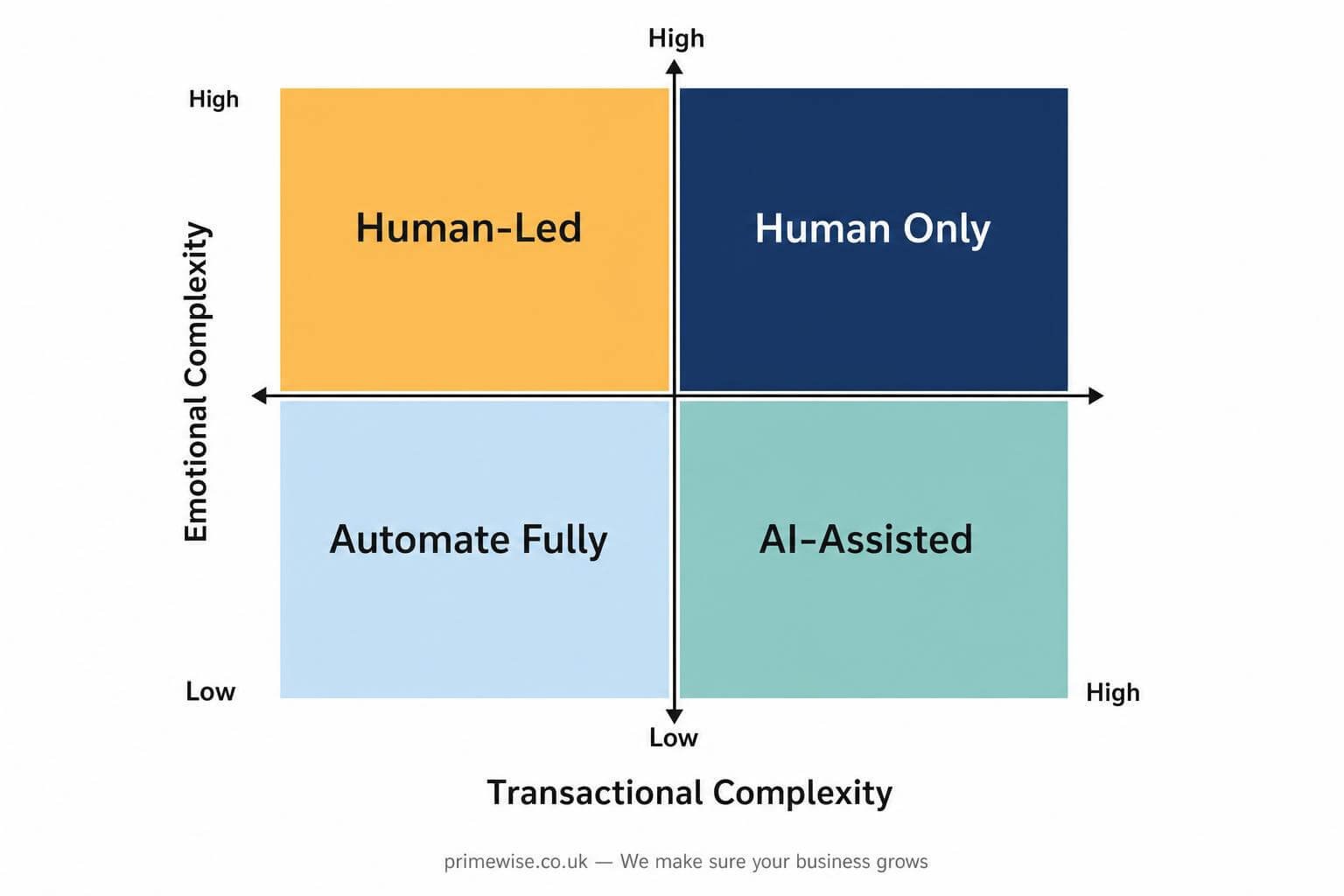
The most reliable operational framework for AI deployment decisions is a two-axis triage matrix that evaluates every inbound contact type against two independent dimensions: emotional complexity and transactional complexity. When both dimensions are low, automated deflection is appropriate. When either or both are high, human involvement is non-negotiable. This framework, applied consistently across all contact types, eliminates the guesswork that causes over-automation failures in regulated environments.
| Quadrant | Emotional Complexity | Transactional Complexity | Recommended Handling | UK Financial Services Examples |
|---|---|---|---|---|
| Automate Fully | Low | Low | AI deflection no human required | ISA balance enquiry, branch hours, password reset, BACS payment status check |
| AI-Assisted | Low | High | Conversational AI with agent-assist on standby | Direct debit amendment, mortgage payment schedule, ISA transfer initiation |
| Human-Led with AI Support | High | Low | Human agent, AI provides real-time sentiment guidance | General complaint from distressed customer, bereavement notification |
| Human Only | High | High | Immediate human escalation no AI resolution attempt | Pension drawdown dispute, fraud report, vulnerable customer welfare case, estate settlement |
Mapping your entire contact taxonomy against this matrix before configuring any AI tool for automating customer support is the single most consequential pre-deployment decision an operations director will make. Firms that complete this mapping exercise prior to vendor selection consistently outperform those that configure automation post-implementation. The matrix also serves as a living compliance document: as regulatory requirements evolve under FCA Consumer Duty, the routing logic can be adjusted without architectural rebuilds.
Prime Candidates for AI Deflection
High-volume, low-complexity interactions are structurally ideal for full AI deflection. These contacts consume disproportionate human agent time relative to their complexity, making them the highest-return targets for automation. Deploying an AI customer support solution against these query types generates immediate cost relief without touching satisfaction scores for high-value client segments.
- Tier-one FAQs covering operational hours, branch locations, and general product policies
- Basic account status checks and routine ISA or current account balance enquiries
- Standardised pre-chat triage data collection and identity verification prompts
- Password resets, PIN reminders, and basic digital access management requests
- BACS and Direct Debit status confirmations requiring no agent judgement
- Appointment scheduling and callback request capture
Automating these touchpoints at scale allows human agents to redirect their full attention to revenue-generating, relationship-critical interactions. The Customer Effort Score identified by Gartner as the primary loyalty predictor in UK financial services improves measurably when low-stakes contacts are resolved in under 60 seconds through a well-configured conversational AI platform, because clients simply experience less friction reaching the resolution they need.
The Human-First Imperative
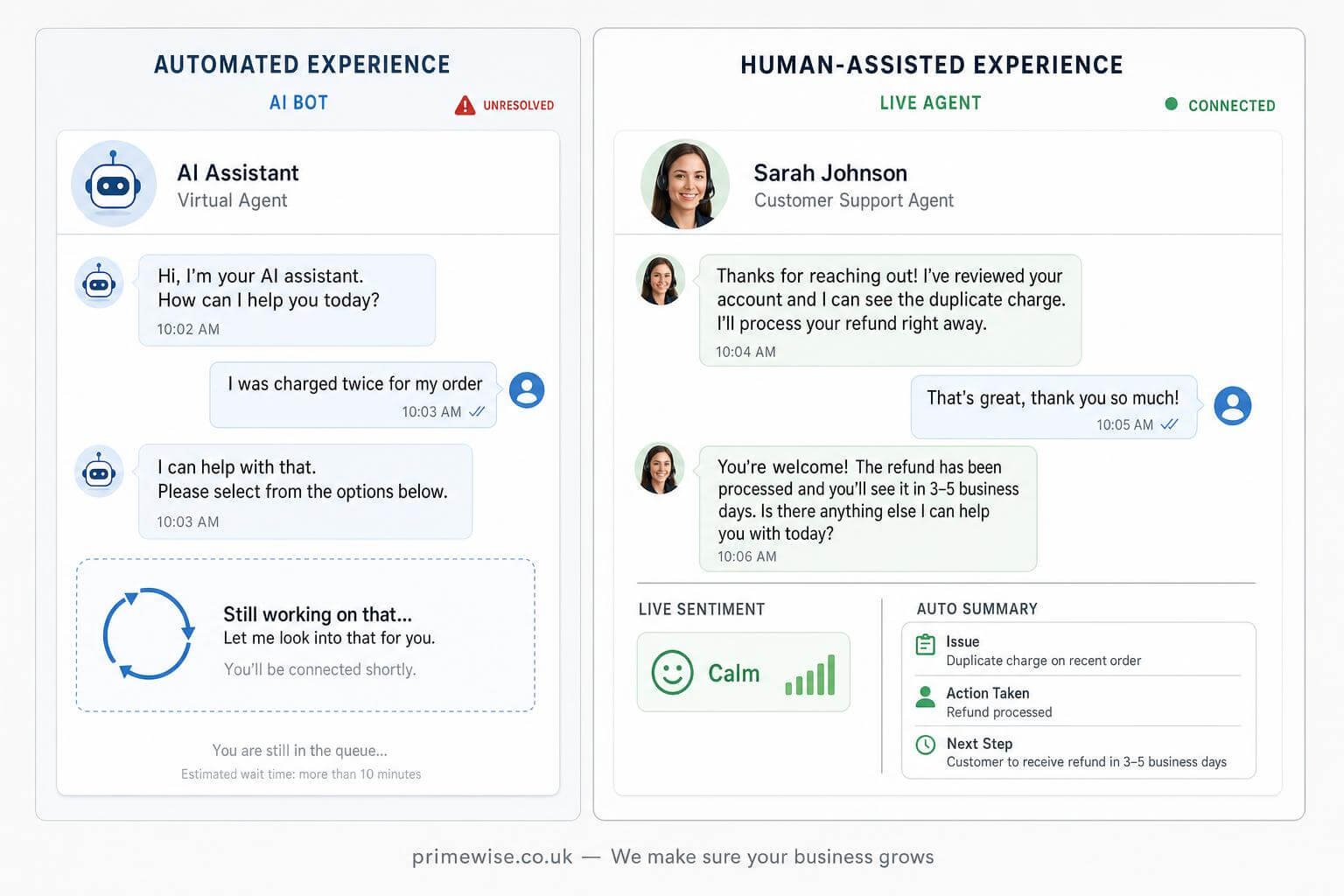
High-empathy, high-complexity scenarios represent the interactions where AI automation chatbots cause the most severe and lasting brand damage when misapplied. The financial consequences of routing a fraud report or a vulnerable customer through an automated dead-end loop extend well beyond a single CSAT score: they generate regulatory scrutiny, social media exposure, and churn of entire household account relationships.
- Complex financial fraud reporting and disputed unauthorised transaction investigations
- Nuanced complaints requiring discretionary judgement and subjective policy interpretation
- Bespoke wealth management consultations and premium investment portfolio reviews
- Bereavement processing, estate management, and probate-related account communications
- Pension drawdown disputes and defined benefit transfer advisory conversations
- Any interaction where a customer displays linguistic markers of acute distress or cognitive vulnerability
The appropriate role of technology in these interactions is as an early-warning detection layer not a resolution engine. Natural language processing models should flag these contacts within the first three message exchanges and transfer comprehensive session context to a human specialist before any automated resolution is attempted. The transfer itself must be seamless: clients who must repeat their situation after being escalated report dramatically lower satisfaction than those who experience a warm, context-aware handoff.
The Automation Paradox and Its True Cost
Operations directors face a structural tension between cost-to-serve reduction targets and customer satisfaction preservation. The automation paradox describes the inflection point where further increases in deflection rate begin to produce net-negative commercial outcomes. Most UK financial services contact centres encounter this inflection point at a deflection rate between 55 and 68 percent, based on CCMA 2024 operational benchmarking data. Beyond that threshold, the marginal cost savings from additional automation are outweighed by the costs of churn, repeat contacts, and regulatory remediation.
The Automation ParadoxDeflection rates above approximately 65% in UK financial services contact centres typically produce net-negative commercial outcomes. Short-term cost savings are erased by increased churn, regulatory risk, and the operational cost of managing frustrated customers flooding back through telephony queues.
The True Cost of Over-Automation
When an AI tool for automating customer support is configured to maximise deflection without regard for contact-type appropriateness, it creates a cascade of operational failures that are expensive to remediate and difficult to reverse. The initial efficiency metrics look compelling in the first quarter, but the downstream costs typically surface across a six-to-twelve month window.
- Artificial escalation spikes as complex tickets repeatedly cycle through misconfigured AI routing
- Severe post-interaction satisfaction score declines following automated dead-end loops
- Heightened FCA regulatory risk when urgent or vulnerable customer complaints are misrouted
- Abandonment of digital channels by premium and institutional client tiers who revert to telephony
- Increased average handle time on inbound calls as agents manage clients frustrated by prior chatbot failures
- Reputational exposure when client complaints about AI dead-ends surface on public review platforms
The deflection rate true-cost calculation must incorporate not only the cost of contacts deflected successfully but also the cost of contacts deflected unsuccessfully including the agent time spent on re-escalation, the repeat contact rate among clients who failed to self-serve, and any regulatory remediation costs incurred due to misrouted vulnerable customer contacts. Firms that build this full-cost model before setting deflection targets make materially better automation investment decisions.
Insight for Operations DirectorsFirms seeking to implement a calibrated triage architecture specific to their FCA-regulated contact centre can access structured diagnostic frameworks and an AI readiness audit through Primewise's operational consulting practice at primewise.co.uk.
Building a Risk-Adjusted Automation Strategy
A risk-adjusted demarcation strategy ensures that AI deployment operates within commercially safe boundaries that protect client lifetime value. Operations teams must embed performance analytics into the automation governance cycle, not treat them as a post-deployment review exercise.
- Establish internal thresholds for maximum consecutive bot interaction turns before mandatory human offer
- Implement semantic trigger libraries that bypass automation entirely for high-risk linguistic patterns
- Audit ticket backlogs weekly to identify recurring deflection failure patterns by contact type
- Correlate deflection success rates directly with client lifetime value cohorts to identify where over-automation causes the most commercial damage
- Review and update the Empathy-Complexity Triage Matrix quarterly as product ranges and regulatory requirements evolve
UK Regulatory Compliance for AI Tools in Customer Service
Operating AI tools in customer service within the UK financial sector requires uncompromising alignment with a regulatory framework that is materially more demanding than generic data protection requirements. The FCA Consumer Duty, effective since July 2023 and actively enforced through 2025 and 2026, places explicit obligations on firms to demonstrate that their customer service architectures deliver good outcomes including for customers in vulnerable circumstances. FCA Discussion Paper DP5/22 and its 2024 AI-focused updates make clear that automated systems are not exempt from these obligations.
Identifying and Routing Vulnerable Customers
The FCA’s Consumer Duty mandates that financial institutions identify and actively support vulnerable customers a population the FCA estimates at approximately 24 million UK adults who display at least one characteristic of vulnerability, including poor health, low financial resilience, recent life events, or low capability. Any AI triage system deployed in a UK financial services environment must be specifically configured to detect and route these contacts rather than deflect them.
- Real-time NLP detection of high-stress linguistic markers including expressions of confusion, desperation, or crisis language within live chat and voice transcription feeds
- Immediate frictionless escalation pathways that bypass standard queuing logic entirely
- Specialised routing algorithms connecting flagged contacts to trained customer welfare agents
- Comprehensive, timestamped audit trails demonstrating FCA-compliant intervention at every decision point
- NLP models trained on UK English regional dialects and UK-specific financial terminology to prevent misclassification of vulnerable contacts
Failing to localise language models to UK English, regional dialects, and UK-specific financial product terminology ISAs, SIPPs, Help to Buy, BACS, Faster Payments is a compliance liability, not merely a UX imperfection. A model that misinterprets a Scottish or Mancunian expression of financial distress as a routine enquiry creates a documented FCA Consumer Duty breach. Operations directors must include dialect and terminology coverage as a mandatory evaluation criterion in any AI vendor selection process.
UK GDPR, PII Redaction, and Data Sovereignty
Data sovereignty represents a distinct compliance obligation that sits alongside Consumer Duty requirements when deploying third-party AI platforms in UK financial services contact centres. Customer support interactions inherently contain highly sensitive personally identifiable information from ISA account numbers and BACS sort codes to income declarations and vulnerable customer disclosures that must be protected through architectural controls rather than relying on vendor assurances alone.
- Mandatory real-time redaction of all personally identifiable information before data leaves the secure processing environment
- Strict enforcement of localised data processing exclusively within UK server boundaries, with contractual prohibitions on cross-border data transfer
- Regular automated penetration testing of all customer-facing AI interfaces and API endpoints
- Transparent data retention policies aligned with Information Commissioner’s Office standards and product-specific regulatory requirements
- Retrieval-Augmented Generation (RAG) architectures that allow LLMs to access internal knowledge bases without exposing customer PII to general model training processes
Retrieval-Augmented Generation is the specific technical architecture that allows large language models deployed in contact centres to generate accurate, policy-compliant responses by referencing live internal knowledge bases rather than relying on general pre-training data. Implementing RAG within a UK-sovereign data boundary solves two problems simultaneously: it keeps AI responses factually accurate and up to date, and it ensures that sensitive client data never enters a general-purpose model training pipeline. For UK financial services firms evaluating AI automation and technical support infrastructure, RAG capability within a sovereign deployment boundary should be a non-negotiable vendor requirement.
The Modern AI Customer Support Solution: A Hybrid Operational Blueprint
The highest-return implementations of AI in customer support do not replace human agents they amplify them. A blended omnichannel AI orchestration model, where automated channels handle deflectable contacts and agent-assist technology empowers human operators on complex cases, consistently delivers the best combined metrics across Customer Effort Score, NPS, Average Handle Time, and regulatory compliance. This is the operational architecture that leading UK financial services firms are building in 2025 and 2026.
Empowering Teams with Agent-Assist Automation
Agent-assist automation operates entirely on the backend of live customer interactions, providing human agents with real-time intelligence without inserting automation into the client-facing conversation. This human-in-the-loop methodology is the key architectural distinction that separates high-performing hybrid contact centres from organisations that have simply deployed a front-end chatbot and called it AI transformation. Agent-assist tools powered by large language models can process the full context of a live conversation in real time and surface relevant policy documents, compliance guardrails, and suggested responses in under two seconds.
- Automated real-time retrieval of relevant internal policy documents, regulatory guidance, and product terms during live agent conversations
- Real-time sentiment analysis providing agents with tonal guidance for example, flagging when a customer’s emotional state is escalating and recommending a de-escalation approach
- Auto-generation of post-call summaries and case notes, reducing after-call work by an estimated 40 to 60 percent
- Reduction of Average Handle Time by 25 to 35 percent through real-time knowledge retrieval that eliminates agent hold time for information searches
- Automated compliance checklist prompting during high-risk interactions such as investment product discussions or complaint handling
Integrating AI automation and technical support at the agent level rather than only at the client-facing layer guarantees faster resolution times without sacrificing the human empathy that preserves high-value client relationships. The measurable outcome is a contact centre that handles higher volumes with the same headcount, while simultaneously improving satisfaction scores among the complex, high-stakes interactions that matter most commercially.
Continuous Learning Through Knowledge Base Automation
Maintaining the internal knowledge bases and standard operating procedures that underpin both automated deflection and agent-assist accuracy represents a substantial ongoing administrative burden. Modern AI automation systems, when correctly configured, can close this loop by independently analysing resolution data and ticket trend patterns to suggest continuous updates to macro-response libraries and internal wikis. This creates a self-improving operational architecture where the quality of AI-assisted support improves as a function of daily operational activity rather than requiring scheduled manual review cycles.
- Automated flagging of outdated procedural documentation when resolution data suggests a knowledge base article is producing incorrect or inconsistent agent responses
- Dynamic generation of new response templates based on emerging ticket trend clusters identified through LLM-powered pattern analysis
- Synchronisation of updated FCA compliance standards and product regulatory changes across all regional support hubs simultaneously
- Measurable reduction in new agent onboarding time typically 30 to 45 percent through always-current knowledge base access replacing manual induction materials
This closed-loop learning environment ensures that both the automated deflection layer and the human agent layer consistently deliver accurate, compliant, and commercially effective financial support. For operations directors managing multiple regional hubs across the UK, knowledge base automation also eliminates the regional compliance drift that occurs when documentation updates are distributed manually and inconsistently applied. Firms looking to implement this architecture within FCA-compliant boundaries are welcome to request a structured diagnostic review through Primewise’s operational AI practice at primewise.co.uk.
Implementation PriorityIf resources require prioritisation, sequence your deployment as: (1) Triage Matrix mapping, (2) Vulnerable customer detection configuration, (3) Agent-assist deployment, (4) Knowledge base automation. Front-end chatbot expansion should follow governance infrastructure, not precede it.