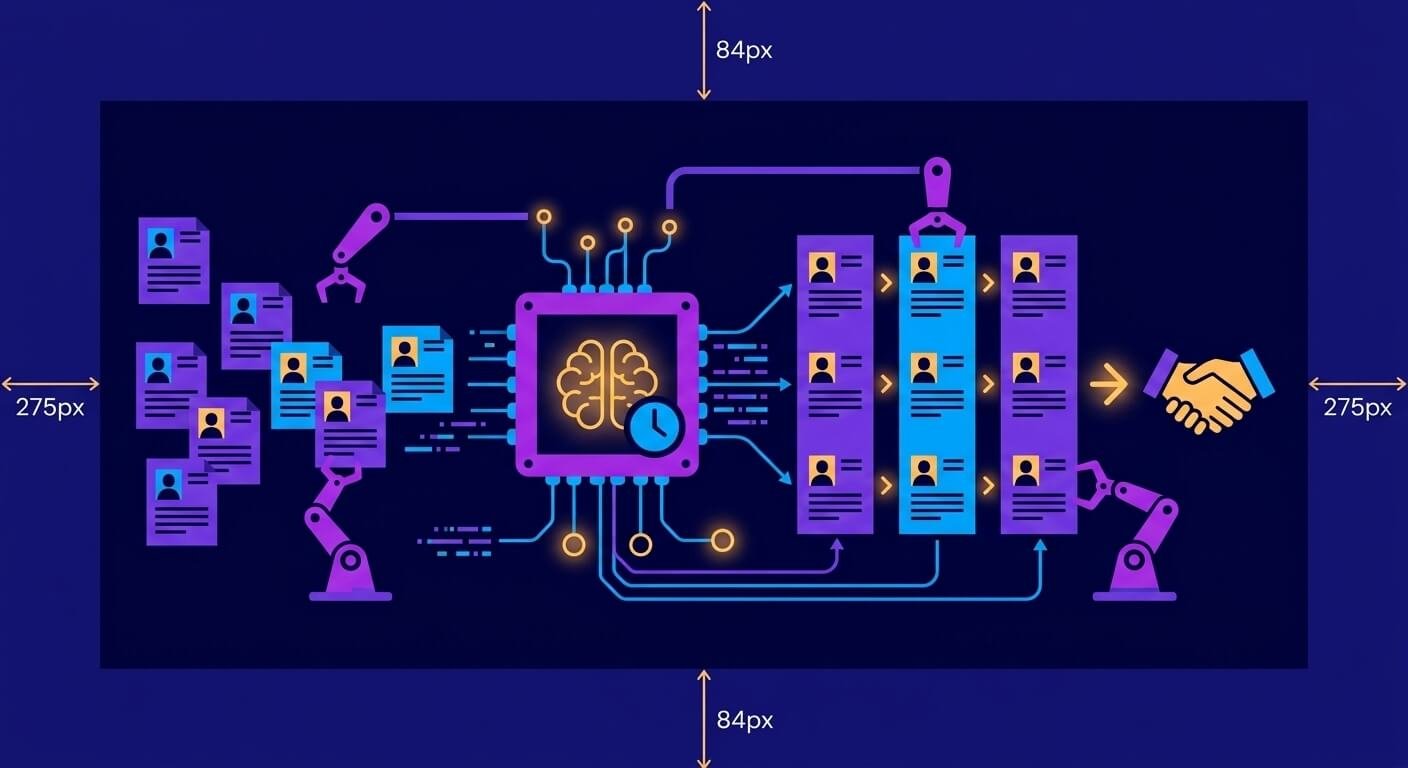
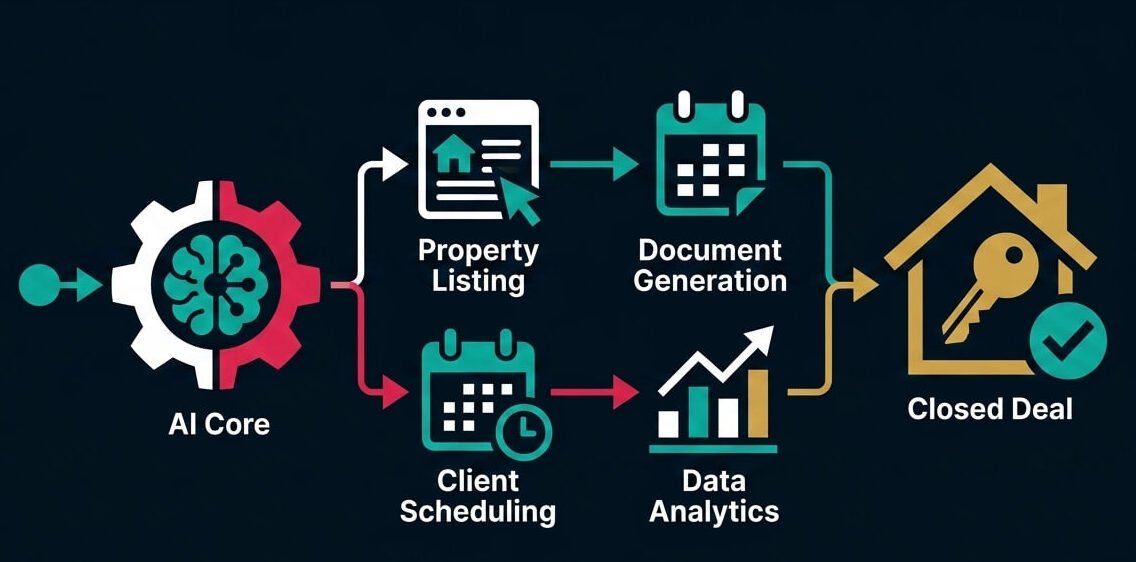
AI automation for real estate is no longer a competitive advantage reserved for technology-first firms it is the operational baseline that UK estate agencies must meet to protect margins, scale transaction volumes, and retain talent. According to Propertymark’s 2024 industry survey, negotiators at mid-to-large UK agencies spend between 60 and 70 percent of their working week on administrative triage rather than revenue-generating activity. That figure represents an enormous commercial inefficiency hiding in plain sight. By deploying machine learning, natural language processing, and robotic process automation across core property workflows, agencies are recovering that lost capacity and redirecting it into the activities that actually close transactions.
What Is AI Automation in Real Estate
AI automation is the application of machine learning, natural language processing, and robotic process automation to execute structured, rule-based tasks such as lead scoring, document parsing, and compliance verification without continuous human intervention. In a property context, this means software systems autonomously handling portal inquiry routing, tenant referencing workflows, viewing calendar management, and AML document checks around the clock, escalating only the exceptions that genuinely require a trained professional’s judgement.
Understanding what is AI in real estate requires moving beyond the surface-level chatbot narrative. The genuinely transformative layer sits in the backend operational stack: intelligent systems that parse unstructured financial data, cross-reference applicant identities against global sanction lists, and synchronise negotiator diaries in real time without a single manual keystroke. This foundational distinction between AI as a customer-facing novelty and AI as an operational engine is what separates agencies achieving measurable ROI from those running expensive pilots that never scale.
INDUSTRY DEFINITIONAI automation in real estate is the deployment of machine learning, NLP, and RPA to execute high-volume administrative tasks lead routing, document parsing, compliance verification without human intervention, freeing negotiators for revenue-generating work.
The Commercial Case for UK Estate Agencies
The UK PropTech sector attracted over £1.2 billion in investment in 2023 according to Beauhurst’s annual PropTech report, with AI-driven workflow automation representing the fastest-growing allocation of that capital. That investment signal reflects a commercial reality that agency directors across London, Manchester, and Birmingham are increasingly confronting: manual operational models cannot absorb the volume, velocity, and regulatory complexity of modern UK property transactions without either compromising service quality or haemorrhaging overhead costs.
Manual Administration Pain Points
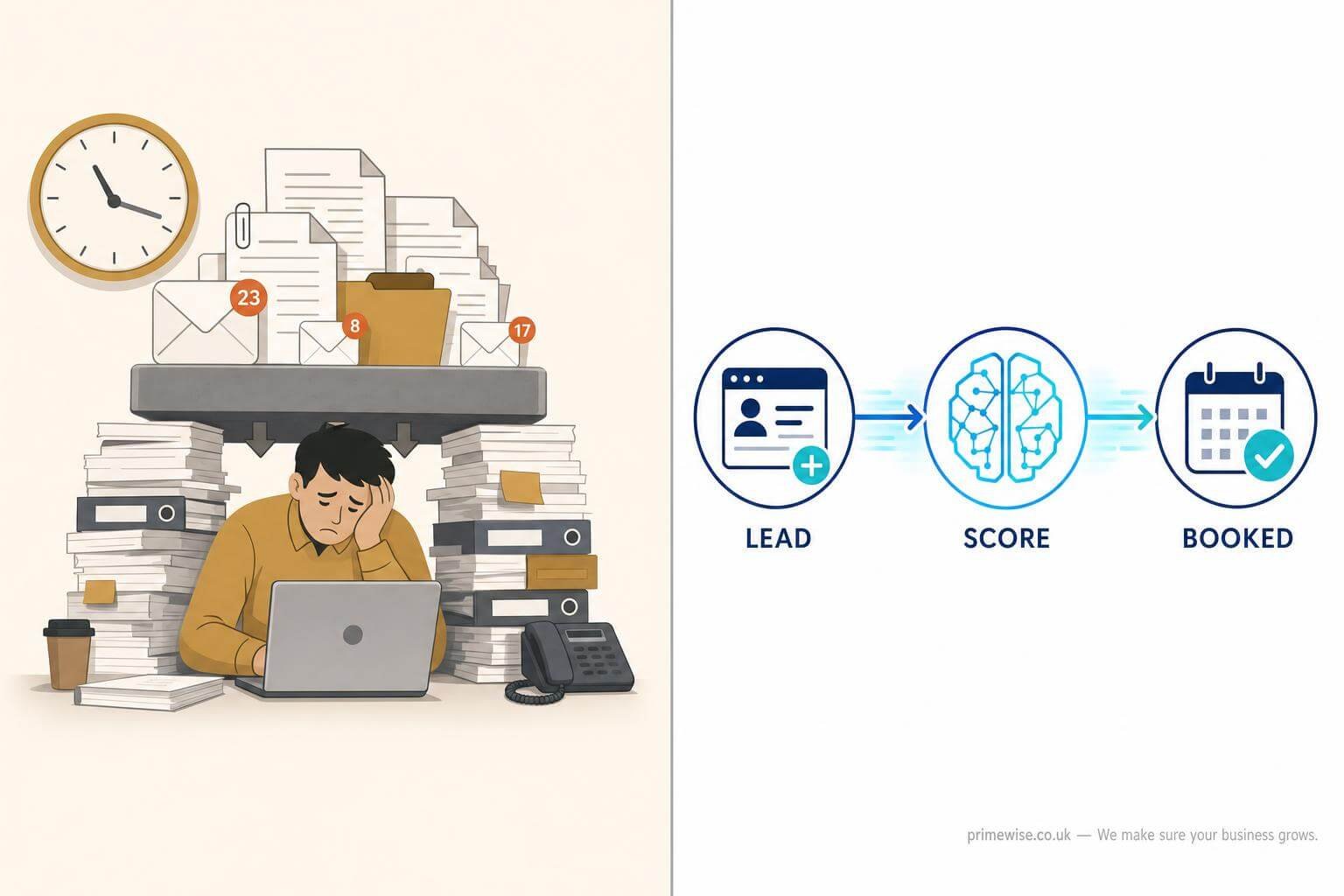
Property professionals managing active lettings portfolios routinely lose between 12 and 15 hours per negotiator per week to tasks that carry zero strategic value: copying applicant data between portals and CRM systems, chasing tenants for referencing documents, manually coordinating viewing times across three or four negotiator diaries, and reformatting compliance paperwork for submission. These are not edge cases they are the daily operational reality for most UK agencies. The bottleneck this creates within the transaction lifecycle directly extends time-to-completion and increases the risk of losing motivated applicants to faster-responding competitors.
Driving Tangible ROI with AI
For operations directors determining how to use AI in real estate to generate measurable returns, the answer lies in quantifying what is currently being lost. Automated lead qualification systems surface high-intent portal inquiries and assign them to the correct negotiator in under three seconds compared to an industry average manual response time of four hours. Research from the AI in Property Alliance indicates that agencies implementing intelligent lead routing report viewing conversion rate improvements averaging 42 percent within the first operational quarter. When those conversion gains are mapped against reduced administrative headcount requirements, the ROI case becomes compelling within two financial quarters for most mid-size UK agencies.
KEY METRICAgencies using AI lead routing cut average response times from 4 hours to under 3 seconds, with viewing conversion rates improving by an average of 42% in the first quarter of deployment.
Proven AI Automation Examples Across Core Workflows
Examining specific AI automation examples across the property transaction lifecycle demonstrates where the genuine operational value sits. The following workflows represent the highest-ROI deployment points identified across residential lettings, sales, and commercial property operations in the UK market.
Intelligent Lead Routing and Portal Qualification
Rightmove processes over 150 million monthly visits, and Zoopla generates in excess of 60 million monthly sessions. The volume of inquiry traffic flowing from those platforms into agency inboxes during peak periods evenings, weekends, and the first 72 hours after a new listing goes live is impossible to triage manually at the speed the modern applicant expects. AI systems address this by parsing incoming portal leads in real time, scoring each inquiry against defined criteria including rental budget alignment, move-in timeline, employment type, and prior communication history, then instantly routing qualified leads to the correct negotiator with a pre-populated contact record. Unqualified or incomplete inquiries are handled via a conversational AI layer that prompts the applicant for additional information, keeping the interaction warm without consuming negotiator time.
Smart Viewing Scheduling in the London Market
Coordinating viewing logistics across London’s micro-geographies presents a challenge that is genuinely unique in its complexity. An agency managing properties across Clapham, Canary Wharf, and Camden simultaneously must account for Zone 2 travel times, peak Underground congestion windows, parking restrictions on residential streets, and the individual diary constraints of three or four negotiators. AI scheduling platforms address this by integrating with negotiator calendars via bidirectional API sync, applying travel-time algorithms that factor in zone mapping and real-time transport disruption data, and offering applicants available slots through an automated conversational interface. The result is a fully optimised viewing schedule generated in seconds, eliminating the multi-email coordination chains that typically consume 30 to 45 minutes per property per booking.
Document Handling OCR and Tenant Referencing
Optical Character Recognition combined with machine learning document classification has fundamentally changed the economics of tenant referencing. Legacy workflows required a compliance administrator to manually open PDF bank statements, scan for salary credits, annotate recurring expenditure patterns, and cross-reference figures against affordability thresholds a process taking 25 to 40 minutes per applicant. AI-powered OCR systems perform the same extraction in under 30 seconds, structuring the output into a standardised referencing report with flagged anomalies highlighted for human review. This is not a replacement of the compliance professional it is an elimination of the mechanical extraction work that consumes their capacity, allowing them to focus exclusively on the interpretive judgements that genuinely require expertise.
Valuation Support and Hyper-Local Data Aggregation
Valuation accuracy is directly correlated with the depth and recency of comparable data available at the point of the market appraisal. AI systems support valuers by aggregating Land Registry sold price data, active listing comparables from Rightmove and OnTheMarket, historical rental yield trends by postcode sector, and local planning application data in advance of every appraisal appointment. The valuer arrives at the property with a pre-built analytics dashboard rather than a manually assembled set of printed comparables. This not only improves valuation accuracy but also strengthens the case for the agency’s fee structure, demonstrating to the prospective instruction that the agency’s market intelligence is considerably more sophisticated than a competitor relying on memory and experience alone.
Navigating UK Property Compliance with AI
Any deployment of AI automation across property workflows that touches applicant financial data, identity documents, or tenancy eligibility decisions must be architected with UK regulatory compliance as the primary design constraint, not an afterthought. The legal exposure for agencies that implement AI carelessly in this area is substantial and measurable.
HMRC’s AML supervision annual report for 2022 to 2023 recorded over £3.8 million in penalties issued to estate agents for Anti-Money Laundering failures, with inadequate customer due diligence cited as the most common breach. The Economic Crime and Corporate Transparency Act 2023 further tightened the due diligence obligations on property firms handling high-value transactions, extending reporting requirements and strengthening the penalties for non-compliance. Against this backdrop, the compliance architecture of any AI system deployed in a UK agency must be explicitly and rigorously designed.
The Compliance-First AI Document Verification Matrix
A robust document verification matrix establishes the precise operational boundaries within which AI can act autonomously and the specific trigger conditions that require a qualified human to assume decision-making control. Under this framework, AI handles the extraction, classification, and initial validation of identity documents, bank statements, and employer references. Human oversight is mandated at three specific trigger points: where OCR confidence scores fall below a defined threshold indicating document quality issues; where applicant-provided identity documents cannot be positively matched against a government-issued biometric database; and where financial data patterns present AML risk indicators such as large unexplained cash deposits or inconsistencies between stated income and banking behaviour. This tiered verification architecture satisfies both the ICO’s guidance on automated decision-making under UK GDPR Article 22 which prohibits solely automated decisions that significantly affect individuals and the FCA’s broader guidance on human accountability in AI-assisted financial assessments.
AML KYC and Right to Rent Guardrails
Estate agencies face significant penalties for breaching Anti-Money Laundering obligations under the Money Laundering Regulations 2017 and their 2023 amendments, as well as Right to Rent civil penalties under the Immigration Act 2014 which were increased to up to £20,000 per adult occupier from February 2024. AI tools configured with appropriate guardrails automatically flag suspicious identity documents, cross-reference applicant details against the UK Financial Intelligence Unit’s consolidated sanction lists, and log every verification action with a full audit trail for HMRC supervisory inspection. The Renters Rights Act, which received Royal Assent in 2025, introduces further changes to tenancy structures that affect how referencing decisions are documented and stored, making the audit trail functionality of a well-configured AI compliance system even more commercially critical going into 2026.
COMPLIANCE WARNINGHMRC issued over £3.8 million in AML penalties to UK estate agents in 2022–2023. Any AI system handling applicant identity or financial data must include human-in-the-loop triggers and a full audit trail to satisfy Money Laundering Regulations 2017 and UK GDPR Article 22.
Choosing the Right AI Automation Agency
The quality of the technology partner is as commercially consequential as the technology itself. An AI automation agency for real estate must demonstrate specific depth in UK property operations not generic automation capability applied to a new vertical. The procurement decision deserves the same rigour as any strategic hire at director level.
Evaluating AI Automation Companies for Property
When assessing AI automation companies, property leaders should apply a structured evaluation framework across five dimensions. First, industry specificity: does the vendor have documented deployments within UK residential or commercial property, or are they retrofitting a horizontal automation product? Second, compliance architecture: can they demonstrate that their document verification workflows include the mandatory human-in-the-loop triggers required under UK GDPR and AML regulations? Third, CRM integration depth: is their connection to your primary agency management platform a full bidirectional sync or a read-only data pull? Fourth, data security: are they ISO 27001 certified and GDPR-compliant with UK data residency? Fifth, commercial transparency: can they provide a phased implementation plan with defined KPIs before any contract is signed? AI automation services for real estate delivered without these five criteria being met will consistently underdeliver against the ROI projections used to justify the investment.
PrimeWise operates exclusively within the UK property sector, delivering end-to-end AI workflow automation covering CRM integration, portal lead routing, OCR-driven compliance verification, and viewing schedule optimisation designed specifically for estate agencies managing complex multi-portfolio operations. The team conducts a structured operational readiness audit before recommending any technology deployment, ensuring that the workflows most likely to generate immediate ROI are prioritised in Phase 1 rather than the workflows that are simply easiest to automate.
CRM Integration Depth and Platform Compatibility
An AI automation system that operates in isolation from the agency’s primary database delivers no durable operational value. Seamless bidirectional data synchronisation with the major UK agency management platforms is non-negotiable. Reapit, the dominant enterprise CRM in the UK agency market, supports full API integration with webhook event triggers that enable real-time lead routing and diary synchronisation. Alto, widely deployed across independent agencies and franchise networks, offers an open API that supports bidirectional property and applicant data sync. SME Professional, Jupix, Dezrez, and Landmark each have varying degrees of API openness the critical question for any AI vendor is whether their integration architecture supports real-time event-driven synchronisation or relies on scheduled batch data pulls, since batch synchronisation introduces latency that undermines the sub-three-second lead response times that define effective AI routing. Any vendor unable to clearly articulate their integration architecture for your specific CRM platform should be eliminated from the procurement shortlist.
Implementation Roadmap for UK Agencies
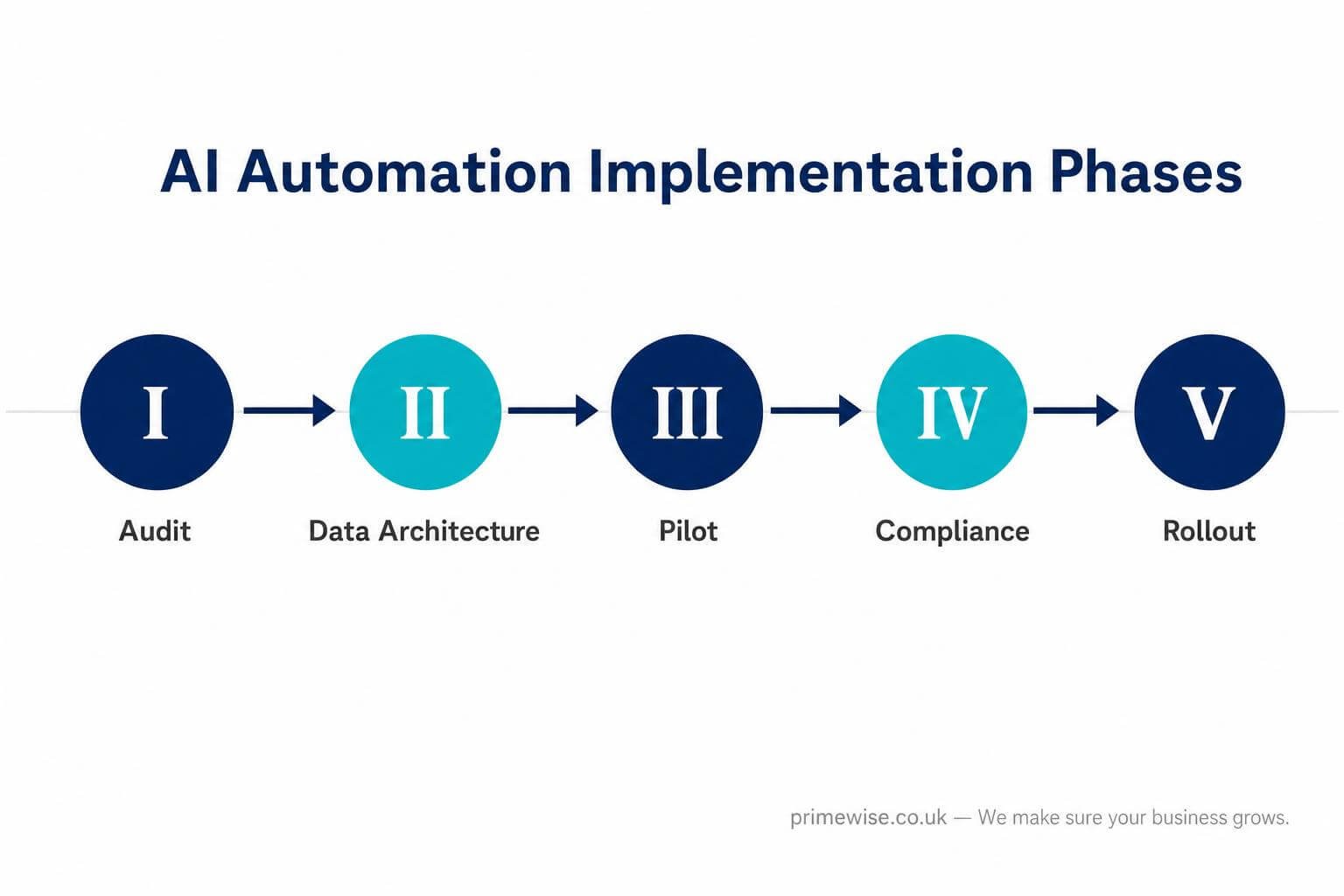
A structured phased deployment approach transforms AI automation from a high-risk technology experiment into a predictable operational upgrade. The following framework reflects the deployment methodology used successfully across UK residential and commercial agencies, balancing implementation speed against compliance integrity and change management requirements.
Phase 1 Operational Audit and Workflow Mapping (Weeks 1 to 4): A specialist consultant maps every manual administrative process touching lead management, applicant communication, document handling, and viewing coordination. The output is a prioritised list of the three to five highest-volume workflows quantified by negotiator hours consumed per week that represent the strongest candidates for immediate automation.
Phase 2 CRM Integration and Data Architecture (Weeks 4 to 12): Data pipelines between the agency management platform and the AI automation layer are established and tested. Data quality issues duplicate records, incomplete applicant profiles, inconsistent tagging conventions are resolved at this stage, since AI systems amplify data quality problems rather than compensating for them.
Phase 3 Pilot Deployment on Lead Routing (Weeks 8 to 16): A single workflow typically portal lead qualification and routing is deployed as a controlled pilot with defined KPI thresholds. Response time, lead-to-viewing conversion rate, and negotiator time recovered are measured against pre-pilot baseline figures to validate the ROI case before broader rollout.
Phase 4 Compliance Validation and Legal Sign-Off (Weeks 12 to 18): The document verification matrix and AML guardrail configurations are reviewed by a qualified compliance professional or external legal adviser before any AI-assisted referencing or identity verification goes live at scale. This stage produces the documented compliance framework required for HMRC supervisory inspection.
Phase 5 Full-Scale Rollout and Model Training (Weeks 16 to 26): Remaining workflows are deployed sequentially. The AI model is trained on agency-specific data patterns local market characteristics, typical applicant profiles, portal inquiry language to improve scoring accuracy over time. Monthly performance reviews track KPI progression and identify the next optimisation cycle.
IMPLEMENTATION INSIGHTAgencies that complete a structured operational audit before any technology spend commit to the right workflows first. PrimeWise offers a no-obligation operational readiness assessment at primewise.co.uk mapping your highest-ROI automation opportunities before a single contract is signed.
Case Study Scaling Document Processing in Central London
A mid-size commercial estate agency operating across Central London’s EC1 to EC4 postcode corridors was processing in excess of 10,000 compliance document checks annually across a portfolio of commercial lettings and high-value sales transactions. Their compliance team of three administrators was spending an average of 35 minutes per applicant on manual OCR extraction and initial AML screening a workload that had become unsustainable as portfolio volume grew without a corresponding increase in headcount budget.
Following a Phase 1 operational audit, PrimeWise identified document processing as the primary bottleneck, consuming over 5,800 administrator hours per year. An AI-powered document verification platform with full bidirectional Reapit integration was deployed across an 18-week implementation cycle. The AI system reduced average per-applicant processing time from 35 minutes to under 90 seconds, recovering approximately 5,600 administrator hours annually. Compliance breach incidents fell to zero in the 12 months following deployment, as the system’s automated sanction list cross-referencing and AML risk-flagging consistently identified issues that had previously been missed under time pressure. The compliance team’s role shifted from mechanical data extraction to expert review of flagged cases a change that significantly improved both job satisfaction and compliance accuracy.
Agencies seeking a comparable deployment framework can request a workflow audit from PrimeWise, whose specialist team maps existing operational bottlenecks before recommending any technology investment. Further information is available at primewise.co.uk.
Semantic Entities and Technology Taxonomy
Understanding the full taxonomy of technologies that contribute to AI automation in property helps agency leaders evaluate vendor claims more accurately and avoid conflating distinct capabilities. PropTech as an industry category encompasses a broad range of digital property tools, but AI automation specifically refers to systems capable of autonomous decision execution not simply data storage or visualisation dashboards.
Robotic process automation handles the mechanical layer of workflow automation: data copying between systems, form completion, scheduled report generation. It is rules-based rather than intelligent. Machine learning introduces pattern recognition across unstructured data the ability to score an applicant’s financial profile or classify a document type without explicit programming for every scenario. Large language models add conversational capability, enabling AI systems to handle inquiry responses, draft tenancy correspondence, and interpret free-text instructions from applicants. Computer vision models power the OCR layer, extracting structured data from photographic identity documents and handwritten bank statements with accuracy levels that now consistently exceed those of manual human review. Predictive analytics models operate at the strategic layer, forecasting vacancy risk across a managed portfolio, identifying properties likely to relist within 90 days, and modelling rental market movements at postcode sector granularity. Understanding which technology layer is responsible for which capability is essential when evaluating vendor proposals any AI automation company that cannot clearly map their product’s technical architecture to these distinct capability categories should be questioned carefully.
Conclusion The Operational Imperative
The commercial argument for AI automation for real estate agencies is no longer theoretical. The data on negotiator time recovery, lead conversion improvement, compliance penalty avoidance, and transaction lifecycle acceleration is sufficiently robust that the question facing UK agency directors in 2026 is not whether to deploy AI automation but which workflows to prioritise first and which partner has the domain expertise to deliver without introducing regulatory risk.
For property directors assessing whether their current operational infrastructure is genuinely ready for AI deployment, PrimeWise offers a no-obligation operational readiness assessment at primewise.co.uk a structured diagnostic that identifies the highest-ROI automation opportunities within your specific transaction and compliance workflows before any technology spend is committed. The assessment takes two weeks, produces a prioritised workflow map with estimated ROI projections, and carries no obligation to proceed with a commercial engagement.