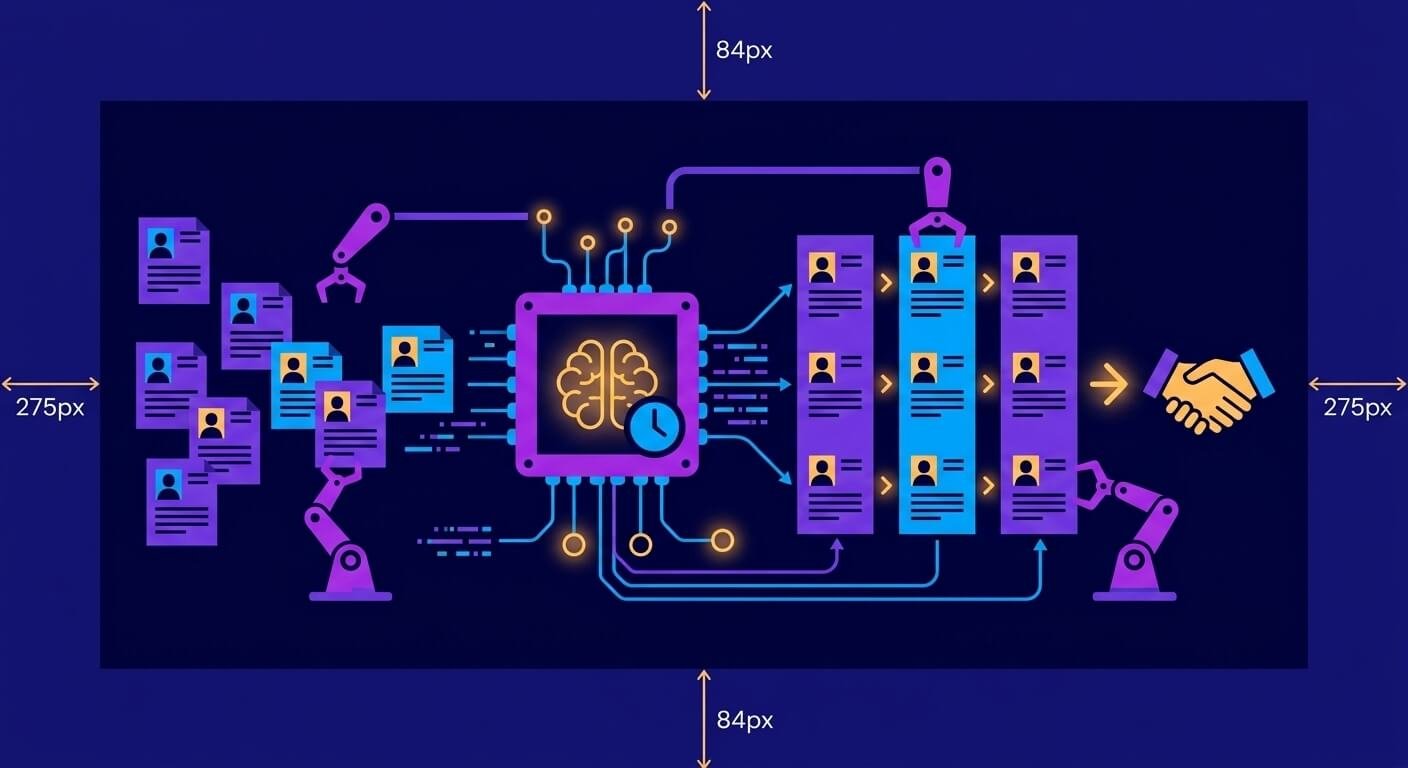

AI integration for business systems is no longer optional for UK fintechs and ai automation for fintech has become the defining operational challenge of 2026. The FCA issued 14 enforcement actions between 2023 and 2025 citing inadequate automated decision-making controls, and the firms caught off-guard shared one trait: they scaled their technology faster than their governance frameworks. This article provides the exact compliance-safe architecture from KYC onboarding to fraud triage to audit trail design that FCA-regulated firms use to automate at pace without triggering enforcement risk. If you are a Head of Operations, CTO, or Chief Compliance Officer at a UK fintech, this is the operational blueprint you need.
What You Will LearnHow to align AI workflows with FCA Consumer Duty and UK GDPR Article 22. The PrimeWise Compliance Velocity Framework for Human-in-the-Loop escalation. Step-by-step blueprints for KYC, fraud triage, and NLP-routed customer support. The PrimeWise Four-Layer Audit Architecture for immutable, regulator-ready logging. How London-based fintechs are using AI automation to solve the compliance talent squeeze.
What Is AI Automation for Fintech
AI automation for fintech is the deployment of machine learning, natural language processing, and robotic process automation to replace or augment repetitive, rules-based operational tasks inside regulated financial firms. In practice, this means automating KYC document extraction, fraud alert triage, customer support routing, and regulatory reporting each with transparent, explainable logic and a defined escalation path to a human analyst when model confidence drops below a set threshold.
Understanding what is AI in fintech requires moving beyond textbook definitions. For an FCA-regulated firm, AI is not simply a productivity tool it is a regulated activity. Any system that makes or materially influences a decision affecting a customer’s financial product, credit access, or account status falls under the Consumer Duty (PS22/9), and must demonstrably deliver good outcomes. How is AI used in fintech operationally? It processes structured and unstructured data at a scale no manual team can match, flags anomalies in milliseconds, and surfaces only the highest-risk exceptions for human review. The operational gain is real, but so is the regulatory obligation attached to every output that system generates.
How AI Automation for Finance Scales Core Fintech Operations
The most successful AI and automation in business and finance deployments do not start with the technology they start with the bottleneck. UK fintechs scaling from Series A to Series C typically face three acute pressure points simultaneously: a manual KYC queue that grows linearly with customer acquisition, a fraud triage team drowning in false positives, and a customer support function struggling to identify vulnerable customers before harm occurs. AI automation for finance resolves each of these by injecting intelligence at the point where human bandwidth runs out.
According to UK Finance’s 2025 Annual Fraud Report, authorised push payment fraud losses reached £459 million in 2024, with firms citing alert fatigue as a primary factor in delayed detection. Simultaneously, the FCA’s 2024 Financial Lives Survey found that 54 percent of UK adults display at least one characteristic of vulnerability a figure that directly affects how automated customer support systems must be designed. These are not abstract compliance concerns. They are the operating conditions inside which every UK fintech’s automation strategy must function.
Automating KYC and KYB Onboarding
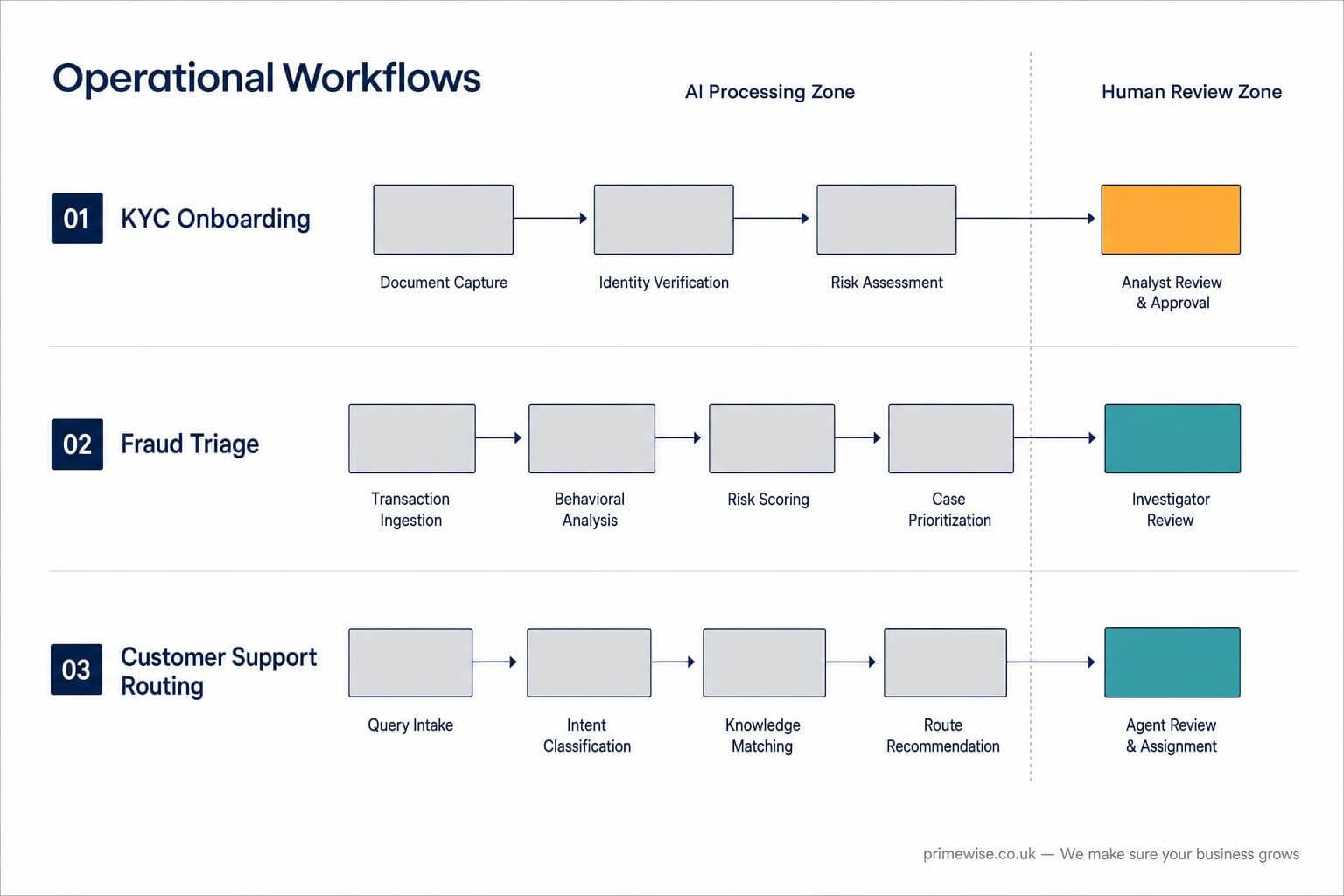
Manual KYC and KYB onboarding is the single largest operational drag on early-stage UK fintechs. A compliance analyst manually reviewing a corporate onboarding case verifying beneficial ownership structures, cross-referencing sanctions lists, and reviewing source-of-funds documentation can take between two and five business days per case. AI-assisted document extraction integrated directly with the Companies House API reduces that to under four hours while maintaining 100 percent audit auditability. Optical character recognition models extract identity data from passports and utility bills, machine learning classifiers cross-reference outputs against AML databases in real time, and any discrepancy or low-confidence result is automatically escalated to a human reviewer.
The operational impact is significant. Firms deploying AI-assisted KYC report a reduction in manual onboarding review time of 65 percent or more, freeing compliance analysts to focus on complex beneficial ownership structures and high-risk jurisdictions rather than routine document checks. Open Banking API integrations further enrich KYC data by providing verified income and account history signals, reducing the burden on customers to self-certify financial information and cutting onboarding abandonment rates in the process.
Balancing Algorithmic Speed in Fraud Triage
Fraud triage is where AI automation for fintech delivers its most visible operational return and its most significant regulatory risk if mismanaged. Advanced anomaly detection models assess hundreds of transactional variables in real time: device fingerprint, geolocation delta, transaction velocity, payee history, and behavioural biometrics. The result is a dramatically smaller alert queue, with genuinely suspicious activity surfaced ahead of the noise. Firms using AI-driven fraud triage report false positive rates dropping by 40 to 60 percent within the first six months of deployment, directly reducing the manual review burden on already stretched operations teams.
The critical governance requirement here is that no AI model should autonomously block a customer’s account or freeze funds without a defined human review trigger. The FCA’s SYSC framework requires that firms maintain adequate oversight of automated systems that affect customer access to financial services. Any automated fraud action that could constitute a denial of service to a consumer must have a documented escalation path and a human sign-off protocol for borderline cases.
NLP Routing for Customer Support
The Consumer Duty’s vulnerability requirements make NLP-powered customer support routing one of the most compliance-sensitive applications of AI automation in fintech. Natural language processing models analyse inbound contact whether by chat, email, or voice transcript and classify queries by urgency, sentiment, and vulnerability indicators. A customer expressing distress about an unauthorised transaction is not routed into a standard queue; they are escalated immediately to a trained specialist agent. This is not a feature enhancement. Under Consumer Duty obligations, failing to identify and appropriately support a vulnerable customer is a regulatory finding waiting to happen.
The operational design principle here is deliberate friction reduction for legitimate customer needs and deliberate friction increase for any automated pathway that might cause harm. NLP models should be trained on the FCA’s own vulnerability guidance, updated quarterly to reflect changes in consumer financial behaviour, and audited against outcomes data to ensure they are genuinely directing vulnerable customers toward resolution rather than toward another automated loop.
The PrimeWise Compliance Velocity Framework
Generic HITL guidance tells fintechs to “involve humans in automated decisions.” That is not operationally useful. What compliance officers and operations leads actually need is a tiered governance model with precise confidence thresholds, defined routing logic, and documented escalation ownership. The PrimeWise Compliance Velocity Framework provides exactly that a three-tier structure that determines, algorithmically and in advance, exactly when a human must intervene in any automated decision.
This framework was developed from direct deployment experience inside FCA-regulated firms and is designed to satisfy both the Consumer Duty’s outcome-based requirements and the PRA’s Model Risk Management expectations under SS1/23. It is not a theoretical model. It is an operational blueprint that maps confidence scores to regulatory obligations in a way that senior management can defend to supervisors and audit committees alike.
Regulatory NoticeUnder UK GDPR Article 22, customers have the right to contest any decision made solely by automated means that significantly affects them. Your escalation matrix must be documented, tested, and produceable to the FCA on demand. Absence of a formal HITL policy is treated as a control failure, not a gap.
Defining the Three Tiers of Automated Decision Governance
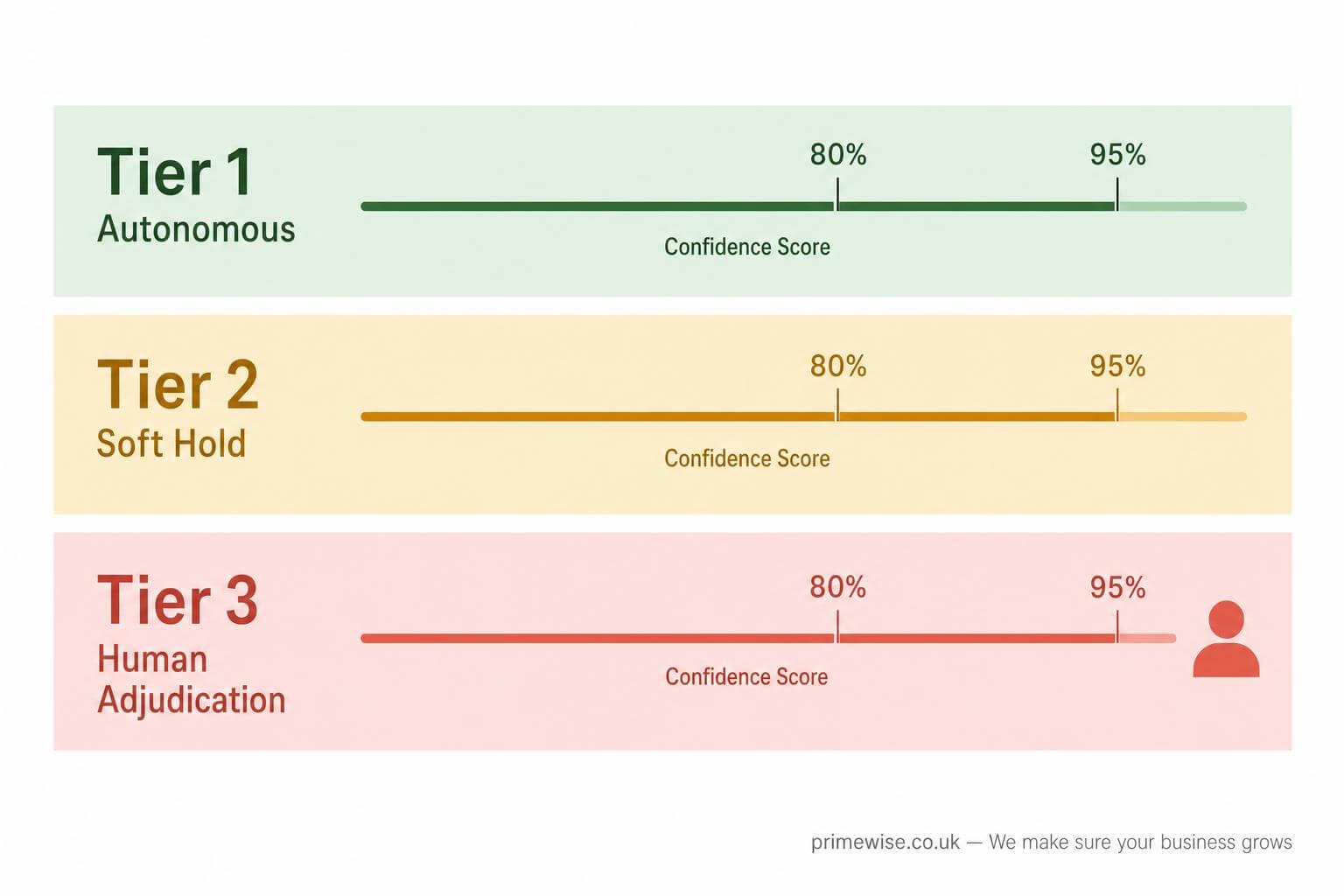
The framework operates across three tiers, each defined by model confidence score, decision type, and the presence or absence of a vulnerability flag on the customer record. Tier One covers autonomous processing: decisions where the model returns a confidence score above 95 percent, the decision type is low-risk, and no vulnerability flag is present. These decisions are processed automatically, logged immutably, and reviewed only through periodic statistical audit. Tier Two covers soft-hold decisions: confidence scores between 80 and 95 percent, or any decision involving a product change, limit reduction, or account restriction. These are routed to a secondary analyst within a defined SLA typically four business hours with the AI output presented as a recommendation, not a conclusion. Tier Three covers mandatory human adjudication: any decision scoring below 80 percent confidence, any decision involving a vulnerable customer flag, any fraud action that would restrict account access, or any creditworthiness determination. These require full human review, documented rationale, and a named sign-off owner before any action is taken.
| Tier | Confidence Score | Decision Type | Action |
|---|---|---|---|
| Tier 1 Autonomous | Above 95% | Low-risk, no vulnerability flag | Auto-processed with immutable log |
| Tier 2 Soft Hold | 80% to 95% | Account changes, limit adjustments | Routed to analyst within 4 hours |
| Tier 3 Human Adjudication | Below 80% or any vulnerable flag | Account restriction, fraud action, credit decision | Named human sign-off required |
This tiered structure eliminates the most dangerous failure mode in automated compliance: the edge case that falls through the gap between “the model was confident” and “the outcome was fair.” By mapping confidence thresholds directly to Consumer Duty outcome categories, fintechs can demonstrate to the FCA that their automation architecture was designed with foreseeable harm prevention as a first-order requirement not a retrospective add-on.
Firms looking to implement this framework without building the governance architecture from scratch can access PrimeWise’s pre-built compliance-safe automation templates, designed specifically for FCA-regulated environments and immediately deployable into existing operational stacks. Explore the AI integration and automation services that UK fintechs are already using to operationalise this framework.
The PrimeWise Four-Layer Audit Architecture
Audit trail design is not a logging problem. It is a trust problem. The FCA does not simply want evidence that a decision was made it wants evidence of what data the model used, which version of the model made the decision, what the model’s rationale was, and that the record cannot have been altered after the fact. The PrimeWise Four-Layer Audit Architecture addresses each of these requirements as a distinct technical layer, creating an audit trail that is not just comprehensive but legally defensible.
The Four Layers of Regulator-Ready Audit Logging
The first layer is the Data Provenance Layer. Every input fed to an AI model customer data, transaction records, third-party enrichment signals must be logged with its source, timestamp, and transformation history. This enables a risk officer to reconstruct exactly what the model saw at the moment it made its decision. The second layer is the Model Version Control Layer. MLOps discipline requires that every production model is versioned, and that the specific version active at the time of any given decision is recorded in the audit log. When a model is retrained or updated, the previous version must remain accessible for retrospective review. This is directly relevant to PRA SS1/23 Model Risk Management expectations, which require firms to demonstrate that model changes are governed and documented.
The third layer is the Decision Rationale Layer. This is where explainability becomes a technical requirement rather than a philosophical aspiration. Using SHAP values or equivalent interpretability tooling, the audit log must record which input features drove the model’s output and by what relative weighting. A fraud triage model that flags a transaction should be able to explain in human-readable terms that device fingerprint mismatch contributed 38 percent of the anomaly score, transaction velocity contributed 27 percent, and payee history contributed 21 percent. That is the level of explainability the FCA expects and that Consumer Duty compliance demands. The fourth layer is the Immutable Cryptographic Log Layer. All audit records must be protected against post-hoc modification using cryptographic hashing each log entry is hashed and chained to the previous entry, making any retrospective alteration immediately detectable. This is the technical standard that transforms an audit log from a spreadsheet into evidence.
Operational InsightSynthetic data for bias testing should be part of your model validation cycle, not an afterthought. Regularly testing your fraud triage and KYC models against synthetic demographic datasets identifies proxy discrimination before it becomes an FCA finding. This directly satisfies the Consumer Duty requirement to avoid foreseeable harm.
AI Automation for London-Based Fintech Solving the Compliance Talent Squeeze
AI automation London deployments are being driven by a specific and acute economic pressure that firms outside the capital do not face to the same degree. ONS data shows compliance analyst salaries in London increased by between 18 and 22 percent year-on-year between 2023 and 2025, driven by a structural shortage of professionals who hold both technical AML expertise and working knowledge of the FCA’s Consumer Duty obligations. A mid-level compliance analyst in the City of London now commands a base salary above £65,000, with senior AML specialists frequently exceeding £90,000. Against this backdrop, the ROI case for AI automation for finance is not theoretical it is a matter of operational survival for firms scaling customer acquisition ahead of their ability to hire.
The fintech AI jobs market is not contracting as a result of automation. It is restructuring. Routine document review, alert triage, and data extraction roles are being absorbed by AI systems, while demand for Model Risk Management specialists, RegTech implementation leads, and AI governance officers is accelerating. For firms seeking AI fintech funding from venture capital or growth equity investors, demonstrating that headcount scales sub-linearly relative to customer growth is increasingly a prerequisite for term sheet consideration not a nice-to-have. Investors evaluating unit economics at Series B and beyond want to see automation reducing the cost-per-onboarded-customer metric, and a documented compliance framework like the PrimeWise Compliance Velocity Framework provides the governance evidence that de-risks the technology narrative in due diligence.
The Digital Operational Resilience Act (DORA), while primarily applicable to EU-regulated entities, has created parallel pressure on UK-adjacent firms operating across borders to raise their operational resilience standards. UK fintechs with EU passporting ambitions or EU institutional clients are finding that DORA-readiness and FCA compliance increasingly share the same infrastructure requirements particularly around incident logging, third-party risk management, and ICT system auditability. Building automation architecture to FCA standards in 2026 effectively provides a strong foundation for DORA alignment as a secondary benefit.
How to Assess Your Current Automation Readiness
Before deploying any AI automation workflow inside an FCA-regulated environment, operational leaders should conduct an honest internal assessment against five core readiness criteria. First, does your firm have a documented model governance policy that assigns ownership for each production AI model, including version control and change management procedures? Second, do you have defined confidence thresholds for every automated decision that affects a customer outcome, with documented escalation paths for each tier? Third, are your audit logs technically immutable cryptographically hashed and stored in a system that prevents post-hoc modification? Fourth, have your AI models been validated against synthetic demographic data to test for proxy discrimination and bias before production deployment? Fifth, does your HITL framework explicitly address vulnerable customer routing, with NLP or equivalent tooling trained to identify vulnerability indicators in real-time customer interactions?
If you identified gaps in any of these five areas, those are your regulatory exposure points. PrimeWise works directly with FCA-authorised fintechs to close these gaps through pre-built compliance-safe automation frameworks, governance documentation, and audit-ready system architecture. Explore how AI automation for fintech is being deployed compliantly across the UK’s leading regulated firms.
Looking AheadThe FCA's AI Discussion Paper (DP5/22) outcomes and the UK AI Regulation Bill's progress through Parliament will introduce further obligations on algorithmic transparency and bias reporting in 2026 and beyond. Firms that build their automation architecture to the standards described in this article are already positioned to meet those requirements without structural remediation.