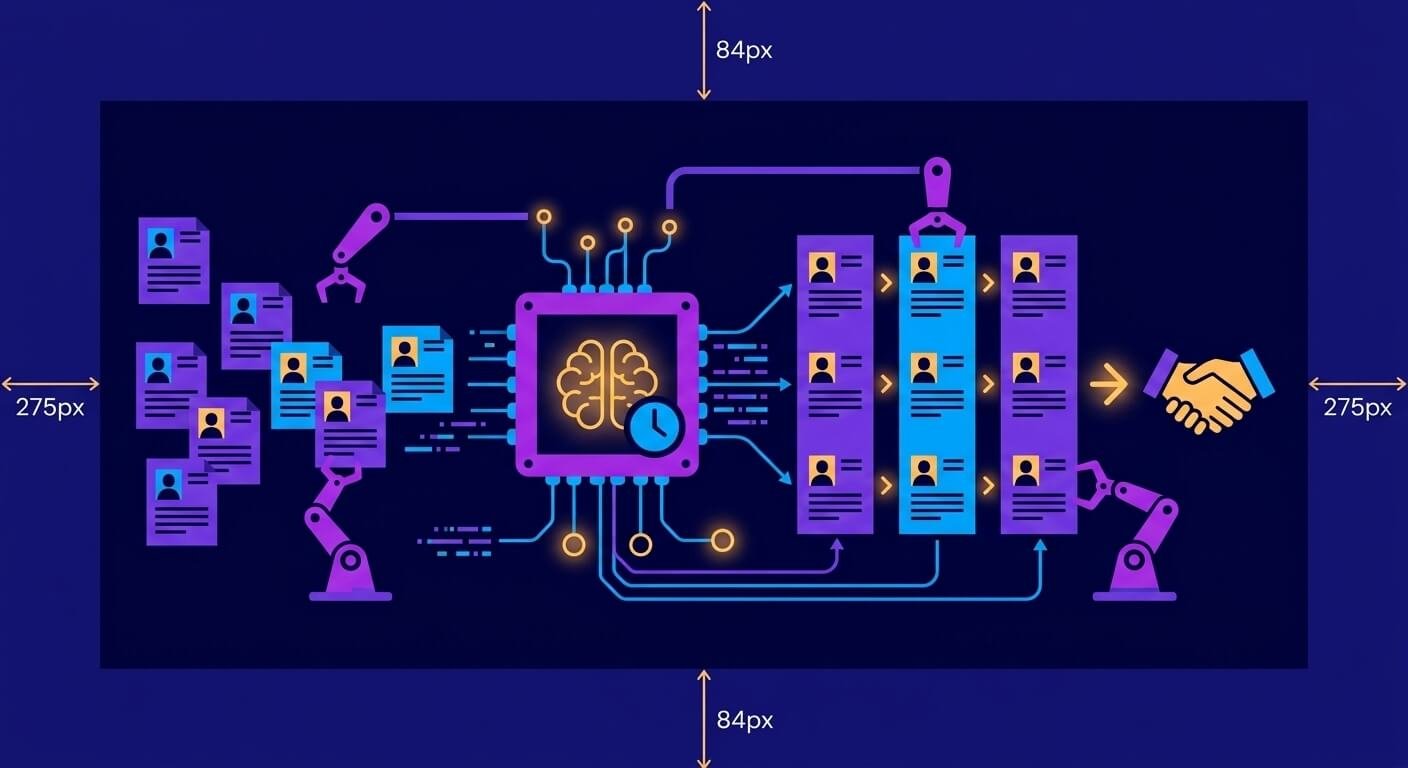

AI automation for professional services is no longer a horizon technology—it is the decisive operational variable separating firms that protect margins in 2026 from those quietly haemorrhaging profitability to manual process debt. If you are a Partner, COO, or Operations Director who has already sat through a dozen vendor pitches and read the surface-level primers, this guide is written for you. It functions as a procurement stress-test, not an introduction. Engaging a specialist AI automation consultancy before committing to enterprise software agreements remains the single highest-leverage decision a firm’s leadership can make, and this guide explains precisely why.
EXECUTIVE SUMMARY: 5 DECISIONS EVERY FIRM MUST MAKE1. Confirm strategic objectives before any vendor engagement begins. 2. Mandate human-in-the-loop governance as a non-negotiable architectural requirement. 3. Calculate total cost of ownership beyond the SaaS licence fee. 4. Verify data residency and regulatory audit-trail capability before shortlisting. 5. Build a change-management case that speaks to equity partner profitability, not abstract efficiency gains.
The structural pressure driving this urgency is well-documented. Rising wage inflation for junior associates and analysts in the City of London, combined with an acute talent shortage, has placed enormous stress on the pyramid operating model that professional services firms have relied on for decades. The Law Society’s 2024 Technology Survey found that 67% of UK law firms now cite AI adoption as a boardroom priority—yet fewer than 22% have completed a full production deployment. That implementation gap represents both the opportunity and the risk. The McKinsey Global Institute estimates that 22% of work tasks across professional services are automatable with technology available today, yet actual adoption rates remain a fraction of that potential. Closing that gap, responsibly and compliantly, is what this guide addresses.
What AI Automation Actually Means in Professional Services
AI automation in professional services is the strategic deployment of machine learning, agentic AI workflows, and orchestration technologies to execute repeatable administrative tasks—document intake, data extraction, KYC and AML checks, client onboarding, and internal routing—while maintaining strict human-in-the-loop oversight at every quality-critical juncture. It is not about replacing the trusted advisor. It is about eliminating the friction that prevents advisors from doing the work clients actually pay premium fees for. The distinction matters enormously when building the internal business case.
It is equally important to define what AI automation in this context is not. It is not deploying a general-purpose large language model against unstructured client data and hoping for accuracy. Generic out-of-the-box LLMs consistently fail in financial and legal data extraction because they lack the constrained, domain-specific parameters required to distinguish a material adverse change clause from a standard representations warranty, or to correctly parse an overseas beneficial ownership structure. Specialised workflow automation, built on retrieval-augmented generation (RAG) architectures and fine-tuned on constrained legal and financial corpora, succeeds precisely where generic tools fail. This distinction is the central argument of this entire guide.
The Operating Model Shift
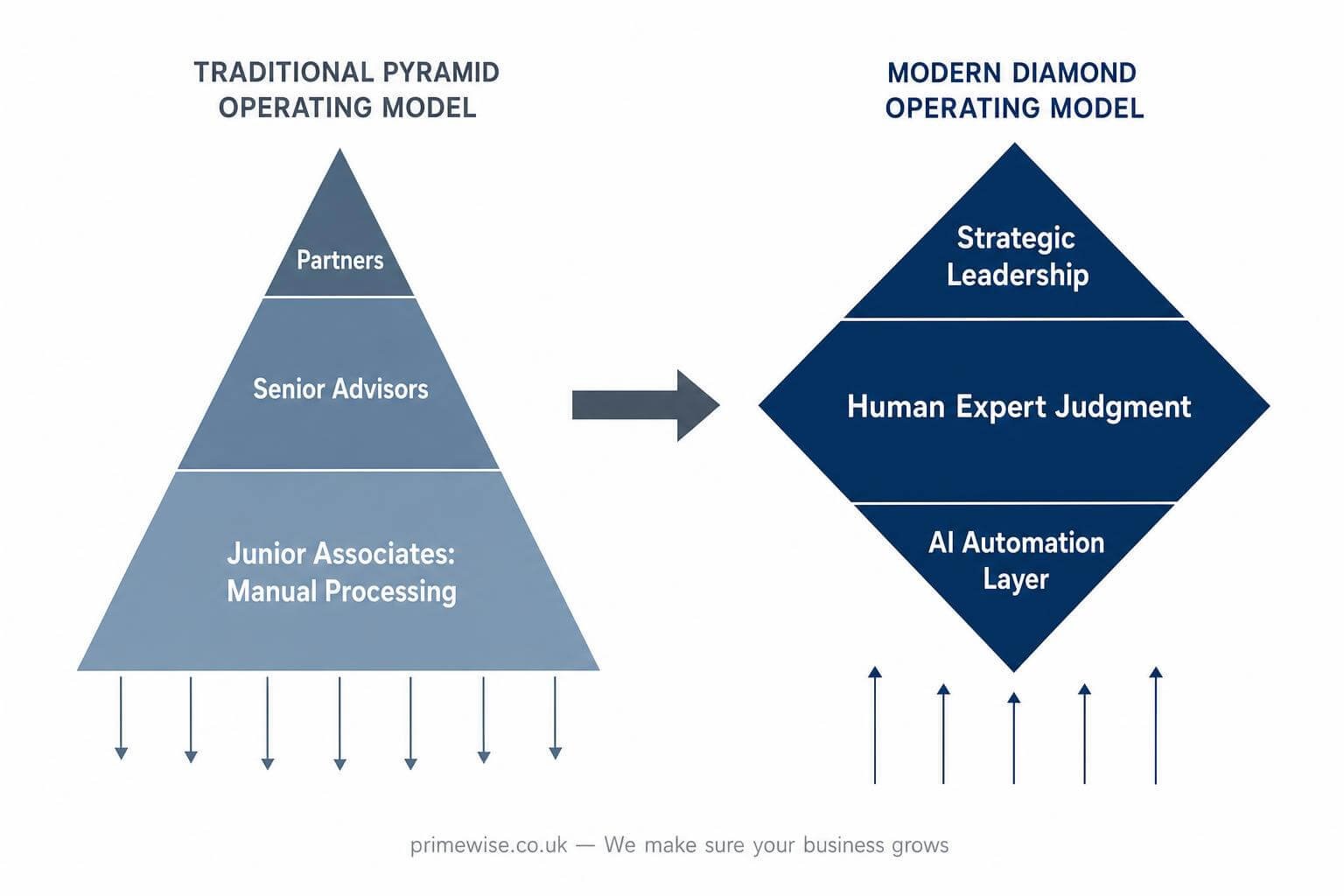
The traditional professional services pyramid—a small layer of senior partners generating strategic value, supported by a broad base of junior associates processing information—is commercially strained. Automation facilitates a transition to what operational strategists increasingly describe as a diamond model. Technology absorbs the high-volume, low-judgment administrative burden at the base. Human capital concentrates in the middle and upper tiers where contextual reasoning, client relationships, and regulatory accountability genuinely require experienced professionals.
This shift directly addresses structural profitability by decoupling revenue growth from linear headcount expansion. A 120-fee-earner regional law firm that deployed a structured intelligent document processing solution recovered an estimated 1,400 billable hours annually after reducing AML onboarding time from 16 days to 36 hours. That figure—1,400 hours—represents material partner distributions, not an abstract efficiency metric. Associates freed from rote data processing develop faster into capable senior advisors, which addresses talent retention at a time when City recruitment costs for qualified associates have increased substantially year-on-year.
The Automation Paradox in UK LLPs
There is a structural tension specific to the UK professional services market that generic automation vendors never acknowledge: the equity partner compensation model structurally rewards personal billings over firm-wide efficiency. A partner who generates £800,000 in personal billings has little immediate financial incentive to champion a technology initiative that reduces billable hours across the practice—even if that initiative materially increases aggregate profit per equity partner. This is the automation paradox in LLPs, and failing to address it explicitly is why the majority of AI transformation programmes in professional services stall at the pilot stage.
The framing that unlocks consensus among equity partners is not cost-cutting. It is margin expansion through capacity reallocation. When administrative bottlenecks are eliminated, utilisation rates for strategic, fixed-fee advisory work increase. Automation enables firms to deliver complex engagements at a materially reduced internal cost base, which widens distributions. The UK Government’s AI Opportunities Action Plan, published in January 2025, signals a sustained policy tailwind for firms investing in automation infrastructure now—a forward-looking argument that resonates with partners thinking about competitive positioning over a five to ten year horizon.
The Human-in-the-Loop Blueprint
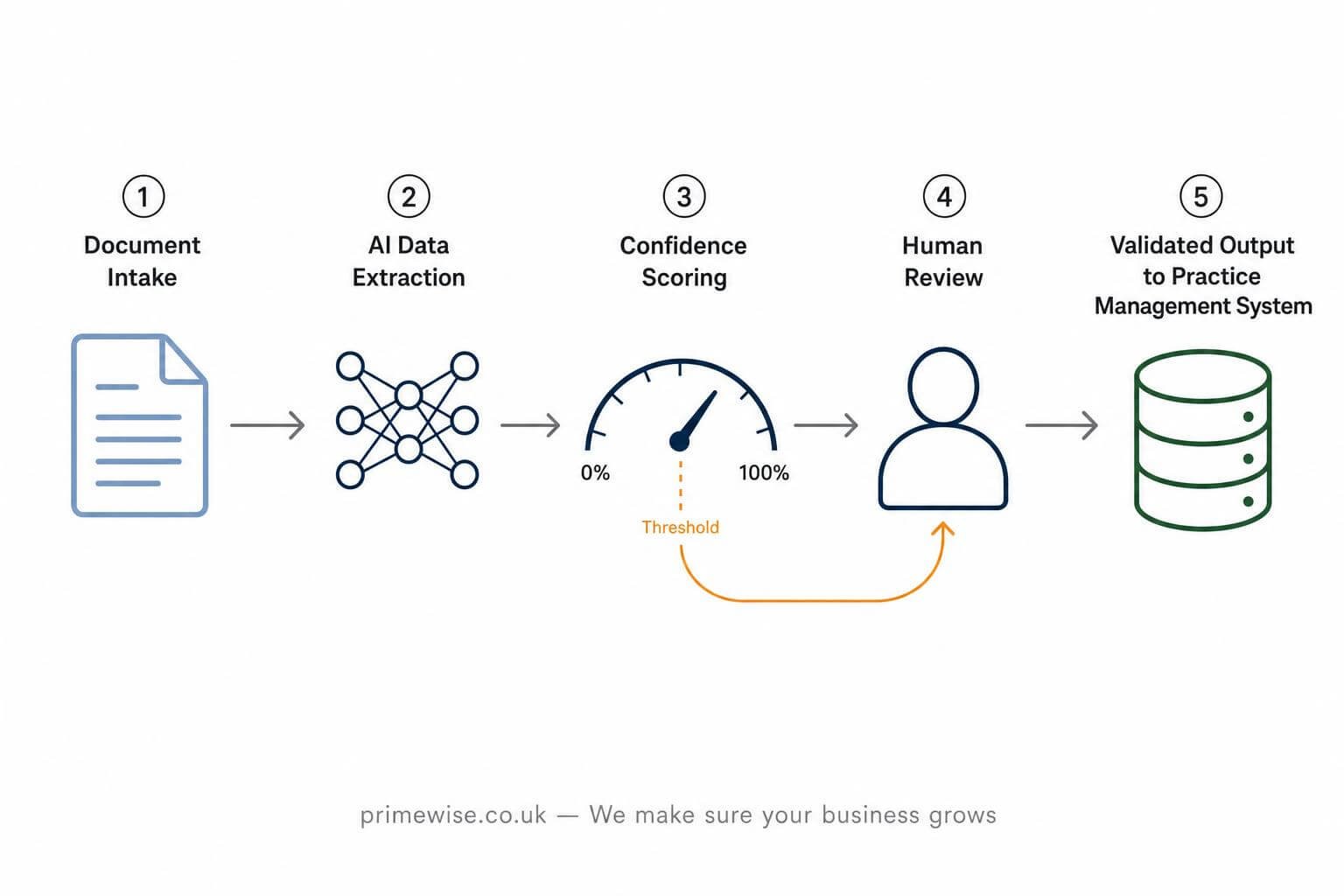
The primary anxiety among professional services leadership regarding AI deployment is hallucination risk and the subsequent erosion of quality control. A properly architected human-in-the-loop workflow eliminates this risk. The logic is straightforward: cognitive automation handles the high-volume processing layer, identifies ambiguities, and routes exceptions to human experts for validation before any output reaches a client file or downstream system. The human expert does not replace the automation—they supervise it at the precise points where professional judgment is required.
Document Intake and Data Extraction
Unbillable hours spent manually extracting clauses from legal contracts, figures from financial statements, or beneficial ownership details from corporate registries represent one of the most severe and measurable margin drains in professional services. Intelligent document processing solutions that combine optical character recognition with domain-specific parsing algorithms and RAG-based retrieval architectures can reduce manual data entry errors by 87% within the first 90 days of deployment, based on operational benchmarks observed across structured implementations in UK-regulated environments. The technology identifies relevant data points, extracts them into structured formats, and flags ambiguous or low-confidence outputs for human review—a workflow that simultaneously accelerates throughput and preserves professional accountability.
The critical differentiator between solutions that succeed and those that fail at this stage is model constraint. A highly constrained model, trained on a firm’s own document typology and calibrated against its specific regulatory obligations, dramatically outperforms a general-purpose model applied to the same data. This is not a marginal performance difference—it is the difference between a system that is production-deployable and one that creates more work than it saves.
Rapid Client Onboarding
Client onboarding remains one of the most friction-heavy processes across professional services. Gathering documentation, verifying ultimate beneficial owners, conducting regulatory background checks, and satisfying AML obligations has historically trapped corporate clients in administrative bottlenecks lasting anywhere from ten days to three weeks. By orchestrating KYC and AML checks through automated data ingestion platforms—automatically cross-referencing global sanctions databases, parsing identity documents, and compiling risk profiles for final partner sign-off—firms can reduce corporate client onboarding from fourteen days to forty-eight hours. The return on investment is immediate: faster onboarding accelerates revenue recognition, reduces client attrition during the intake process, and signals operational sophistication to sophisticated counterparties.
Intelligent Internal Routing
Extracting and validating data is only half the operational challenge. The subsequent requirement is ensuring that verified information flows correctly to downstream systems without manual re-keying across disconnected platforms. Intelligent internal routing uses secure API integrations to synchronise structured outputs with existing practice management systems—Clio, Aderant, Elite 3E for legal practices; CCH and equivalent platforms for accountancy firms—as well as CRM systems and document management environments. Newly onboarded client data, extracted contract variables, or completed working paper inputs route automatically to the correct partner desk or practice group. Eliminating manual re-entry removes a significant proportion of downstream administrative errors and materially accelerates service delivery velocity.
Navigating the Vendor Landscape
The enterprise software market in 2026 is saturated with providers claiming transformative AI capability. For procurement leaders, navigating vendor fatigue requires a rigorous, objective evaluation framework anchored in the specific workflow requirements and security obligations of professional services. The evaluation cannot be delegated to junior IT staff—it requires direct involvement from practice leadership who understand the regulatory and operational context in which the technology must perform.
For firms that lack the internal bandwidth to run a structured vendor evaluation independently, specialist advisors such as Primewise.co.uk provide independent technology assessment frameworks specifically calibrated for UK-regulated LLP environments—reducing the risk of a costly misalignment between vendor promises and operational reality.
Vendor Red Flags Checklist
Protecting the firm during vendor evaluation requires a clear set of disqualifying criteria. The following represent the most consequential dealbreakers identified across professional services procurement processes.
- Any provider that uses proprietary client data to train or improve public models without explicit, contractually binding data segregation guarantees must be disqualified immediately.
- Absence of ISO 27001 or SOC 2 Type II certification signals an unacceptable security posture for high-stakes regulated environments.
- Vendors unable to demonstrate unalterable audit logs for every automated decision and data processing event cannot support FCA or SRA regulatory audits.
- Salespeople who promise seamless integration without scoping legacy system architecture in detail are signalling a superficial understanding of enterprise deployment.
- Providers without documented experience in UK LLP environments, including understanding of LLP governance and equity partner decision structures, will underestimate change management complexity.
- Any vendor unable to confirm onshore UK data hosting for personally identifiable information represents a UK GDPR compliance liability.
- Absence of configurable human-in-the-loop escalation pathways is a fundamental architectural disqualifier for professional services contexts.
Shadow AI Risk
One of the most underestimated risks in professional services automation is shadow AI—the phenomenon of fee-earners independently using unapproved consumer AI tools to process client documents or draft advice, outside any firm-sanctioned governance framework. A 2024 survey of UK professional services employees found that over 40% had used a consumer AI tool for a work task without employer knowledge or approval. The data security, confidentiality, and regulatory implications of this behaviour are severe. Firms that delay implementing governed, firm-wide automation solutions inadvertently increase shadow AI risk by leaving a productivity vacuum that individuals fill with uncontrolled alternatives. Proactive deployment of governed automation is therefore both an efficiency measure and a risk management imperative.
Total Cost of Ownership Reality Check
A persistent and costly misstep in digital transformation is treating the SaaS licensing fee as a proxy for total deployment cost. The annual subscription is typically the smallest component of the true investment. Leadership must ring-fence separate budgets for API middleware and integration development, bespoke workflow configuration and model fine-tuning, continuous model training and accuracy maintenance, staff training and change management programmes, and ongoing vendor support and governance review cycles. Firms that calculate these components upfront consistently report more accurate ROI timelines and fewer budget overruns than those that treat the licence fee as the total commitment.
ROI BENCHMARKFirms automating document intake and client onboarding report average payback periods of 14 to 18 months when total cost of ownership is calculated accurately at the outset. Firms that underestimate implementation costs at procurement stage report payback periods exceeding 36 months due to unplanned expenditure on integration and change management.
The ROI calculation also differs materially by firm type. A Magic Circle law firm processing high-volume transactional due diligence will realise automation returns primarily through throughput acceleration on M&A and capital markets mandates. A mid-market accountancy practice will realise returns through automated working paper preparation, tax compliance data extraction, and streamlined client reporting cycles. A Big Four-adjacent management consultancy will see the greatest gains in proposal automation, research synthesis, and internal knowledge management. Segmenting the business case by firm type ensures that the projected returns are credible to equity partners who understand their own practice economics.
Regulatory Alignment and Security Architecture
Professional services firms operate under a level of regulatory scrutiny that demands automation systems be designed for compliance from the ground up, not retrofitted to satisfy it. Algorithmic transparency, robust audit trails, and demonstrable data governance are not optional enhancements—they are prerequisites for operating within FCA and SRA frameworks.
FCA and SRA Compliance Requirements
The Financial Conduct Authority’s operational resilience guidelines, including the requirements established under CP22/24, mandate that regulated entities maintain complete, auditable records of how client data is processed and how automated decisions are made. The Solicitors Regulation Authority’s Technology and Legal Services Report similarly emphasises that automation deployments must support, not obscure, fiduciary duty. In practical terms, this requires that the selected platform generates unalterable processing logs for every automated event—capturing what data was processed, by which model component, at what time, and where human review was triggered. When facing a regulatory audit, the firm must be able to reconstruct the complete processing history of any client document within minutes, not days.
UK GDPR and Data Residency
UK General Data Protection Regulation requirements for personally identifiable information demand that professional services firms maintain complete data sovereignty over client data. Vendor selection must therefore prioritise providers offering confirmed onshore UK cloud hosting with no cross-border data transfer for personally identifiable information. Beyond geographical residency, the technical architecture must incorporate robust anonymisation and pseudonymisation protocols—stripping or masking PII from documents before those documents interact with any external model inference layer. The ICO’s published guidance on AI and data protection provides the specific technical and governance framework that procurement teams should use as a compliance checklist during vendor evaluation. Firms that embed this guidance into their procurement criteria rather than treating it as a post-deployment consideration will encounter significantly fewer implementation delays.
COMPLIANCE WARNINGSelecting a vendor without confirmed UK data residency and documented ICO-aligned data processing protocols exposes the firm to UK GDPR enforcement action and potential SRA or FCA regulatory intervention. Do not proceed past the shortlisting stage without written confirmation of data residency and a copy of the vendor's current Data Protection Impact Assessment.
AI Governance and the Emerging Technology Horizon
As the technology matures through 2026 and beyond, the distinction between assisted automation and agentic AI becomes operationally critical. Current intelligent document processing and workflow automation solutions operate with defined task boundaries and human escalation points. The next generation—autonomous AI agents capable of end-to-end matter handling, from initial document intake through analysis, drafting, and system update, with minimal human intervention—is advancing rapidly. Firms that establish robust AI governance frameworks now, covering algorithmic accountability policies, model performance monitoring protocols, and clear human oversight mandates, will be positioned to adopt agentic systems safely as they mature. Firms that have not yet formalised governance structures will face a compounding compliance debt as regulatory expectations in this area tighten.
The FCA and SRA are both signalling increasing interest in how regulated firms govern algorithmic decision-making. Establishing an internal AI governance committee, defining accountable senior individuals for automated system performance, and maintaining a live model risk register are practices that demonstrate regulatory maturity and will become de facto expectations within the near-term supervisory horizon. Firms building these structures today are creating a durable competitive and regulatory advantage.
Technical Glossary for Procurement Leaders
Understanding the precise technical terms used by vendors and regulators reduces the risk of misaligned expectations during procurement. The following definitions are calibrated for professional services decision-makers rather than software engineers.
- Agentic AI: AI systems capable of autonomously executing multi-step tasks across interconnected systems with minimal human instruction per step—the architectural direction that follows current workflow automation.
- Retrieval-Augmented Generation (RAG): A technical architecture that grounds AI outputs in a firm’s own verified document corpus before generating a response, dramatically improving accuracy and reducing hallucination in domain-specific applications.
- Human-in-the-Loop: A workflow design principle where AI handles high-volume processing and routes ambiguous or high-stakes outputs to human experts for validation before any downstream action is taken.
- Shadow AI: The use of unapproved consumer AI tools by employees outside firm-sanctioned governance frameworks, representing a significant data security and compliance risk.
- Intelligent Document Processing (IDP): A category of automation technology combining OCR, natural language processing, and machine learning to extract structured data from unstructured documents such as contracts, financial statements, and identity documents.
- Data Residency: The physical or cloud geographic location where data is stored and processed—critical for UK GDPR compliance in professional services contexts.
- AI Governance Framework: A set of internal policies, accountabilities, and monitoring procedures that ensure AI systems operate within defined ethical, legal, and regulatory boundaries.
Key Takeaways for Leadership Teams
The firms that will achieve durable competitive advantage through AI automation are not those that deploy first—they are those that deploy correctly. The difference lies in the quality of the procurement decision, the rigour of the governance architecture, and the sophistication of the change management programme. Here are the five most actionable recommendations from this guide.
- Prioritise human-in-the-loop architecture as a non-negotiable design requirement, not a feature to configure later.
- Calculate total cost of ownership before any vendor shortlisting, including integration, configuration, training, and change management budgets.
- Use vendor red flags systematically—disqualify on data residency and audit trail capability before evaluating any other feature.
- Frame the business case to equity partners around margin expansion and distribution growth, not headcount reduction.
- Establish AI governance structures now to remain ahead of FCA and SRA supervisory expectations as they tighten over the next 24 months.
Leadership teams at professional services firms seeking to move from strategic intent to production deployment can access Primewise.co.uk‘s complimentary AI readiness diagnostic—designed specifically for FCA and SRA-regulated partnerships. The diagnostic assesses current operational bottlenecks, maps automation opportunity against your firm’s specific practice mix, and provides a prioritised implementation roadmap aligned with UK regulatory requirements. For firms that are serious about closing the implementation gap, it is the logical next step.