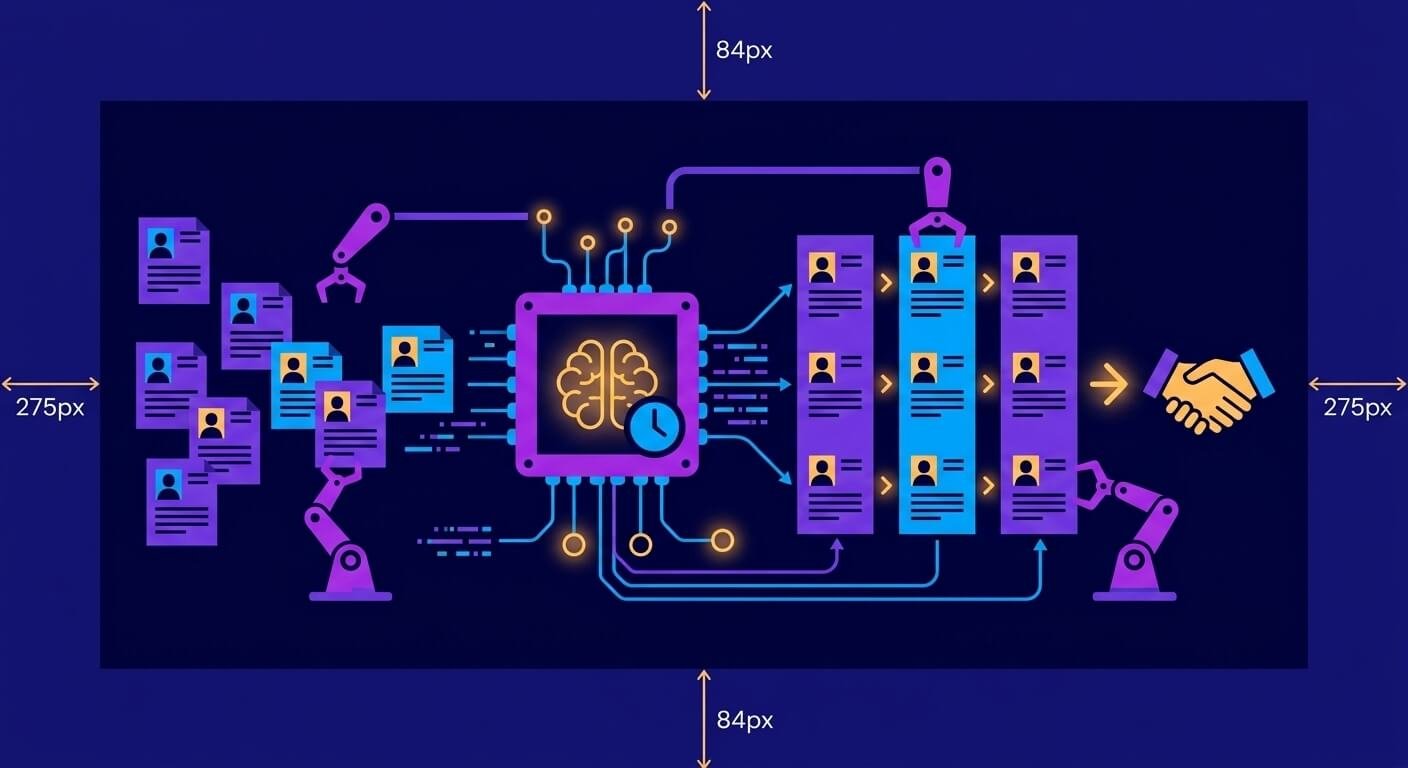

AI automation for finance teams is no longer a boardroom aspiration it is an operational reality that UK CFOs and Finance Directors are being held accountable for delivering in 2026. Finance functions that deploy AI correctly are cutting month-end close time by up to 40%, eliminating 75% of manual data entry in accounts payable, and satisfying Financial Reporting Council audit standards without adding headcount. This guide, written from direct experience automating AP, AR, reconciliation, and management reporting inside UK SMEs and mid-market firms, defines the precise boundaries every finance leader must enforce to capture the efficiency gains without exposing the business to governance failure.
At a GlanceThis guide is written for UK CFOs, Finance Directors, and Financial Controllers evaluating AI in their finance function. You will learn which transactional workflows are safe to automate for immediate ROI, which processes must remain under strict human control, and how to structure audit-proof governance frameworks that satisfy FRC standards and HMRC MTD requirements. Key compliance boundaries are defined clearly throughout.
What AI Automation in Finance Operations Actually Means
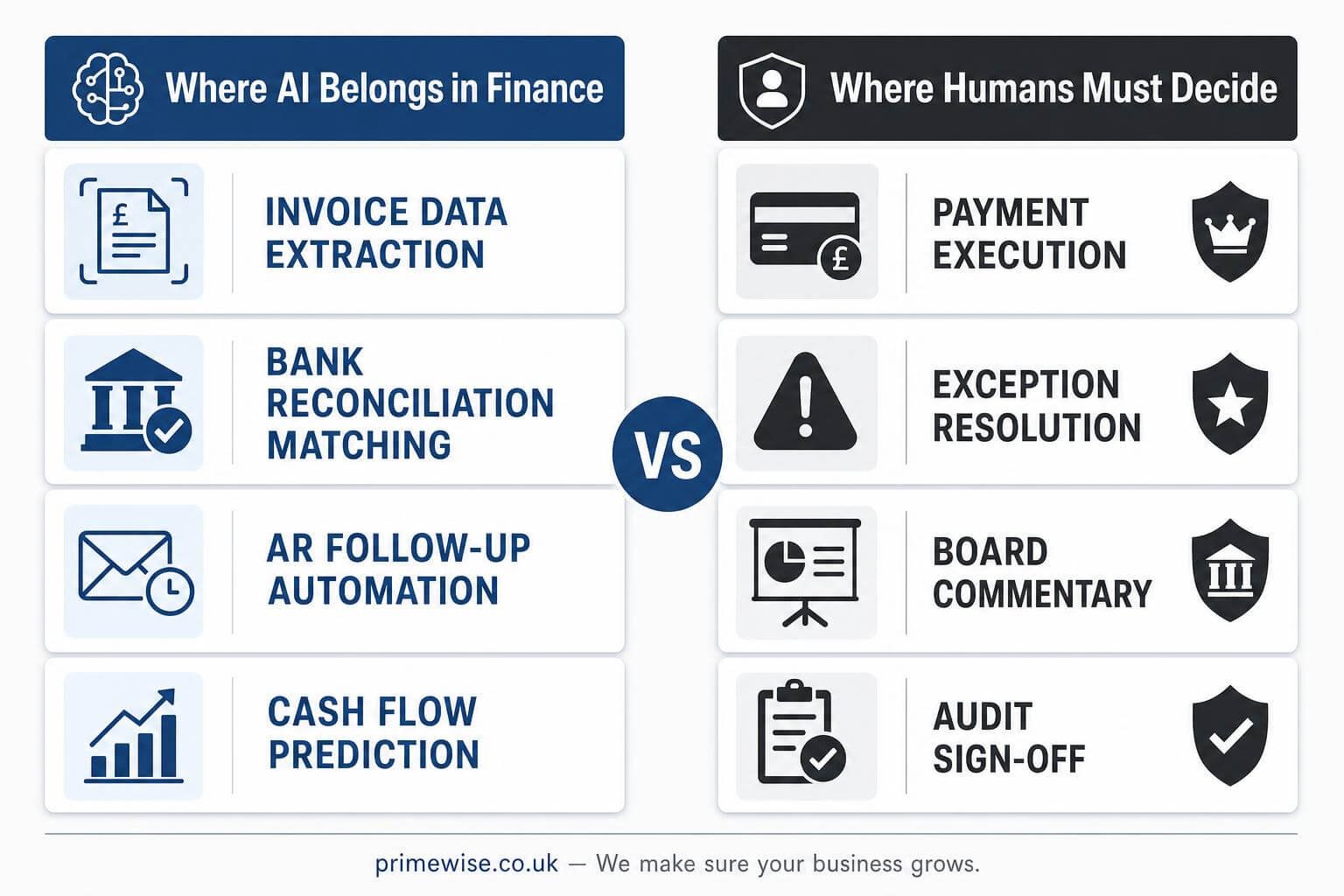
AI automation in finance operations means deploying machine learning models and large language models to accelerate high-volume, repetitive tasks invoice data extraction, bank reconciliation first-pass matching, and AR follow-up cadences whilst maintaining strict human-in-the-loop controls over all final financial approvals. It is not autonomous finance. The machines handle the data processing heavy lifting; qualified humans retain every authorisation gate. This distinction is the foundation of every successful, audit-defensible deployment.
The Boardroom Pressure Finance Leaders Actually Face
Finance directors across UK mid-market businesses are operating inside a genuine tension in 2026. Boards are demanding measurable efficiency gains, reduced operational headcounts, and visible technology modernisation. At the same time, the FD carries the ultimate legal responsibility for zero-defect financial governance, external audit compliance, and fraud prevention. These objectives are not naturally compatible, and no software vendor will acknowledge the conflict honestly.
The pressure is quantified in the numbers. McKinsey’s global finance automation research found that finance functions automating transactional processing reduced operational costs by 20 to 30 percent. The ICAEW’s Digital Finance survey consistently identifies manual data entry and reconciliation as the top two sources of finance team inefficiency in UK SMEs. The commercial case is not in dispute. The question is how to capture those gains without creating the systemic vulnerabilities that cause audit failures, regulatory breaches, or, in worst-case scenarios, material financial fraud.
The answer is a disciplined operational framework that separates tasks where algorithmic assistance adds measurable value from tasks where it introduces unacceptable risk. That framework is what this guide delivers.
The 80/20 Finance AI Governance RuleAI should handle 80% of the transactional processing volume data extraction, matching, anomaly flagging, and follow-up cadences. Humans must maintain 100% of the approval and control authority payment execution, exception resolution, and financial narrative. Violating this ratio in either direction destroys the value of the deployment.
Safe Automation for Immediate Returns
The highest-return, lowest-risk AI deployments in finance share a common characteristic: they act as intelligent assistants that prepare, categorise, and flag information for human review rather than autonomous agents that make and execute financial decisions. Isolating these high-volume, low-stakes processing tasks allows finance departments to eliminate operational bottlenecks without touching the governance architecture that auditors depend upon.
Accounts Payable LLM-Powered Document Processing
The accounts payable function is the most immediately fertile ground for AI efficiency. Legacy optical character recognition systems struggle with the format variation inherent in supplier invoices from hundreds of different vendors. Large language models trained on document extraction tasks can accurately capture line-item data, supplier details, VAT numbers, and purchase order references regardless of invoice layout, language, or format. This capability alone eliminates the most time-consuming element of AP processing for most UK mid-market finance teams.
Beyond extraction, AI performs automated three-way matching comparing the supplier invoice against the corresponding purchase order and goods receipt note and flags any discrepancy for human review before the invoice enters the payment queue. In practice, firms processing 500 invoices per month can reduce the manual cost per invoice from the industry benchmark range of £8 to £12 down to £1 to £3 with LLM-powered OCR automation. That is a measurable, boardroom-presentable ROI that can be modelled before a single line of integration code is written.
Accounts Receivable Predictive Cash Flow Management
Managing debtors at scale requires balancing commercial relationships against liquidity needs a balance that purely manual credit control consistently fails to maintain under volume pressure. AI enhances accounts receivable by analysing historical payment behaviour patterns to generate probabilistic cash flow forecasting timelines and identify accounts with elevated default risk. These predictive models allow credit controllers to prioritise their intervention effort on the accounts most likely to miss payment rather than working through a flat alphabetical chaser list.
Automated follow-up communication cadences triggered by the AI’s risk scoring send appropriately timed, tailored messages to late-paying customers without requiring manual intervention at each stage. The outcome is a transformation of credit control from a reactive administrative function into a proactive liquidity management discipline. Cash collection accelerates, DSO reduces, and the finance team redirects its human capacity toward strategic relationship management and exception handling rather than routine chasing.
Bank Reconciliation First-Pass Matching and Anomaly Detection
Bank reconciliation is structurally ideal for AI automation because it involves high-volume, rule-governed pattern matching the exact domain where machine learning consistently outperforms human operators on speed and consistency. AI algorithms process the straightforward matching of bank statement transactions against general ledger entries in minutes rather than hours, instantly identifying unmatched items, missing references, duplicated entries, and ledger anomalies that require human investigation.
The practical benefit is not just speed. Human fatigue during manual reconciliation is a documented source of posting errors, particularly in the final days of a month-end close. By delegating the routine matching to the AI and surfacing only the genuine exceptions, finance teams apply their accounting judgement precisely where it adds value to the complex, ambiguous cases that require contextual commercial understanding. This is the core operating principle of effective AI deployment in finance: machines process, humans judge.
RPA Versus AI Automation in Finance
A distinction that frequently creates confusion at the evaluation stage is the difference between Robotic Process Automation and AI-based automation. RPA tools such as UiPath and Blue Prism execute rigid, rule-based process sequences they are effective for structured, repetitive tasks where the input format never changes, such as copying data between two systems with fixed fields. They break immediately when the input format varies or an unexpected exception appears.
AI-based automation, by contrast, handles variability. LLM-powered document processing can interpret an invoice it has never seen before. Machine learning models can identify an anomalous transaction pattern without being explicitly programmed with the rule that defines it. For UK mid-market finance functions dealing with hundreds of supplier formats, dynamic customer behaviour, and evolving transaction types, AI automation delivers significantly greater resilience than RPA alone. In practice, a well-designed finance automation architecture often combines both: RPA for the structured handoffs between fixed systems, and AI for the intelligent interpretation layer that handles real-world document and data variability.
The Compliance Red Lines Where AI Must Not Operate
The efficiency gains outlined above are only commercially sustainable if the organisation draws and enforces hard boundaries around the tasks that must never be delegated to an algorithm. These red lines are not theoretical caution they are defined by the realities of financial fraud risk, FRC audit standards, and the fundamental limitations of probabilistic AI systems operating in environments that demand deterministic precision.
Final Payment Execution and Batch Approvals
This is the most critical red line in finance AI governance. An AI system must never hold the autonomous authority to execute a payment run or release funds from a business bank account. Delegating Bacs or CHAPS payment gateway access to an algorithm directly violates the segregation of duties principle that underpins every credible internal controls framework. It eliminates the human checkpoint that catches fraudulent supplier records, duplicate payment requests, and social engineering attacks targeting the payment process.
The correct operational model is explicit: the AI prepares the payment batch in full extracting invoice data, performing three-way matching, calculating net amounts, and organising the run and then presents the complete batch to a senior finance professional for review and manual authorisation. This review should operate under the four-eyes principle, requiring dual authorisation from two independent named approvers for any payment run above a defined materiality threshold. The AI does the preparation; two qualified humans execute the release. This architecture satisfies both the segregation of duties requirement and the fraud prevention standards that external auditors will test.
Resolving Complex Subjective Reconciliation Exceptions
Whilst AI manages routine transaction matching with high accuracy, it lacks the commercial context to resolve genuinely ambiguous exceptions. An unallocated cash receipt from a strategic customer making a partial payment against a disputed invoice, a currency translation variance arising from a contract renegotiation, or a timing difference created by an inter-company netting arrangement these situations require a finance professional who understands the business relationship, the contractual terms, and the strategic context. Delegating these exceptions to automated resolution logic risks misallocating funds, creating cascading ledger errors, and producing a balance sheet that passes the algorithm’s internal validation rules whilst being materially incorrect.
Generating Final Management Commentary and Board Reporting
Large language models are genuinely capable of synthesising numerical data into coherent written narrative. This capability creates a specific and serious governance risk: finance leaders using raw LLM output as final management commentary in board packs or statutory accounts. AI-generated financial narrative lacks access to the strategic context, forward-looking judgements, and nuanced commercial interpretation that management accounts must communicate to board-level stakeholders. It can misrepresent trend causation, omit material qualifications, or present an operationally accurate but strategically misleading picture of business performance. Human controllers must author the final financial narrative without exception. AI can produce a draft for efficiency; that draft must be critically reviewed, substantially edited, and owned by a named qualified professional before it reaches the board.
Compliance WarningUnder UK GDPR Article 22, individuals have the right not to be subject to decisions based solely on automated processing where those decisions produce significant effects. In financial operations contexts particularly credit decisions and payment terms ensuring human review is not only good governance practice but a legal obligation under UK data protection law.
Structuring Audit-Proof Human Controls
Satisfying external auditors in an AI-assisted finance environment requires more than deploying software responsibly. It demands a governance architecture that produces irrefutable evidence of human oversight at every critical decision point. The FRC’s Audit Quality Review thematic findings have consistently emphasised that firms deploying automated workflows must document the human decision points within those workflows explicitly not as a general policy statement, but as a transaction-level audit trail. Finance transformation specialists such as PrimeWise work with UK mid-market finance functions to design exactly this kind of human-in-the-loop control architecture, ensuring automation deployments satisfy both operational efficiency objectives and FRC governance standards.
The AI Proposes Human Disposes Framework
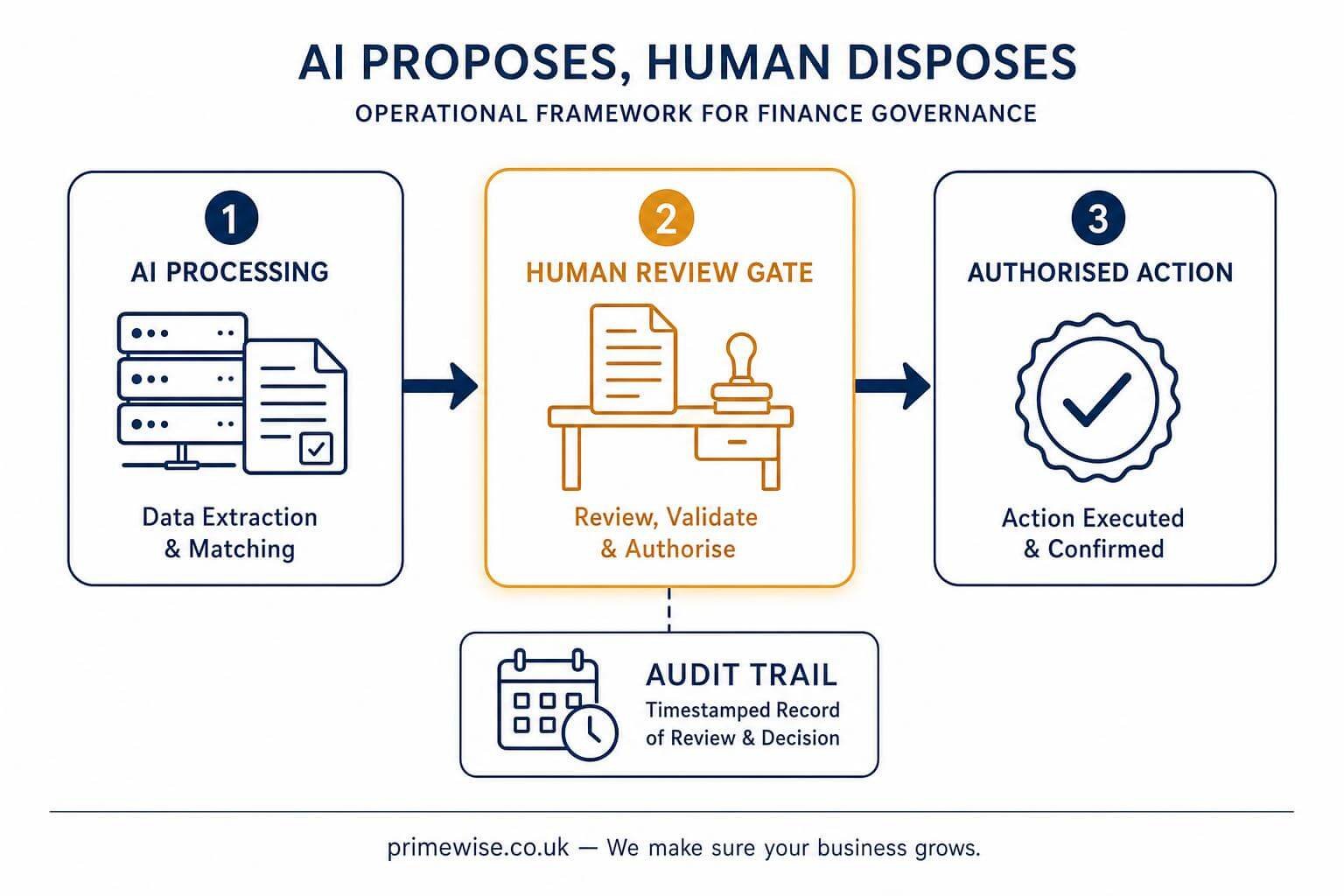
The most effective and auditor-accepted operational model for AI in finance is the AI Proposes, Human Disposes framework. In this structure, the AI system completes all data processing, categorisation, matching, and exception-flagging activity, then presents a fully prepared action a payment batch, a reconciled ledger, a customer risk rating to the human finance professional for review and authorisation. The human operator validates the evidence, applies their professional judgement, and executes or rejects the proposed action. The AI proposes; the human disposes.
This framework is significant because it preserves the full speed benefit of automation whilst embedding legal accountability in the hands of a qualified professional at every consequential decision point. It is not a bureaucratic overhead layered onto an automated process it is the architecture that makes the automated process both commercially viable and audit-defensible. Every finance function deploying AI should be able to map each automated workflow explicitly to this model and demonstrate the evidence of human disposal at the point of each consequential action.
Technical Governance System Logging and Data Provenance
External auditors examining an AI-assisted finance function will require absolute certainty about how specific financial figures were generated, by which system, at what time, and under whose authority. This requirement demands comprehensive system logging and version control for every automated activity in the finance stack. Every algorithmic action from invoice line-item extraction to first-pass reconciliation match must generate a timestamped, immutable audit trail that records the input data, the algorithmic output, and the identity and timestamp of the human approver who authorised the final action.
This data provenance architecture ensures that an external auditor can trace any automated journal entry or payment record back to its source document in full. It also ensures that if an automated system produces an error, the firm can demonstrate precisely where in the workflow the error originated and which control should have caught it. Firms that cannot produce this audit trail for automated transactions face the realistic prospect of a qualified audit opinion a consequence that eliminates any efficiency saving the AI deployment achieved.
AI Vendor Security and Compliance Credentials
Selecting an AI platform for financial operations requires evaluating the vendor’s security posture with the same rigour applied to any financial system procurement. Finance leaders must confirm that prospective AI vendors hold ISO 27001 certification for information security management and, where applicable, SOC 2 Type II attestation for the controls governing data security, availability, and confidentiality. These certifications are not marketing credentials they are independently audited confirmations that the vendor’s infrastructure meets the minimum security standards appropriate for handling sensitive financial data.
Critically, any AI platform processing UK financial data must operate in a closed-loop model where the firm’s data is never used to train the vendor’s public or shared models. This is a UK GDPR compliance requirement and a commercial confidentiality imperative. Finance leaders should require explicit contractual confirmation of this data isolation before procurement and should validate it against the Information Commissioner’s Office guidance on automated processing of personal and commercially sensitive data. Platforms that cannot provide this contractual assurance should be excluded from consideration regardless of their functional capability.
UK Regulatory Compliance and Legacy ERP Integration
Deploying AI automation within a UK finance function requires navigating a specific regulatory and technology landscape that differs materially from the generic global guidance most AI vendors publish. UK-specific compliance requirements, the maturity profile of mid-market ERP environments, and the operating structures of shared services functions all shape what a responsible, sustainable AI deployment looks like in practice.
HMRC MTD and UK GDPR Alignment
HMRC’s Making Tax Digital programme mandates that digital links must exist between source data and the VAT or corporation tax submission no manual re-keying of figures is permitted within the digital chain. AI automation deployments must be architected to preserve these digital links throughout the data pipeline. Any AI-assisted journal posting or invoice processing step that breaks the digital link between the source transaction and the tax submission creates a structural MTD compliance failure regardless of how accurately the AI processed the underlying data.
UK GDPR, administered by the Information Commissioner’s Office, imposes additional obligations on AI systems processing personal data including employee payroll data, individual director data within financial records, and any customer financial information held in AR systems. Article 22 of UK GDPR specifically addresses automated decision-making, requiring that where automated processing produces decisions with significant effects on individuals, appropriate human review mechanisms must be demonstrably in place. Finance leaders must assess their AI deployments against this provision and document their human review controls explicitly in their Records of Processing Activities.
Legacy ERP Environments and Integration Architecture
The majority of UK mid-market finance functions operate on ERP platforms that were not designed with AI integration in mind. Sage 200, Access Financials, and heavily customised Microsoft Dynamics NAV environments are common in the London mid-market and typically expose limited, inconsistent API connectivity. Connecting an AI automation layer to these legacy systems requires careful integration architecture typically involving middleware or iPaaS platforms to ensure that data flows securely between the AI processing layer and the core ledger without creating synchronisation gaps or data integrity risks.
More modern ERP platforms Microsoft Dynamics 365 Finance, Oracle NetSuite, and Xero offer significantly richer native API connectivity and, in several cases, embedded AI capabilities that reduce the integration complexity. Finance leaders evaluating AI automation should factor ERP connectivity into the vendor selection process from the outset. A highly capable AI platform with poor connectivity to the firm’s specific ERP version creates a more expensive and fragile deployment than a modestly capable platform with robust, documented integration support for that exact environment.
Organisations operating across multiple entities through shared services centre structures face an additional layer of integration complexity. AI deployments in SSC environments must handle entity-level data segregation, inter-company transaction identification, and multi-currency consolidation without blurring the boundaries between legal entities in the underlying ledger. These requirements are manageable but must be specified explicitly in the solution design phase they are not addressed adequately by out-of-the-box AI finance products.
The Five Non-Negotiable Rules of AI Automation in Finance
The operational frameworks, compliance requirements, and governance structures described throughout this guide resolve into five definitive rules. These are not guidelines or suggestions they are the conditions under which AI automation in a UK finance function either succeeds sustainably or fails expensively.
- AI prepares every transaction workflow; a qualified human authorises every consequential financial action without exception.
- Final payment execution requires dual human authorisation under the four-eyes principle no algorithm holds payment gateway access under any operating scenario.
- Every automated action generates a timestamped, immutable audit trail that a named human professional has reviewed and approved before it enters the financial record.
- All AI platforms processing UK financial data must operate in closed-loop, data-isolated environments that comply with UK GDPR, ICO guidance on automated processing, and HMRC MTD digital link requirements.
- AI-generated content reconciliation outputs, cash flow forecasts, financial commentary is a draft input to human judgement, never a final output for board reporting or statutory accounts.
Your Next StepPrimeWise offers a complimentary Finance Automation Readiness Review for UK mid-market CFOs and Finance Directors. The review delivers a documented map of your safe automation opportunities, red-line compliance boundaries, and a phased implementation roadmap aligned to your existing ERP environment with no obligation and no vendor bias. Contact PrimeWise at primewise.co.uk to arrange your review.
Sources and Further Reading
- Financial Reporting Council Audit Quality Review thematic findings on technology risk and automated workflows: frc.org.uk
- HMRC Making Tax Digital for VAT and Corporation Tax guidance: gov.uk/making-tax-digital
- Information Commissioner’s Office UK GDPR Article 22 guidance on automated decision-making: ico.org.uk
- ICAEW Digital Finance resources and technology adoption guidance for UK finance professionals: icaew.com
- McKinsey Global Institute Finance function automation and operational cost reduction research: mckinsey.com
This article provides operational and strategic guidance for UK finance professionals evaluating AI automation. It does not constitute legal, financial, or regulatory advice. Readers should consult a qualified professional adviser for guidance specific to their organisation’s circumstances, regulatory obligations, and technology environment.