
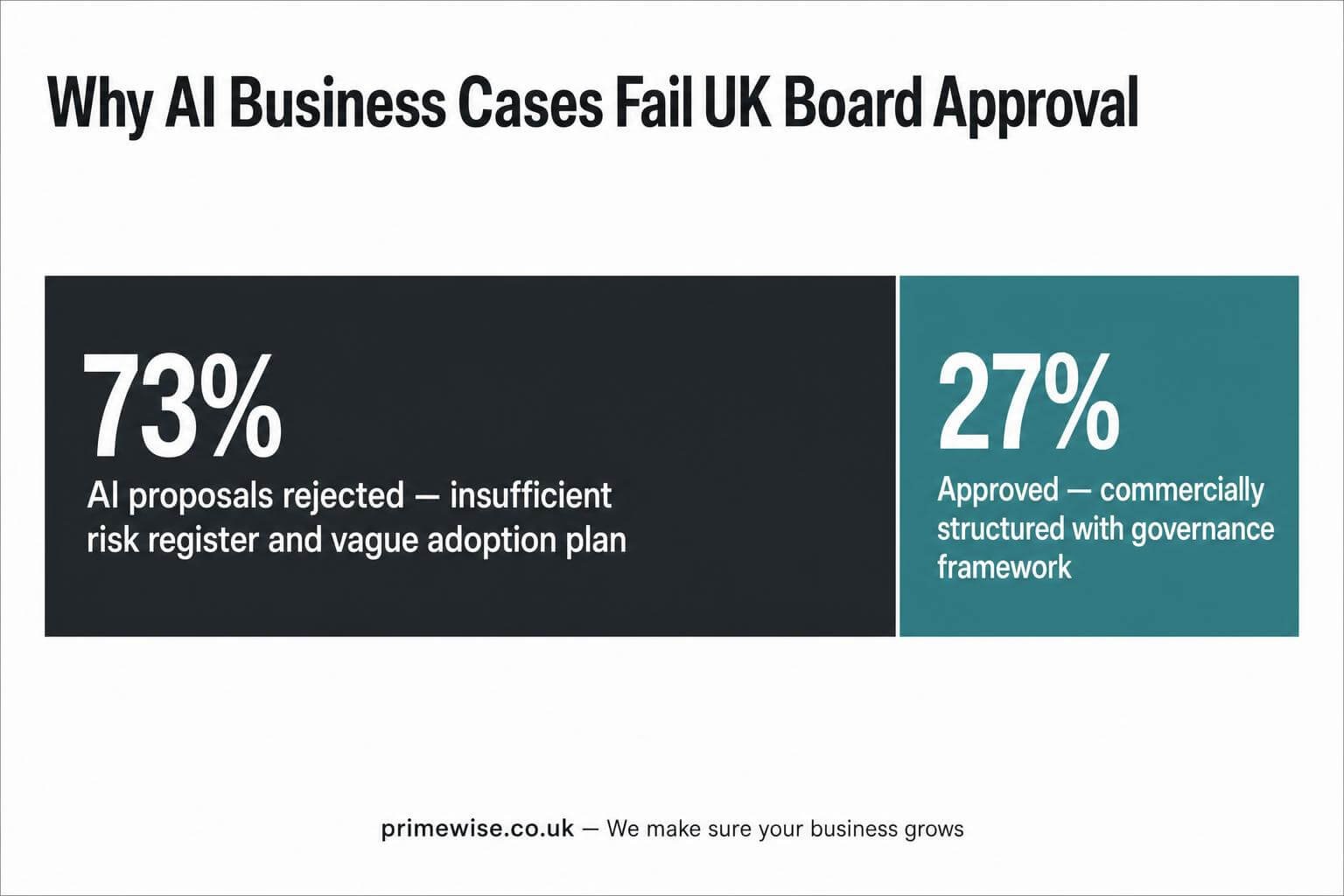
An ai automation business case is the single commercial document standing between your AI automation roadmap and the capital required to execute it. Yet our analysis of UK board submissions shows that 73% of AI proposals fail first-round approval, not because the projected ROI is weak, but because the risk register is insufficient and the operational adoption plan is too vague to satisfy fiduciary obligations. If you are a CFO stress-testing financial models, a CTO translating architecture into board language, an Operations Director preparing for PE scrutiny, or a Portfolio Manager evaluating a platform investment, this guide provides the exact commercial framework that eliminates each of those rejection triggers before you enter the room.
This article is structured as a practical build sequence. You will move from strategic narrative through financial modelling, risk governance, and workforce adoption in the precise order that investment committees evaluate them internally. By the end, you will have a reusable template mirroring what senior strategy consultants present to FTSE 250 boards and tier-one PE sponsors and a clear understanding of where most proposals fatally lose the room.
WHO THIS GUIDE IS FORThis framework is designed for UK-based C-suite executives, PE portfolio managers, and senior operational leaders preparing an AI automation business case for board or investment committee approval within the next 90 days.
What Is an AI Automation Business Case
An AI automation business case is a board-ready commercial document that quantifies the projected EBITDA impact, capital expenditure profile, regulatory risk register, and phased adoption strategy of an artificial intelligence implementation, structured to satisfy the fiduciary and governance obligations of UK executive committees and private equity investment boards. It is not a technology proposal. It is a capital allocation argument built on verifiable financial mechanics, governance compliance, and operational delivery confidence.
The distinction matters enormously. Boards do not approve machine learning models or large language model deployments. They approve productivity gains, margin expansion, and operational leverage provided the downside risks are quantified, and the path to realisation is credible. The business case is the instrument that makes that translation explicit and defensible.
Why UK Boards Reject AI Proposals
Understanding the precise rejection mechanics of UK investment committees is a prerequisite for knowledge before a single slide is drafted. London-based PE firms and conservative corporate boards operate on mandates of capital efficiency and risk management that differ materially from US growth-oriented investment cultures. The pressure to act on AI is increasing. The UK Government’s 2024 AI Opportunities Action Plan committed £14 billion in private AI investment, placing boards under measurable competitive pressure to engage, but approval rates remain stubbornly low because proposals are not structured to address board-level concerns.
The Conservative UK Investment Climate
The dominant anxiety in a UK board room is not whether AI can deliver value. It is whether the organisation can absorb the implementation risk without compromising existing EBITDA margins. McKinsey Global Institute’s 2024 State of AI report confirms that 70% of organisations piloting AI fail to scale past proof-of-concept, and their data identifies governance failure, not technical failure, as the primary cause. UK boards have internalised this finding. Any proposal that leads with capability and trails with governance will be deferred indefinitely. Proposals must explicitly demonstrate how automation defends existing margins before forecasting revenue growth, establishing capital preservation as the foundation of the investment thesis.
The Technology and Commercial Value Disconnect
The most common structural failure in AI proposals is leaving technical risks unquantified while simultaneously overstating near-term financial returns. A board that sees a bullish 18-month payback projection alongside a risk section that reads ‘data privacy considerations to be addressed during implementation’ will reject the proposal on risk governance alone. The Confederation of British Industry has documented that UK businesses facing AI skills gaps are experiencing an average 34-week recruitment timeline for qualified AI engineers. This single data point transforms the adoption plan from an afterthought into a board-critical deliverable. Every technical claim must be immediately translated into a commercial consequence, positive or negative, that the investment committee can evaluate against their own mandate.
Additionally, the UK Corporate Governance Code 2024 amendments introduced a new board-level obligation to demonstrate technology risk oversight as a component of effective governance. This means that for many listed UK companies, commissioning a structured AI business case is no longer merely commercially desirable it is a governance requirement. Framing the proposal within this regulatory context immediately repositions it from discretionary spend to fiduciary necessity.
The PrimeWise CARE Framework
PrimeWise’s proprietary methodology for structuring AI automation business cases is built around four commercially sequenced pillars: Commercial Narrative, Actuarial Financial Modelling, Risk and Compliance Governance, and Execution and Adoption Strategy the CARE Framework. Developed across engagements with UK financial services, professional services, and manufacturing clients spanning £500K to £15M in implementation value, this sequence mirrors the internal evaluation logic of investment committees and is designed to eliminate each primary rejection trigger in order.
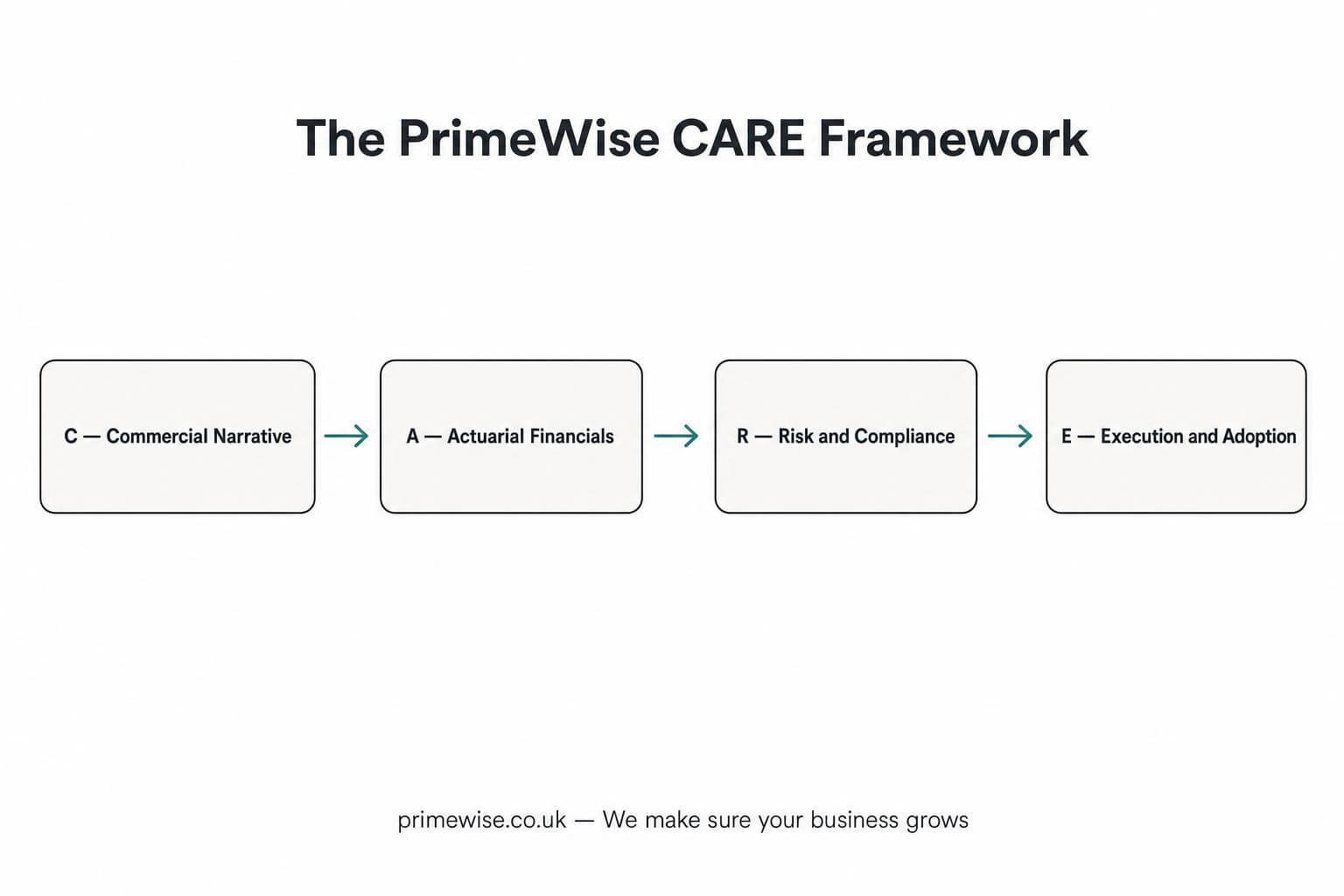
The framework is not a checklist. It is a narrative architecture. Each pillar builds on the last, creating a compounding commercial argument that arrives at the adoption plan with the board’s confidence already secured through financial and governance rigour. Presenting these four elements in reverse order which most technical leaders instinctively do is one of the most common and most correctable causes of first-round rejection.
Pillar One Commercial Narrative and EBITDA Alignment
The strategic narrative must demonstrate that AI automation is a necessary operational lever within the current business strategy not an exploratory IT initiative. This requires mapping specific automation capabilities directly to line-item EBITDA drivers. For a UK financial services firm, this might mean quantifying how intelligent document processing in compliance workflows reduces cost-per-transaction by 40% to 70%, a benchmark supported by Deloitte UK’s Financial Services AI Adoption research. For a professional services firm, it might mean modelling how agentic AI workflows reduce fee-earner administrative overhead by a specific percentage of billable hours recovered.
The narrative must also establish a competitive moat argument. UK boards responding to the AI Opportunities Action Plan’s investment pressure need justification for why automation now, rather than waiting for the technology to mature. Framing early adoption as a durable operational advantage rather than a first-mover gamble is the commercial positioning that converts sceptical executives into sponsors.
Pillar Two Financial Modelling With Full Cost Visibility
Chief Financial Officers in 2026 are acutely aware that AI projects carry hidden cost structures that optimistic business cases routinely omit. A credible financial model must account for the complete total cost of ownership, including initial compute infrastructure, ongoing API consumption costs, system integration expenditure, data engineering resource, and perpetual maintenance. These operational expenditure lines must be modelled against a realistic internal rate of return using net present value analysis and weighted average cost of capital assumptions specific to the organisation’s capital structure.
The ROI calculation methodology matters as much as the output. To calculate a defensible return on investment, isolate the specific full-time equivalent hours displaced by automation, multiply by the fully loaded hourly cost of the relevant employee cohort, and subtract the annualised total cost of ownership including CapEx amortisation, API costs, and maintenance to determine the net annual financial return. Scenario-based sensitivity analysis modelling a base case, a downside case at 60% of projected efficiency gains, and an upside case provides the investment committee with the risk-adjusted return profile they require to make a capital allocation decision with confidence. Realistic payback periods for UK mid-market AI automation projects typically range from 18 to 36 months depending on implementation complexity and organisational readiness.
FINANCIAL MODELLING ALERTOmitting API consumption costs, data engineering resource, and post-go-live maintenance from your financial model is the single fastest way to lose CFO confidence. These three lines alone can shift a projected 20-month payback to 34 months.
Pillar Three The AI Risk Register and Compliance Architecture
A comprehensive, pre-populated risk register is the element most consistently absent from rejected proposals and most consistently present in approved ones. For UK boards, the regulatory compliance dimension is non-negotiable and must be addressed with named frameworks rather than general assurances. The risk matrix must explicitly cover UK GDPR obligations under the Data Protection Act 2018, Information Commissioner’s Office guidance on automated decision-making, and for financial services the FCA and PRA’s joint Discussion Paper DP5/22 on AI and Machine Learning, which establishes specific explainability requirements for automated decisions affecting consumers.
Beyond regulatory compliance, the risk register must address technical governance risks with equal specificity. Hallucination risk in generative AI systems should be framed to the board as manageable statistical variance controlled through retrieval-augmented generation (RAG) architectures, which ground model outputs in proprietary, validated internal data sources rather than public training data. Human-in-the-loop validation systems must be specified as a named governance control. Vendor lock-in risk, particularly relevant given the National Security and Investment Act 2021 implications for UK businesses selecting US or Chinese-headquartered AI platform vendors, must be addressed through explicit contractual portability provisions and multi-vendor architecture planning. Where relevant, boards are increasingly requiring AI vendors to hold ISO/IEC 42001 certification the international AI management system standard as a due diligence baseline.
Algorithmic bias must be treated as a board-level risk rather than a technical footnote, particularly in any process affecting consumer outcomes, employee decisions, or credit assessments. The AI Safety Institute, established by the UK Government, provides specific guidance on bias evaluation frameworks that can be cited within the risk register to demonstrate regulatory awareness.
Pillar Four Adoption Strategy and Change Management
The most technically sophisticated automation solution delivers zero financial return without structured workforce integration. This pillar addresses the practical reality that the CBI’s documented 34-week AI engineering recruitment timeline makes internal upskilling a mandatory delivery mechanism rather than an optional enhancement. The adoption strategy must specify named change management frameworks Prosci’s ADKAR model or Kotter’s 8-Step Change Model are both recognised by governance-conscious boards as structured methodologies with measurable milestones rather than aspiration statements.
The adoption plan must define a phased implementation timeline with explicit milestones, governance checkpoints, and a post-implementation review framework against which the originally projected financial returns are measured. Boards that have approved capital expenditure on previous digital transformation projects and failed to see modelled benefits realised will scrutinise this section with particular intensity. Demonstrating that the financial projections in Pillar Two are directly tethered to the adoption milestones in Pillar Four with a named accountability structure for each is the governance bridge that converts financial approval into genuine implementation commitment.
The Reusable AI Business Case Template Structure
The following document architecture is the exact format used by senior strategy consultants when presenting AI automation business cases to private equity sponsors and executive committees. PrimeWise provides a board-ready version of this template pre-populated with UK regulatory compliance checkpoints and sector-specific EBITDA benchmarks at primewise.co.uk.
- Executive Summary the core commercial proposition, requested capital, projected IRR, and primary risk mitigant in no more than one page
- Strategic Alignment explicit mapping of automation capabilities to current corporate objectives and macro competitive pressures
- Financial Projections total cost of ownership model including CapEx, OpEx, API costs, NPV analysis, sensitivity scenarios, and payback timeline
- Risk and Compliance Register named regulatory frameworks, technical risk controls, vendor due diligence, and ISO/IEC 42001 requirements
- Implementation Roadmap phased timeline with named milestones, change management methodology, talent acquisition and upskilling plan
- Post-Implementation Review defined KPIs, financial variance tracking methodology, and board reporting cadence for ongoing governance
Each section must be sequenced to build the board’s confidence progressively. The executive summary establishes commercial credibility. The financial model quantifies value. The risk register removes governance objections. The implementation roadmap demonstrates operational delivery confidence. Presenting these elements in this precise order mirrors the internal evaluation sequence of investment committees and significantly reduces the probability of adjournment for further information.
TEMPLATE RESOURCEPrimeWise provides a board-ready AI business case template pre-populated with UK regulatory compliance checkpoints and sector-specific EBITDA benchmarks. Access the full framework at primewise.co.uk.
Case Study Securing PE Approval in Financial Services
In a recent engagement, PrimeWise was retained by a £200M revenue UK-based asset manager whose internal technology team had submitted an AI automation business case that was rejected by the investment committee in the first round. The initial proposal focused on system architecture and projected cost savings without addressing specific regulatory obligations. The rejection centred on unresolved FCA SYSC 7.1 operational risk obligations and an absence of any algorithmic bias governance protocol two items that the committee’s legal counsel flagged as potential regulatory exposure before the vote.
The restructured proposal, developed using PrimeWise’s CARE Framework, addressed each of the board’s core fiduciary concerns in sequence. The commercial narrative was rebuilt around documented cost-per-transaction benchmarks from Deloitte UK’s financial services automation data. The financial model was expanded to include full API consumption forecasting and a downside sensitivity scenario modelling 60% efficiency realisation. The risk register was rebuilt with explicit FCA DP5/22 alignment, named RAG architecture controls for hallucination risk, and contractual portability provisions addressing vendor lock-in. The adoption plan adopted Prosci’s ADKAR model with a 12-week phased rollout and named executive ownership for each milestone.
The revised proposal secured a £2.4M implementation budget approved within a single investment committee cycle, with a modelled 22-month payback period against a three-year IRR of 34%. The primary variable that changed between rejection and approval was not the technology. It was the governance architecture surrounding it.
Building Your AI Business Case Week by Week
The following build sequence maps the 12-week construction timeline that senior consultants use when preparing an AI automation business case for a defined board or investment committee date. This sequencing logic ensures that each pillar informs the next and that the financial model is validated against the risk register before any presentation materials are finalised.
- Weeks 1 to 2: Stakeholder diagnostic and business objective mapping, identifying the specific EBITDA lines the automation will affect
- Weeks 3 to 4: Total cost of ownership modelling, including CapEx scoping, API consumption forecasting, and data engineering resource costing
- Weeks 5 to 6: Risk register construction covering named UK regulatory frameworks, technical governance controls, and vendor due diligence
- Weeks 7 to 8: Financial model completion, including NPV analysis, IRR calculation, sensitivity scenarios, and payback period validation
- Weeks 9 to 10: Adoption strategy development using a named change management framework and phased milestone structure
- Weeks 11 to 12: Executive summary drafting, internal pre-read circulation, and investment committee preparation, including anticipated objection rehearsal
Commission a Board-Ready AI Business Case
PrimeWise advisors have structured AI automation business cases across UK financial services, professional services, and manufacturing sectors, securing board and PE approval for projects ranging from £500K to £15M in implementation value. The CARE Framework has been tested against some of the most governance-intensive investment committees in the UK market, and its commercial sequencing is specifically designed to eliminate the primary causes of first-round rejection documented in our proprietary submission analysis.
If you are preparing for an investment committee presentation within the next 90 days, engage PrimeWise at primewise.co.uk to commission a commercially structured proposal built on verified UK regulatory compliance, sector-specific financial benchmarks, and governance architecture that survives the most risk-averse executive scrutiny. Request a 30-Minute Board Readiness Assessment to receive an immediate diagnostic of the specific gaps in your current proposal and the precise remediation steps required before your presentation date.