
Knowing what not to automate with AI is, in 2026, more strategically valuable than knowing what to automate. Every week, operations leaders across the UK reach out to our AI automation consultancy carrying the same burden: a board mandate to deploy, a proof-of-concept that has gone sideways, and a remediation bill that nobody budgeted for. The uncomfortable truth is that the pressure to automate driven by AI FOMO at the executive level consistently outpaces the operational due diligence required to make it work. Before your organisation commits another pound to autonomous workflow deployment, the nine processes outlined in this article deserve a serious governance conversation.
At PrimeWise, our enterprise delivery forensics across UK financial services, professional services, and regulated industries have consistently produced one confronting metric: automating high-nuance workflows generates hallucination remediation costs averaging three times the projected operational savings. That figure is not theoretical. It is drawn from live client engagements between 2023 and 2025, spanning over forty enterprise transformation programmes. It is the number that changes boardroom conversations.
The Automation Deficit Explained
The automation deficit describes the operational gap between what an AI system is projected to deliver and what it actually costs to govern, correct, and remediate once deployed into a complex, human-led workflow. It occurs when the true cost of exception handling the senior analyst hours, the regulatory exposure, the customer experience degradation is never factored into the original business case. Most automation proposals are built on a flawed numerator: they calculate the cost of human labour being replaced, but they never model the cost of the errors the algorithm will produce in that human’s absence.
For chief operating officers and governance leads, the automation deficit is the hidden liability sitting inside every poorly scoped AI deployment. Understanding it before funding a proof of concept is the single highest-return governance action available in 2026. The workflows described below represent the categories where this deficit is most reliably triggered and where PrimeWise’s delivery experience consistently recommends maintaining human primacy.
GOVERNANCE WARNINGIf a proposed workflow has an exception rate above 15%, an autonomous AI model will almost certainly fail. High exception rates signal reliance on uncodified institutional knowledge that cannot be transcribed into algorithmic rules. Stop the proof of concept before it starts.
Nine Workflows to Keep Human
These nine categories are not theoretical constructs. They are drawn from delivery post-mortems, regulatory enforcement actions, and the operational forensics of failed AI rollouts across UK enterprises. Each one shares a common characteristic: the consequence of algorithmic error consistently and materially outweighs any efficiency gain the automation could realistically produce.
Vulnerable Customer Identification
The Financial Conduct Authority’s Consumer Duty, which came into full force in July 2023 and was extended to closed book products in July 2024, places an explicit obligation on regulated firms to identify and appropriately support consumers in vulnerable circumstances. The FCA’s own Financial Lives 2024 survey data indicates that approximately 47% of UK adults currently display at least one characteristic of vulnerability whether financial, cognitive, emotional, or relating to life events. That is not a minority edge case. It is the statistical majority of your retail customer base.
AI systems fundamentally cannot perform this identification with the reliability Consumer Duty requires. The linguistic cues of financial anxiety, cognitive decline, or acute stress are subtle, non-linear, and highly contextual. A customer who uses clipped, transactional language on a Tuesday morning may be perfectly fine, or may be in severe distress. Human agents trained in vulnerability awareness read tone, pace, hesitation, and conversational non-sequiturs in a way that no current large language model can replicate reliably. The regulatory consequence of misidentification is not a slap on the wrist. Under Consumer Duty, firms face FCA enforcement, redress obligations, and reputational disclosure requirements. This workflow must remain human-led, with technology serving only as a flagging support tool never as the primary assessor.
Complex Compliance Triage
When triaging a complex regulatory breach, drafting a Section 166 response, or preparing a submission for the Prudential Regulation Authority, the chain of reasoning must be transparent, auditable, and defensible under cross-examination. Generative AI models are fundamentally incapable of providing this. Their outputs are probabilistic approximations, not logical derivations. They cannot cite a specific regulatory instrument, apply its precise jurisdictional scope, and then construct a defensible narrative not with the accuracy that regulators demand and enforcement proceedings require.
The FCA’s PS21/3 on operational resilience and the Bank of England and FCA’s joint discussion paper DP5/22 on AI and machine learning in financial services both underscore a consistent supervisory expectation: firms must be able to explain any decision that affects a consumer or the integrity of the market. Algorithmic black boxes fail this test categorically. The ICO’s 2023 guidance on AI and data protection reinforces this position from a data rights perspective. Complex compliance triage requires a human expert who can be accountable for the logic, not an algorithm whose reasoning pathway cannot be reconstructed post-hoc. Responsible AI deployment in compliance functions means augmentation only never autonomous triage.
High-Stakes Contract Negotiation
The City of London’s financial and professional services market is built on premium relationship capital. Bespoke structuring, complex bilateral negotiations, and multi-party contract frameworks involve reading the room, interpreting unstated commercial pressures, and trading on relational trust that has been built over years. These are not variables that can be inputted into a model. They exist in the silence between clauses, in the concession that signals a counterparty’s real priority, and in the institutional memory of how a particular relationship has navigated conflict before.
Language models trained on historical contract data can accelerate first-draft generation and identify clause inconsistencies with genuine utility. That is a legitimate and high-value co-pilot application. But the negotiation itself the dynamic, relationship-sensitive, commercially strategic human interaction is entirely beyond current AI capability. Firms that have attempted to replace relationship managers with AI in premium service lines have consistently reported brand equity erosion and counterparty attrition. The automation bias risk here is particularly acute: junior staff may over-rely on AI-generated clause recommendations without the contextual judgment to know when the algorithm is wrong about what the relationship can bear.
Edge-Case Fraud Investigations
Standard transactional fraud detection is a legitimate and effective use case for machine learning. High-volume, rules-based pattern recognition at speed is exactly where algorithmic systems outperform humans, and deploying them here is sensible governance. The problem arises when that same logic is extended to edge-case fraud investigations the cases that do not fit the pattern, where the suspicious behaviour is precisely its apparent normality, and where investigative intuition and lateral thinking are the primary analytical tools.
UK GDPR Article 22 is directly relevant here. It protects individuals from being subject to a decision based solely on automated processing that produces legal or similarly significant effects. A fraud lockout or account suspension constitutes exactly such a decision. The ICO has been explicit that firms must maintain a robust human review mechanism for these outcomes, and that the right to meaningful human review cannot be operationally watered down through under-resourcing or bureaucratic friction. Edge-case fraud investigations require an experienced investigator who can challenge the algorithm’s output, assess the full contextual picture, and apply human accountability to a decision that may have severe consequences for the individual. Algorithmic accountability cannot be outsourced to a model that cannot be cross-examined.
Tier-Two Dispute Resolution
When a customer complaint escalates to tier two, something important has already happened: that customer has experienced the failure of the first line and the failure of the initial resolution attempt. They are not calling for information. They are calling for validation, accountability, and a human being who has the authority and the empathy to actually fix their problem. Deploying an algorithm at this point is not just operationally inefficient it is actively destructive to the customer relationship.
In one documented case from a major European financial services firm, the deployment of an autonomous bot for tier-two complaint handling resulted in a 12% reduction in Net Promoter Score within six months, triggering a £2 million manual remediation programme and a formal FCA supervisory review of the firm’s complaints handling practices. The firm ultimately restored full human staffing to tier-two resolution and wrote off the entire technology investment. The lesson is not that the technology was poorly configured. The lesson is that the workflow was a categorically poor automation candidate high empathy requirement, high consequence of error, and zero tolerance for the formulaic responses that even well-trained models default to under pressure.
Strategic Asset Allocation
High-net-worth clients engage wealth managers for a specific and irreplaceable bundle of value: human expertise, fiduciary accountability, and the confidence that their generational financial strategy is being guided by a professional who understands their full personal context. Algorithms can assist with data aggregation, portfolio modelling, and market scenario analysis. These are legitimate and valuable augmentation applications. But the final asset allocation decision the one that balances a client’s risk appetite against their values, their family obligations, their liquidity needs, and their legacy intentions requires a human fiduciary who can be held legally and professionally accountable for the outcome.
The FCA’s Senior Managers and Certification Regime creates clear individual accountability lines for investment advice in regulated firms. Delegating strategic allocation to an autonomous system creates an accountability vacuum that the regulatory framework explicitly does not permit. Beyond regulation, there is the client experience dimension: the removal of a trusted human relationship manager in favour of an algorithmic interface has been consistently shown in FCA consumer research to reduce both client retention and assets under management in the twelve months following transition. Fiduciary duty cannot be automated. It is, by legal and relational definition, a human responsibility.
Crisis Communications Management
Brand reputation management during a live crisis requires three capabilities that no current AI system can reliably provide simultaneously: hyper-contextual situational awareness, tonal precision calibrated to a specific stakeholder audience, and real-time adaptive judgment as the narrative evolves. The stakes of getting this wrong are asymmetric. A misaligned statement during a regulatory investigation, a product recall, or a data breach can transform a manageable incident into a systemic reputational catastrophe one that persists in search results, regulatory records, and stakeholder memory for years.
The AI hallucination risk in crisis communications is operationally unacceptable. Generative models trained on historical communication patterns will produce outputs that reflect what has been said before, not what needs to be said now, in this specific context, to this specific audience, under these specific constraints. Crisis communications is precisely the workflow where the deviation from historical norms is most critical and precisely where AI is least equipped to perform. Human PR and communications specialists with sector-specific regulatory awareness must lead. Technology can assist with monitoring, sentiment analysis, and distribution logistics. The message itself cannot be generated by an algorithm when the organisation’s future is contingent on it.
Employee Disciplinary Processes
The Employment Rights Act, combined with the Equality Act 2010 and the UK’s developing framework around algorithmic accountability in the workplace, creates a legal and ethical minefield for any organisation that attempts to automate HR disciplinary workflows. Performance improvement plans, formal disciplinary hearings, and redundancy consultations require profound emotional intelligence, strict procedural compliance, and the kind of contextual individual assessment that employment tribunals specifically look for when evaluating fair process. Algorithmic bias in these processes does not just create tribunal exposure it destroys workplace culture, suppresses psychological safety, and drives the departure of the high-performing employees who have the most options.
The UK’s Information Commissioner’s Office has explicitly flagged the use of automated systems in employment decisions as a high-risk area under UK GDPR, requiring Data Protection Impact Assessments and meaningful human review of any algorithmically influenced outcome. Change management for AI in HR is possible technology can assist managers by flagging documentation inconsistencies or identifying patterns across the organisation. But the moment the algorithm influences an individual’s employment status without substantive human judgment at the centre of the process, the firm is in territory that employment law was specifically designed to protect against.
Exception Handling in Legacy System Integrations
The bolt-on automation fallacy is most visible and most costly in legacy system integration contexts. When an AI tool is layered on top of an outdated database architecture, the inevitable data quality issues, schema mismatches, and processing exceptions require constant human intervention to resolve. The automation does not eliminate the human workload. It transforms it: instead of frontline staff handling routine processing, the firm now requires senior technical analysts to diagnose and resolve continuous algorithmic misinterpretations, at a significantly higher hourly cost.
PrimeWise delivery data from 2024 and 2025 across UK financial services clients shows that exception handling in legacy automation integrations consistently generates remediation costs running between two and three times higher than the original projection of human labour savings. The robotic process automation limitations in these environments are not fixable through model retraining. They are structural they reflect the fundamental incompatibility between probabilistic AI systems and the brittle, rule-bound, underdocumented logic of legacy infrastructure. If the underlying system cannot be modernised, the automation business case should not be funded.
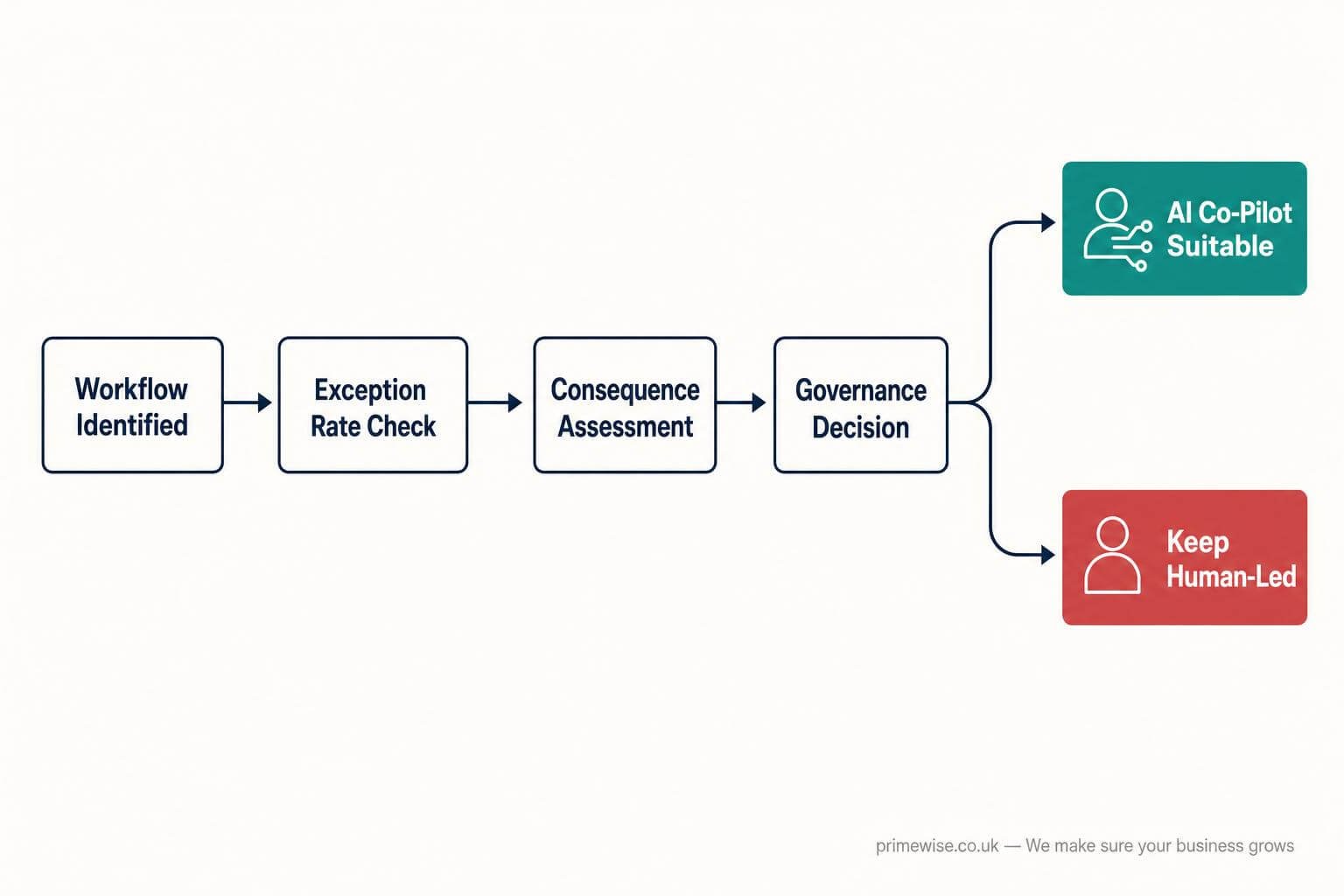
KEY INSIGHTThe 15% Exception Rate Rule: if process mining reveals that a human-led workflow currently operates with an exception rate above 15%, autonomous AI deployment will fail. This threshold indicates that the process depends on uncodified institutional knowledge, relational context, and instinctual problem-solving none of which can be reliably encoded into algorithmic rules.
Identifying Poor Automation Candidates Early
The most expensive moment to discover that a workflow is a poor automation candidate is six months into a live deployment. The second most expensive moment is at the end of a proof-of-concept programme that has already consumed budget, internal credibility, and stakeholder patience. The least expensive moment by a significant margin is before the business case is approved. PrimeWise’s advisory methodology is structured to front-load this evaluation, using two diagnostic frameworks that transform subjective board-level enthusiasm into objective operational risk assessment.
The Automation Deficit Matrix
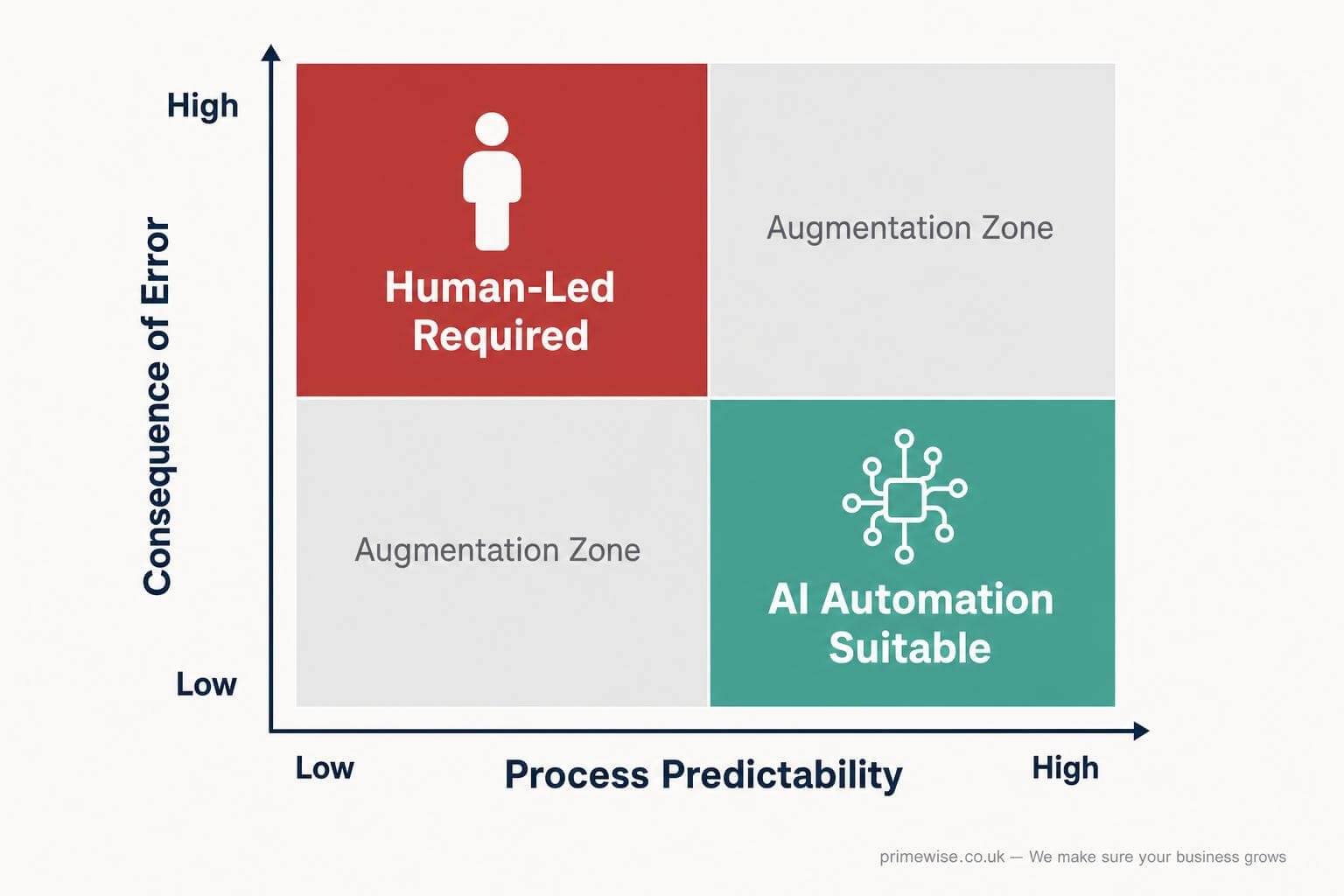
The PrimeWise Automation Deficit Matrix evaluates proposed workflows on two axes: process predictability and consequence of error. Workflows that score high on both predictability and low on consequence of error are strong automation candidates rules-based, high-volume, low-stakes processing where the algorithm’s occasional errors are recoverable and inexpensive. Workflows that score low on predictability and high on consequence of error are categorically human-led the nine categories described above fall squarely into this quadrant.
The matrix’s operational value lies in its application before vendor engagement. When a board requests an AI automation proposal, the governance team runs the target workflow through the matrix before a single procurement conversation takes place. This single intervention prevents the most common failure mode in enterprise AI governance: the selection of a vendor solution before anyone has asked whether the workflow should be automated at all. It is a deceptively simple framework that has, in our delivery experience, prevented multiple seven-figure failed deployments.
The Fifteen Percent Exception Rate Rule
Through extensive process mining across UK enterprise environments, PrimeWise has established a reliable delivery heuristic: if a human-led workflow currently operates with an exception rate exceeding 15%, autonomous AI deployment will fail. This is not a probabilistic forecast. It is a pattern that has held across every engagement where we have been able to run pre-deployment process analysis. Exception rates above this threshold indicate that the workflow is dependent on uncodified institutional knowledge the accumulated, informal, experiential understanding that experienced staff apply instinctively, and that cannot be extracted, documented, or encoded into algorithmic rules without a transformation programme that typically costs more than the automation it enables.
How PrimeWise Structures Your Human-AI Governance Review
For COOs and transformation directors facing board pressure to deploy AI, PrimeWise offers a structured Human-AI Governance Review that delivers three outcomes in a single engagement: a workflow-level automation risk assessment using the Automation Deficit Matrix, a regulatory alignment audit against FCA Consumer Duty, UK GDPR Article 22, and PS21/3 operational resilience requirements, and a prioritised roadmap identifying which workflows should be automated, which should be augmented with human-in-the-loop AI, and which should be explicitly ring-fenced from autonomous execution.
This is not a technology evaluation. It is an operational governance exercise that protects your organisation from the sunk costs, regulatory exposure, and customer experience degradation that follow poorly scoped AI deployments. The firms that benefit most are those that engage before the proof-of-concept is commissioned while the cost of changing course is still low. If your organisation is currently under board pressure to automate workflows that exhibit the characteristics described in this article, speak to PrimeWise before the business case is approved. The governance conversation costs significantly less than the remediation project.
SAFE DEPLOYMENT PRINCIPLEThe most effective alternative to outright rejection of AI is pivoting to human augmentation. Deploy technology as a digital co-pilot: let the algorithm handle data synthesis, document drafting, and preliminary research. Keep human accountability for the final decision. This satisfies FCA Consumer Duty, UK GDPR Article 22, and risk-averse stakeholders simultaneously.
Safely Deploying AI as a Co-Pilot
Rejecting automation in the nine workflows above does not mean rejecting technology. Human-in-the-loop AI where the algorithm augments human decision-making without replacing it represents the correct deployment model for high-consequence, low-predictability workflows. In this architecture, the AI system handles what it does well: processing large volumes of unstructured data, surfacing relevant regulatory precedents, generating first-draft documentation, and flagging anomalies for human review. The human expert retains what only they can provide: contextual judgment, emotional intelligence, fiduciary accountability, and the ability to explain a decision to a regulator, a client, or an employment tribunal.
Establishing strict governance guardrails is essential to prevent automation bias the documented cognitive tendency for human reviewers to uncritically accept algorithmic outputs rather than applying independent judgment. AI governance frameworks must specify explicitly where human override authority sits, how algorithmic recommendations are labelled and contextualised for the human reviewer, and what escalation pathway exists when the system produces an output that falls outside defined confidence thresholds. The UK AI Safety Institute’s evaluation frameworks provide a useful starting scaffold for this governance architecture, and PrimeWise’s Human-AI Governance Review incorporates these standards into client-specific operational design.