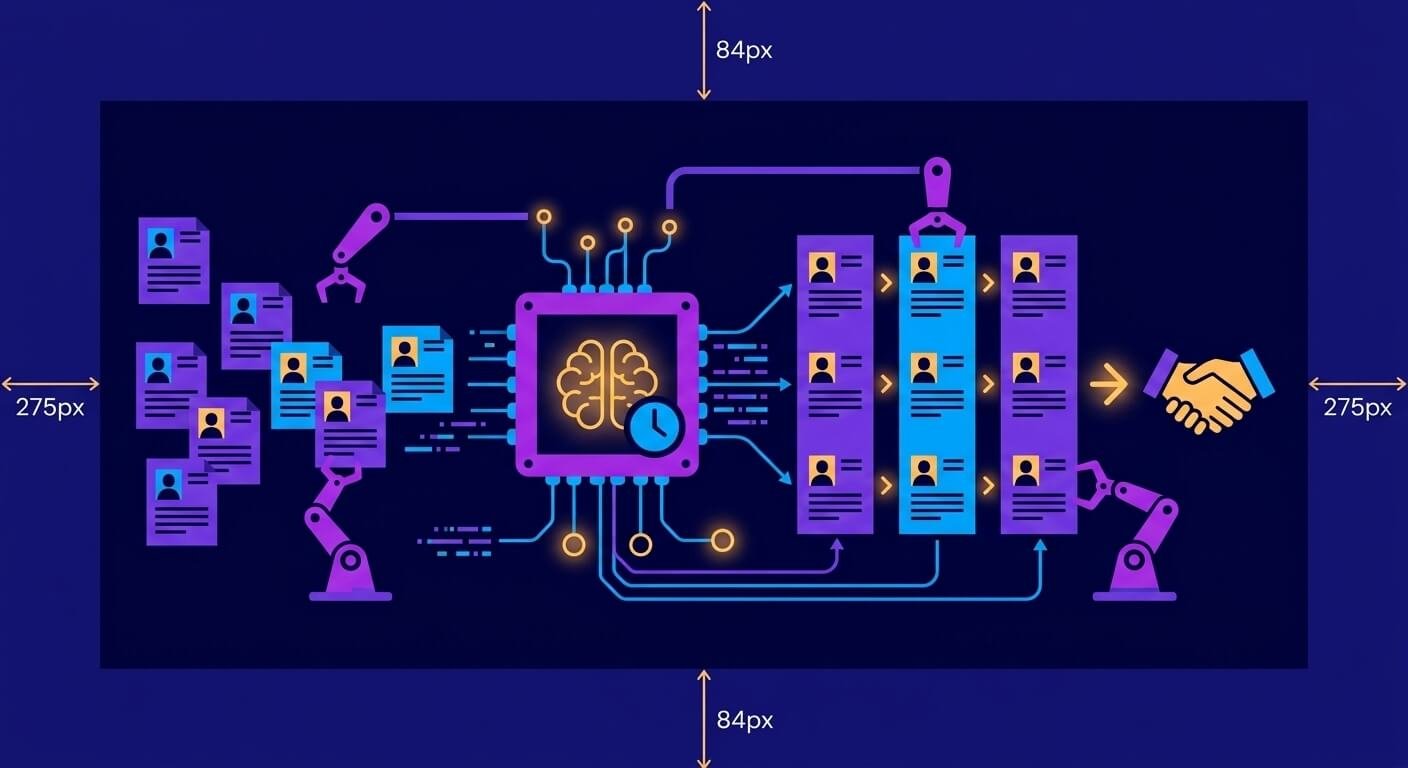

Knowing exactly when to hire an AI integration consultant is the difference between a firm that scales profitably and one that haemorrhages margin on manual processes while watching a DIY tech project stall for the third consecutive quarter. If your senior team is drowning in administrative repetition, your capacity is capped, or compliance anxiety is quietly strangling your digital roadmap, this article mirrors precisely where you are and maps the exact decision point that separates high-growth professional services firms from those perpetually stuck at the same revenue ceiling.
Is This Article For You?This guide is written for founders, managing partners, and C-suite executives at UK financial and professional services firms who already understand AI's potential but are evaluating whether now is the right moment to bring in an expert. If you recognise three or more of the seven triggers below, the cost of waiting is likely higher than the cost of acting.
The Founder’s Executive Summary
The core problem facing UK professional services firms in 2026 is structural. Scaling revenue has historically demanded a near-linear increase in headcount more clients means more fee earners, which means more PAYE, more recruitment spend, and thinner margins. AI integration breaks this equation, but only when deployed by someone who understands the operational architecture of regulated businesses, not just the technology stack. The decision to bring in a specialist consultant is not a technology decision; it is a capital efficiency decision.
- The fundamental problem is the FTE-to-Revenue Disconnect revenue growth requires costly, linear headcount increases that rapidly erode profit margins.
- The triggers are operational: highly paid talent buried in manual workflows, internal AI projects stalled, and client mandates being turned away due to capacity constraints.
- The risk of inaction includes FCA and ICO compliance exposure, dangerous shadow IT proliferation, and compounding productivity loss estimated at £200,000 to £800,000 annually for mid-sized firms.
- The solution is engaging an expert consultant to act as an embedded operations director derisking integration, managing change adoption, and delivering deployment velocity that internal teams cannot match.
What an AI Integration Consultant Actually Does
An AI integration consultant is a strategic operations expert who diagnoses workflow bottlenecks and architects bespoke automation solutions tailored to a firm’s specific regulatory environment, technology stack, and growth objectives. The critical distinction from a generic software vendor is this: a consultant manages the human side of the transition. They ensure staff adoption, govern data sovereignty, and engineer compliance-safe deployments particularly vital for firms operating under FCA authorisation or ICO data governance obligations. Where a vendor sells a product, a consultant builds an outcome.
Internal attempts to deploy artificial intelligence consistently fall victim to implementation paralysis. Existing technology leads are already managing day-to-day technical debt, and an internal AI committee quickly becomes another agenda item competing with fee-earning work. According to McKinsey’s 2024 State of AI in Financial Services report, firms that engaged external AI implementation specialists achieved full workflow deployment 3.5 times faster than those relying on internal task forces, while saving an estimated £60,000 in lost productivity during the transition period. An external specialist eliminates shadow IT risk, accelerates deployment velocity, and ensures that bespoke solutions are adopted securely across the organisation from day one.
The FTE-to-Revenue Disconnect
The traditional growth model for UK financial and legal firms relies on recruiting more fee earners to grow revenue. This creates what operational strategists call the FTE-to-Revenue Disconnect a structural vulnerability where each incremental unit of revenue requires a proportional increase in payroll cost. With Employer National Insurance contributions rising to 15% in April 2025, London recruitment fees averaging 20% to 25% of first-year salary, and a chronic talent shortage across financial services roles in the City, adding headcount now erodes margins faster than ever. The CBRE 2025 London Financial Services Talent Report confirmed that all-in hiring costs for a mid-level analyst role in the City now regularly exceed £52,000 before the individual has generated a single billable hour.
Expert AI integration provides the operational leverage required to break this cycle permanently. Firms that deploy AI-driven workflow automation can scale output, onboard new client mandates, and absorb regulatory complexity without linearly inflating their PAYE burden. The leverage ratio is the fundamental metric and it is the single most compelling argument for engaging a specialist before the next hiring cycle begins.
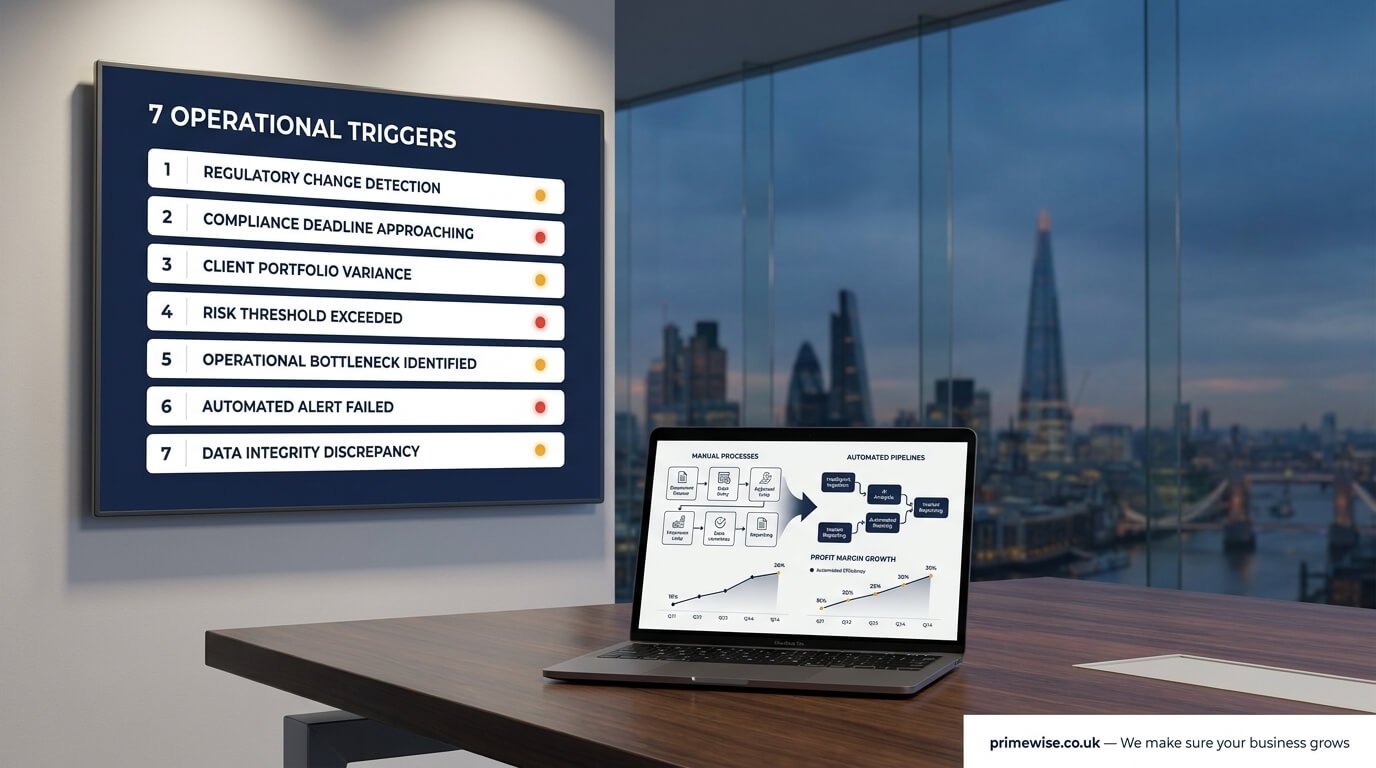
7 Operational Triggers That Mean Your Firm Is Ready
Identifying the precise moment your operations require external intervention prevents catastrophic delays in service delivery and avoids the compounding cost of inaction. The following seven triggers are drawn from operational diagnostics conducted across UK financial and professional services firms. If three or more of these describe your current reality, you have crossed the threshold where the cost of engagement is consistently outweighed by the cost of delay.
Trigger 1 Senior Talent Buried in Administrative Repetition
When your highest-paid professionals the analysts, associates, and advisors billing at £150 to £400 per hour are spending 12 to 18 hours each week manually reconciling data across siloed systems, copying information between platforms, and generating reports by hand, your firm is experiencing a severe misallocation of capital. The Law Society’s 2025 Technology Adoption Survey found that 67% of UK law firms reported over 22% of fee-earner time lost to non-billable administrative tasks. In wealth management and financial advisory practices, the figure is comparable.
An AI integration consultant automates these repetitive workflows using tools such as Make.com, n8n, or bespoke Retrieval-Augmented Generation (RAG) pipelines that extract, process, and distribute structured data without human intervention. The immediate commercial impact is straightforward: returning even ten billable hours per week per senior professional at standard billing rates represents tens of thousands of pounds in recoverable annual revenue per head.
Trigger 2 You Have Breached the Capacity Drain Index Threshold
Service firms hit a predictable breaking point when internal administration consumes more than 20% of total billable capacity. This is the Capacity Drain Index threshold the point at which operational drag begins visibly suppressing revenue growth and making accurate capacity planning impossible. When project managers cannot reliably forecast delivery timelines because manual workflow bottlenecks introduce unpredictable delays, client satisfaction deteriorates alongside margins.
A strategic AI integration consultant maps the full capacity drain profile of the firm before deploying targeted workflow automation. The effect is immediate and measurable: firms that address the Capacity Drain Index systematically typically reclaim 15% to 30% of previously lost billable capacity within the first 90 days of deployment, without adding a single headcount.
Trigger 3 Compliance Anxiety Has Frozen Your Tech Roadmap
Founders in FCA-regulated and ICO-governed businesses frequently pause their entire digital transformation strategy due to legitimate anxieties about data sovereignty and regulatory exposure. The FCA’s Artificial Intelligence in Financial Services discussion paper DP5/22 and the ICO’s published Guidance on AI and Data Protection make clear that firms deploying AI systems that process client data carry significant accountability obligations. This is not paranoia it is accurate risk assessment.
The solution is not to avoid AI; it is to engage a consultant who architects ring-fenced LLM deployments and private RAG systems that guarantee client data never enters a public model. A specialist with direct experience navigating FCA and ICO compliance requirements can build a governed AI infrastructure one where every data flow is auditable, every model boundary is documented, and every deployment decision can be justified to a regulator. Compliance anxiety should be the trigger to hire, not the reason to delay.
Regulatory NoteThis article is intended for informational purposes. Firms operating under FCA authorisation should conduct independent regulatory review prior to deploying any AI system that processes client data. Reference the FCA's DP5/22 and the ICO's AI and Data Protection Guidance for current obligations.
Trigger 4 Post-Brexit Administrative Overhead Is Crushing Productivity
UK firms operating across European markets now carry a disproportionate manual administration burden as a direct result of post-Brexit regulatory divergence. Cross-border reporting, customs compliance documentation, dual regulatory submissions, and the absence of mutual recognition frameworks have created a sustained administrative drag that legacy technology stacks are entirely unequipped to absorb. When qualified, expensive professionals are manually navigating this complexity, the productivity cost is substantial and entirely avoidable.
Bespoke AI automation acts as an invisible operations team absorbing the manual shock of post-Brexit compliance administration, standardising cross-border reporting workflows, and dramatically reducing the time qualified staff spend on regulatory paperwork. No-code AI deployment platforms and custom workflow automation stacks can be configured to meet both UK GDPR and EU GDPR requirements simultaneously, enabling firms to operate across both jurisdictions without duplicating their compliance effort or their headcount.
Trigger 5 You Are Turning Away Revenue Due to Capacity Constraints
Declining a lucrative new client mandate because your onboarding process cannot absorb the volume is the clearest possible signal that operational infrastructure has become a growth ceiling. When scalability limits dictate your revenue trajectory, emergency hiring responses typically follow sprees that erode project margins, introduce quality risks, and burden existing staff with training obligations at precisely the moment they are already overstretched.
An AI readiness assessment conducted prior to the next growth cycle identifies exactly where the onboarding and delivery bottlenecks sit, then maps a targeted automation roadmap to eliminate them. Firms that deploy AI-driven client onboarding workflows consistently reduce onboarding cycle times by 60% to 80%, enabling them to accept new mandates at scale without compromising service quality or triggering unplanned recruitment. This single outcome the ability to say yes to revenue you were previously forced to decline routinely justifies the full cost of consultant engagement within the first quarter.
Trigger 6 Your Internal AI Initiative Has Stalled Beyond 90 Days
Many firms attempt what consultants in this space term the DIY Illusion assembling an internal AI steering committee tasked with mapping and deploying automation solutions. These initiatives are overwhelmingly likely to fail. Initiative fatigue sets in rapidly when committee members have competing day job priorities. Technical debt accumulates as each discovery phase reveals integrations more complex than initially scoped. According to McKinsey’s 2024 analysis, internal AI initiatives in professional services firms take an average of 14 months to reach live deployment compared to 4 months when led by an external implementation specialist.
If your internal project has been active for more than 90 days without a live deployment, it has almost certainly entered a stall cycle that internal momentum alone will not break. An external AI integration consultant brings the deployment velocity, the implementation methodology, and the change management framework necessary to move from discussion to live operation within weeks rather than months. The AI implementation roadmap they deliver is not theoretical it is sequenced, resourced, and built around your firm’s specific operational constraints.
Trigger 7 Employees Are Using Unapproved Consumer AI Tools
When team members, frustrated by an outdated enterprise technology stack, begin independently procuring consumer-grade AI tools free tiers of ChatGPT, personal Gemini accounts, or unsanctioned Microsoft Copilot configurations your firm has a live shadow IT problem with serious regulatory consequences. The ICO has issued explicit guidance that organisations remain liable for data processed through employee-used AI tools, even when those tools were adopted without formal IT approval. In FCA-regulated environments, this exposure is not theoretical; it is an enforcement risk.
The appropriate response is not to prohibit the behaviour banning tools that improve productivity rarely succeeds and simply drives usage underground. The appropriate response is to deploy a governed, compliant alternative that meets the business need safely. An AI governance framework, built and implemented by a specialist consultant, centralises these disparate tool usages under a unified, auditable infrastructure typically a private RAG deployment or an FCA-compliant workflow automation stack built on vetted platforms such as Microsoft Azure AI or AWS Bedrock. The consultant’s role is to make the compliant option the easy option.
The Opportunity Cost Matrix
The capital allocation required for AI integration consultant fees is consistently outweighed by the compound cost of operational waste, lost billable capacity, compliance exposure, and foregone revenue. Firms identifying with four or more of the seven triggers above are typically leaving between £200,000 and £800,000 in annual productivity value unrealised, based on operational diagnostic data from UK professional services engagements. This is not a technology investment; it is a margin recovery exercise with a measurable ROI timeline.
A concrete example illustrates the scale of the opportunity. A boutique wealth management firm in the City of London engaged an AI integration consultant to redesign their compliance-heavy client onboarding workflow. Prior to implementation, new client onboarding took 14 working days on average and consumed significant time from a four-person advisory team. Following a targeted automation deployment built on a private, FCA-compliant document processing and data extraction pipeline onboarding cycle time reduced to three working days. The advisory team reclaimed 41 billable hours per week across the four-person team. At their standard billing rate, this represented an annualised productivity recovery of approximately £390,000, achieved without hiring a single additional member of staff and without triggering a single compliance flag during the subsequent FCA supervisory review.
ROI BenchmarkUK professional services firms that engage external AI implementation consultants achieve full workflow deployment 3.5x faster than internal task forces, saving an estimated £60,000 in transition productivity loss and recovering an average of 15–30% of previously lost billable capacity within 90 days of go-live.
Is Your Firm Operationally Ready The AI Readiness Diagnostic
Review the seven triggers above and count how many currently apply to your firm. This is your AI Readiness Score, and it carries a direct financial implication.
- One to two triggers: Your firm is approaching readiness. Begin an AI readiness assessment now to map your workflow automation opportunities before the threshold is breached.
- Three to four triggers: You are at the critical inflection point. The cost of engagement is almost certainly lower than the monthly cost of your current operational inefficiency.
- Five or more triggers: Every additional month without intervention is generating quantifiable, compounding revenue and margin loss. The diagnostic conversation is overdue.
Firms at the three-trigger threshold and above consistently find that the gap between their current operational output and their potential capacity freed by targeted workflow automation represents six figures in recoverable annual value. The ROI calculation is not complex; the barrier is almost always the decision to act.
How to Choose the Right AI Partner for a UK Firm
Selecting the right digital transformation partner for a regulated UK firm demands evaluation criteria that extend well beyond technical capability. The most important filter is sector-specific operational fluency. A consultant who speaks the language of AUM growth, fee income, FCA supervisory risk, and P&L rather than APIs and software licences is categorically more valuable to a professional services firm than a generalist technologist with impressive platform certifications.
Demand a comprehensive change management framework as a core deliverable, not an afterthought. The single most common reason AI integration projects fail after technically successful deployment is staff adoption failure teams revert to familiar manual processes because the transition was not managed with the same rigour as the build. Insist on watertight SLA agreements that tie consultant accountability to measurable operational outcomes: billable hours recovered, onboarding cycle times reduced, compliance incidents prevented. References from firms in directly comparable regulated sectors are non-negotiable due diligence.
PrimeWise operates as an embedded AI operations partner for UK financial and professional services firms architecting FCA-compliant automation stacks that decouple revenue growth from headcount cost. Unlike generalist technology consultants, PrimeWise works exclusively in the language of operational leverage, regulatory risk, and measurable P&L impact. The first engagement begins with a no-obligation operational diagnostic: a structured 45-minute conversation that maps your firm’s specific capacity drain profile against a measurable ROI timeline. If you recognised your firm in four or more of the triggers above, that 45-minute conversation could identify six figures in recoverable annual value with a clear implementation roadmap to realise it.