AI automation agency cost is the single most misunderstood variable in digital transformation budgeting today. The market for AI automation agency services has exploded but so has the number of inexperienced operators selling commodity templates as enterprise solutions. This guide cuts through the noise with a precise global pricing matrix, a transparent cost-of-ownership framework, and the red flags that signal an underqualified vendor before you commit a penny.
2026 Quick Pricing ReferenceEntry-level offshore builds: £800–£2,500. Mid-market UK and US specialists: £4,000–£12,000. Enterprise-grade AI architecture: £20,000 and above. Monthly managed retainers: £500–£4,000 depending on compute and complexity. These figures represent fair market value benchmarks as of Q1 2026.
What an AI Automation Agency Actually Does
An AI automation agency is a technology consultancy that integrates artificial intelligence into business workflows to reduce manual overhead and improve operational throughput. The scope of work ranges from deploying simple webhook-triggered chatbots to engineering bespoke machine learning pipelines, custom retrieval-augmented generation (RAG) systems, and full legacy ERP integrations. The critical distinction one this guide will return to repeatedly is the difference between a consultancy that engineers proprietary systems and an operator who connects pre-built SaaS tools with a no-code interface and calls it artificial intelligence.
Why the Market Is Broken Right Now
An estimated 85% of newly formed AI automation agencies operate with fewer than 12 months of enterprise software experience. This figure aligns with broader observations from Gartner’s 2025 AI implementation research and McKinsey’s Global AI Adoption Survey, both of which documented an unprecedented surge in sub-scale technology vendors entering the market following the mass commercialisation of large language models in 2023 and 2024. The pattern is consistent: individuals with minimal engineering backgrounds replicate business models popularised by online influencers, package off-the-shelf Zapier or Make.com automations as bespoke AI systems, and price them just below what a mid-market agency charges creating a deceptive value illusion.
For procurement teams and executive boards, this creates severe information asymmetry. The language used by an inexperienced no-code operator and a senior AI architect can sound nearly identical in a sales deck. The differentiators lie beneath the surface: in security architecture, compliance credentials, system documentation, and the engineering depth required to build something that will not break, leak data, or become commercially redundant within six months.
The Liam Ottley Effect and AAA Clones
A specific market phenomenon worth naming directly is what the industry has termed the “AAA clone” problem referring to the wave of AI Automation Agency operators who emerged following the popularisation of the business model through YouTube channels such as Liam Ottley’s. These operators typically hold Zapier, Make.com, or n8n certifications and connect public OpenAI or Anthropic APIs to client systems using drag-and-drop workflow builders. Make.com’s free tier supports up to 1,000 operations per month, while paid plans begin at approximately £9 per month costs that bear no resemblance to the thousands these operators charge for what amounts to a configured subscription. Identifying this tier is the first critical procurement skill.
The Global AI Agency Pricing Matrix
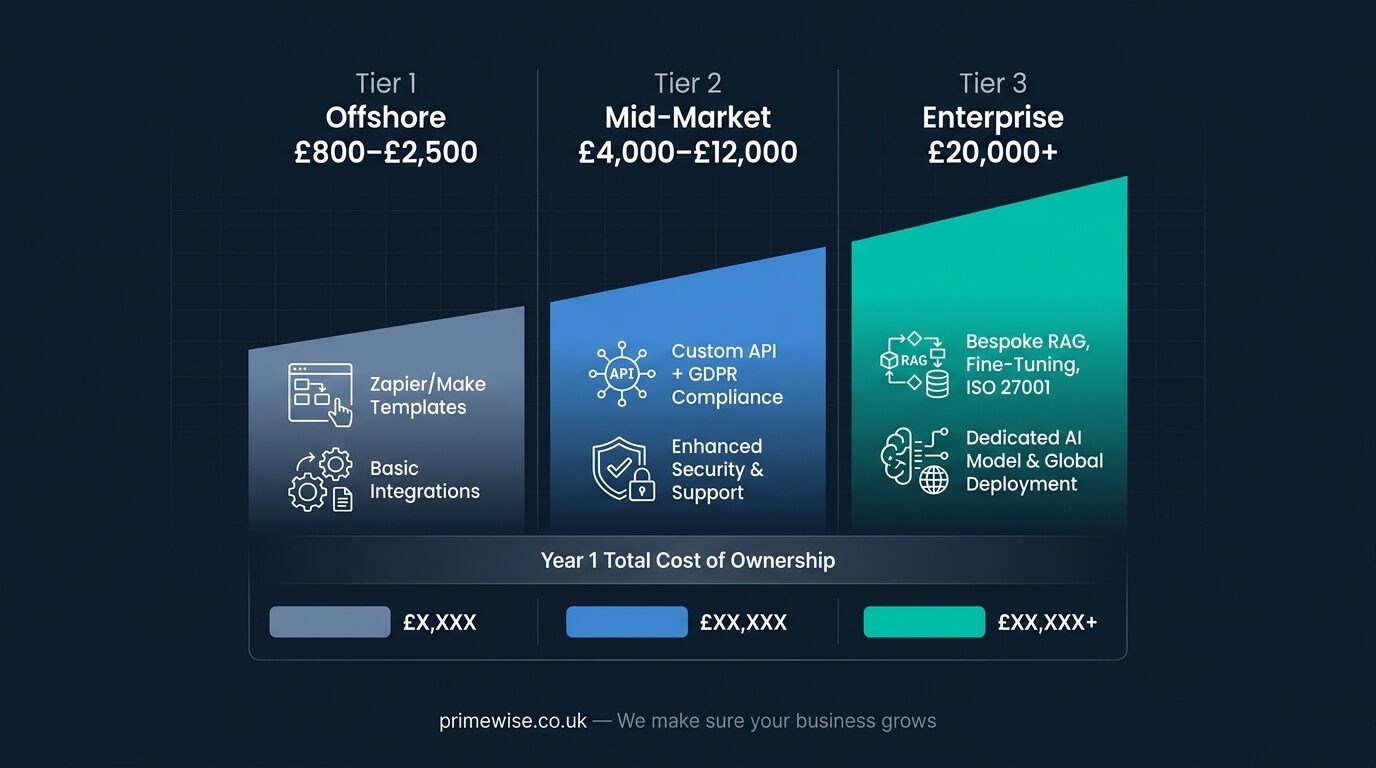
Understanding where a proposed engagement sits within the global talent hierarchy is the foundation of any rational AI procurement decision. The following tiers are based on aggregated market data from UK, US, and offshore agency engagements observed across the period 2024 to Q1 2026.
| Tier | Cost Range | Location Profile | Typical Deliverable | Compliance Level |
|---|---|---|---|---|
| Tier 1 Entry Level | £800–£2,500 | India, Eastern Europe | No-code Zapier or Make.com templates | Minimal |
| Tier 2 Mid-Market | £4,000–£12,000 | UK, US domestic | Custom API integrations, generative AI builds | GDPR-aware |
| Tier 3 Enterprise | £20,000+ | London, New York | Bespoke RAG, fine-tuning, ERP integration | ISO 27001, full data residency |
Tier 1 Offshore and Entry-Level Builds
Operators in this bracket are primarily based in India or Eastern Europe and deliver basic workflow automation using no-code platforms. Zapier’s professional tier costs approximately £49 per month for 2,000 tasks, while Make.com’s business plan runs around £29 per month meaning the underlying tooling carries negligible cost. Builds at this tier involve minimal bespoke coding, lack formal security documentation, and are structurally unsuitable for any engagement involving personally identifiable information, financial data, or regulated industries. They remain viable for low-stakes internal administrative tasks in non-regulated environments, such as automating internal meeting summaries or routing basic support tickets.
Tier 2 Mid-Market UK and US Specialists
This tier represents genuine fair market value for the majority of small to medium enterprises. Domestic agencies in this bracket build robust API integrations, deploy capable custom generative models, and operate rigorous testing environments. These are typically established digital agencies that have organically expanded into AI integration, staffed by engineers who understand commercial data handling requirements. At this level, intellectual property is protected during processing, GDPR considerations are actively managed, and deliverables include technical documentation sufficient for internal IT audits. UK consultancies operating in this tier including PrimeWise, which provides ISO-compliant AI deployments with transparent API cost forecasting sit at the responsible centre of the market.
Tier 3 Enterprise AI Architecture
Investments exceeding £20,000 access premium London or US-based engineering talent, with senior consulting day rates ranging from £800 to £1,500 according to ONS digital sector wage data and current UK contractor market benchmarks. Deliverables at this tier include custom RAG architectures built on frameworks such as LangChain, LlamaIndex, or AutoGen; precise model fine-tuning on proprietary datasets; vector database deployments using Pinecone, Weaviate, or Chroma; and full legacy ERP integrations. The engineering objective at this level is hallucination elimination building systems that are contextually aware of a firm’s private data without leaking that data back into public training pipelines. ISO 42001 AI management system certification is increasingly expected at this tier for regulated industries.
PrimeWise Scoping OfferIf your organisation is evaluating AI automation investment above £10,000, PrimeWise offers a complimentary commercial scoping session to identify the precise build tier and true cost-of-ownership structure appropriate for your operational requirements. No obligation, no sales script peer-level advisory only.
Commodity Builds Versus True AI Consulting
The most commercially dangerous mistake in AI procurement is paying enterprise prices for a commodity build. Unqualified agencies routinely package basic prompt-chaining connecting a user input to an OpenAI API call and returning the response as proprietary artificial intelligence. The OpenAI API itself charges approximately £0.002 per 1,000 tokens on GPT-4o mini, meaning the underlying intelligence layer of a £5,000 “bespoke AI system” may cost its builder less than £3 per month to run. Protecting procurement budgets requires understanding precisely what has been engineered versus what has merely been configured.
What a ChatGPT Wrapper Looks Like
A ChatGPT wrapper is any system where user input is passed to a public OpenAI, Anthropic, or Google API endpoint, a response is returned, and the intermediary layer adds minimal or no proprietary logic. These systems are trivially buildable using tools like Flowise, Botpress, or Voiceflow all of which have free tiers and drag-and-drop interfaces. The presence of a branded interface, a multi-step prompt template, or an embedded widget does not constitute bespoke AI engineering. Buyers should request full architecture documentation, including the specific API endpoints called, the proprietary code repository, and a clear explanation of what intellectual property they will own upon project completion.
What Genuine RAG Architecture Delivers
A genuine retrieval-augmented generation system stores a company’s proprietary documents, policies, and operational data in a private vector database. When a user queries the system, semantically relevant document chunks are retrieved and injected into the language model’s context window meaning the model answers from verified internal knowledge rather than hallucinating from its general training data. Building this correctly requires selecting the appropriate embedding model (such as OpenAI’s text-embedding-3-large or an open-source alternative like BGE-M3), configuring a vector store with appropriate chunking and overlap strategies, engineering a retrieval pipeline with reranking, and implementing strict data isolation to prevent cross-tenant contamination. This is software engineering work that no drag-and-drop tool performs reliably at enterprise scale.
Red Flags Before You Sign
Underpriced engagements are rarely bargains. They are deferred liabilities that manifest as data breaches, operational failures, or expensive rebuilds within 12 to 18 months. The following signals indicate a vendor operating below the threshold of professional enterprise delivery.
- No service level agreement a professional agency defines uptime commitments, incident response times, and escalation paths in writing before any contract is signed
- No API cost forecast any agency that cannot produce a projected monthly compute cost estimate before deployment is not operating at a professional level
- No data processing agreement handling client data without a formal DPA is a direct GDPR violation under UK law
- No architecture documentation if a vendor cannot produce a system diagram showing data flow, storage locations, and API dependencies, they cannot support or audit the system they have built
- Vague IP ownership terms contracts must explicitly state that the client owns the codebase, models, and all derivative intellectual property upon delivery
- No named engineers agencies that present polished sales teams without identifying the actual engineers who will build the system frequently outsource delivery to lower-tier subcontractors
- Promises of “custom AI” below £1,500 at this price point, the only economically viable delivery model is a configured no-code template, not a custom-engineered system
Critical Procurement WarningUnder UK GDPR, ICO enforcement actions for data breaches involving inadequate technical controls resulted in penalties averaging £3.2 million per action in 2024 (ICO Annual Report). Engaging an unqualified AI vendor without a formal DPA and data residency controls is not a cost saving it is an unquantified regulatory liability.
The Failed Arbitrage Case Study
A mid-sized UK financial services firm processing approximately 800 customer interactions per day engaged an offshore operator at £2,000 to deploy a customer service chatbot. The system was built using a public OpenAI endpoint with no data isolation layer, no encryption in transit for UK-resident customer data, and no audit logging. Within four months, a routine API configuration error caused a subset of customer records to be exposed in system responses to unrelated queries. The regulatory and reputational remediation cost exceeded £140,000. The system was decommissioned.
A comparable firm operating in the same sector engaged a senior UK consultancy for £22,000 to deliver an enterprise-grade RAG architecture hosted on Azure UK South, with end-to-end encryption, ISO 27001-aligned access controls, full audit logging, and a 12-month managed retainer. Measured over 18 months, the automation reduced customer service headcount requirements by 1.4 FTE, generated £88,000 in annualised operational savings against a total investment of £30,400 including retainer costs, and produced no compliance incidents. The calculated return on investment exceeded 400%. The distinction was not the technology it was the engineering discipline and compliance architecture surrounding it.
The True Cost of AI Ownership Matrix
Evaluating AI automation investment through a single project fee is the most common budgeting error made by first-time buyers. The initial build typically represents only 30% to 40% of first-year total expenditure. A professional procurement decision requires calculating the full Year 1 Total Cost of Ownership across four distinct cost categories.
| Cost Category | Entry Level (Tier 1) | Mid-Market (Tier 2) | Enterprise (Tier 3) |
|---|---|---|---|
| Initial Build | £800–£2,500 | £4,000–£12,000 | £20,000–£60,000 |
| Monthly API and Compute | £50–£300 | £200–£1,500 | £1,000–£5,000 |
| Hosting and Infrastructure | Shared public cloud | £100–£500 per month | £500–£2,000 per month |
| Maintenance and Refactoring | Ad hoc, no SLA | £500–£2,000 per month | £1,500–£4,000 per month |
| Estimated Year 1 Total | £1,400–£6,100 | £11,200–£42,000 | £42,000–£132,000 |
Variable Compute and API Token Costs
The most frequently underestimated line item in AI deployment budgets is language model token consumption. OpenAI’s GPT-4o is priced at approximately £0.004 per 1,000 input tokens and £0.012 per 1,000 output tokens as of Q1 2026. An enterprise deployment processing 10,000 queries per day, each consuming an average of 800 input tokens and 400 output tokens, generates a monthly API cost of approximately £4,800 entirely independent of hosting, maintenance, or staffing. Any agency that fails to model this projection before contract signing is not operating at a professional level. Require a written compute cost forecast as a contract prerequisite, not an afterthought.
Managed Retainers and What They Must Cover
A professional managed retainer is not an open-ended subscription. It is a structured service agreement that specifies: defined SLA uptime commitments (typically 99.5% for enterprise deployments); proactive model refactoring as underlying LLM versions deprecate (GPT-3.5-turbo, for example, reached end-of-life in late 2024); security patch cadence aligned to infrastructure provider release cycles; and monthly performance reporting against agreed KPIs. Retainers that lack these defined deliverables in writing are, in commercial terms, undefined liabilities not service contracts.
AI Automation Cost by Industry Sector
Compliance overhead, data sensitivity, and integration complexity vary significantly by sector, and these variables directly affect the cost floor for any professional AI deployment. Generic pricing benchmarks must be adjusted against the specific regulatory and technical context of the commissioning organisation.
- Financial services FCA-regulated firms require FCA-compliant data governance, typically adding 25% to 40% to mid-market build costs due to audit trail requirements and explainability obligations under the Consumer Duty framework
- Legal and professional services document processing and contract analysis automations require fine-grained access controls and privilege-preserving data architectures, with typical mid-market engagements ranging from £8,000 to £18,000
- Healthcare and life sciences NHS Digital and ICO guidance on AI in clinical settings mandates data residency in UK-approved environments, pushing most legitimate deployments firmly into Tier 3 pricing
- E-commerce and retail lower compliance overhead makes this sector the most commercially accessible, with well-structured Tier 2 deployments routinely delivering positive ROI within six months for customer service and inventory automation use cases
- Logistics and supply chain ERP integration complexity (SAP, Oracle, Microsoft Dynamics) typically pushes even mid-scale projects toward the upper boundary of Tier 2 or the lower boundary of Tier 3
UK Market Dynamics and Regulatory Considerations
For UK-based businesses, the decision between a domestic certified agency and an offshore alternative carries legal weight that extends well beyond vendor preference. The UK Data Protection Act 2018, operating in parallel with UK GDPR post-Brexit, imposes strict requirements on where personal data is processed and stored. Sending UK-resident customer data to a default OpenAI API endpoint routes that data through US-based infrastructure a configuration that requires an active data transfer mechanism (such as standard contractual clauses) and explicit documentation of the legal basis for transfer. Many offshore and entry-level agencies do not meet this requirement and are unlikely to be aware that it applies.
GDPR Compliance and Data Residency
Selecting an agency that provisions dedicated infrastructure on Azure UK South or AWS eu-west-2 (London) ensures that data residency requirements are met by default. ISO 27001 certification provides independent third-party verification that an agency’s information security management system meets international standards a credential that should be requested and verified, not assumed from a sales claim. ISO 42001, the AI management system standard published in 2023, is increasingly becoming the benchmark for enterprise AI governance and is expected to feature in public sector AI procurement frameworks from 2026 onwards.
HMRC R&D Tax Credits for AI Investment
UK businesses commissioning bespoke AI architecture from domestic engineering talent may be eligible to offset a significant portion of their investment through HMRC’s Research and Development Expenditure Credit scheme. Following the merger of the SME and RDEC schemes in April 2024, qualifying companies can claim a 20% taxable credit on eligible R&D expenditure with enhanced rates available for R&D-intensive businesses. Custom RAG development, bespoke model fine-tuning, and novel AI governance framework design are activities that HMRC has historically accepted as qualifying under the software development category, provided adequate technical documentation is maintained. Average SME R&D claims under the merged scheme were valued at approximately £53,000 in the 2024 tax year, according to HMRC statistical releases. Engaging a domestic agency that can support the R&D claim with appropriate technical documentation is a material financial advantage over offshore alternatives that cannot participate in this framework.
Seven Due Diligence Questions to Ask Any AI Agency
Before engaging any AI automation agency at any price point, procurement teams should require written answers to the following questions. The quality and specificity of responses will rapidly distinguish professional consultancies from underqualified operators.
- Where will our data be stored and processed, and under which legal transfer mechanism if outside the UK?
- Can you provide a written API cost forecast for the first 12 months based on our projected usage volume?
- What is your ISO 27001 or equivalent certification status, and can we see the certificate?
- Who are the named engineers who will build our system, and can we review their previous work?
- What IP ownership terms does your standard contract include, and will we own the full codebase on delivery?
- What is your model deprecation policy when the underlying LLM we rely on reaches end of life?
- Can you provide a reference from a client in a comparable industry with a comparable compliance requirement?
Expert InsightThe single fastest way to identify an underqualified AI agency is to ask for their data flow diagram before any commercial conversation begins. A senior consultancy will have this documented before you ask. An AAA clone will not know what it means. PrimeWise Technical Advisory Team
How to Structure the Commercial Engagement
Professional AI automation contracts separate two fundamentally different commercial relationships: the fixed-fee intellectual property creation engagement and the ongoing managed service retainer. Conflating the two creates ambiguity that typically benefits the vendor, not the buyer. The build phase should be scoped with fixed deliverables, defined acceptance criteria, and a clear IP assignment clause. The retainer phase should specify named SLA metrics, a defined change request process for scope evolution, and a break clause at six months. Mastering this structural separation gives procurement teams the negotiating leverage to hold vendors accountable at every phase of the engagement.