
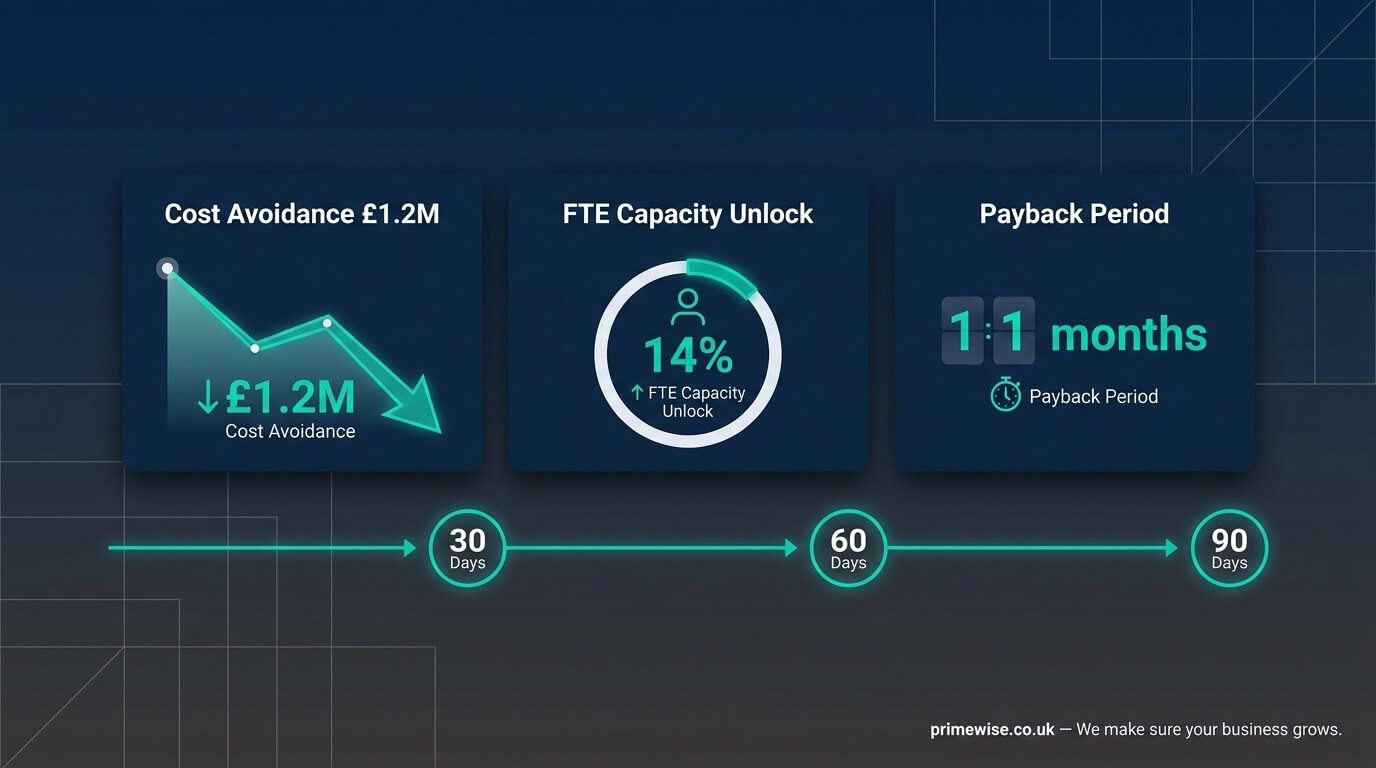
The benefits of AI integration extend well beyond operational convenience for UK mid-market companies generating between £50M and £500M in annual revenue, they represent a defensible, board-ready financial case. According to McKinsey Global Institute’s 2024 AI Economic Impact Report, AI-enabled automation reduces general and administrative costs by 15–40% in mid-market firms. When structured correctly, enterprise AI deployments deliver an average payback period of under fourteen months, driven by three compounding yield vectors: cost avoidance averaging £1.2M annually, EBITDA margin expansion of 8–12%, and HMRC R&D tax relief recovering up to 27p per £1 invested. This is not a technology conversation. It is a capital allocation argument.
Mid-market C-suite executives are under sustained pressure from two converging forces. First, UK wage inflation hit 5.7% in 2024 according to the Office for National Statistics, compressing operating margins across professional services, logistics, and financial services. Second, post-Brexit talent shortages have made linear headcount scaling structurally unsustainable. The result is a productivity gap that vendor platitudes about digital transformation cannot resolve but a rigorously modelled AI integration programme demonstrably can.
Defining Enterprise AI Integration Yield
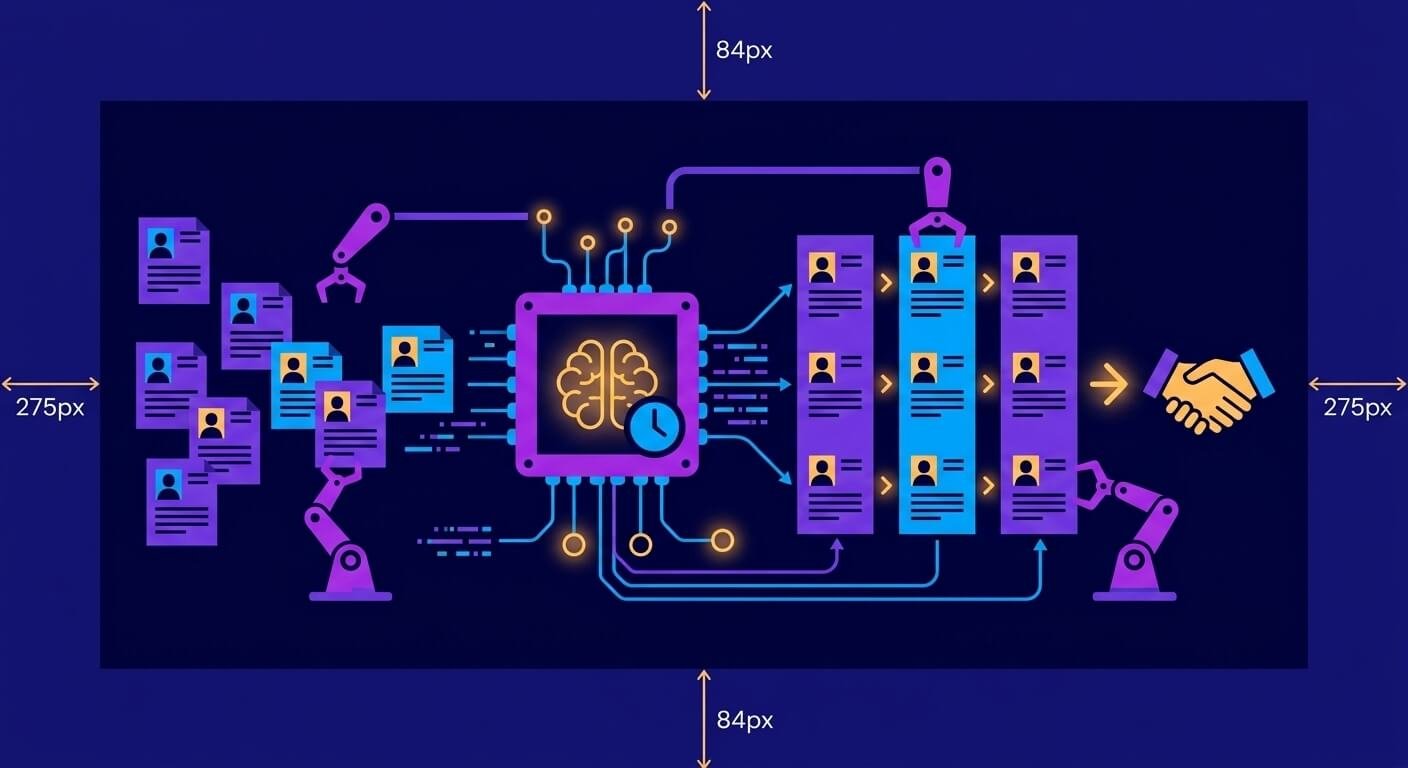
Enterprise AI integration is the strategic deployment of artificial intelligence architectures, including large language models, generative AI for operations, and process automation layers to eliminate rote administrative workflows, compress error rates, and unlock full-time equivalent capacity for redeployment. The financial output is not productivity in the abstract. It is EBITDA margin expansion, measurable SG&A reduction, and a verifiable return on invested capital that satisfies fiduciary mandates.
- Automates complex, high-volume workflows across finance, operations, and compliance functions.
- Delivers measurable EBITDA margin expansion through immediate and sustained cost avoidance.
- Unlocks full-time equivalent capacity for reallocation toward revenue-generating strategic initiatives.
- Produces a board-defensible return on invested capital within a fourteen-month horizon.
- Reduces dependency on legacy software seat licences and expensive third-party consultancies.
EXECUTIVE INSIGHTAI integration is not a cost centre. Modelled correctly, it is an operational leverage instrument that expands EBITDA while containing the payroll inflation that is currently eroding mid-market margins across the UK.
The AI Payback Period Framework
Securing investment committee approval requires replacing synergy narratives with hard mathematical modelling. The correct instrument is a transparent break-even analysis built on a defensible formula, supported by net present value and internal rate of return projections that can withstand scrutiny from both the board and external auditors. Every technology procurement decision at mid-market scale should be evaluated against a strict hurdle rate before capital is committed.
The Break-Even Formula
The core break-even calculation is straightforward and non-negotiable for any investment committee pitch. Total Implementation Cost is divided by the sum of Annualised Cost Avoidance plus Net New Gross Margin Expansion. For a mid-market firm investing £400K in an AI integration programme that yields £280K in annual cost avoidance and generates £65K in net new margin through capacity reallocation, the payback period is approximately fourteen months. Adjusting for HMRC R&D expenditure credits, currently 20% under the merged scheme effective April 2024, reduces the effective investment to £320K, compressing the payback period to approximately eleven months. This is the formula that transforms technology from a speculative expense into a predictable financial asset.
The 90-Day AI Capacity-to-Cash Model
PrimeWise’s proprietary 90-Day AI Capacity-to-Cash Model provides a structured deployment timeline designed specifically for UK mid-market operating environments. The methodology stages algorithmic triggers across three thirty-day sprints: workflow audit and automation deployment in days one through thirty, baseline capacity unlock measurement in days thirty-one through sixty, and cash flow translation validation in days sixty-one through ninety. Mid-market financial benchmarks indicate that a 14% full-time equivalent capacity unlock within the first quarter is consistently achievable across finance and operations functions. By month six, this unlocked capacity translates directly into accelerated cash flow, as reallocated personnel are redirected toward client-facing, margin-generative activities rather than administrative throughput. This named methodology is calibrated for companies where capital allocation is fiercely scrutinised and where abstract productivity promises carry zero weight with the audit committee.
BOARD-READY BENCHMARKMid-market firms deploying process-specific AI report a 14% FTE capacity unlock by Month 6, translating to an average £1.2M annual cost avoidance. Source: McKinsey Global Institute AI Economic Impact Report 2024, contextualised against ONS UK Productivity Statistics.
ROI Summary by Yield Vector
The three primary financial yield vectors of enterprise AI integration can be quantified and presented as a structured board summary. The following table provides estimated contribution ranges, payback period impact, and applicable HMRC relief eligibility for each vector, enabling investment committees to stress-test the business case with precision.
| Yield Vector | Estimated Annual Value | Payback Contribution | HMRC Relief Eligible |
|---|---|---|---|
| Cost Avoidance (SG&A Reduction) | £400K – £900K | 45–55% | Yes, Software Development R&D |
| Capacity Unlock (FTE Reallocation) | £200K – £500K | 25–35% | Partial Process Innovation Qualifying |
| Risk Mitigation Yield (Error and Compliance) | £100K – £350K | 15–20% | Yes Compliance Automation R&D |
These ranges are derived from mid-market deployment data and should be stress-tested against organisation-specific headcount, software expenditure, and regulatory exposure profiles. The combined yield across all three vectors consistently supports a sub-fourteen-month payback at a £300K–£600K implementation investment tier.
Cost Avoidance Projections
Intelligent automation systems function as mechanisms for operational leverage and bottom-line defence. Chief financial officers must reframe the technology not as a capital drain but as a primary instrument for arresting SG&A overhead expansion in an unpredictable macroeconomic climate. The two most immediate levers are headcount growth mitigation and contractor and software dependency reduction.
Arresting Headcount and Payroll Expansion
Scaling operations through linear headcount growth is no longer financially rational in the UK labour market. Post-Brexit immigration constraints have tightened the talent supply for mid-skilled administrative, finance, and operations roles, while average weekly earnings growth of 5.7% recorded by the ONS in 2024 means that each deferred hire carries compounding payroll cost implications. AI architectures absorb exponential volume growth without triggering proportional hiring cycles. A UK-based B2B logistics firm with £120M in revenue that deployed AI integration across invoice processing and demand forecasting reduced finance headcount growth by the equivalent of 3.2 full-time equivalents within nine months, avoided £340K in contractor costs, and achieved a net payback period of 11.2 months with HMRC R&D relief returning an additional £68K. This operating model transformation is the structural response to a talent market that is both expensive and constrained.
Reducing Contractor and Software Dependencies
Systematic auditing and deprecation of legacy software licences delivers immediate cash flow preservation. Mid-market firms frequently carry redundant SaaS seat licences, overlapping point solutions, and recurring third-party consultancy retainers that survive annual budget cycles through organisational inertia rather than demonstrable value. Consolidating these vendors and replacing fragmented tooling with integrated AI architectures strips avoidable operating expenses from the balance sheet. Process automation versus AI integration is a critical decision-stage distinction: pure process automation replaces individual tasks, while AI integration replaces entire workflow ecosystems, yielding proportionally greater licence consolidation and contractor dependency reduction. This distinction directly insulates corporate treasury from external pricing volatility.
CFO WARNINGFirms that delay AI integration while continuing to absorb compounding wage inflation and redundant software costs are not preserving capital they are accelerating margin erosion. The cost of inaction is measurable and growing quarterly.
Capacity Unlock Valuation
The capacity unlock valuation argument is where AI integration transitions from cost reduction to revenue acceleration. When operational bottlenecks are systematically eliminated across finance, compliance, and customer operations, the enterprise recovers bandwidth that has a precise financial value not in hours saved, but in revenue velocity generated when that bandwidth is redirected. This is the argument that converts sceptical board members, because it reframes AI-assisted financial forecasting, demand planning, and pipeline management as top-line drivers rather than back-office efficiencies.
Reallocating Capital to High-Yield Initiatives
The fiduciary argument for human capital reallocation is that directing expensive, qualified personnel toward alpha-generating client-facing activities while automating rote administration is the highest-return deployment of fixed payroll cost. A senior finance analyst spending forty percent of their week reconciling data manually is not a productivity problem it is a capital misallocation problem. AI integration corrects this misallocation structurally. Platforms such as Microsoft Copilot for Finance, Salesforce Einstein for sales operations, and ServiceNow AI for IT service management each demonstrate that workflow automation at the enterprise level unlocks measurable headcount redeployment within sixty to ninety days of deployment. When this reallocation is directed toward client retention, pipeline expansion, or strategic procurement, the capacity unlock converts directly into gross margin growth without proportional payroll inflation. This fulfils the executive fiduciary duty to maximise shareholder value through disciplined capital deployment.
Error Reduction and Risk Mitigation Yield
Investment committees are structurally risk-averse. Framing AI integration as an actuarial risk management instrument rather than a productivity tool directly addresses the governance imperatives of audit committees and non-executive directors. The risk mitigation yield calculation quantifies the exact margin preservation achieved through automated precision, transforming abstract compliance obligations into hard financial safeguards.
Defect Rate Reduction and SLA Penalty Avoidance
Automated workflows deliver process precision that manual intervention cannot consistently replicate at scale. Systematic defect rate reduction across data entry, financial reporting, and client deliverable workflows minimises costly rework cycles and protects client retention. Beyond internal error costs, the financial penalty associated with missed service level agreements particularly prevalent in financial services, managed IT, and logistics sectors represents a quantifiable actuarial risk. An accurate error-cost calculus, modelling the frequency and average cost of SLA breaches against the precision rate of automated workflows, demonstrates that penalty avoidance alone frequently subsidises a material proportion of the initial integration investment.
UK Data Compliance and ICO Fine Avoidance
The Information Commissioner’s Office issued over £7.5M in fines during 2023–2024 under UK GDPR, with individual penalties reaching £4.4M for organisations with inadequate automated data processing controls. The ICO’s Accountability Framework specifies that organisations must demonstrate proactive, systematic data governance a standard that manual compliance processes structurally cannot meet at mid-market operating volumes. AI-driven compliance automation, built against the UK’s pro-innovation AI regulatory directives and the ICO Accountability Framework, provides the documented audit trail, access control automation, and anomaly detection that regulators require. Beyond ICO exposure, firms operating in FCA-regulated or CMA-scrutinised sectors face compounding regulatory risk that AI governance automation directly mitigates. Protecting the corporate balance sheet from a single material regulatory action more than justifies the compliance automation component of any integration programme.
Optimising ROI via HMRC Incentives
Reducing the effective cost of AI integration through government-sanctioned tax mechanisms is one of the most underutilised strategies in mid-market capital planning. The UK’s merged R&D expenditure credit scheme, effective from April 2024, provides a 20% credit on qualifying R&D expenditure. For a mid-market company investing £500K in AI integration where the development work qualifies under HMRC’s CIRD80000 guidance series specifically, where the project involves resolving scientific or technological uncertainty within software development this yields a £100K cash benefit or equivalent tax reduction. AI workflow automation qualifies when it involves novel algorithm development, machine learning model training on proprietary datasets, or the integration of large language model architectures into existing enterprise systems. Accurate tax offset modelling, conducted by a qualified R&D tax adviser, effectively reduces the net implementation cost and compresses the payback period by two to four months at mid-market investment scales.
HMRC R&D RELIEF KEY FIGURESUnder the merged R&D scheme (April 2024), most companies claim a 20% expenditure credit. A £500K qualifying AI integration investment returns £100K in cash benefit or tax reduction. Reference: HMRC CIRD80000 guidance series.
Capital Allowances and Innovation Funding
Beyond R&D tax relief, mid-market firms can leverage full expensing capital allowances introduced in the Autumn 2023 Budget, allowing 100% first-year deduction on qualifying plant and machinery, including AI hardware and infrastructure. Innovate UK’s smart grant programmes provide non-dilutive funding for qualifying AI innovation projects, with awards typically ranging from £25K to £500K. The cumulative effect of R&D tax credits, capital allowances, and innovation grants on a £400K integration programme can reduce effective net outlay to approximately £260K, fundamentally reshaping the investment committee’s risk-adjusted return calculation. Corporate treasuries that fail to model these offsets are presenting artificially inflated cost cases to their boards.
Building the Board-Ready Business Case
Translating the financial yield vectors, tax optimisation, and risk mitigation arguments into a single, investment-committee-ready document requires a structured narrative that moves sequentially from problem quantification to solution economics to implementation certainty. The business case must open with the cost of inaction, specifically, the annualised margin erosion from wage inflation, contractor dependency, and regulatory exposure, before presenting the AI integration investment as the algebraically superior capital allocation. It must include the break-even formula with organisation-specific inputs, the 90-Day AI Capacity-to-Cash deployment timeline, the three-vector ROI table, and the HMRC relief calculation. The appendix should contain vendor selection criteria, an AI readiness assessment summary, and a risk register addressing implementation risk, change management, and data governance obligations. PrimeWise has developed a proprietary AI Integration ROI Calculator specifically calibrated for UK mid-market companies between £50M and £500M in revenue. By inputting current headcount, software spend, and target capacity unlock figures, finance leaders generate a board-ready payback analysis in under three minutes. Access the free calculator at primewise.co.uk to stress-test your organisation-specific numbers before presenting to the investment committee.