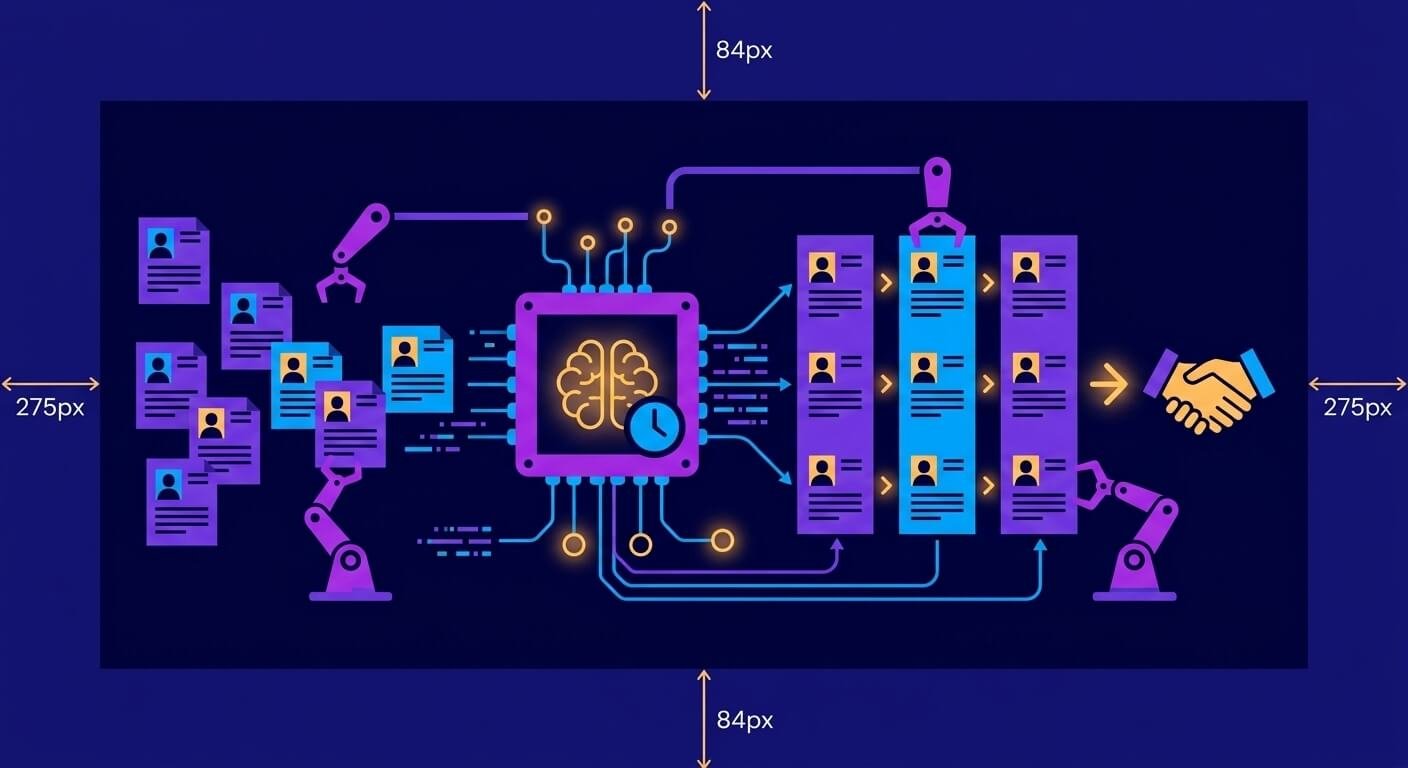

A retainer-based fractional CMO service is the fastest-growing executive engagement model in the UK, yet over two-thirds of senior fractional operators report significant margin erosion within their first year due to avoidable structural failures in their commercial agreements. UK fractional CMOs commanded monthly retainers between £4,000 and £18,000 in 2025, but the gap between top-quartile operators and those bleeding profit is not seniority or sector knowledge. It is the precision of their retainer architecture. Whether you are a UK business evaluating fractional CMO costs for the first time or an experienced marketing executive structuring your own engagement practice, this guide delivers the commercial frameworks, rate benchmarks, SOW mechanics, and IR35 risk profiles used by top-tier operators in 2026.
Executive SummaryProtecting margins and delivering genuine executive value from a fractional CMO engagement requires choosing the right commercial model from the outset. Industry data indicates that 68% of fractional marketing executives abandon flat-rate pricing in their second year due to margin decay. The three dominant structures, flat monthly, capped hours, and outcome-based pricing, each carry distinct risk profiles, IR35 implications, and scope management challenges. An emerging fourth model, the hybrid retainer, is rapidly becoming the 2026 market standard for engagements seeking both stability and performance alignment.
What Is a Fractional CMO Retainer
A fractional CMO retainer is a part-time executive marketing leadership agreement in which a business engages a senior chief marketing officer on a retained basis, typically for 8 to 20 hours per month, structured under one of three primary commercial models: flat monthly fee, capped hours, or outcome-based performance pricing. In the UK, these agreements are governed by standard contract law and must be assessed for IR35 compliance under the off-payroll working rules introduced by the Finance Act 2021. The retainer legally binds strategic deliverables, mitigates operational risk, and dictates compensation structure, making its precise architecture the single most important commercial decision a fractional operator or hiring firm will make.
It is also critical to distinguish a fractional CMO retainer from an interim CMO contract. An interim CMO is typically engaged on a fixed-term, near-full-time basis to cover a specific vacancy or transformation programme, often on a day-rate structure ranging from £850 to £1,800 per day in the UK market. A fractional CMO, by contrast, operates across multiple clients simultaneously, deploying strategic oversight at a fraction of the cost of a full-time hire. This structural distinction has direct consequences for IR35 assessment, scope definition, and the correct choice of retainer model.
The Flat Monthly Retainer
The flat monthly retainer remains the predominant pricing structure in the UK corporate landscape. It aligns with the fiscal conservatism of established enterprise boards, PE-backed portfolio companies, and financial services firms that require predictable operational expenditure within fixed quarterly budgets. For the fractional operator, it provides a stable recurring revenue stream independent of minor fluctuations in weekly time commitment, making it the foundation of a scalable fractional practice.
Commercial Mechanics and Market Rates
Within the premium UK digital and B2B marketing sector, flat monthly retainers typically range from £4,000 to £12,000 per calendar month for standard senior fractional engagements. However, sector and stage matter significantly. Series A SaaS companies in London commonly engage fractional CMOs at £6,000 to £9,500 per month, while established FMCG or professional services brands with more complex multi-channel environments may extend to £12,000 to £18,000 per month for operators with demonstrable category experience. The average contract duration for flat monthly engagements is six to twelve months, with a three-month break clause as the market-standard minimum commitment.
Demarcating Strategy from Tactical Execution
A successful flat monthly retainer depends entirely on a highly specific statement of work that separates strategic oversight from tactical implementation. The SOW must explicitly list which functions fall under the fractional CMO’s executive mandate, such as go-to-market strategy, channel mix decisions, agency management, brand positioning, and quarterly marketing planning and must equally state, in plain language, what is excluded. Copywriting, graphic design, paid media buying, CRM configuration, and social media content production require separate resource allocation and must not be implied as deliverables within the retainer fee. Without this demarcation, scope creep becomes structurally inevitable.
The Infinite Revision Loop
The primary failure mode of the flat rate model is what practitioners call the infinite revision loop. As client familiarity grows, boundary-pushing escalates additional slide decks, unscheduled strategy calls, redrafted briefs, and informal advisory requests outside agreed communication cadences. Without a formal change order process, a £6,000 monthly retainer can collapse to an effective hourly rate of £22 to £28 within three months. Mitigating this margin erosion requires explicit out-of-scope definitions, a mandatory written change request protocol, and a communication cadence clause specifying the number, format, and maximum duration of included executive touchpoints per month.
Scope Protection Clause SOW ExtractAny request falling outside the deliverables listed in Schedule A of this agreement constitutes an out-of-scope instruction. Out-of-scope work requires a separate written estimate and signed commercial approval before commencement. Informal requests made via messaging platforms do not constitute approved instructions.
The Capped Hours Retainer
Operating on a time-and-materials basis, the capped hours retainer offers precise capacity planning and lower perceived commitment risk for clients who are hesitant to invest in a fixed monthly fee without proven output. It is particularly common in early-stage businesses, short-term project mandates, and transitional engagements where the scope is genuinely unclear at the outset. However, it introduces structural challenges that make it commercially inferior for experienced operators over any engagement longer than three months.
Structural Benchmarks and Hourly Rates
Current UK market dynamics position senior fractional CMO operators at £150 to £350 per hour under a capped hours structure. London-based operators with a demonstrable track record in high-growth B2B or regulated sectors typically command the upper range. FMCG and DTC specialists in regional markets tend to occupy the £175 to £250 band. A typical capped hours engagement commits between 12 and 20 hours per month, placing the effective monthly equivalent between £2,400 and £7,000, generally below the flat monthly benchmark for comparable seniority, which is why this model structurally undervalues fractional executives over time.
Establishing Strict Timesheet Boundaries
Formulating an effective SOW for a capped hours model requires mechanisms that track executive value without descending into low-level task accounting. The agreement should mandate structured deliverable tracking rather than granular activity logging. Predefined communication cadences, scheduled executive reporting, and project milestone gates protect the operator from micromanagement while giving the client the audit trail they require. Include a minimum billing increment clause typically 30-minute units to prevent the administrative overhead of sub-threshold time recording from eroding billable hours.
The Efficiency Penalty
The core commercial vulnerability of the capped hours model is the efficiency penalty. As the fractional CMO becomes more familiar with the client’s systems, stakeholders, and strategic context, they naturally execute faster. A strategy session that required three hours in month one may take 90 minutes in month four yet the output is identical in value. Under a capped hours structure, improved performance directly reduces compensation. This dynamic commoditises the fractional role, misaligns financial incentives, and creates a perverse pressure for the operator to work slowly or manufacture billable activity. For this reason, transitioning established capped-hours clients to a flat monthly retainer at the first quarterly review is standard best practice among experienced fractional executives.
Outcome-Based Pricing Models
Outcome-based pricing structures reserve their highest commercial upside for operators with genuine execution confidence and a sophisticated understanding of how to negotiate, define, and legally protect performance attribution. Rather than billing for time or capacity, the fractional CMO is compensated for the commercial impact of their strategic leadership, aligning executive incentives directly with client growth. This model is increasingly attractive to scale-up founders and growth-stage boards who have been burned by high retainer costs with insufficient measurable return.
Revenue Share and Baseline Metrics
The standard UK structure for outcome-based fractional CMO retainers combines a reduced monthly base fee, typically £1,500 to £3,500 per month, with a performance incentive of two to five percent of marketing-attributed revenue growth above an agreed baseline. For a client with a £500,000 annual marketing-sourced pipeline, a 3% performance incentive on 20% growth would generate an additional £3,000 in variable compensation per month. Negotiating these variable liabilities requires complete transparency regarding the client’s current financial baselines, existing pipeline data, and CRM data quality before the contract is signed.
Defining Baselines and Attribution Models
Legally protecting outcome-based compensation demands attribution clauses of extraordinary precision. The SOW must specify the agreed CRM platform, whether HubSpot, Salesforce, or another system and the exact pipeline stage at which marketing-sourced credit is recognised. It must define the lookback window for multi-touch attribution, typically 90 days in B2B contexts. It must establish the dispute resolution mechanism for contested revenue attribution and confirm which team, marketing, sales, or finance, holds the authoritative data set. Without these clauses, revenue share disputes are structurally inevitable and frequently terminal to the client relationship.
Regulatory Friction and Sales Bottlenecks
Performance-based retainers carry severe macroeconomic and operational risks that are acutely pronounced in specific UK sectors. Within Financial Conduct Authority-regulated industries, including wealth management, retail banking, insurance, and consumer credit strict financial promotions compliance reviews under the Financial Services and Markets Act 2000 can add four to twelve weeks of delay to campaign deployment. A B2B fintech that engaged a fractional CMO on a pure outcome-based retainer in Q3 2024, for example, experienced a six-week FCA approval delay on a lead generation campaign, directly deferring the pipeline that would have triggered the operator’s performance fee. Structuring FCA compliance delays as a contractual force majeure event that protects the base fee without nullifying the performance incentive is the correct legal mechanism in regulated sector engagements.
Outcome-Based Model Key RiskIf internal sales handoff bottlenecks, CRM data gaps, or regulatory delays prevent lead conversion, the fractional executive forfeits revenue share despite flawless marketing execution. Always include a base fee floor and a force majeure clause covering regulatory compliance delays in any outcome-based agreement operating within FCA-regulated sectors.
The Hybrid Retainer The 2026 Market Standard
The dominant trend in the UK fractional executive market entering 2026 is the hybrid retainer a structure that combines a predictable flat monthly base fee with a capped performance bonus tied to agreed commercial milestones. This model resolves the principal weaknesses of all three legacy structures simultaneously: it eliminates the scope creep vulnerability of a pure flat fee by removing the incentive for the client to extract unlimited time, removes the efficiency penalty of hourly models by decoupling compensation from time spent, and reduces the binary risk of pure outcome-based structures by guaranteeing a minimum base revenue for the operator.
At Primewise, the majority of UK fractional CMO engagements are structured as hybrid retainers combining a predictable monthly base with a performance-linked upside. This model consistently delivers stronger client retention, better commercial alignment between operator incentives and business objectives, and cleaner IR35 positioning than either pure flat or pure hourly structures. A typical Primewise hybrid structure for a Series B technology client might combine a £5,500 monthly base with a £2,000 performance bonus payable upon achieving agreed quarterly pipeline targets creating a total potential monthly value of £7,500 while maintaining the predictable OpEx that CFOs require.
A PE-backed UK B2B technology firm restructured from a capped-hours to a hybrid retainer arrangement in Q1 2025, reducing total fractional CMO spend by 18% while increasing marketing-attributed pipeline by 34% in the following two quarters. A London-based Series B fintech structured a 2.8% revenue share on a £340,000 marketing-attributed pipeline within its first six months of a hybrid engagement, with FCA compliance delays contractually ring-fenced as force majeure events protecting the base fee throughout.
Navigating HMRC Compliance and IR35
Fractional retainers carry inherent off-payroll working risks within the United Kingdom. Failing to proactively address IR35 exposure at the point of contract design rather than retrospectively following an HMRC enquiry exposes both the fractional operator and the hiring organisation to substantial tax liabilities, interest charges, and reputational risk under the off-payroll working rules legislated in the Finance Act 2021. All parties should use the HMRC Check Employment Status for Tax tool as a starting point, with formal legal review for any engagement valued above £3,000 per month.
IR35 Risk by Retainer Model
The design of the retainer directly determines IR35 risk profile. Outcome-based and hybrid models most strongly signal outside IR35 status by demonstrating genuine commercial risk the operator is exposed to financial downside if performance targets are not met, satisfying the mutuality of obligation and financial risk tests that HMRC applies. Flat monthly models are generally low-risk provided the SOW clearly demonstrates a right of substitution, no requirement for personal service, and absence of direct line management control. Capped hours models present the highest IR35 risk of the three legacy structures: rigid prescribed working hours, absence of a substitution clause, and continuous direct supervision are red flags that HMRC has historically used to classify such arrangements as disguised employment under ITEPA 2003.
IR35 ComplianceDo not rely solely on HMRC's CEST tool for complex fractional executive arrangements. Seek independent legal advice from a specialist employment tax solicitor for any engagement with an annual contract value exceeding £36,000. Link your SOW design decisions directly to IR35 status from day one, not as an afterthought.
The Fractional Retainer Risk-Yield Matrix
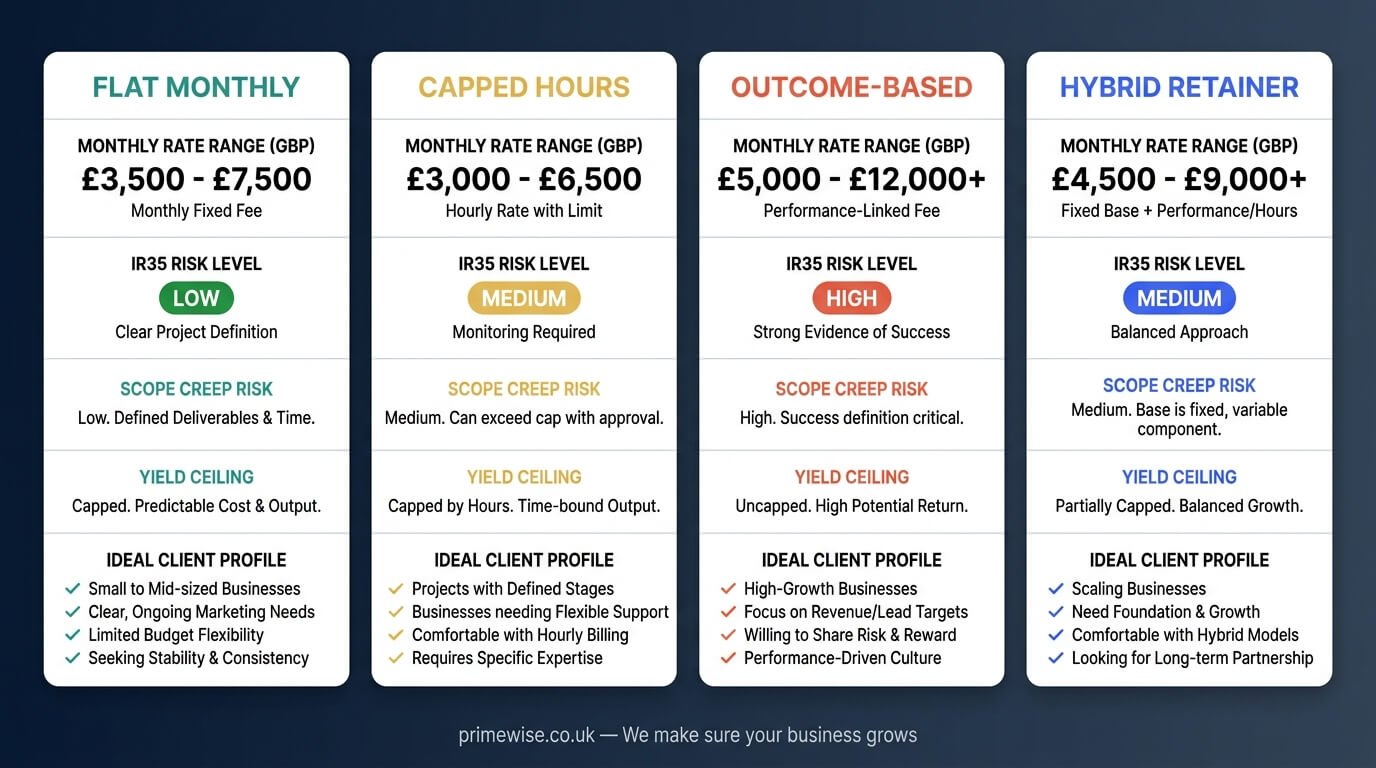
To evaluate pricing architecture objectively, fractional operators and client procurement teams should apply a systemic framework that balances downside exposure against upside scaling potential. The Risk-Yield Matrix below categorises all four commercial models across the dimensions most relevant to UK executive engagements in 2026, enabling faster, better-informed contract negotiations.
| Model | Typical Monthly Range | IR35 Risk | Scope Creep Risk | Yield Ceiling | Ideal Client Profile | Typical Duration |
|---|---|---|---|---|---|---|
| Flat Monthly | £4,000 – £12,000 | Low | High | Fixed | Enterprise, PE-backed, Financial Services | 6 – 12 months |
| Capped Hours | £2,400 – £7,000 | High | Medium | Hard-capped | Early-stage, project-based, transitional | 3 – 6 months |
| Outcome-Based | £1,500 base + 2–5% revenue share | Very Low | Low | Uncapped | Growth-stage, founder-led, high-confidence mandates | 6 – 18 months |
| Hybrid Retainer | £4,000 – £9,500 base + performance bonus | Very Low | Low | Performance-linked | Series A/B, scale-up, B2B SaaS, regulated sectors | 12 – 24 months |
The matrix reveals a clear pattern. Pure hourly models carry disproportionate IR35 risk while capping yield making them structurally unsuitable for experienced fractional executives beyond the first engagement quarter. Outcome-based models offer the highest theoretical yield but are operationally unsuitable in any sector where the fractional operator does not control the full revenue conversion funnel. The hybrid retainer consistently delivers the best risk-adjusted commercial outcome for both operator and client across the widest range of UK business contexts.
Structuring Your Fractional CMO Engagement
Selecting the wrong retainer model at the start of an engagement is not a minor administrative error it is a commercially consequential decision that compounds with every invoice cycle. Scope creep in a poorly written flat monthly SOW, the efficiency penalty accumulating silently in a capped hours arrangement, or an attribution dispute fracturing an outcome-based relationship: each of these failure modes is entirely avoidable with precise contract architecture from day one.
Primewise provides a complimentary 45-minute commercial architecture review for UK businesses evaluating fractional CMO engagement models and for senior marketing executives structuring their own retainer practice. There is no obligation and no sales pressure only a structured, expert conversation about the commercial model that best fits your specific business context, growth stage, and risk appetite. Book your review at primewise.co.uk.