

What does a performance marketing consultant do, precisely? A Primewise performance marketing consultant designs, executes, and scales measurable paid digital campaigns, translating granular channel metrics into board-level financial outcomes. They manage media buying across paid search, programmatic display, and paid social, enforce rigorous weekly pacing audits, and deliver structured monthly performance decks aligned to Customer Acquisition Cost, Lifetime Value, and corporate revenue targets. According to Primewise’s proprietary client engagement data, implementing rigid weekly pacing protocols reduces wasted digital ad spend by an average of 18% within the first 30 days of a live engagement, ensuring every pound invested directly supports acquisition and growth objectives.
KEY TAKEAWAYSA senior performance marketing consultant delivers: daily bid and budget management; weekly WIP reporting and search query mining; monthly cross-channel attribution decks; FCA-aligned compliance documentation; and first-party data governance under UK GDPR. This structured cadence eliminates black-box agency reporting and replaces it with commercially accountable, boardroom-ready intelligence.
The Core Role of a Performance Marketing Consultant
A performance marketing consultant is a senior operator who takes direct, contractual accountability for paid media capital and commercial growth outcomes. Unlike a traditional digital agency account manager, a consultant functions as an embedded commercial strategist responsible not just for campaign activation but for the entire financial logic underpinning media spend decisions. The role sits at the intersection of data science, financial planning, and channel execution. In the UK, where the IAB UK’s 2025 Digital Adspend Report confirmed that total digital advertising investment exceeded £29 billion, the pressure on businesses to deploy capital with precision has never been greater. A consultant’s primary value is converting that investment pressure into a structured, repeatable, and measurable commercial process.
Bridging the Gap Between Metrics and the Boardroom
The most persistent frustration reported by UK finance directors and CMOs is the disconnect between what their agency reports and what their P&L actually reflects. Click-through rates and impression share are tactically useful but commercially meaningless without direct linkage to Customer Acquisition Cost, payback period, and revenue contribution. A senior performance marketing consultant operates with full awareness of this divide. They architect reporting frameworks that translate platform-level data from Google Ads, Meta, LinkedIn, and programmatic DSPs into financial intelligence that a CFO can interrogate. This commercial fluency is what separates a strategic consultant from a reactive account manager.
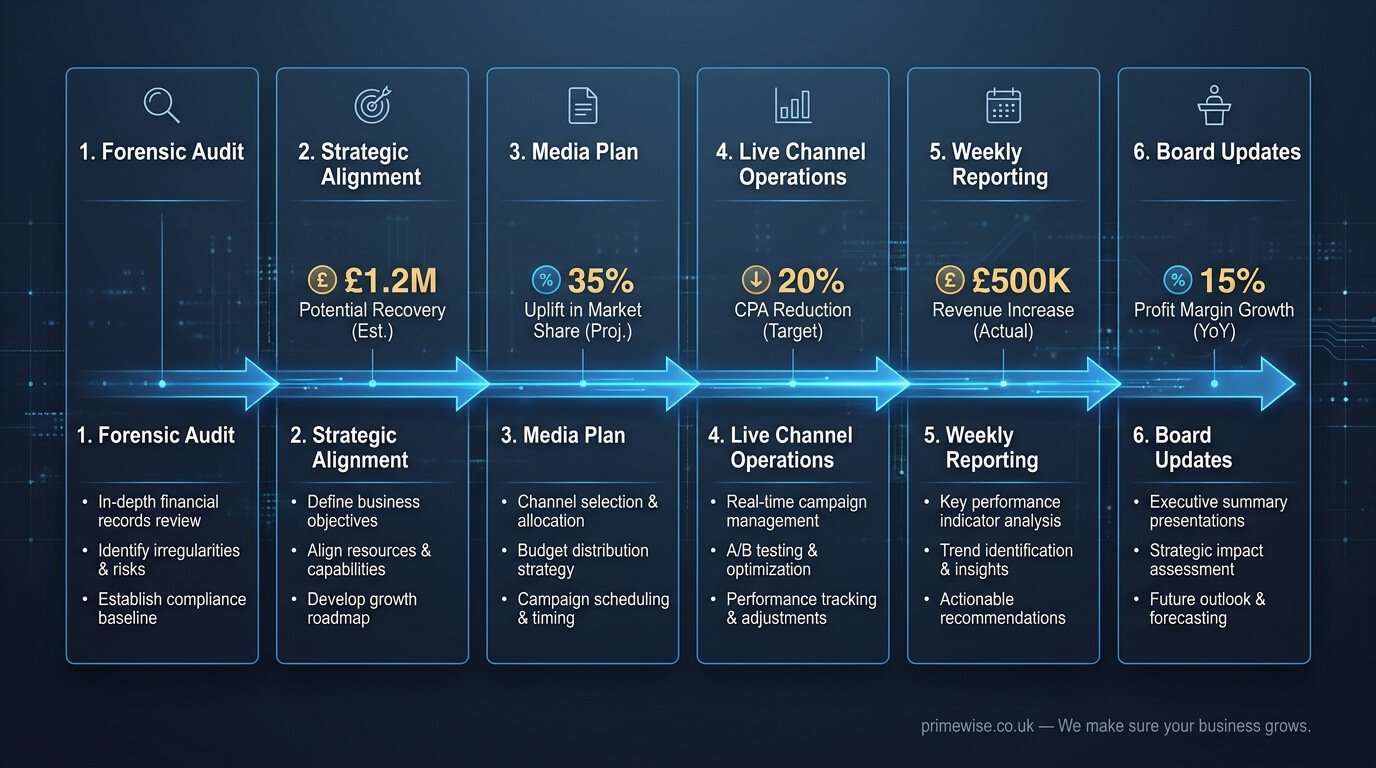
The Six Stage Performance Engagement Matrix
Elite performance marketing consultants do not operate on intuition or ad-hoc adjustments. Over 15 years of live client engagements, a definitive operational framework has emerged that structures every consulting engagement from first contact to advanced omnichannel forecasting. This Six Stage Performance Engagement Matrix provides a repeatable, auditable process that eliminates the guesswork from paid media investment and provides businesses with a clear SLA-backed deliverable at every phase.
Stage One The Forensic Account Audit
No new capital should be deployed until the historical inefficiencies of an account are fully understood and documented. The audit phase is non-negotiable. It involves a comprehensive forensic review of all historical paid media account data, identifying structural campaign errors, misallocated budgets, and conversion tracking inaccuracies that have silently eroded performance. In UK financial services accounts, where Google Ads CPCs for mortgage and investment products range from £8 to £45 per click depending on the product vertical, a single tracking misconfiguration can distort acquisition cost data by tens of thousands of pounds per quarter. Key audit deliverables include a complete structural review of all active and historical ad accounts, verification of conversion tracking integrity including server-side tagging and consent mode v2 compliance under ICO guidance, a competitive gap analysis mapping share-of-voice opportunities against primary competitors, alignment of the digital value proposition with overarching commercial revenue targets, and establishment of core financial baseline metrics including CPA, ROAS, and media efficiency ratio for accurate forward forecasting.
Stage Two Strategic Alignment and the Media Plan
Once the audit is complete, findings are translated into a formal media plan a living financial document that maps exact budget allocations across Google Ads Performance Max architecture, Meta Advantage Plus campaigns, LinkedIn B2B lead generation, and programmatic DSP strategy. This is not a generic channel plan; it is a capital allocation framework built against a specific revenue target with defined CPA thresholds by channel. The media plan also establishes the attribution window configuration for each channel, addressing the critical distinction between blended ROAS and channel-level ROAS that so often creates misalignment between marketing and finance teams. Every budget line in the media plan is justified by forecasted incremental lift, not historical habit.
Stage Three Live Channel Operations and Daily Bid Management
The execution phase is where the strategic logic of the media plan meets the reality of live auction environments. A consultant manages real-time bidding across all active channels, deploying bid modifiers based on device, geography, audience segment, and time of day. In hyper-competitive London-centric B2B and financial services markets, where CPCs are consistently among the highest in Europe, daily bid management is not optional it is the primary lever for maintaining profitability. This phase also includes continuous ad copy iteration, landing page alignment reviews, and audience suppression management to prevent budget wastage on existing customers or low-intent cohorts.
Stage Four Weekly Reporting and Optimisation Cycles
Sustainable performance is built through relentless weekly oversight. The weekly optimisation cycle encompasses budget pacing audits to prevent early-month budget exhaustion, search query report mining and negative keyword deployment to eliminate irrelevant traffic, scientific A/B testing of creative assets logged for statistical significance, bid strategy adjustments based on incremental cost per acquisition trends, and audience performance segmentation reviews across all active channels. Each of these activities is documented in a structured Work In Progress agenda, shared with stakeholders before every weekly meeting to ensure complete operational transparency and cross-functional alignment with sales and revenue operations teams.
Stage Five Monthly Performance Decks and Attribution Analysis
Monthly deliverables shift the operational focus from tactical execution to strategic commercial impact. The consultant produces a comprehensive performance deck that includes month-over-month variance analysis across all channels, multi-touch attribution modelling that distributes conversion credit accurately across the customer journey, Customer Data Platform integration status updates where applicable, and media mix modelling insights that inform forward budget allocation decisions. These decks are built to be presented directly at board level using the language of finance, not marketing. Revenue contribution, cost-per-acquired-customer against LTV, and channel-level payback periods replace impressions and engagement rates as the primary KPIs.
Stage Six Executive Board Updates and Strategic Forecasting
The final stage closes the loop between tactical execution and corporate strategy. Monthly board updates translate the entire consulting engagement into a single, commercially coherent narrative: what was spent, what was generated, what was learned, and what is recommended next. For UK enterprises operating within FCA-regulated environments, these updates are specifically structured to meet the stringent risk, data compliance, and reporting standards required by the Financial Conduct Authority. This includes documentation of consent mode architecture, first-party data activation protocols compliant with ICO guidelines, and audit trails for all media spend decisions that may be subject to regulatory scrutiny.
UK REGULATORY NOTEPerformance marketing operations for FCA-regulated firms must comply with ICO consent mode v2 requirements and UK GDPR data handling standards. Server-side tracking, first-party data activation strategies, and documented consent audit trails are non-negotiable deliverables in any compliant UK paid media engagement. The ICO has issued enforcement notices against firms operating non-compliant tracking architectures, making this a material financial and reputational risk.
Weekly Deliverables The Complete Checklist
The engine of consistent digital growth runs on disciplined weekly execution. The following represents the complete weekly deliverables framework that a senior performance marketing consultant should be contractually accountable for across every active engagement. This checklist is the foundation of any robust Service Level Agreement between a business and its consultant.
- Budget pacing audit daily run rate reviewed against monthly allocation to prevent front-loaded spend exhaustion
- Bid optimisation log documented CPA-based bid modifier adjustments across all active campaigns and ad groups
- Search query mining report negative keyword additions and intent-match refinements logged with traffic and spend impact noted
- Creative A/B testing log active tests recorded with statistical significance thresholds, winner declarations, and next iteration briefs
- Audience segmentation review suppression list updates, lookalike audience refreshes, and retargeting pool health checks
- Landing page conversion rate audit alignment between ad copy, landing page message, and CTA reviewed for friction points
- Channel anomaly report flagging of any CPC spikes, Quality Score drops, or delivery issues requiring immediate escalation
- Structured WIP agenda pre-shared meeting document detailing prior week completions, current action items, and upcoming strategic priorities
- Revenue operations alignment note brief update to sales and RevOps teams on lead volume, lead quality scores, and CRM pipeline contribution
Monthly Deliverables The Complete Checklist
Monthly deliverables operate at a fundamentally different altitude. Where weekly activities are tactical and granular, monthly outputs are strategic and commercial. The monthly deliverables package should be sufficient for a CFO or board director to make confident capital allocation decisions without requiring any further explanation from the consultant. Ambiguity in monthly reporting is a professional failure, not an administrative oversight.
- Full performance deck month-over-month analysis across all channels covering spend, revenue, CPA, ROAS, and media efficiency ratio
- Cross-channel attribution report multi-touch model mapping revenue contribution across paid search, paid social, programmatic, and organic touchpoints
- Media plan revision dynamic reallocation of budgets based on incremental lift data and marginal CPA trends by channel
- Incrementality testing update documentation of any holdout tests or geo-based lift studies conducted during the period
- Media mix modelling insight forward-looking budget scenario analysis across channel combinations
- First-party data governance report consent rate trends, CDP audience health, and UK GDPR compliance status
- Executive board update commercially framed narrative deck suitable for C-suite and board presentation
- FCA compliance documentation for regulated entities, a structured record of all data handling, consent architecture, and spend audit trails
- 90-day forward forecast projected CPA, lead volume, and revenue contribution based on current trajectory and planned budget changes
How to Measure the ROI of a Performance Marketing Consultant
Hiring a consultant is itself a capital allocation decision, and it must be evaluated with the same rigour applied to any other business investment. Financial directors and procurement leads should assess consultant performance against a defined set of commercial KPIs, not subjective measures of effort or communication quality. The following framework provides a transparent, measurable evaluation structure for any engagement.
The Core KPIs for Consultant Accountability
ROAS improvement over a defined 90-day baseline is the primary commercial metric. If a consultant cannot demonstrate a statistically significant improvement in blended ROAS within 90 days, the engagement economics require re-evaluation. Secondary metrics include CPA reduction expressed as a percentage versus the pre-engagement benchmark, media efficiency ratio improvement, lead quality score progression measured against CRM pipeline data and close rate trends, and waste reduction the percentage of total ad spend that can be directly attributed to irrelevant or non-converting traffic segments. These metrics, collectively reviewed in the monthly board deck, provide an unambiguous commercial picture of consultant value. Primewise structures every engagement around these KPIs from day one, with documented baselines established during the forensic audit phase.
CONSULTANT ACCOUNTABILITY BENCHMARKIndustry benchmark for senior UK performance marketing consultants: ROAS improvement of 15–30% over 90-day baseline is considered standard for a well-structured engagement. CPA reduction of 10–25% within 60 days is achievable in most B2B and financial services verticals when combined with rigorous weekly pacing and search query refinement. Any consultant unable to evidence these outcomes against a documented baseline should be formally reviewed against their SLA.
Incrementality Testing and Advanced Measurement
In 2026, last-click attribution is professionally obsolete. The growing adoption of incrementality testing using holdout experiments and geo-based lift studies has become a defining competency of senior performance marketing consultants. Incrementality testing isolates the true causal impact of paid media investment by comparing the behaviour of exposed versus unexposed audience cohorts. This methodology is particularly critical for UK financial services firms, where the CMA’s ongoing scrutiny of programmatic transparency has placed renewed pressure on advertisers to evidence genuine commercial uplift from their media spend rather than relying on platform-reported conversion data that may double-count organic conversions.
Media Mix Modelling for UK Enterprises
Media Mix Modelling, or MMM, represents the upper tier of performance measurement sophistication and is increasingly expected by enterprise clients with media budgets exceeding £500k per annum. MMM uses econometric modelling to quantify the revenue contribution of each channel including offline channels while accounting for external variables such as seasonality, competitor activity, and macroeconomic conditions. For data clean room strategy in UK financial services, where individual-level data sharing between advertisers and platforms is constrained by UK GDPR, MMM provides a privacy-safe methodology for budget allocation decisions that satisfies both commercial and compliance objectives. A consultant deploying MMM is operating at the frontier of the discipline and delivering insights that no standard agency reporting stack can replicate.
A Case Study in Board-Level Budget Authorisation
The commercial impact of structured consulting methodology is best illustrated through a specific engagement scenario. A UK-based B2B enterprise software provider with an annual media budget of approximately £800,000 engaged a performance marketing consultant following two years of inconclusive performance data from their incumbent agency. The agency had been providing standard channel-level reports that showed improving CTRs and decreasing CPCs but could not connect these metrics to the firm’s actual pipeline or revenue outcomes. Within the first 30 days, the forensic audit identified a conversion tracking misconfiguration that had been inflating reported ROAS by approximately 34%. Correcting this single error and rebuilding the attribution framework from the ground up provided the board with an accurate CPA baseline for the first time. Over the following 90 days, rigorous weekly pacing, search query refinement, and a reallocation of budget away from broad match Performance Max campaigns and into tightly structured LinkedIn B2B lead generation campaigns reduced CPA by 22% and improved Marketing Qualified Lead to Sales Qualified Lead conversion rate by 18%. The structured monthly board deck, which framed these results in terms of revenue contribution and payback period rather than platform metrics, secured a confident £500,000 budget increase for the following financial year. The board’s decision was based entirely on the clarity of the commercial evidence presented not on the consultant’s claims about their own expertise.
PRIMEWISE ENGAGEMENT MODELPrimewise operates this exact six-stage engagement cadence for UK enterprise clients across financial services, B2B technology, and professional services sectors. Every engagement begins with a forensic media audit and ends with boardroom-ready performance intelligence. For FCA-regulated clients, all reporting architectures are built to meet ICO and FCA governance standards from day one. Request a media audit to establish your current cost-per-acquisition baseline and identify immediate efficiency opportunities within your existing paid media investment.
Performance Marketing Consultant Costs in the UK
Understanding the commercial structure of a consulting engagement is essential for procurement leads and finance directors evaluating proposals. In the UK market in 2026, senior independent performance marketing consultants typically operate at day rates between £800 and £2,500 depending on their sector specialisation, media budget under management, and the complexity of the regulatory environment they work within. Monthly retainer structures for agency-level performance marketing consultancy typically range from £5,000 to £25,000 per month, with the higher end of that range reflecting full-service channel management, proprietary measurement infrastructure, and board-level reporting. These figures represent the investment required for genuine senior-level expertise. Firms that engage at the lower end of the market typically receive campaign management without strategic oversight which is precisely the disconnect that structured consultancy is designed to resolve. The DMA UK’s 2025 benchmarking data consistently shows that businesses with consultant-led paid media programmes outperform agency-managed accounts by 23% on media efficiency ratio over a 12-month period.
How Performance Marketing Consultants Support FCA Compliance
For UK firms operating within FCA-regulated sectors including wealth management, mortgage broking, insurance, and consumer credit the compliance dimension of performance marketing is not a peripheral concern. It is a primary operational requirement. The ICO has issued enforcement notices against UK firms operating non-compliant cookie and tracking architectures, with fines under UK GDPR capable of reaching 4% of global annual turnover. A senior consultant working within these sectors must implement server-side tracking to reduce reliance on third-party cookies, deploy consent mode v2 architecture in full compliance with ICO guidelines published at ico.org.uk, maintain documented audit trails of all media spend decisions and audience data activation activities, ensure all financial promotions within ad copy comply with FCA financial promotion rules as defined at fca.org.uk, and provide the board with a monthly data governance report that evidences compliance status across all active campaigns. This compliance infrastructure is not a cost centre it is a risk mitigation framework that protects the firm from material financial and reputational exposure. IAB UK’s guidance on programmatic transparency, available at iabuk.com, provides additional standards that consultants operating in this space should be familiar with and actively implementing.