

The performance marketing consultant vs In-House hire debate is the most consequential capital allocation decision a UK financial firm makes at a growth inflexion point. Whether you choose to work with a performance marketing consultant or build internal headcount determines your burn rate exposure, your IR35 liability, and ultimately how fast you convert budget into revenue. This guide gives you the exact financial model, decision framework, and revenue benchmarks to make that call with confidence before your next board meeting.
Who This Guide Is ForThis article is written for CEOs, CFOs, and Marketing Directors at UK financial services and FinTech firms who are evaluating whether to hire a senior performance marketer or retain a specialist consultant. All cost figures reference 2025-2026 UK statutory rates. IR35 and employment law references should be verified with a qualified UK accountant or employment solicitor before acting.
The Core Decision Explained
At its simplest, this decision maps to channel maturity and revenue stage. A performance marketing consultant is the right instrument when you are testing unproven acquisition channels, managing burn rate, or need enterprise-grade expertise without a permanent payroll liability. An in-house performance marketer becomes the right instrument when channels are proven, CAC is stable, and compounding institutional knowledge creates more long-term value than variable agility. Getting this sequencing wrong in either direction costs UK firms an average of six to twelve months of commercial momentum and in competitive FinTech markets, that window rarely reopens.
Fast Facts For UK Decision-Makers
Before committing to either resource model, every CFO and CMO should have these verified data points anchored in their analysis. These figures represent the factual baseline against which all further financial modelling in this guide is built.
- UK Employer National Insurance contributions stand at 13.8% on earnings above £9,100 per year source: HMRC 2025-2026 rates.
- Senior performance marketers in London commanded £65,000 to £95,000 base salary in 2024-2025 source: Reed and Glassdoor UK salary data.
- Applying the standard 1.35x to 1.45x loaded cost multiplier yields a true annual cost of £87,750 to £137,750 for a single senior hire.
- Specialist performance marketing retainers in the UK typically range from £4,000 to £9,000 per month, equating to £48,000 to £108,000 annually with full exit flexibility.
- Average time-to-fill for senior digital marketing roles in London financial services exceeds 67 days before a three-month notice period begins source: estimated from REC and LinkedIn Talent Insights data.
- Total onboarding-to-productivity lag for a senior in-house hire typically spans three to six months, representing substantial deferred revenue.
- IR35 non-compliance enforcement activity against UK financial services firms exceeded £850M in penalties post the 2021 off-payroll working reforms source: HMRC enforcement disclosures.
- The FCA’s Senior Managers and Certification Regime (SM&CR) creates additional compliance obligations when full-time marketing hires hold customer-facing or significant influence functions a cost dimension almost no competitor analysis currently addresses.
Total Loaded Cost The Number Most Boards Get Wrong
The single most common financial miscalculation made by UK leadership teams is equating a hire’s base salary with its true operational cost. This error leads to systematically underbudgeted headcount plans and awkward mid-year reforecasting conversations. Understanding the genuine financial commitment requires a disciplined audit of every statutory and operational overhead that the base salary number conceals.
Breaking Down The True Cost Of A Senior London FTE
The industry-standard methodology for calculating the true cost of a full-time employee in the UK applies a loaded cost multiplier of 1.35x to 1.45x against gross base salary. On a £75,000 midpoint base, this produces a true annual cost of between £101,250 and £108,750 before any variable incentives or exceptional expenses are factored in. The multiplier captures Employer National Insurance at 13.8% on earnings above £9,100, mandatory auto-enrolment pension contributions, and the indirect but very real costs of recruitment agency fees, enterprise software licences, hardware provisioning, and continuous professional development. Recruitment fees alone from a specialist London agency typically represent 15% to 20% of first-year salary, a one-time cost that never appears in an approved headcount plan but reliably materialises at invoice stage.
| Cost Category | Basis | Estimated Annual Impact |
|---|---|---|
| Base Salary | London Senior PM Midpoint | £75,000 |
| Employer NI at 13.8% | On earnings above £9,100 | +£9,121 |
| Auto-Enrolment Pension | Minimum 3% employer contribution | +£2,250 |
| Recruitment Agency Fee | 18% of base, amortised Year 1 | +£13,500 |
| Software and Tools | Analytics, CRM, paid media seats | +£4,800 to £8,400 |
| Hardware and IT Setup | Laptop, peripherals, provisioning | +£1,500 to £2,500 |
| L&D and CPD | Training, certifications, conferences | +£1,500 to £3,000 |
| True Loaded Annual Cost | £107,671 to £114,771 |
Flat Retainers Versus IR35 Navigation
A properly structured consultancy retainer cuts through this complexity entirely. Retaining a specialist performance marketing consultant under a business-to-business statement of work delivers a flat, predictable monthly expenditure typically £4,000 to £9,000 with no National Insurance liability, no pension obligation, no recruitment fee, and no software provisioning cost, as most senior consultants carry their own tooling. Critically, it eliminates IR35 exposure entirely when the engagement is structured correctly. The off-payroll working rules introduced under Chapter 10 of ITEPA 2003 and significantly tightened by the 2021 reforms place the liability for IR35 determination squarely on the client organisation in the private sector. A legitimate B2B consultancy contract with clear deliverables, substitution rights, and absence of control creates the clean legal separation that shields the financial firm from HMRC enforcement enforcement that has already cost the UK financial services sector over £850M since 2021. For regulated firms under SM&CR, this separation also avoids triggering certification regime obligations that would apply to a full-time employee in an equivalent role.
The Channel Maturity Hiring Matrix
The most reliable decision framework for this choice is not revenue stage alone it is the intersection of revenue stage with acquisition channel maturity. Deploying a permanent hire against an immature channel is one of the most expensive and reversible mistakes a growth-stage financial firm can make. The following matrix is designed to give leadership teams a clear, defensible rationale for their resource allocation decision.
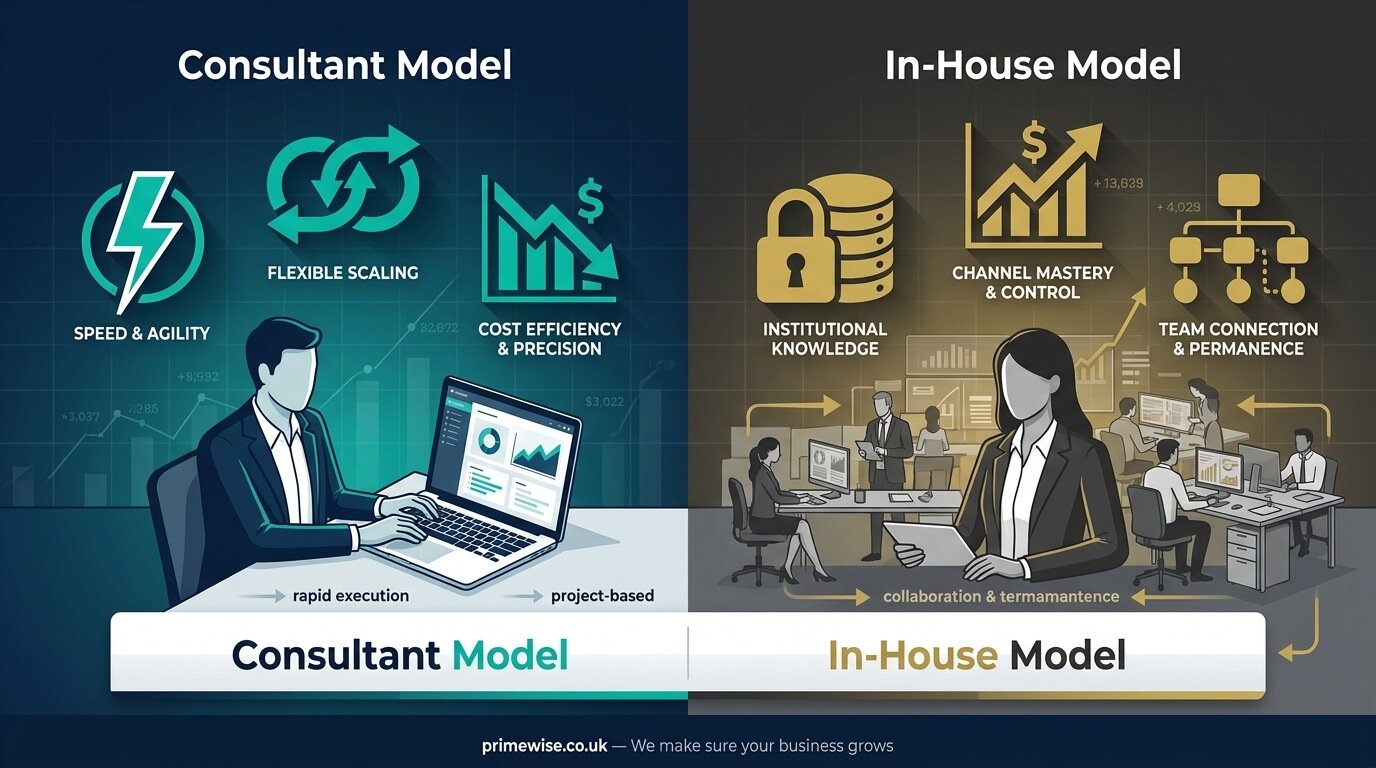
| Decision Dimension | Performance Marketing Consultant | In-House Performance Marketer |
|---|---|---|
| Speed to Deployment | Five to ten working days | Ninety to one hundred and fifty working days |
| Monthly Cost Range UK | £4,000 to £9,000 retainer | £8,958 to £11,481 fully loaded |
| IR35 Exposure | None under correct B2B structure | Not applicable full PAYE employee |
| Channel Maturity Fit | Discovery, testing, validation phases | Scaling and optimisation of proven channels |
| Knowledge Retention Risk | Moderate mitigated by SOW documentation | Low institutional knowledge retained internally |
| Exit Flexibility | High standard notice per contract terms | Low statutory employment rights apply from Day 1 |
| SM&CR Compliance Trigger | No external service provider | Potentially yes depending on role scope |
| Bad Hire Recovery Cost | Minimal exit per contract clause | High legal process, notice pay, recruitment cycle restarts |
Revenue Stage And ARR Alignment
Channel maturity defines what type of talent you need. Revenue stage defines whether you can afford the fixed cost of that talent. These two axes combine to produce a clear hiring decision. The following benchmarks reflect the realities of the UK FinTech and financial services funding landscape in 2025-2026.
Seed Through Series A Firms
At pre-Series A and early Series A stage, burn rate management is the overriding commercial priority. Most firms at this stage are operating with ARR below £2M and a runway of twelve to eighteen months. Allocating a fixed headcount budget of £100,000 or more to a single marketing hire represents a disproportionate percentage of operating expenditure at a stage where the acquisition channels themselves have not yet been validated. Engaging a fractional performance marketing consultant allows these firms to run enterprise-calibre paid search, paid social, and programmatic campaigns without the fixed payroll liability. The variable cost structure preserves runway and preserves the agility to pivot channel strategy as market feedback arrives. FinTech marketing budget allocation at this stage should skew heavily toward variable spend roughly 70% variable, 30% fixed to maintain the flexibility that early-stage survival demands.
Series B And Beyond
The Series B funding milestone typically associated with ARR crossing £3M to £5M with demonstrably stable customer acquisition cost on at least one core channel represents the mathematical trigger for transitioning to senior in-house headcount. At this stage, the compounding value of institutional knowledge, proprietary data ownership, and embedded cultural alignment begins to outweigh the agility premium of a consultant. Relying entirely on external resource for core, proven acquisition channels introduces strategic dependency risk. A senior in-house performance marketer whether a Head of Performance or a Director of Growth ensures that the operational playbooks, audience data, and platform relationships built during the consulting phase are institutionalised within the organisation and protected behind the enterprise firewall. Growth marketing consultants in the UK typically acknowledge this transition point and will proactively support a structured handover rather than resist it.
The ARR Decision RuleIf your UK firm has ARR below £2M or your primary acquisition channels are still in test phase, a performance marketing consultant almost always delivers superior risk-adjusted returns. If ARR exceeds £3M and at least one channel has a proven, stable CAC, building internal headcount protects compound returns and institutional knowledge.
The Decision Tree Making The Call Definitively
Executive decisions benefit from structured, binary logic rather than nuanced essays. The following decision tree is designed to give leadership teams a defensible, board-ready rationale for whichever resource model they select. Work through each question in sequence and your answer will emerge without ambiguity.
- If your current ARR is below £1.5M engage a performance marketing consultant.
- If your primary acquisition channel CAC has not yet been validated across at least ninety days of consistent spend engage a performance marketing consultant.
- If your firm has experienced one or more failed senior marketing hires in the last two years engage a consultant first to validate strategy before committing to another permanent hire.
- If you are twelve months or fewer from a planned funding round preserve runway flexibility with a consultant model.
- If your ARR exceeds £3M and your core channel CAC has been stable for two or more consecutive quarters build internal headcount.
- If your business holds sensitive customer data where institutional knowledge of audience segmentation creates compounding competitive advantage prioritise an in-house hire to protect that asset.
- If you are operating under SM&CR and the marketing function holds significant influence certification requirements take legal advice before structuring either option.
Time To Value The Metric Boards Overlook
Time-to-value is the interval between a resource commitment and the first measurable revenue contribution from that resource. It is the metric that most directly exposes the hidden cost of the in-house hiring process. In a market where performance channels compound daily and competitor spend never pauses, every week of delayed execution represents concrete lost revenue not hypothetical opportunity cost.
The London Recruitment Lag In Financial Services
Securing a senior performance marketer in the London financial services and FinTech market involves a multi-stage process that the best candidates those actively employed will not compress. A realistic recruitment timeline for a senior role runs four to six weeks of active search and interviewing, followed by a mandatory three-month notice period enforced by the candidate’s current employer, followed by three to six months of onboarding and ramp-up to full strategic contribution. Against this timeline, a conservative estimate places first meaningful campaign output at five to nine months from the date a hiring decision is made. A paid media consultant London firms retain can be briefed, access-granted, and live in campaigns within five to ten working days. The cost-per-acquisition benchmarks for financial services products mean that a nine-month delay in channel execution does not represent a marginal difference it represents a material revenue gap that will appear in the next board report regardless of how it is framed.
Managing The Risk Of A Misaligned Hire
The asymmetry of the bad hire scenario in the UK employment context is systematically underweighted in headcount planning. Under UK employment law and ACAS guidance, terminating an underperforming employee even within the first year requires documented performance management processes, formal improvement plans, and in most cases legal counsel before a clean exit is achievable. The total cost of an unsuccessful senior hire, including salary paid during underperformance, legal and HR advisory fees, and the cost of restarting the recruitment cycle, reliably exceeds twelve months of base salary. Contrast this with a consultancy agreement where performance clauses and notice provisions are determined contractually at the outset, and the exit risk profile is fundamentally different. Engaging a fractional expert first to validate both channel strategy and cultural fit before committing to permanent headcount is not cautious it is the mathematically superior risk management approach for any firm operating below Series C scale.
The Phased Transition Model In Practice
The most commercially effective approach for UK financial services firms at a growth inflection point is neither a binary choice nor a permanent compromise. It is a deliberate, sequenced transition that uses consultancy to eliminate execution risk before committing to permanent headcount. A prominent Series B financial services firm recently demonstrated this model at its most effective, engaging external performance marketing consultancy to validate complex paid search and paid social unit economics over a six-month period. The consultant established baseline CAC across four acquisition channels, identified two channels as non-viable, and built the operational playbooks, reporting architecture, and audience segmentation frameworks for the two channels that delivered consistent, profitable returns. Once the board had visibility of stable, risk-adjusted performance data, the consultant guided the job brief specification, interview process, and technical evaluation for a newly appointed internal performance marketing director then managed a structured, documented handover that preserved every operational insight developed during the engagement.
This phased approach the model employed by fractional performance marketing consultancies including Primewise eliminates the binary choice between bloated fixed headcount and strategic capability gaps. It protects runway, validates channels, and ensures that when internal headcount is finally committed, the hire walks into a proven, documented operational environment rather than a blank sheet. For UK FinTech firms managing the competing pressures of investor expectations, FCA obligations, and constrained operating budgets, this sequencing is not optional best practice it is the difference between scalable growth and expensive trial and error.
Primewise Fractional ConsultancyPrimewise provides structured performance marketing consultancy for UK financial services firms with no employment liability, no IR35 exposure, and deployment measured in days. If your firm is evaluating this decision ahead of a funding round or board review, explore the engagement model at primewise.co.uk.
YMYL Compliance And Trust Architecture
Because this decision directly affects capital allocation, employment law compliance, and tax liability for regulated financial firms, the advice in this guide sits squarely within Google’s Your Money or Your Life quality framework. All NI rates and IR35 references reflect HMRC’s 2025-2026 published guidance. Employment law references reflect ACAS current advisory standards. Readers are strongly advised to verify all statutory figures with a qualified UK accountant and to seek independent legal counsel before structuring any consultancy engagement or employment contract. The financial figures provided in this article are illustrative benchmarks derived from published market data and should not be treated as financial or legal advice.