

Performance marketing vs growth marketing is one of the most consequential structural decisions a UK financial services executive will make in 2026. The choice determines not just which channels you fund, but how your entire organisation is architected around revenue. A skilled performance marketing strategist will win ad auctions and drive initial acquisitions. But without a growth layer for engineering retention and lifetime value, those acquisitions quietly erode your unit economics. This guide cuts through the theory and delivers the operational frameworks, KPI ownership matrices, and budget allocation models that C-suite leaders and CMOs need to build profitable, scalable marketing operations in the UK financial sector.
Who This Is ForThis resource is written for CMOs, Heads of Growth, and CFOs at UK financial services firms evaluating whether to restructure their marketing function, audit their current unit economics, or select the right agency partner. It is a decision-support document, not a glossary.
The Definitive Distinction
Performance marketing is a tactical, channel-level discipline. It deploys paid media to capture existing demand, measured by immediate financial outcomes: Cost Per Acquisition (CPA), Return on Ad Spend (ROAS), Cost Per Lead (CPL), and Impression Share. Growth marketing is a strategic, cross-functional methodology that optimises the entire customer lifecycle from the first ad impression through to long-term retention measured by compounding unit economics, including the LTV to CAC ratio, Net Revenue Retention (NRR), Activation Rate, and Time to Value (TTV). Performance teams are accountable for filling the funnel. Growth teams are accountable for ensuring that funnel produces sustainable, profitable revenue.
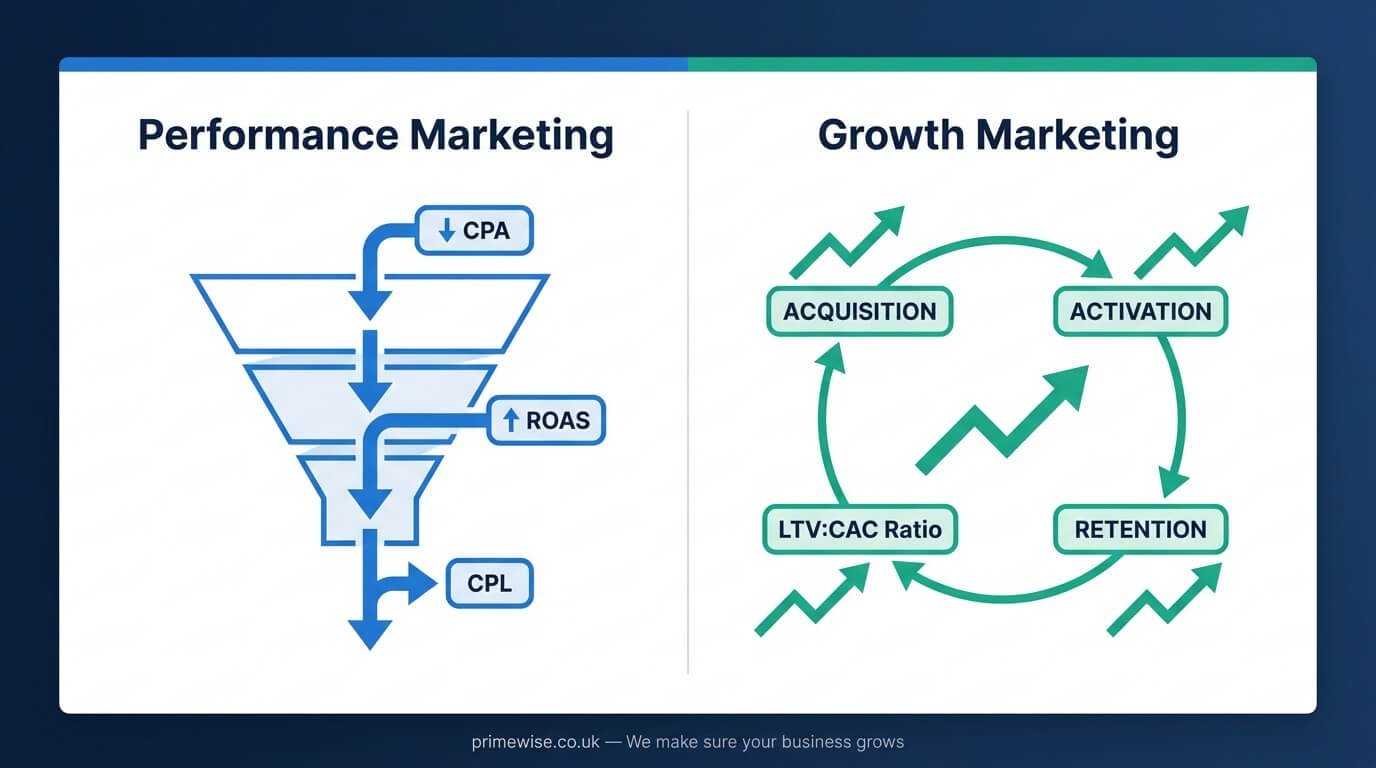
The KPI Ownership Matrix
The most operationally damaging mistake in financial services marketing is misassigning metrics to the wrong team. When a performance media buyer is held accountable for 12-month customer churn, or a growth pod is evaluated solely on weekly lead volume, the entire reporting structure becomes dysfunctional. The following matrix defines strict accountability boundaries so that board-level reporting reflects what each function actually controls.
| Dimension | Performance Marketing | Growth Marketing |
|---|---|---|
| Primary Objective | Demand capture and lead acquisition | Full-lifecycle revenue optimisation |
| Core KPIs | CPA, ROAS, CPL, Impression Share | LTV: CAC ratio, NRR, Activation Rate, TTV, Churn Rate |
| Funnel Position | Top and middle of the funnel | Full funnel, including post-acquisition |
| Budget Horizon | Short-term campaign cycles | Medium to long-term compounding returns |
| Team Composition | Media buyers, PPC specialists, paid social managers | Data strategists, product designers, CRO specialists, retention marketers |
| FCA Compliance Complexity | Lower pre-approved ad creative and claims | Higher onboarding iteration requires legal sign-off |
| Tooling Stack | Google Ads, Meta Ads, DV360, SA360 | Mixpanel, Amplitude, HubSpot, Segment, Braze |
| Reporting Cadence | Daily and weekly | Weekly, monthly, and quarterly cohort analysis |
| Ideal Company Stage | Launch, rapid pipeline growth phases | Post-product-market fit, scaling for retention |
| UK Financial Sector Use Case | New account acquisition, mortgage lead gen | Wealth management retention, fintech activation loops |
Team Structure Blueprints
Where digital marketing teams sit within a corporate hierarchy is not an HR question it is a revenue architecture decision. The structural model chosen determines whether your acquisition spend compounds into lifetime value or leaks into churn. There are two dominant models operating across UK financial services in 2026, and each has a precise use case.
The Centralised Performance Model
The traditional approach centralises media buying within a single marketing silo, typically reporting to a CMO or Head of Demand Generation. This structure is highly efficient for rapid capital deployment across paid search and social channels. Google Ads and Meta campaigns can be launched, optimised, and scaled quickly within a unified team with a consistent bidding strategy. The operational weakness is isolation. Media buyers in this structure rarely interact with customer success, product, or data teams. The result is a structural gap between the promise made in a paid advertisement and the reality of the onboarding experience. A prospective client clicks through a compelling mortgage ad and encounters a friction-heavy application process. The performance team has no visibility of that drop-off, and no mandate to fix it.
The Growth Pod Model
High-performing UK financial firms are increasingly adopting cross-functional growth pods that deliberately break down departmental boundaries. A true growth pod integrates data analysts, product designers, UX researchers, and marketing strategists into a single autonomous unit with a shared North Star Metric, typically a compounding revenue figure rather than a siloed campaign KPI. This structure allows the pod to iterate on the entire user journey. When a wealth management prospect drops out of the onboarding flow at step three of five, the pod can identify the friction point, propose a fix, get compliance sign-off, and deploy a revised experience, all without escalating to three separate department heads. PrimeWise structures these integrated growth pods specifically for FCA-regulated UK firms, combining performance acquisition oversight with lifecycle retention architecture to ensure expensive acquired leads actually convert and compound.
The London Talent GapPost-Brexit, the UK faces a documented shortage of full-funnel growth leaders who combine rigorous quantitative analysis with creative product strategy. The IPA Bellwether Q4 2025 report highlights that UK financial services firms are increasingly outsourcing performance acquisition while struggling to hire internally for growth architecture roles driving up blended CAC without improving retention metrics.
Budget Allocation and Unit Economics
Chief Financial Officers in financial services frequently challenge marketing budget requests because the connection between spend and sustainable revenue is poorly articulated. The performance-versus-growth budget split is not an arbitrary ratio it is a function of your current CAC payback period, your product’s activation rate, and the competitive CPC environment you are operating in.
The Leaky Bucket Problem
Over-indexing on performance marketing without a dedicated growth retention layer creates a structurally unprofitable acquisition engine. You acquire customers at scale, the CPA looks clean on the weekly report, but poor onboarding, no post-purchase communication strategy, and an undifferentiated product experience cause rapid early churn. The LTV to CAC ratio collapses. The performance team gets blamed for poor lead quality when the actual failure is downstream. Conversely, over-investing in growth mechanics without maintaining top-of-funnel volume leads to pipeline starvation. A sophisticated retention engine operating on a shrinking new customer base cannot sustain revenue targets. The operationally sound model splits capital to ensure the initial acquisition cost is actively subsidised by engineered backend retention making the blended unit economics work even when first-purchase profitability is impossible.
High CPC Environments and First-Purchase Profitability
UK financial services operate in one of the most expensive paid search environments globally. Competitive keywords across mortgage, wealth management, and insurance categories routinely command CPCs that make acquiring a customer on the first interaction economically irrational in isolation. According to eMarketer’s 2025 UK Digital Ad Spend Report, financial services CPCs on Google Search increased by an average of 19 percent year-on-year, with premium wealth management terms exceeding £18 per click in competitive London markets. In this environment, a pure performance marketing strategy is mathematically flawed. The acquisition cost can only be justified when a robust growth layer ensures that the customer generates sufficient lifetime revenue to offset the initial media spend, typically requiring a minimum 12-month retention cycle to reach positive unit economics.
FCA Compliance and Growth Testing
The intersection of agile growth methodology and FCA regulatory requirements is where most UK financial firms stall. Standard conversion rate optimisation practices, urgency triggers, social proof tactics, and simplified risk disclosures frequently conflict with obligations under the FCA’s Consumer Duty rules introduced in July 2023 and financial promotions requirements under COBS 4. The Consumer Duty framework explicitly requires that firms demonstrate good outcomes for retail customers, meaning that any onboarding A/B test that increases conversion by reducing the clarity of risk information is not just a compliance risk it is a regulatory liability.
The operationally viable solution is a compliance-approved testing framework. UK wealth managers and lenders building genuine growth capabilities are documenting every proposed onboarding and landing page experiment through a pre-clearance process with their compliance function before deployment. This slows iteration velocity by approximately two to three weeks per test cycle compared to unregulated sectors, but it eliminates the existential risk of an FCA financial promotion fine which under Consumer Duty enforcement can reach into seven figures for repeat violations. The firms scaling successfully are those that have invested in building this compliance integration into the growth pod structure from the outset, rather than treating regulatory review as an afterthought that interrupts the testing roadmap.
FCA Consumer Duty and MarketingSince July 2023, the FCA's Consumer Duty requires firms to evidence that their marketing materials and onboarding journeys produce genuinely good customer outcomes. This directly impacts growth marketing A/B testing practices. Any experiment that obscures fees, simplifies risk, or applies psychological pressure tactics to drive conversion is a potential regulatory violation, not just a compliance note.
The Acquisition to Activation Accountability Matrix
One of the most costly operational failures in financial services marketing occurs at the handover point between the performance acquisition team and the product or onboarding team. A high-intent lead generated by a precisely targeted Google Ads campaign decays in the CRM because nobody owns the activation step. Defining this handover with explicit accountability is the single most impactful structural intervention a CMO can make before adjusting any budget allocation.
The PrimeWise Acquisition-to-Activation Accountability Matrix defines five sequential handover stages: Paid Acquisition, Lead Qualification, Initial Onboarding Contact, Product Activation, and First Value Realisation. At each stage, a named team or individual holds explicit ownership of the conversion metric. Performance owns stages one and two. Growth owns stages three through five. The critical governance rule is that no stage operates without a defined SLA if a qualified lead has not received onboarding contact within four business hours of submission, an automated escalation triggers to the growth pod lead. This prevents the silent lead decay that systematically destroys the payback period calculations that CFOs use to evaluate marketing investment.
Internal client data from PrimeWise engagements with UK financial services firms indicates that restructuring isolated marketing departments into integrated growth pods using this matrix framework has produced a 32 percent average reduction in CAC payback periods. This figure is derived from a cohort of seven FCA-regulated clients across wealth management, consumer lending, and insurance sectors engaged between 2023 and 2025, measured by comparing CAC payback periods in the 12 months prior to restructuring versus the 12 months following implementation. The acceleration in payback velocity frees working capital faster, enabling aggressive reinvestment in performance acquisition channels and compounding the competitive advantage against slower-moving competitors.
Practical Frameworks for Scaling Growth Capability
UK financial services firms at different stages of development require different interventions. A challenger bank at Series B has different constraints to an established IFA network with legacy CRM infrastructure. The following diagnostic framework, the PrimeWise Growth Architecture Readiness Assessment, identifies where to intervene first by auditing five operational dimensions.
- CAC Payback Period: If your current payback period exceeds 18 months, the immediate priority is retention intervention, not increased acquisition spend.
- Activation Rate: If fewer than 60 percent of acquired leads complete your defined activation event within 30 days, onboarding friction is destroying performance marketing ROI regardless of lead quality.
- LTV Data Quality: If your firm cannot produce a cohort-level LTV figure segmented by acquisition channel, you are operating performance campaigns without a financial compass.
- Compliance Testing Protocols: If your growth team has no documented pre-clearance process for onboarding experiments, you are one A/B test away from an FCA financial promotions violation.
- Internal Growth Capability: If your only full-funnel marketing resource is a specialist performance agency with no brief to influence post-click experience, you have an acquisition engine with no retention transmission.
Product-Led Growth in UK Fintech
A strategic layer increasingly relevant to UK fintech firms is Product-Led Growth (PLG), where the product itself becomes the primary acquisition and retention mechanism. Monzo and Wise are the benchmark examples in the UK market, both firms built referral mechanics, in-product engagement loops, and frictionless onboarding experiences that reduced reliance on paid performance channels while dramatically compounding their NRR. Monzo’s publicly reported customer referral programme, for instance, contributed meaningfully to its first million customers without proportional increases in paid acquisition spend.
PLG is not applicable to every financial services context. A commercial lending firm serving SME clients cannot replicate a consumer app’s viral loop mechanics. But the underlying principle applies universally: engineer the product experience so that customer success generates its own demand signals. For UK wealth managers, this might mean a transparent portfolio dashboard that clients proactively share with family members. For insurance firms, it might mean a claims experience so frictionless that it generates referral behaviour without a formal programme. The growth marketing function is the team responsible for identifying, testing, and scaling these product-led loops alongside the performance acquisition engine.
Attribution Modelling and Budget Confidence
A persistent operational failure in financial services marketing is the inability to connect performance spend to long-term growth outcomes through a coherent attribution model. Multi-Touch Attribution (MTA) assigns fractional credit to each marketing touchpoint across a conversion path, while Marketing Mix Modelling (MMM) uses statistical regression to measure the incremental revenue impact of each channel at an aggregate level. Both methodologies are essential connective tissue between the performance team’s daily spend decisions and the growth team’s cohort-level LTV analysis.
Without MMM, the CFO cannot determine whether the £200,000 quarterly Google Ads budget is generating incremental revenue or cannibalising organic and referral traffic that would have converted anyway. Without MTA, the growth team cannot identify which acquisition channels deliver customers with the highest 12-month retention rates a metric far more commercially important than CPA for any financial services firm operating in a high-churn category. Implementing both models in parallel is no longer a best-practice recommendation in 2026, it is the operational baseline for any financial firm serious about marketing accountability.
The 2026 Attribution BaselineUK financial services firms that cannot connect paid acquisition spend to 12-month cohort LTV data are making budget allocation decisions in the dark. Marketing Mix Modelling and Multi-Touch Attribution are now the minimum infrastructure requirement for credible board-level marketing reporting.
Glossary of Key Terms
The following definitions are provided for senior executives and board members who are commercially sophisticated but not necessarily immersed in performance marketing terminology. Precision in these definitions prevents miscommunication between finance, product, and marketing leadership during budget and strategy reviews.
- CAC (Customer Acquisition Cost): The total marketing and sales spend required to acquire one new paying customer, including agency fees, media spend, and internal team costs.
- LTV (Lifetime Value): The total projected net revenue a customer generates over the full duration of their relationship with the firm.
- LTV: CAC Ratio: The ratio of customer lifetime value to acquisition cost. A ratio below 3:1 in financial services typically indicates structurally unprofitable acquisition economics.
- ROAS (Return on Ad Spend): Revenue generated for every pound spent on advertising. A ROAS of 4x means £4 of revenue generated per £1 of media spend.
- NRR (Net Revenue Retention): The percentage of recurring revenue retained from existing customers over a defined period, including expansions and contractions. An NRR above 100 percent indicates revenue growth from the existing customer base without new acquisition.
- CPA (Cost Per Acquisition): The cost of acquiring a single customer or lead through a specific paid channel or campaign.
- TTV (Time to Value): The elapsed time between a customer’s first interaction and their first meaningful value realisation from the product or service.
- CPC (Cost Per Click): The cost paid for each click on a paid search or social advertisement.
- Activation Rate: The percentage of acquired leads or sign-ups who complete a defined activation event for example, funding an account, completing an application, or completing onboarding within a specified timeframe.
How PrimeWise Supports UK Financial Services Growth Teams
PrimeWise works exclusively with FCA-regulated UK financial services firms to design and implement the integrated growth architectures described in this article. The core engagement model combines performance acquisition oversight, ensuring paid media budgets are deployed against the highest-LTV customer segments, with a lifecycle retention architecture that engineers the post-click experience to compress CAC payback periods and build compounding NRR. Rather than managing campaigns in isolation, PrimeWise embeds within client teams as a structural partner, building the internal capability and compliance-approved testing frameworks that remain as permanent organisational assets after the engagement concludes.
If your firm is currently experiencing high acquisition costs alongside disappointing retention metrics, or if you are unable to produce a credible LTV: CAC ratio by acquisition channel for your next board presentation, the diagnostic starting point is a Growth Architecture Review, a structured audit of your current team design, KPI ownership, attribution infrastructure, and compliance testing protocols. This review produces a prioritised restructuring roadmap specific to your firm’s regulatory context, company stage, and competitive market position.
To request a CAC Payback Audit or book a Growth Architecture Review with the PrimeWise team, contact us directly through the site. The conversation begins with your numbers, not a sales deck.