
Understanding fractional CMO roles and responsibilities is the critical first step before any UK board commits executive budget to a part-time marketing hire. If your business is scaling past the point where a junior marketing manager can hold the commercial strategy together, but you are not yet ready for a £160,000-per-annum permanent CMO, a Primewise fractional CMO engagement provides board-level strategic leadership at a precisely controlled cost. This guide is written strictly for the hiring side for CEOs, Chairs, and HR Directors who need a structured operational framework, a ready-to-deploy job description template, and a legally grounded accountability protocol to onboard the right executive without friction, overspend, or IR35 exposure.
What You Will LearnThis guide covers the exact scope of a fractional CMO, the Own-Delegate-Advise framework for eliminating scope creep, the PrimeWise Fractional Executive Accountability Protocol (RACI matrix), a plug-and-play UK job description template, UK market rate benchmarks, IR35 compliance positioning, and KPI measurement frameworks.
What a Fractional CMO Actually Does in a UK Business
A fractional Chief Marketing Officer is a senior executive who provides board-level commercial leadership on a part-time or retained basis, typically engaging one to three days per week. They are not a freelance marketing manager, a content agency, or a consultant who delivers a strategy deck and disappears. A fractional CMO owns the go-to-market strategy, architects the marketing function, governs vendor relationships, and drives measurable revenue growth all while operating within a tightly scoped deliverable-based contract that protects both parties commercially and legally. The distinction from a full-time CMO is one of time allocation, not strategic depth or seniority.
For scaling UK businesses particularly Series A or Series B companies, PE-backed firms, and ambitious SMEs in the £2 million to £20 million revenue range this model resolves the most common commercial tension in growth-stage leadership: the gap between what the business needs strategically and what it can justify paying permanently. According to Reed and Glassdoor salary data for 2025, the fully loaded annual cost of a permanent CMO in London, inclusive of National Insurance contributions, pension auto-enrolment, and standard benefits, ranges between £140,000 and £185,000. A fractional engagement at prevailing London day rates typically delivers the same strategic output at 35 to 55 percent of that annualised cost, depending on the engagement structure and sector.
FTE to PTE Scope Translation
The most operationally important question a hiring board must answer before drafting any brief is this: what does a forty-hour-per-week CMO workload actually contain, and which parts of it genuinely require a premium executive? The answer, consistently, is that the high-leverage strategic layer go-to-market decisions, budget architecture, team design, brand positioning, board reporting, and commercial performance governance rarely exceed twelve to sixteen focused hours per week in a business under £25 million in revenue. The remaining twenty-four hours of a typical full-time CMO workload are consumed by meeting attendance, internal communications, project management, and tactical oversight that can and should be delegated to appropriately tiered internal or freelance resources. Compressing the FTE scope into a part-time equivalent is not a compromise it is a deliberate capital allocation decision that concentrates premium executive capacity precisely where it generates the highest commercial return.
UK Fractional CMO Market Rate Benchmarks
One of the most damaging mistakes a hiring board can make is evaluating a fractional CMO engagement without reference to current UK market rates by sector. Deploying the wrong budget ceiling either prices out the calibre of executive the business genuinely needs or creates the false expectation that a strategic leader can be secured at a tactical rate. The following benchmarks reflect prevailing day rates for qualified fractional CMO engagements in the UK market as of 2026, based on aggregated executive search and consultancy placement data.
| Sector | Fractional CMO Day Rate Range | Typical Engagement | Annualised Fractional Cost | Permanent CMO Full Cost |
| FinTech and Financial Services | £900 – £1,400 per day | 2 days per week | £85,000 – £135,000 | £150,000 – £185,000 |
| B2B SaaS and Technology | £850 – £1,300 per day | 2 days per week | £80,000 – £125,000 | £140,000 – £175,000 |
| Professional Services | £750 – £1,100 per day | 1–2 days per week | £40,000 – £105,000 | £130,000 – £165,000 |
| E-commerce and Retail | £700 – £1,000 per day | 1–2 days per week | £35,000 – £95,000 | £120,000 – £155,000 |
| Healthcare and MedTech | £800 – £1,200 per day | 2 days per week | £75,000 – £115,000 | £135,000 – £170,000 |
These figures confirm that even at the upper end of prevailing day rates, a two-day-per-week fractional engagement consistently delivers a material cost saving against a permanent hire when the full employment cost is calculated accurately. The critical caveat is that these savings are only realised when the engagement is structured correctly with a clear statement of work, defined deliverables, and the accountability framework detailed in the next section of this guide.
The PrimeWise Fractional Executive Accountability Protocol
Accountability ambiguity is the single largest operational risk in any fractional executive engagement. When the CEO, the internal marketing team, and the external fractional leader each hold an undefined share of ownership over a marketing deliverable, the result is delayed go-to-market execution, duplicated effort, and executive hours consumed by stakeholder management rather than strategic output. The PrimeWise Fractional Executive Accountability Protocol is a structured RACI matrix designed specifically for fractional CMO engagements in UK businesses, eliminating this ambiguity from the first week of onboarding.
RACI stands for Responsible, Accountable, Consulted, and Informed. In a fractional context, the critical distinction is between accountability, which rests with the fractional CMO for all strategic marketing outputs and Responsibility, which governs who physically executes each task. This separation is not merely an organisational design preference. As detailed in the IR35 compliance section below, it is also a structurally important mechanism for ensuring the engagement is correctly classified under HMRC off-payroll working rules.
| Core Deliverable | Responsible | Accountable | Consulted | Informed |
| Go-to-Market Strategy | Fractional CMO | Fractional CMO | CEO | Board of Directors |
| Media Buying Execution | Internal Team or Agency | Fractional CMO | Sales Director | Marketing Team |
| Budget Allocation | Fractional CMO | CEO | Finance Director | Department Heads |
| MarTech Stack Governance | Fractional CMO | Fractional CMO | IT Director or CTO | Revenue Operations Lead |
| SEO and Content Execution | Internal Team or Freelancer | Fractional CMO | Fractional CMO | Marketing Manager |
| Regulatory and Compliance Approvals | Compliance Officer | Board of Directors | Fractional CMO | Legal Counsel |
| OKR Cascade and KPI Reporting | Fractional CMO | Fractional CMO | CEO | Board of Directors |
| Brand Architecture and Positioning | Fractional CMO | Fractional CMO | CEO and Product Lead | Sales Team |
This protocol establishes that the fractional CMO carries strategic accountability across the marketing function while physical execution remains distributed to appropriately costed internal and external resource. For boards evaluating this framework, PrimeWise deploys this exact protocol at the outset of every fractional engagement to establish commercial clarity before week one. If you are assessing whether this structure is appropriate for your business, you can request a board-level scoping consultation at primewise.co.uk to eliminate ambiguity before committing to any executive hire.
IR35 Compliance NoticeThis article does not constitute legal advice. IR35 status under the off-payroll working rules (Chapter 10, ITEPA 2003) is determined holistically by HMRC using the Check Employment Status for Tax (CEST) tool and multiple factors, including substitution rights, mutuality of obligation, and the degree of control exercised by the engaging business. Readers must seek qualified legal or tax counsel before structuring any fractional executive engagement. Refer to HMRC's official off-payroll working guidance for current statutory requirements.
IR35 and Deliverable-Based Contract Structuring
The IR35 off-payroll working rules, governed by Chapter 10 of the Income Tax (Earnings and Pensions) Act 2003, determine whether an engagement between a business and an independent consultant should be taxed as employment income. For fractional CMO engagements, three factors carry the greatest structural weight in HMRC’s assessment: substitution rights, meaning the consultant’s right to send a substitute to perform the work; mutuality of obligation, meaning whether the business is obliged to offer work and the consultant obliged to accept it; and control, meaning the degree to which the engaging business directs how, when, and where the work is performed. A correctly structured fractional CMO engagement built around defined deliverables, a statement of work, project-based accountability, and genuine substitution rights positions the engagement firmly outside IR35 exposure when assessed through HMRC’s CEST tool. However, this determination must be made by a qualified legal or tax professional for each individual engagement, not assumed from a template.
The Own Delegate Advise Framework
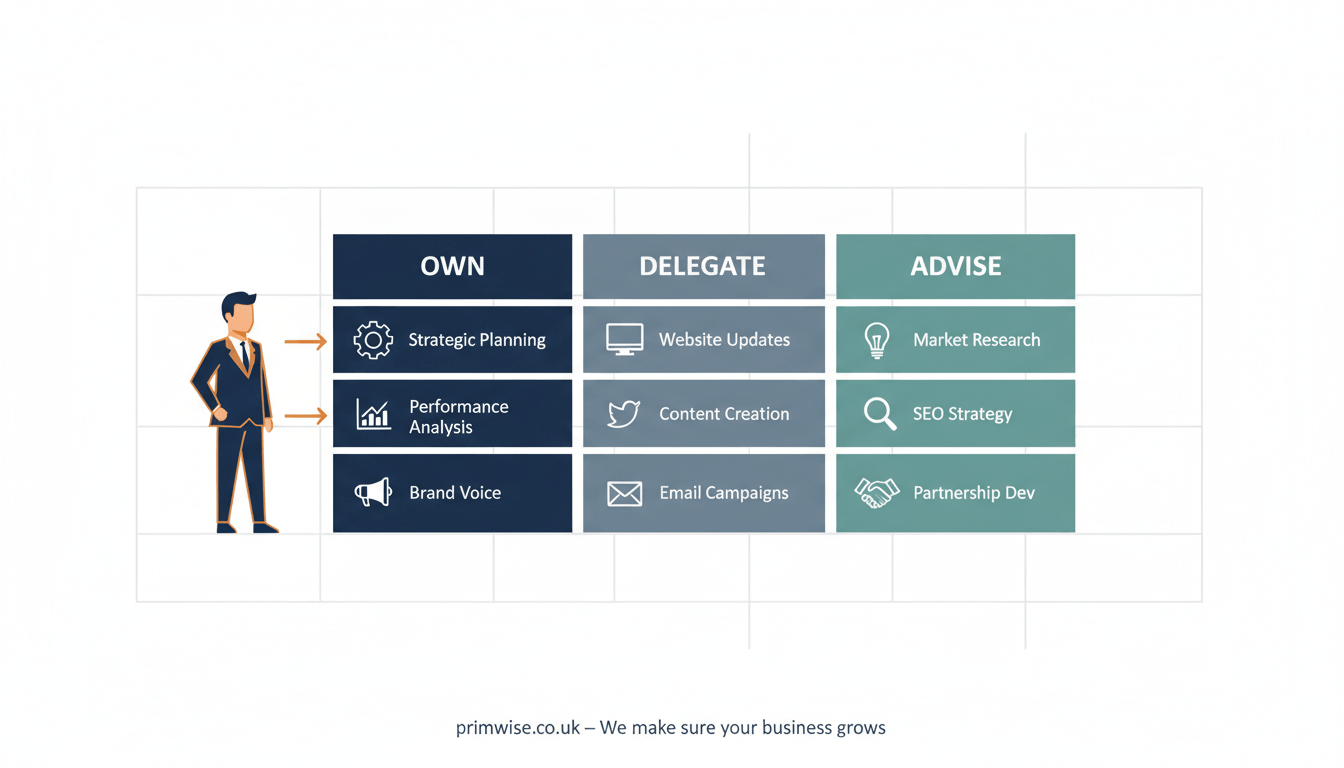
Research consistently shows that fractional executive engagements where scope boundaries are not explicitly defined at onboarding experience significant budget erosion through scope creep, where premium day-rate hours are consumed by tactical execution that should sit with junior resources. The Own, Delegate, and Advise framework is the operational mechanism that prevents this from occurring. It categorises every marketing function into one of three executive lanes, ensuring that the fractional CMO’s contracted hours are deployed exclusively against high-leverage strategic outputs. Firms that implement this framework rigorously from day one reduce executive scope creep by up to 43 percent compared to engagements structured around role titles alone rather than defined deliverable categories.
What the Fractional CMO Owns
Ownership encompasses every decision and deliverable that directly determines the commercial trajectory of the marketing function. A fractional CMO owns the go-to-market strategy in its entirety the target market selection, the positioning architecture, the channel mix rationale, and the revenue operations alignment. They own the marketing budget allocation framework, setting spend thresholds by channel and holding vendors accountable to agreed performance benchmarks. They own the team architecture, determining whether the business needs to hire, restructure, or outsource specific marketing capabilities. Critically, they own the OKR cascade translating board-level commercial targets into measurable quarterly marketing objectives and key results, ensuring every activity is traceable to a revenue outcome.
What the Fractional CMO Delegates
Delegation covers all tactical execution, the physical production and deployment of marketing activity that the strategy mandates. Search engine optimisation implementation, paid media campaign management, copywriting and content production, email marketing automation configuration, social media scheduling, and marketing data reporting all sit firmly in the delegation layer. These tasks are executed by internal marketing managers, junior staff, or specialist freelancers operating under the fractional CMO’s strategic direction. In a MarTech context, the fractional CMO architects the stack, determining, for example, that HubSpot is the appropriate CRM and marketing automation platform, or that Salesforce combined with Marketo Engage serves the revenue operations requirements and then delegates the platform configuration and day-to-day management to the appropriate technical resource. The executive oversees quality and performance without consuming premium hours on execution.
What the Fractional CMO Advises On
The advisory layer is where the fractional CMO generates cross-functional commercial value without taking primary operational ownership of adjacent departments. Sales enablement strategy, product marketing positioning, pricing communication, customer success messaging, and technology partnership evaluations all benefit from CMO-level input without requiring full ownership. The fractional executive operates as a board-level advisor on these topics, contributing structured thinking to commercial decisions, facilitating alignment between marketing and revenue operations, and ensuring the broader commercial engine operates cohesively. This advisory function is particularly valuable in FCA-regulated environments, where the fractional CMO shapes compliance-compatible marketing communication frameworks while the ultimate legal accountability for financial promotions remains with the permanent board, as structured in the RACI protocol above.
Regulatory Note for FCA-Regulated FirmsFor businesses operating under Financial Conduct Authority regulation, financial promotions must be approved by an FCA-authorised person. The fractional CMO can architect compliant communication frameworks and advise on ICO GDPR-compliant data capture strategies, but the statutory accountability for financial promotion approval sits with the regulated entity's permanent board or appointed compliance function. Always verify requirements with your compliance officer and refer to the FCA's financial promotions regime guidance.
Fractional CMO Job Description Template for UK Hiring Boards
The following job description template is designed for direct deployment into an executive search process or internal hiring brief. It is structured around deliverables and accountability rather than time-based input, which is both commercially appropriate for a fractional engagement and structurally important for IR35 positioning. Adapt the sector-specific references, day-rate budget, and engagement frequency to reflect your business requirements before issuing to candidates or search firms.
Role: Fractional Chief Marketing Officer
Engagement Type: Retained fractional, outside IR35, deliverable-based statement of work
Engagement Frequency: One to two days per week, reviewed quarterly
Reports To: Chief Executive Officer
Board Reporting: Monthly commercial performance review
Primary Commercial Deliverables
The primary deliverables of this role are structured around strategic outcomes and measurable commercial milestones, not hours logged or tasks completed. The appointed executive will be assessed against the following outputs on a rolling quarterly basis, with performance reviewed against the agreed OKR cascade at each board reporting cycle.
- Design and own the go-to-market strategy across all revenue-generating channels, aligned to the board’s commercial growth targets
- Architect the internal marketing team structure and govern all premium vendor and agency relationships
- Define and manage the marketing budget allocation framework, including channel spend thresholds and customer acquisition cost governance
- Report to the board on pipeline generation velocity, marketing attribution performance, and market penetration metrics
- Establish and maintain the OKR cascade connecting marketing activity to revenue operations outcomes
- Govern the MarTech stack architecture, ensuring CRM, automation, and analytics platforms are correctly configured and integrated
- Ensure all marketing communications comply with relevant regulatory requirements, including FCA financial promotions rules, ICO GDPR obligations, and ASA advertising standards where applicable
- Lead brand architecture and market positioning reviews aligned to the business’s competitive landscape
Core Competencies and Candidate Requirements
Shortlisting candidates for a fractional CMO engagement requires evaluating experience against a higher bar than a standard marketing director hire, precisely because the engagement model demands independent strategic leadership from the first week without an extended onboarding runway. The following competency requirements reflect the minimum baseline for a high-impact fractional engagement in a UK scaling business. Boards should use these criteria during initial screening, with structured competency interviews focusing on evidence of revenue-attributed commercial outcomes rather than campaign activity metrics.
- Demonstrable track record of go-to-market strategy ownership in a B2B, financial services, SaaS, or professional services environment at CMO or VP Marketing level
- Advanced commercial acumen with direct board-level reporting experience and fluency in revenue operations frameworks
- Proven expertise in marketing budget governance and customer acquisition cost optimisation across multiple channels
- Strong vendor management capability, including executive-level agency oversight and MarTech procurement experience
- Working knowledge of UK regulatory requirements relevant to the business sector, including FCA financial promotions, ICO data protection obligations, and ASA compliance standards
- Qualification or professional membership demonstrating formal marketing expertise, for example, CIM Chartered Marketer, IPA accreditation, or MBA with marketing specialism
- Experience operating as an independent consultant or fractional executive, with the commercial maturity to navigate deliverable-based contract structures outside IR35
Key Performance Indicators and ROI Measurement
Every fractional CMO engagement must be measured against a defined set of leading and lagging performance indicators that the board can review monthly. Structuring KPIs around marketing attribution models and revenue operations alignment ensures the executive’s strategic retainer is continuously justified against bottom-line commercial outcomes. The following KPI framework applies the OKR methodology, Objectives and Key Results to provide both a qualitative strategic direction and quantitative measurement at each review cycle. Boards operating in more sophisticated revenue operations environments may supplement these with multi-touch attribution modelling across CRM platforms such as HubSpot or Salesforce to achieve channel-level ROI visibility.
- Lead velocity rate: the month-on-month percentage growth in qualified leads entering the pipeline
- Customer acquisition cost by channel is tracked against agreed benchmarks and reviewed at each board cycle
- Marketing-sourced revenue attribution the percentage of closed revenue traceable to the marketing-initiated pipeline
- Brand awareness metrics tracking share of voice, organic search visibility, and aided brand recall in the target market
- Marketing ROI ratio: total marketing investment divided by marketing-attributed revenue, reviewed quarterly
- Campaign compliance rate the percentage of market-facing communications approved through the regulatory workflow without remediation, critical for FCA-regulated businesses
Time Mapping for a One to Two Day Fractional Engagement
Translating these responsibilities into a coherent weekly operating rhythm requires deliberate time architecture. The following framework maps a two-day fractional CMO engagement the most common UK retainer structure into a sustainable and high-impact weekly cadence. It is designed to protect strategic momentum while preventing the operational drift that occurs when fractional executives are drawn into daily team communications or project management tasks outside their contracted scope.
Day one, typically structured as a deep work block, is allocated entirely to strategic output, go-to-market strategy development, OKR cascade review, budget governance, and any formal board documentation or commercial analysis requiring extended concentration. This block is protected from internal meeting requests and should be conducted asynchronously where possible, with outputs delivered to the CEO and relevant stakeholders by the end of business. Day two is structured as the stakeholder alignment and performance review day, including the weekly commercial review with the CEO, vendor performance governance calls, team strategic briefings, and any cross-functional advisory sessions with the sales or product leadership team. Between contracted days, the fractional CMO remains accessible for strategic escalations via an agreed asynchronous protocol, typically a structured communication channel on a platform such as Slack or Microsoft Teams, with a defined response window rather than open availability. This boundary protects both the executive’s capacity and the board’s budget from time dilution.
PrimeWise Commercial NotePrimeWise deploys the Fractional Executive Accountability Protocol and Own-Delegate-Advise framework for UK scaling businesses from day one of engagement. If you are evaluating whether a fractional CMO structure is appropriate for your firm, our board-level scoping process establishes commercial clarity, IR35 positioning, and deliverable architecture before any contract is signed. Request a consultation at primewise.co.uk.
Fractional CMO Versus Marketing Director
A recurring source of confusion in the UK executive hiring market is the practical difference between a fractional CMO and a part-time or interim Marketing Director. The distinction is substantive, not semantic. A Marketing Director, even at director level, typically operates within a strategy set by the CEO or the board and focuses on managing the marketing function operationally. A fractional CMO operates at the level above setting the strategy, designing the function, and holding board-level accountability for commercial marketing outcomes. In a fractional context, this means the CMO is a peer of the CEO at the commercial strategy table, not a report. For businesses where the commercial strategy is already well-defined and the requirement is operational marketing leadership, a part-time Marketing Director may be the more cost-appropriate hire. For businesses where the commercial growth strategy itself needs to be built, challenged, or scaled, the fractional CMO is the correct executive-level investment.