
The fractional cmo vs marketing consultant decision is one of the most commercially consequential choices a founder or managing partner will make. Understanding the difference between these two models determines whether your next marketing investment produces a strategic roadmap or a measurable revenue outcome. Fractional CMO leadership represents embedded executive accountability, not advisory guidance, and confusing the two is one of the most expensive mistakes scaling firms make in 2026.
This guide is written for founders, CEOs, and managing partners at UK scale-ups who are actively evaluating senior marketing interventions. You already know you need executive-level expertise. The critical question is whether you need someone to diagnose the problem or someone to fix it. That distinction determines everything: who manages your team, who owns your budget, and who is accountable when the numbers do not move.
EXECUTIVE SUMMARYA marketing consultant delivers diagnostic audits and strategic roadmaps without operational authority. A fractional CMO embeds within your organisation, owns the marketing P&L, manages internal staff, and holds full accountability for commercial growth. For UK scale-ups, the IR35 classification of each model differs significantly. Cost differential versus a full-time London CMO (£180,000–£280,000 per annum) makes the fractional model financially compelling. Choose a consultant when your team can execute. Choose a fractional CMO when execution itself is the problem.
What Is the Core Difference Between These Two Models
The sharpest way to understand the fractional cmo vs marketing consultant distinction is through the lens of accountability. A marketing consultant provides structured analysis and strategic recommendations. They diagnose, prescribe, and depart. A fractional CMO accepts operational ownership. They join your leadership team on a part-time basis, manage your people, control your budget, and are accountable for results. One model ends at the boardroom presentation. The other begins there.
This is not a difference in seniority or experience. Many marketing consultants are exceptionally senior practitioners. The difference is structural. A consultant’s engagement is bounded by deliverables. A fractional CMO’s engagement is bounded by commercial outcomes. That single distinction reshapes everything from contract structure to IR35 classification to the return on investment timeline your board should expect.
What Does a Marketing Consultant Actually Deliver
A marketing consultant excels in fixed-scope diagnostic work. Their primary output is structured insight: a go-to-market audit, a competitive positioning review, a channel attribution analysis, or a messaging framework. These are high-value deliverables when the underlying problem is one of direction rather than execution. The engagement is typically project-based, priced on deliverables or day rates, and concludes when the document is handed over. The consultant has no authority over your team, no involvement in vendor negotiations, and no stake in whether the recommendations are ever implemented.
This model is genuinely powerful when deployed correctly. If your internal marketing team is competent and simply requires an objective external lens to recalibrate strategy, a consultant provides exceptional value at a clearly bounded cost. The risk emerges when founders hire a consultant expecting a transformation and receive a presentation instead. The transformation still requires someone with the authority to execute it.
How Does a Fractional CMO Manage Your Internal Team
A fractional CMO operates as a part-time member of your C-suite with full executive authority. They attend leadership meetings, line-manage your marketing staff, lead the agency procurement process, set quarterly OKRs, own the marketing P&L, and report directly to the board on commercial performance. The fractional element refers to their time commitment, not their authority level. They bring the same operational capability as a full-time CMO at a fraction of the annual cost.
In practice, this means they make difficult decisions that consultants are structurally prevented from making. They restructure underperforming teams. They terminate ineffective agency relationships. They rebuild acquisition funnels from the ground up. They translate the strategic vision held in the founder’s head into an operational reality that generates measurable commercial traction within a defined timeline.
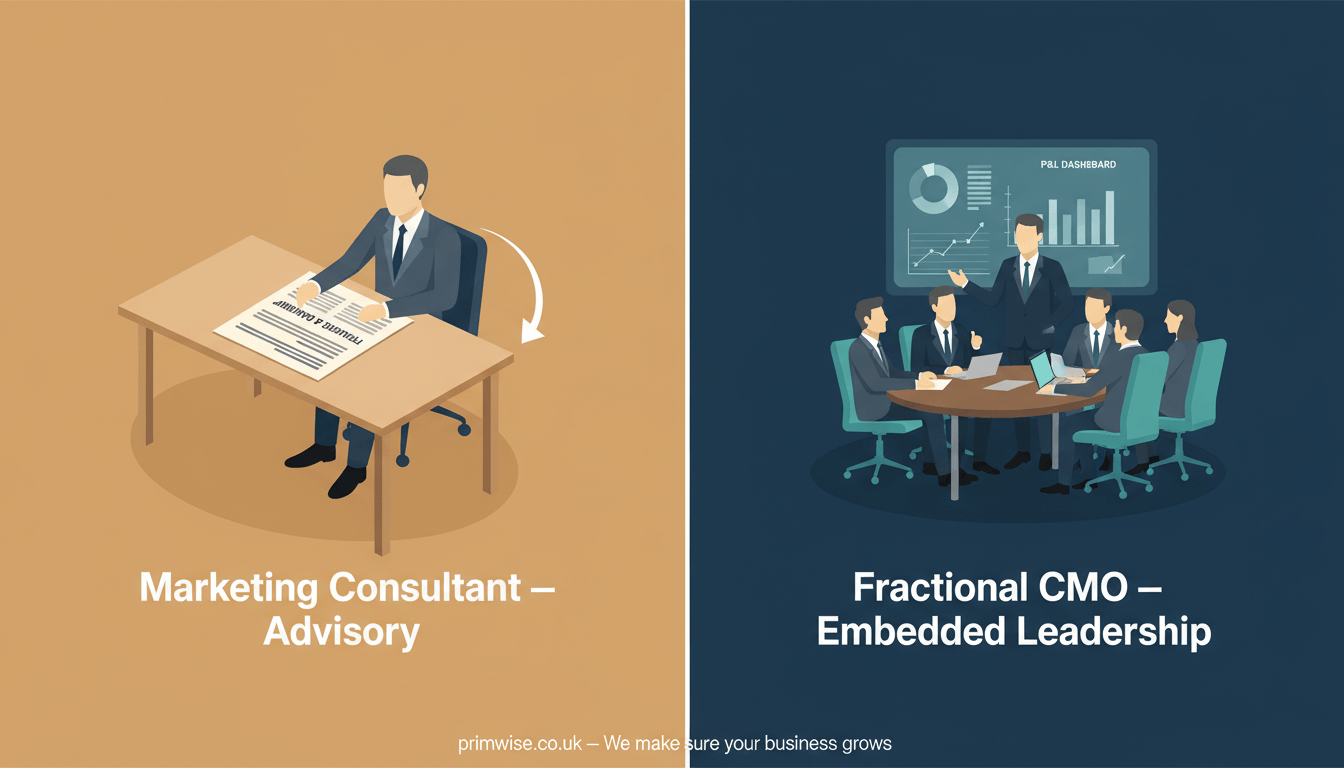
The Advisory vs Embedded Accountability Matrix
When evaluating which executive marketing model suits your current growth stage, mapping decision-making authority against commercial risk provides the clearest framework. The matrix below distils the operational reality of each engagement type across the metrics that matter most to a board-level conversation.
| Operational Metric | Marketing Consultant | Fractional CMO |
|---|---|---|
| Primary Output | Diagnostic Audits and Strategic Roadmaps | Embedded Execution and Measurable Growth |
| P&L Accountability | None | Full Budget Ownership |
| Team Management Authority | Advisory Guidance Only | Direct Hiring and Firing Authority |
| Agency Procurement | Recommendations Only | Contract Negotiation and Vendor Management |
| Board Reporting | Project Deliverable Presentation | Ongoing Commercial Performance Reporting |
| IR35 Classification | Typically Outside IR35 | Requires Strict Contractual Boundaries |
| Typical Engagement Length | 30 to 90 Days | 6 to 18 Months |
| Commercial Risk Profile | Low Implementation Risk | High Accountability, High Reward |
Industry data reinforces this operational disparity. Firms utilising embedded fractional leaders report a 40% reduction in campaign time-to-market compared to purely advisory models. This acceleration occurs precisely because the fractional leader removes the implementation gap the structural void between strategic recommendation and operational execution that consistently undermines advisory-only engagements.
STRATEGIC INSIGHTThe most common capital misallocation in executive marketing procurement is hiring a consultant when the underlying problem is an execution deficit. If your team already struggles to implement existing strategy, adding more strategy compounds the failure. The diagnostic question is not 'what should we do?' but 'who will do it?'
Founding teams and managing partners seeking to evaluate whether embedded fractional leadership or strategic advisory better serves their current growth stage can access a structured executive diagnostic through PrimeWise at primewise.co.uk. Their fractional CMO engagements are architected specifically for London-based FinTech and professional services scale-ups navigating Series A to Series C growth trajectories, offering a complimentary 30-minute diagnostic call with a senior partner to assess precise executive marketing requirements.
UK Market Realities That Change the Calculation
The fractional cmo vs marketing consultant decision carries distinct structural implications in the UK market that do not apply in the same way elsewhere. Three forces shape this landscape in 2026: IR35 off-payroll working rules, the prohibitive cost of full-time C-suite talent in London, and the capital efficiency demands of the current UK venture environment.
Navigating IR35 for Embedded Marketing Executives
IR35 compliance is a non-negotiable consideration when engaging any senior external marketing executive in the UK, and the classification differs significantly between the two models. A marketing consultant delivering a fixed-scope audit producing a defined output with no management authority, no integration into the client’s organisational structure, and no substitution clause restrictions typically operates clearly outside IR35 under the off-payroll working rules governed by Chapter 10 and Chapter 11 of ITEPA 2003.
A fractional CMO who manages staff, attends C-suite meetings as a quasi-officer of the company, and exercises budget authority presents a materially different IR35 risk profile. HMRC’s Check Employment Status for Tax (CEST) tool, available directly at HMRC.gov.uk, should be completed before any embedded engagement commences. For medium and large engagers, the responsibility for issuing a Status Determination Statement sits with the client firm, and errors carry significant tax liability. Early-stage FinTech firms operating below the small company threshold (fewer than 50 employees, turnover under £10.2 million, balance sheet under £5.1 million) retain the off-payroll small company exemption, which shifts the IR35 determination responsibility to the contractor’s own personal service company. Specialist IR35 advisory firms such as Kingsbridge, Bauer, and Cottrell provide commercially validated contract reviews before engagement commences.
IR35 COMPLIANCE ALERTEmbedding a fractional CMO without a Status Determination Statement exposes the hiring firm to retrospective PAYE liability, interest, and penalties. Complete HMRC's CEST assessment before any embedded executive engagement begins. Always obtain specialist legal review of the contract's substitution and control clauses.
The True Cost of London CMO Talent in 2026
Full-time CMO compensation in London represents a substantial capital commitment that constrains most scale-ups before the hire is even made. Based on 2025 to 2026 market data from Robert Half and the Chartered Institute of Marketing, a full-time Chief Marketing Officer in London commands a total package of between £180,000 and £280,000 per annum inclusive of base salary, employer National Insurance contributions, pension obligations, benefits, and recruitment fees. For a Series A firm managing runway discipline, this represents between 15% and 25% of a typical funding round allocated to a single leadership hire before any marketing activity is funded.
The fractional model fundamentally restructures this equation. A senior fractional CMO retainer in the UK market ranges from £5,000 to £18,000 per month depending on scope, sector specialism, and time commitment. At the upper end of this range, the annualised cost remains significantly below the minimum full-time package, while the firm retains the flexibility to scale engagement intensity up or down as growth stages evolve. For a Series A or early Series B FinTech operating under current UK venture capital constraints the British Business Bank’s 2025 UK Venture Capital Report confirmed a 23% contraction in early-stage deal volume this cost structure is not merely attractive, it is often the only viable path to elite executive marketing capability.
The Hybrid Engagement Model
A third commercial structure is increasingly common in the London professional services and FinTech sectors, yet rarely discussed with sufficient clarity in existing resources. The hybrid engagement model begins with a defined consultant diagnostic phase typically 30 to 60 days followed by a formal transition into an embedded fractional CMO retainer. This structure resolves a genuine procurement dilemma: founders who are uncertain whether their challenge requires a roadmap or an execution leader can commission the diagnostic phase to generate the evidence base for that decision, then transition seamlessly into embedded leadership if the diagnostic reveals an execution deficit.
The hybrid model carries distinct contractual requirements. The initial diagnostic engagement must be structured as a clean, deliverable-bounded project to establish a defensible outside-IR35 position for that phase. The subsequent fractional CMO engagement then requires a separate contract with fresh IR35 determination, appropriate substitution clauses, and explicit operational boundary definitions. Conflating the two phases into a single rolling contract creates unnecessary regulatory exposure and weakens the commercial clarity of both relationships. For firms evaluating this path, specialist firms such as PrimeWise structure their engagements precisely around this hybrid architecture, with documented phase transitions and board-presented decision gates between the diagnostic and execution stages.
A London FinTech Case Study from Series A to Series B
A prominent London-based financial technology firm provides a compelling illustration of the fractional cmo vs marketing consultant decision in practice. Following their Series A round, the company faced stagnating growth: customer acquisition costs had risen 34% over six months, their internal marketing team lacked senior strategic capability, and a planned transatlantic market expansion had stalled without a credible go-to-market framework. The founding team engaged an external marketing consultant for a focused 30-day diagnostic engagement covering digital acquisition architecture, brand positioning, and team capability assessment.
The diagnostic produced a clear finding: the strategic direction was broadly sound, but the execution infrastructure talent, agency relationships, and budget governance was severely inadequate. The roadmap was intelligent. The team could not implement it. Recognising that a second advisory engagement would compound the problem rather than resolve it, the firm transitioned the consultant relationship into a 12-month embedded fractional CMO retainer through a structured hybrid engagement. The fractional leader restructured the internal team, terminated two underperforming agency relationships, established board-level commercial reporting including monthly CAC to LTV ratio analysis, and rebuilt the digital acquisition strategy from the channel attribution level upward.
The operational results directly supported a successful Series B funding round 11 months into the engagement, with customer acquisition costs reduced by 28% and a validated EMEA expansion pipeline that formed a central plank of the investor deck. Engagements of this nature, where diagnostic advisory transitions into embedded fractional leadership, represent the structured service architecture offered by specialist firms such as PrimeWise, whose fractional CMO engagements are architected specifically for London-based FinTech and professional services scale-ups navigating Series A to Series C growth trajectories.
Financial Expectations and ROI Timelines
Transparent cost modelling and realistic return on investment expectations are prerequisites for board approval of any senior marketing intervention. The following table provides specific financial benchmarks based on 2025 to 2026 UK market data, enabling founders to construct a commercially grounded business case before procurement commences.
| Financial Metric | Marketing Consultant | Fractional CMO | Full-Time London CMO |
|---|---|---|---|
| Typical Engagement Cost | £8,000 – £35,000 per project | £5,000 – £18,000 per month | £180,000 – £280,000 per annum (total package) |
| Deliverable Timeline | 30 to 90 days | 6 to 18 months | Ongoing employment |
| Measurable ROI Onset | 6 to 18 months via internal execution | 90 to 180 days for commercial traction | 6 to 12 months |
| Capital Efficiency | High for diagnostic phase | High for execution phase | Low at early stage |
| IR35 Risk | Typically Low | Medium requires SDS | Not Applicable (Employee) |
The cost data reveals a critical insight for early-stage capital allocation. The gap between a consultant project fee and a fractional CMO retainer is substantially smaller than founders typically estimate, while the accountability gap between the two models is enormous. A £25,000 consultant engagement that produces a roadmap requiring 18 months of uncertain internal execution carries a very different risk-adjusted cost than a fractional CMO retainer that generates measurable commercial traction within 90 to 180 days and holds direct accountability for the outcome.
Selecting the Right Model for Your Growth Stage
The fractional CMO vs marketing consultant decision resolves most cleanly when founders apply a single diagnostic question: is the primary constraint on our marketing performance a lack of strategic clarity or a lack of execution capability? If the answer is strategic clarity, a consultant engagement is the appropriate and capital-efficient intervention. If the answer is execution capability or if previous advisory engagements have produced roadmaps that were never effectively implemented, an embedded fractional leader is the structurally correct solution.
The following decision criteria provide a practical framework for this evaluation. Apply them against your organisation’s current operational reality rather than its aspirational state.
- Engage a marketing consultant when your internal team demonstrates strong execution capability but lacks an objective external perspective to recalibrate strategic direction.
- Select advisory engagement for a specific, bounded diagnostic challenge with a clearly defined output requirement and a 30 to 90-day timeline.
- Transition to a fractional CMO when marketing stagnation persists despite previous strategic interventions, and the root cause is identified as an execution deficit.
- Procure embedded fractional leadership when board-level P&L accountability, rigorous commercial reporting, and direct agency procurement authority are operationally required.
- Consider the hybrid model when diagnostic certainty is insufficient to commit immediately to embedded leadership, using the diagnostic phase as a structured evidence-gathering exercise.
- Evaluate fractional CMO structures when transatlantic or EMEA market expansion creates demand for senior marketing leadership that the business cannot yet justify funding on a full-time basis.
DECISION ACCELERATORIf your last advisory engagement produced a roadmap your team never fully implemented, the problem is not the strategy. The problem is the execution infrastructure. Embedded fractional leadership resolves this at a fraction of full-time CMO cost. The next step is a structured diagnostic, not another audit.
Founding teams navigating this decision benefit most from a structured external assessment of their current marketing capability, team density, and growth stage requirements before committing capital to either model. PrimeWise offers a complimentary 30-minute executive diagnostic call at primewise.co.uk specifically designed for London-based scale-ups evaluating senior marketing interventions. The diagnostic is structured as an intellectual engagement rather than a sales conversation, producing a clear recommendation on whether advisory or embedded leadership represents the commercially optimal path for your specific growth stage.