Fractional CMO vs Interim CMO is one of the most commercially consequential distinctions a UK chief executive or procurement director will face when securing senior marketing leadership. The two titles sound interchangeable at a boardroom level, yet their contractual obligations, IR35 risk profiles, remuneration mechanics, and operational boundaries are fundamentally different. Choosing the wrong model does not simply result in a suboptimal hire; it can trigger HMRC off-payroll penalties, employment tribunal exposure, and misaligned intellectual property ownership. Whether you are evaluating our fractional CMO engagement model or considering a full-time interim placement, this guide gives you the exact legal and commercial framework to make the right call before you sign.
Quick AnswerA Fractional CMO is an ongoing, part-time strategic marketing executive managing a multi-client portfolio. An Interim CMO is a full-time, fixed-term leader brought in for a single-client transition or turnaround. Their contracts, IR35 risk profiles, and remuneration structures are entirely different.
Defining Each Role With Precision
At the boardroom level, both titles refer to senior marketing leadership provided without a permanent employment contract. Beyond that superficial similarity, the two models diverge sharply. A Fractional CMO maintains an active portfolio of non-competing client relationships simultaneously, delivering strategic marketing leadership on a part-time, retained basis. This is not a temporary arrangement; engagements routinely run for twelve months or longer, and the executive’s commercial independence is a defining legal characteristic of the model. An Interim CMO, by contrast, is engaged exclusively by one organisation for a fixed, defined period, typically between three and nine months, to provide full-time leadership through a specific transition event such as a turnaround, parental leave cover, or post-acquisition restructuring.
The Fractional CMO Model
The fractional model is architected around strategic output rather than physical presence. These executives are not stop-gap hires; they are long-term partners who happen to operate on a part-time schedule. Because they serve multiple clients concurrently, their contractual independence is not merely a preference it is a legal requirement. Any attempt to impose total exclusivity on a fractional executive fundamentally undermines their status as an independent B2B service provider, which carries serious IR35 implications explored in detail below. The Fractional CMO’s value proposition centres on delivering senior-level strategic thinking at a fraction of the cost of a full-time C-suite appointment, making the model particularly well-suited to growth-stage businesses, scale-ups, and established firms running lean executive structures.
The Interim CMO Model
The interim model is built for intensity and speed. When a business faces a CMO vacancy during a critical growth phase, a regulatory crisis, or a major operational pivot, the interim executive parachutes in as the de facto full-time marketing leader for the duration of the engagement. Their undivided attention is the core commercial proposition. They attend daily stand-ups, lead cross-functional teams, manage budgets, and drive execution behaving in almost every operational respect like a permanent employee, which is precisely why their IR35 management demands far greater contractual vigilance. Because they are single-client focused, interim CMOs command a premium daily rate that reflects the opportunity cost of foregoing a portfolio model.
UK Remuneration Benchmarks for 2026
Establishing accurate market rates is essential for firms that want to attract credible executive talent without overpaying or under-resourcing the marketing function. The remuneration structures for fractional and interim CMOs differ not just in quantum but in their underlying commercial logic, and confusing the two frameworks leads to contracts that neither party honours effectively.
Interim CMO Day Rates
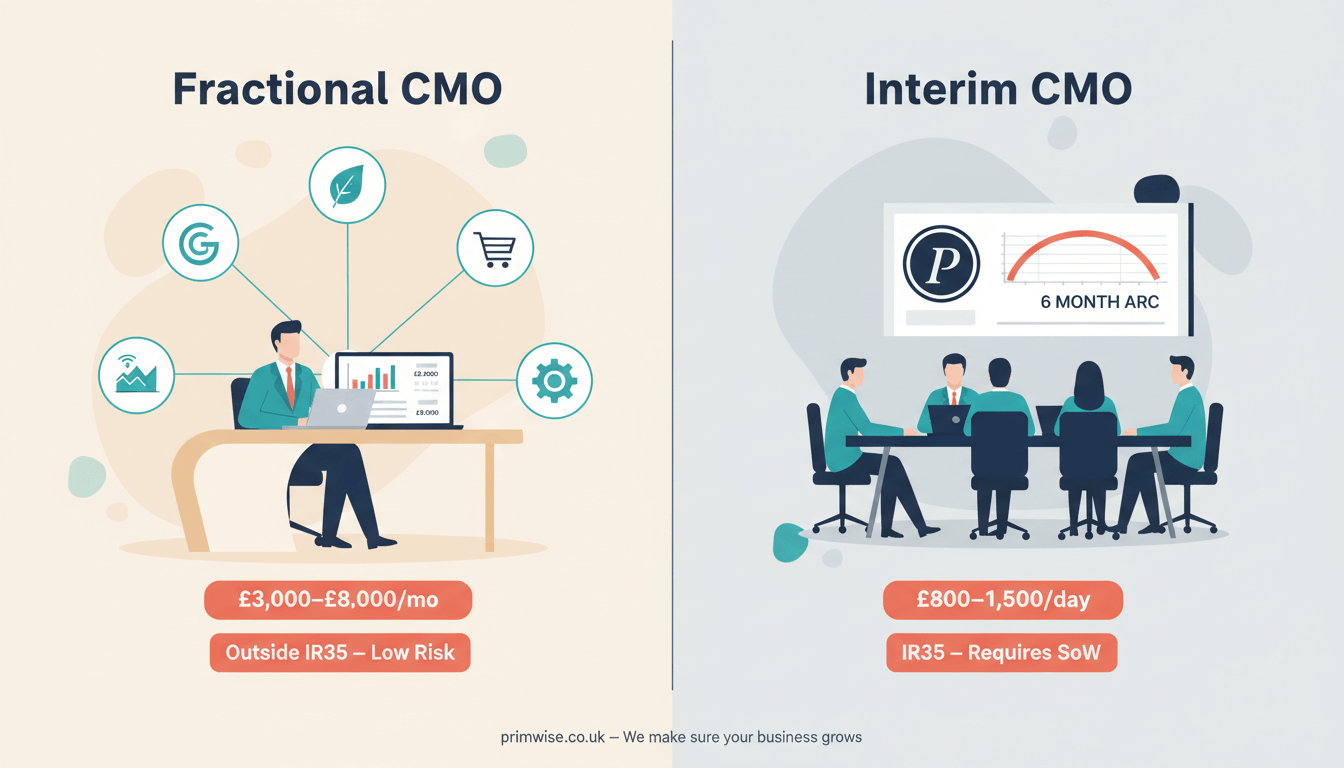
Interim CMOs in the UK operate predominantly on a time-and-materials basis, billing a daily rate that reflects their full-time commitment and the specialist nature of their transition expertise. Based on current senior marketing executive placement data from the UK interim management market, experienced interim CMOs command between £800 and £1,500 per day. At the upper end of that range, you are securing executives with P&L ownership experience, blue-chip brand portfolios, and demonstrable turnaround credentials. If sourced through a specialist interim management provider, agency placement fees typically add a further 15 to 25 percent uplift to the total commercial cost. For London-based or London-focused engagements, a geographic premium of approximately 15 to 20 percent applies above the national average, reflecting the density of demand and cost of living pressures in the capital.
Fractional CMO Retainer Structures
Fractional CMOs do not bill by the day. Their remuneration is structured as a fixed monthly retainer anchored to strategic deliverables rather than time at desk. Based on Primewise’s analysis of UK fractional CMO engagements across growth-stage businesses, monthly retainers typically range from £3,000 to £8,000 depending on the breadth of the strategic brief, the seniority of the executive, and the sector. Financial services and regulated industries command a premium above the sector average, reflecting the compliance complexity and stakeholder management demands inherent to those environments. For Series B to Series D technology businesses specifically, the median monthly retainer sits closer to £5,200. This output-focused structure provides businesses with highly predictable monthly expenditure and eliminates the billing volatility associated with day-rate engagements.
London Market PremiumWhether engaging a fractional or interim CMO, businesses operating in London or requiring London-based executive presence should budget for a 15 to 20 percent premium above national UK benchmarks. This uplift reflects high talent demand, not inflated executive ego.
Contractual Nuances That Protect Your Business
The contractual architecture underpinning each model is where most businesses make avoidable and costly errors. Understanding the specific legal mechanics of each engagement type is not optional for firms navigating financial services, technology, or any sector handling proprietary commercial data. The structure of your contract determines not just the working relationship, but your tax liability, your intellectual property ownership, and your legal exposure if the relationship breaks down.
Why Exclusivity Invalidates the Fractional Model
One of the most common and damaging mistakes made during fractional CMO contract negotiations is the insistence on full exclusivity. This is legally untenable. A genuine fractional executive is a B2B service provider operating under a commercial services agreement, not an employment contract. Their right to service multiple non-competing clients simultaneously is a fundamental indicator of their independence and independence is the cornerstone of an outside-IR35 status determination. When a client demands total exclusivity from a fractional executive, they remove that independence, transforming the relationship into one that closely resembles employment. HMRC does not look at the label on the contract; it looks at the reality of the working relationship. A well-drafted fractional contract must explicitly preserve the executive’s right to maintain a multi-client portfolio, and should include a right of substitution clause acknowledging that the executive, rather than the client, controls how the strategic work is delivered.
Protecting Against Competitor Exposure
While blanket exclusivity is off the table for fractional engagements, protecting your firm from direct competitor access is entirely legitimate and should be a standard feature of any well-drafted fractional services agreement. Under UK employment law and restrictive covenant principles, you are entitled to impose tightly scoped non-compete clauses that prevent the fractional executive from simultaneously working with named direct competitors. The key word is tightly scoped. An overly broad restriction that prevents the executive from working in an entire sector will likely be unenforceable and may itself attract employment tribunal scrutiny. Restrictions must be proportionate in duration, typically three to six months post-engagement, geographically limited where relevant, and precisely defined in terms of which competitor categories are excluded. These clauses sit comfortably within a B2B services framework and do not compromise the executive’s outside-IR35 status when correctly drafted.
Intellectual Property Ownership and Transfer
Intellectual property transfer is a contractual pillar that is routinely overlooked until a dispute arises. For interim CMOs, IP assignment is relatively straightforward: because the executive is producing work product as a single-client full-time resource, a comprehensive IP assignment clause that vests all deliverables in the client from the point of creation is standard and enforceable. For fractional CMOs, the picture is more nuanced. Because they are producing strategic frameworks, brand playbooks, and growth methodologies that may draw on proprietary methodologies developed across their portfolio, IP clauses must distinguish between pre-existing intellectual property (which remains with the executive) and client-specific deliverables (which are assigned to the client). Failing to draw this distinction clearly in the contract can lead to disputes over ownership of marketing strategies, brand architectures, and data-driven frameworks that the business has come to depend upon.
Legal DisclaimerThis article is for informational purposes only and does not constitute legal advice. For IR35 status determinations and bespoke contract drafting, businesses should consult a qualified UK employment solicitor or IR35 specialist.
Navigating UK IR35 Legislation
The UK Off-Payroll Working rules, codified under Chapter 10 of the Income Tax (Earnings and Pensions) Act 2003 (ITEPA 2003), place the burden of IR35 status determination squarely on the hiring organisation, not the contractor. Since the extension of these rules to the private sector in April 2021, medium and large businesses engaging senior executives through personal service companies or limited companies have been legally required to issue a Status Determination Statement (SDS) before the engagement commences. Misclassifying a senior marketing executive concluding they are outside IR35 when the working reality places them inside can result in the firm becoming liable for the executive’s PAYE tax and National Insurance contributions, plus HMRC penalties and interest. The stakes are exceptionally high at CMO level given the remuneration involved.
IR35 Risk Profile of the Fractional Model
Fractional CMOs, when correctly structured, carry a low IR35 risk profile. The three primary determinants of IR35 status under HMRC guidance are substitution, control, and mutuality of obligation. A genuine fractional engagement satisfies all three in the executive’s favour: they have the contractual right to substitute a qualified replacement if they are unable to deliver; the client does not control their daily working methods, only the strategic outputs required; and there is no ongoing expectation of continued work beyond the contracted deliverables. HMRC’s Employment Status Service (ESS) tool, available on GOV.UK, can be used to conduct a preliminary self-assessment, though businesses operating at senior executive level are strongly advised to supplement this with a formal IR35 specialist review given the complexity of CMO-level engagements.
IR35 Risk Profile of the Interim Model
Interim CMOs face a materially higher IR35 risk exposure. Because they operate full-time within a single organisation, attend company meetings, manage direct reports, and integrate deeply into the corporate structure, many of the behavioural indicators of employment are present by default. The risk escalates significantly when businesses extend standard employee benefits to interim executives issuing company handbooks, providing equipment on standard employee terms, or listing them on the internal organisational chart without contractual caveats. To maintain a viable outside-IR35 status, the interim CMO engagement must be anchored to a meticulously drafted Statement of Work that defines engagement milestones, transfers control of methodology to the executive, avoids open-ended time commitments, and clearly restricts the scope of the role to the defined transition objectives. HMRC scrutinises interim arrangements at C-suite level with particular intensity; the HMRC v Professional Game Match Officials Ltd ruling reinforced the principle that operational integration, regardless of contract labelling, is a primary indicator of deemed employment.
Drafting a Compliant Statement of Work
Whether you are engaging a fractional or interim CMO, the Statement of Work is the single most important document in your contractual framework. A compliant SoW must define the specific deliverables and milestones rather than specifying hours, establish that the executive controls the methodology and working approach rather than the client, include a right of substitution clause that is operationally realistic rather than merely cosmetic, set clear start and completion dates rather than open-ended rolling arrangements, and avoid language that implies integration into the permanent workforce. For interim engagements specifically, the SoW should be structured around defined transition phases for example, a 90-day diagnostic and stabilisation phase followed by a 60-day handover programme rather than an undifferentiated block of time. This phase-gate structure reinforces the project-based nature of the engagement and significantly strengthens the outside-IR35 argument.
The Contractual Risk Matrix
The table below maps the core contractual and commercial vectors of both models side by side. This framework has been developed from Primewise’s direct experience structuring senior marketing executive engagements across UK growth-stage and established businesses, and is designed to serve as a practical due diligence reference before any contract is finalised.
| Contractual Vector | Fractional CMO | Interim CMO |
|---|---|---|
| Client Engagement Profile | Multi-client portfolio | Single-client only |
| Typical Engagement Duration | 12 months or longer (ongoing) | 3 to 9 months (fixed-term) |
| Remuneration Structure | Fixed monthly retainer (£3,000–£8,000) | Daily rate billing (£800–£1,500/day) |
| IR35 Risk Profile | Generally Low Outside IR35 | High Requires rigorous SoW |
| IR35 SDS Requirement | Required but low-risk outcome likely | Required high scrutiny applies |
| Exclusivity Rights | Cannot be imposed legally invalidates model | Standard single-client exclusivity applies |
| Right of Substitution | Must be included and operationally genuine | Rarely applicable presence-dependent role |
| IP Default Ownership | Pre-existing IP retained; client deliverables assigned | Full work-product assignment to client standard |
| Notice Periods | Typically 30 to 90 days | Typically 1 to 4 weeks |
| Non-Compete Scope | Direct competitors only proportionate duration | Broader sector restrictions standard |
| Typical Engagement Trigger | Growth strategy, brand repositioning, scale-up leadership | Turnaround, parental leave, post-acquisition |
| Suitable Company Stage | Series A to established enterprise (lean C-suite) | Any stage requiring full-time transition cover |
When to Choose Each Model
The correct engagement model is determined entirely by your immediate operational reality and your medium-term strategic objectives. There is no universally superior option; there is only the model that is correctly aligned to your specific circumstances. The decision framework below maps common corporate scenarios to the appropriate engagement model based on operational requirements rather than budget alone.
- A Series B SaaS business scaling from £2M to £10M ARR with no full-time CMO needs ongoing strategic direction without C-suite overhead the fractional model is the natural fit.
- A 200-person financial services firm whose CMO departs unexpectedly mid-transformation programme requires immediate full-time leadership continuity the interim model is the correct choice.
- A private equity-backed business undergoing a B2C to B2B pivot needs a strategic marketing architect with sector expertise over a 12-month repositioning fractional engagement with defined quarterly deliverables is optimal.
- A healthcare technology company covering a CMO’s 12-month parental leave needs undivided, full-time operational management an interim placement is required, not fractional cover.
- A professional services firm preparing for a Series D fundraise needs marketing due diligence support, investor narrative development, and demand generation strategy a fractional CMO with financial services sector experience is the superior model.
- A post-acquisition integration requiring two legacy marketing teams to be unified under a single operational structure within six months demands a full-time interim leader with change management credentials.
Common MisconceptionA Fractional CMO is not a cheaper version of an Interim CMO. They are structurally different engagement models serving different business needs. Choosing one over the other purely on cost is a category error that routinely leads to both contractual disputes and strategic underperformance.
Questions to Ask Before You Sign
Regardless of which model you are pursuing, the due diligence conversation you have before contract execution is as important as the contract itself. The following questions are designed to surface the critical commercial and legal exposures that are routinely glossed over during initial executive engagement discussions.
- Has an IR35 Status Determination Statement been issued and documented before the engagement start date?
- Does the Statement of Work define deliverables and milestones, or does it describe working hours and management responsibilities?
- Is the right of substitution clause operationally genuine, or is it a cosmetic contractual addition that would never be exercised?
- Has the non-compete clause been reviewed by a UK employment solicitor to confirm it is proportionate, enforceable, and does not inadvertently imply an employment relationship?
- Does the IP assignment schedule clearly distinguish between the executive’s pre-existing methodologies and the client-specific deliverables produced during the engagement?
- What are the exit provisions, and do the notice periods reflect the engagement model shorter for interim, longer for fractional given the embedded strategic relationship?
- If engaging a fractional CMO, has the contract been reviewed to confirm total exclusivity is not being imposed, even inadvertently through language around availability or first-refusal clauses?
A Real-World Scenario
Consider a 120-person SaaS business headquartered in Manchester. The founding CMO resigns during a CFO-led cost reduction programme. The board debates whether to hire a fractional or interim replacement. The business has an eight-month runway to its next funding round, a marketing team of four that needs leadership, and a strategic brief that centres on repositioning from SME to enterprise buyers. In this scenario, the correct answer is nuanced. For the first 90 days, an interim CMO provides the full-time stabilisation and team continuity the programme demands. Post-stabilisation, if the business transitions into a growth-through-content and account-based marketing phase ahead of the fundraise, a fractional CMO with enterprise SaaS positioning credentials becomes the more commercially efficient and strategically appropriate choice. This is not an either-or decision across the entire lifecycle of the marketing leadership gap; it is a sequenced deployment of the right model at the right phase.
How Primewise Structures These Engagements
Primewise works exclusively with UK-based growth-stage and established businesses to structure senior marketing executive engagements that are IR35-resilient, commercially precise, and strategically aligned from day one. Our standard engagement framework for fractional CMO placements includes a pre-drafted Statement of Work built around quarterly deliverables, an IP assignment schedule that clearly delineates pre-existing and client-specific intellectual property, a competitor exclusion matrix tailored to your sector and business model, and an IR35 Status Determination Statement prepared in advance of engagement commencement. For interim CMO placements, we apply a phase-gate SoW structure that reinforces the project-based nature of the engagement and significantly mitigates HMRC reclassification risk. Every engagement we structure is reviewed against HMRC’s ESS tool outputs and supplemented by our in-house IR35 compliance framework developed across hundreds of senior executive placements.
Work With PrimewiseWhether you need fractional strategic oversight or full-time interim transition leadership, Primewise builds the contractual framework before the first briefing call. Book a 30-minute Engagement Scoping Call with a Primewise CMO Strategist to define your model, benchmark your budget, and protect your commercial interests from day one.