
What is a fractional CMO? Put simply, it is a senior marketing executive who delivers the same C-suite commercial strategy as a full-time Chief Marketing Officer through a part-time fractional CMO service typically saving UK businesses over £140,000 per year in fixed overheads. For founders juggling product, fundraising, and operations, it is one of the most capital-efficient decisions available in the 2026 UK scale-up ecosystem.
Key TakeawaysA Fractional CMO typically costs £3,000–£6,000 per month versus £200,000+ total annual cost for a permanent hire. True fractional engagements operate outside IR35 as B2B service contracts. The model is particularly suited to SEIS/EIS-backed businesses and pre-Series A scale-ups. A structured 90-day integration roadmap ensures commercial impact from day one. Fractional leadership differs fundamentally from interim management, part-time consultancy, and agency relationships.
The Plain-English Definition
A Fractional CMO is an experienced marketing executive who partners with a business on a part-time retainer basis to deliver C-suite strategic leadership and commercial alignment without the long-term commitment, full-time salary, or PAYE employment liabilities of a permanent hire. They sit on your leadership team, attend board-level conversations, and own the marketing strategy from positioning through to pipeline. The word fractional refers to the fraction of their working week they allocate to your business not a fraction of their expertise or seniority.
What a Fractional CMO Actually Does Day to Day
Beyond the definition, founders want to know what this person actually does inside their business. A Fractional CMO sets the go-to-market strategy, defines the ideal customer profile, owns brand positioning, establishes OKR frameworks for the marketing team, and holds agencies accountable to commercial KPIs. They introduce marketing attribution modelling so every pound of spend is traceable to pipeline value. They lead demand generation strategy, oversee account-based marketing programmes, and ensure that HubSpot CRM integration or equivalent revenue operations tooling is actually driving sales velocity rather than just storing contacts. Critically, they translate marketing activity into the language of the boardroom CAC, LTV, payback period, and blended return on marketing investment.
Fractional CMO vs Interim, Part-Time, and Agency
Founders frequently conflate four distinct models of marketing leadership, and the confusion is expensive. Understanding the structural differences is essential for sound corporate governance and avoiding costly misaligned engagements.
| Model | Typical UK Cost | IR35 Status | Strategic Depth | Engagement Length | Best Suited For |
|---|---|---|---|---|---|
| Fractional CMO | £3,000–£6,000 per month | Outside IR35 (B2B contract) | Full C-suite strategy | 6–24 months rolling | Scale-ups, SMEs, pre-Series A |
| Interim CMO | £800–£1,500 per day | Risk of falling inside IR35 | Status quo management | 3–6 months fixed | Crisis cover, vacancy filling |
| Part-Time Consultant | £500–£900 per day | Variable assess individually | Tactical execution | Project-based | Specific campaign delivery |
| Marketing Agency | £3,000–£15,000 per month | Outside IR35 (supplier) | Channel-specific tactics | Rolling or project | Execution of defined briefs |
An interim manager typically steps in full-time to cover a sudden vacancy, maintaining continuity until a permanent replacement is found. They are gap-fillers, not growth drivers. A part-time consultant executes defined tactical deliverables writing copy, running a campaign, managing overflow work but rarely touches commercial strategy. A marketing agency executes specific channel activity: paid search, content, SEO, or social. None of these roles provides the overarching C-level leadership that connects marketing spend directly to revenue outcomes. A Fractional CMO directs the agency, manages the internal team, and reports to the CEO occupying the strategic layer that most scaling businesses are missing entirely.
Important DistinctionA marketing agency executes what it is briefed to do. A Fractional CMO decides what the agency should be briefed to do and whether it should be retained at all.
The Financial Reality of Fractional Leadership
Cash-flow discipline and capital efficiency are existential concerns for any scaling UK enterprise. The cost comparison between a permanent marketing executive and a fractional engagement is stark, and every founder considering this model deserves a transparent breakdown.
The True Cost of a Permanent CMO in the UK
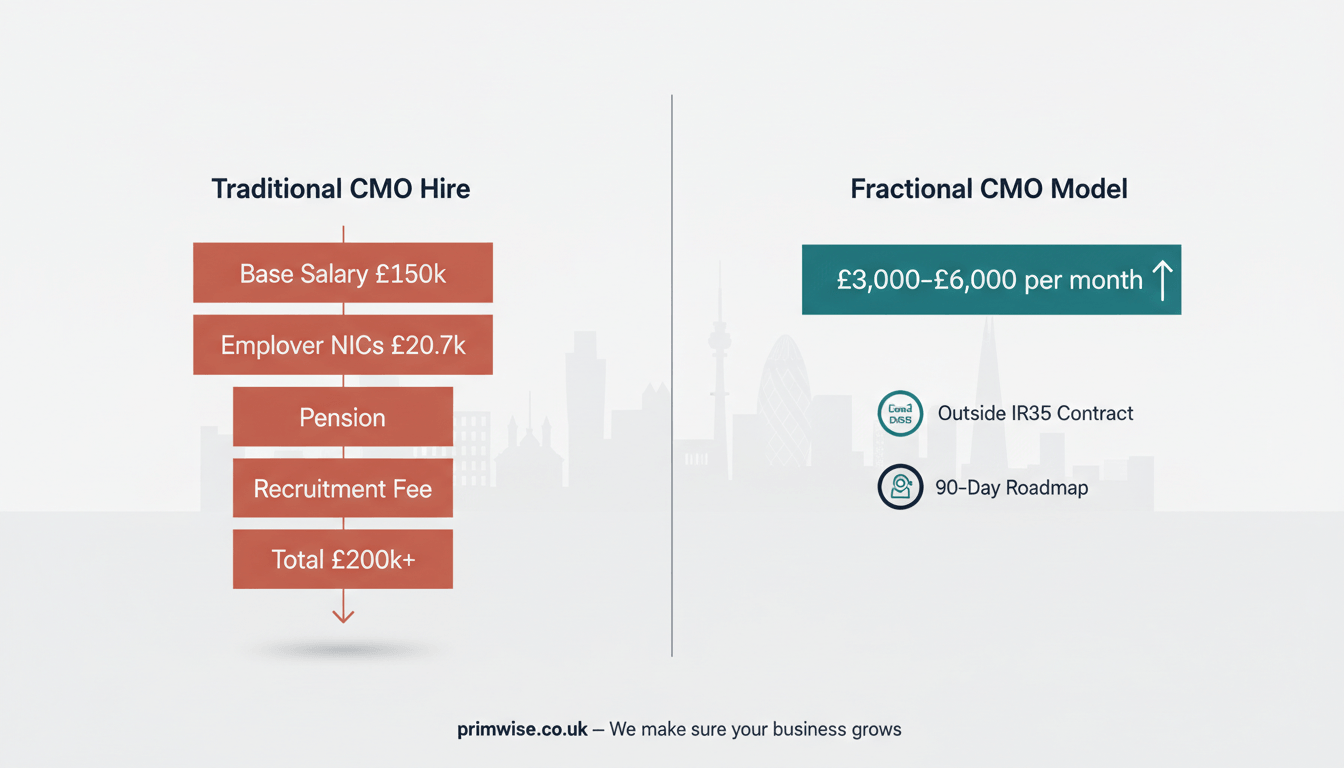
According to the 2025 CIPD Reward Management Survey, the median total compensation package for a UK Chief Marketing Officer in London exceeds £175,000 when employer pension contributions, National Insurance liabilities, and executive search fees are included. A base salary of £150,000 triggers mandatory Employer National Insurance Contributions at 13.8 percent, adding over £20,700 in immediate payroll cost. Add auto-enrolment pension contributions, statutory sick pay liability, performance bonuses, equity participation, and an executive search fee averaging 20–25 percent of first-year salary, and the true annual cost of a permanent PAYE CMO comfortably exceeds £200,000 before a single strategy document is produced. This is a fixed overhead that burns regardless of business performance.
The Cost Efficiency of the Fractional Model
Engaging a Fractional CMO transforms a heavy fixed liability into a flexible operational expense. A typical monthly retainer ranges between £3,000 and £6,000 representing a reduction in fixed marketing leadership overhead of between 60 and 80 percent compared to a permanent hire. For SEIS and EIS-backed businesses where investors scrutinise every line of the management accounts, this model demonstrates exemplary capital allocation while still securing board-level strategic expertise. It lowers customer acquisition cost, reduces burn rate, and accelerates the path to the commercial metrics that unlock Series A conversations. Revenue-based marketing becomes achievable when the leadership cost is proportionate to the revenue stage of the business.
Cost ComparisonA permanent UK CMO costs £200,000+ per year in total employment overhead. A Fractional CMO retainer costs £36,000–£72,000 per year with no NIC liability, no pension obligation, and no redundancy risk.
UK Compliance and IR35
For any UK founder engaging external senior talent, HMRC’s off-payroll working rules are a legitimate concern. Getting this wrong creates retrospective tax liability, interest charges, and reputational risk. Understanding precisely why a compliant fractional engagement sits outside IR35 is not optional it is a governance requirement.
Why True Fractional Engagements Sit Outside IR35
HMRC’s IR35 legislation targets disguised employment situations where an individual performs work that is economically equivalent to employment but routes their income through a limited company to reduce tax. A properly structured fractional engagement fails all three primary IR35 tests. First, the Right of Substitution: a genuine fractional leader can send a suitably qualified substitute to fulfil contractual obligations, which no employer-employee relationship permits. Second, Mutuality of Obligation: there is no obligation on the client to offer ongoing work beyond the agreed strategic deliverables, and no obligation on the fractional leader to accept it. Third, Control: the fractional executive dictates their own working methods, hours, and location, rather than being subject to the direction and supervision of the client’s management structure. HMRC’s own Check Employment Status for Tax (CEST) tool, when applied to a correctly structured fractional contract, will consistently return an outside-IR35 determination. Founders should also note the precedent set in cases such as Christa Ackroyd Media Ltd v HMRC, which reinforced that the substance of the working relationship not merely the contractual wording determines IR35 status.
Moving Beyond the UK Day-Rate Culture
The traditional UK contractor mindset charging for hours logged at a client’s desk, attending daily standups, working under line management supervision is precisely the behaviour that falls inside IR35. Modern B2B scale-ups must shift entirely to outcome-based commercial engagements. A Fractional CMO is compensated for delivering strategic milestones: a completed go-to-market playbook, a defined marketing maturity framework, a revenue operations architecture, or a measurable reduction in cost-per-acquisition. The engagement is governed by deliverables, not timesheets. This distinction protects both parties legally and ensures the business pays for commercial outcomes rather than executive attendance.
IR35 DisclaimerThis content constitutes general guidance only and does not constitute legal or tax advice. Founders should seek qualified IR35 advice from a specialist contractor accountant or employment tax solicitor before engaging any external senior executive.
Signs Your Business Needs a Fractional CMO
Identifying the right inflection point is critical. Engaging too early wastes strategic resource on a business that is not yet ready to execute at scale. Engaging too late means months of revenue lost to uncoordinated tactical activity. The following indicators, drawn from common patterns across the UK SME and scale-up ecosystem, signal that the time for fractional leadership has arrived.
- Marketing spend is increasing but the sales pipeline is stagnant or declining
- The founder is spending more than 30 percent of their week managing junior marketing staff or briefing agencies
- External agencies are producing activity content, campaigns, social but nobody owns the commercial strategy that briefs them
- There are no measurable KPIs connecting marketing output to revenue metrics such as CAC, LTV, or pipeline coverage ratio
- SEIS or EIS investors are questioning marketing spend efficiency and demanding clearer capital allocation reporting
- The business is approaching Series A and the investor deck requires a credible marketing leadership narrative
- The sales team is generating its own leads because marketing is not producing pipeline-ready demand
- Brand positioning is inconsistent across channels and no single executive owns the narrative
The Tactical Overload Trap
The most common trigger for fractional leadership engagement is what practitioners in the UK scale-up ecosystem call tactical overload a high volume of marketing activity that consumes significant budget and resource but generates no measurable commercial progress. Junior marketers and channel agencies may produce an impressive volume of social media posts, blog content, email sequences, and paid campaigns. Yet the sales pipeline remains flat, inbound lead quality deteriorates, and the founder struggles to articulate the return on any of it. This is not an execution failure it is a strategy failure. There is no commercial due diligence layer connecting tactical output to revenue goals, and no one with the seniority to demand it. A Fractional CMO resolves this immediately by establishing marketing attribution modelling, setting pipeline-linked OKRs, and ruthlessly reallocating budget from low-return channels to high-conversion demand generation programmes.
The 90-Day Fractional CMO Integration Matrix
A structured onboarding process is the difference between immediate commercial impact and a slow, expensive ramp. The most effective fractional engagements follow a rigorous three-phase integration framework Assess, Align, Accelerate designed to deliver measurable outcomes within the first quarter.
Month One Commercial Audit and Assessment
The first 30 days are dedicated to forensic discovery. The Fractional CMO conducts a full commercial audit: evaluating existing agency spend and contract terms, reviewing the internal team’s capabilities and capacity, assessing the current marketing technology stack whether HubSpot, Salesforce, or a bespoke CRM and scrutinising the attribution modelling in place to understand which activities are genuinely driving pipeline. This phase also involves qualitative interviews with the sales team, senior leadership, and where appropriate, existing customers, to map the gap between the value the business believes it delivers and the value the market actually perceives. Budget wastage is identified and eliminated. The output of month one is a single Commercial Audit Report that forms the evidence base for all subsequent strategy decisions.
Month Two Strategy Formulation and Alignment
With the audit complete, month two shifts to strategy design. The Fractional CMO develops the bespoke go-to-market strategy for the business’s current revenue stage, refines the corporate value proposition, sharpens brand positioning, and defines the ideal customer profile with the precision required for effective account-based marketing in competitive B2B SaaS or professional services markets. An OKR framework is established for the marketing function, with every objective traceable to a commercial revenue target. The agency roster is reviewed and, where necessary, renegotiated or restructured. The output of month two is the Go-To-Market Playbook a living document that governs all marketing activity for the engagement period and provides the leadership team with the strategic clarity needed for investor reporting and Series A preparation.
Month Three Execution Leadership and Acceleration
Month three marks the transition from strategy to execution leadership. The Fractional CMO assumes full commercial accountability for the marketing function, directing internal team members, holding agencies to the KPIs established in month two, and driving the go-to-market strategy into the market. Demand generation programmes are launched, account-based marketing sequences are activated, and pipeline metrics begin to accumulate. By the end of the 90-day period, the business has a functioning marketing maturity framework, a measurable cost-per-acquisition baseline, and the data infrastructure required to report confidently to investors, boards, and commercial partners. This is not a theoretical model it is the operational architecture that allows a scaling UK business to demonstrate the commercial leadership required for its next growth stage.
A UK Scale-Up Case Study
To illustrate the commercial impact of this model in practice, consider the following representative scenario based on patterns common across the UK B2B SaaS and professional services sectors. A Series A-ready UK SaaS business with twelve employees, two junior marketers, and three agency relationships was spending approximately £28,000 per month on marketing with no formal attribution framework and a deteriorating cost-per-acquisition. The founding team was allocating 35 percent of their combined executive time to marketing management, diverting focus from product development and investor relations.
Six months after engaging a Fractional CMO on a £5,000 per month retainer, the business had consolidated its agency spend by 22 percent, implemented a full HubSpot revenue operations architecture, and reduced its blended cost-per-acquisition by 34 percent. Inbound pipeline coverage ratio improved from 0.8x to 2.4x of quarterly revenue target. The founding team reclaimed an estimated 28 hours per week of executive time. The total cost of the fractional engagement over six months was £30,000 approximately 15 percent of what a permanent CMO hire would have cost for the same period, inclusive of recruitment fees. This scenario is illustrative and based on composite outcomes; individual results will vary based on business stage, market, and execution quality.
Illustrative OutcomesThis case study is a composite illustration based on patterns common across UK B2B scale-up engagements. It is not a guarantee of specific results. Outcomes will vary based on business stage, sector, and execution quality.
How PrimeWise Delivers Fractional CMO Engagements
PrimeWise structures its fractional CMO engagements as fully compliant B2B retainers, designed specifically for SEIS and EIS-backed scale-ups, established SMEs whose revenue has plateaued, and businesses preparing for Series A fundraising. Every engagement is governed by strategic deliverables not timesheets ensuring strict outside-IR35 compliance while guaranteeing that the business pays for measurable commercial outcomes. The 90-Day Integration Matrix described above is the operational framework applied from day one of every PrimeWise engagement, providing founders and boards with immediate visibility of progress, clear KPIs, and a commercial leadership structure that investors can scrutinise with confidence.
If your business has reached the point where marketing activity is no longer translating into pipeline growth or where the cost of senior talent is constraining your ability to scale the fractional model is worth a direct conversation. Explore how PrimeWise’s Fractional CMO service works and find out whether your business is at the right stage for fractional leadership.