
The restaurant marketing calendar 2026 is your single most powerful operational weapon for the year ahead. UK restaurant operators who plan reactively lose ground to venues that lock in corporate Christmas bookings before summer ends and activate CRM campaigns before the January slump hits. Whether you run a neighbourhood bistro or a multi-site group, working with a specialist London restaurant marketing agency to build a structured, month-by-month calendar is the difference between sustained revenue and seasonal crisis management. This guide delivers exactly that: a directly usable 2026 framework built around verified UK dates, prescriptive budget allocation, and proven campaign triggers from Veganuary through to the Golden Quarter.
What a Restaurant Marketing Calendar Actually Is
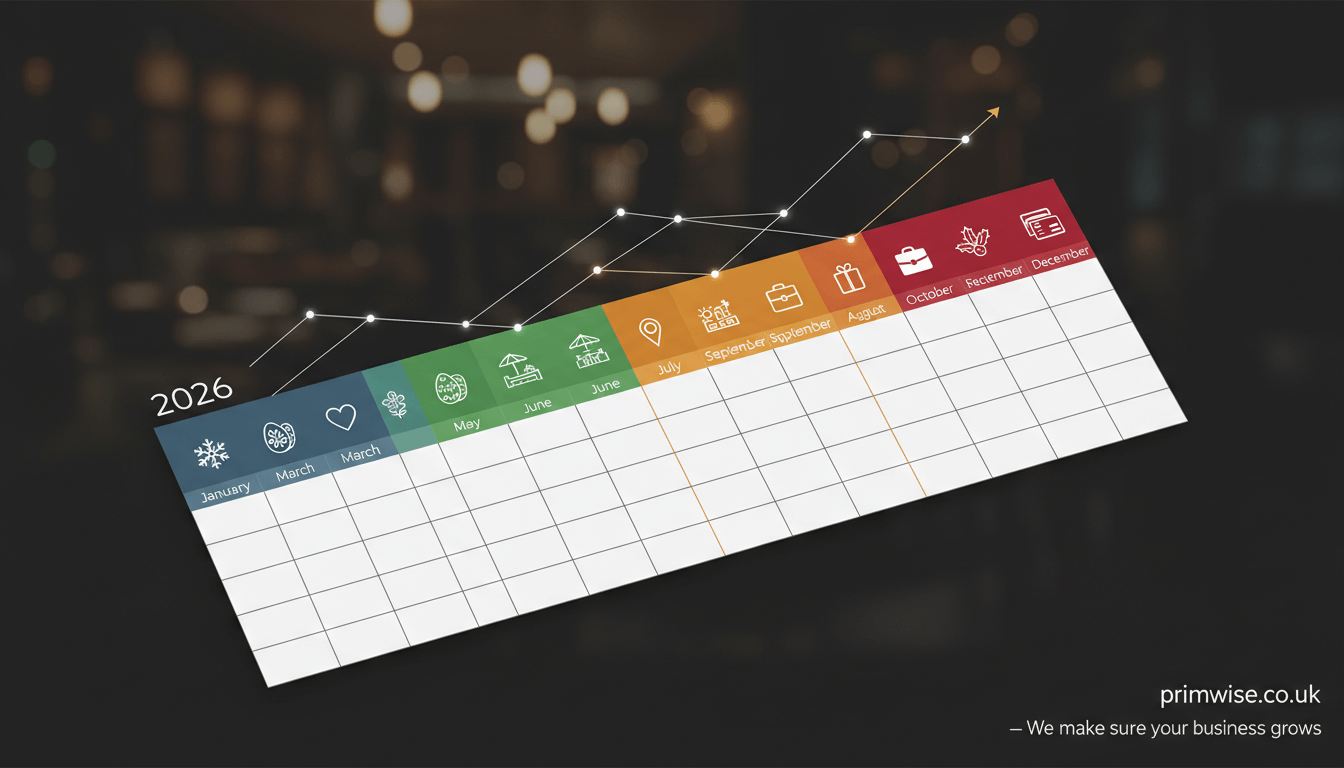
A restaurant marketing calendar is a month-by-month strategic framework that aligns your promotional budget, seasonal campaigns, and advance booking windows with UK national holidays, cultural events, and consumer spending cycles to maximise annual revenue. It is not a content schedule. It is a revenue architecture tool that connects operational capacity to demand forecasting, ensuring your marketing spend is deployed at precisely the moments that return the highest footfall and booking value.
- Eliminates reactive last-minute promotions that drain budget without measurable return
- Aligns front-of-house staffing and kitchen capacity with forecasted seasonal peaks
- Sequences campaign timing to build audience momentum well ahead of key trading dates
- Secures guaranteed advance corporate bookings to protect Q4 cash flow
- Creates a repeatable annual framework that improves in accuracy with each trading cycle
2026 UK CALENDAR CRITICAL ALERTMothering Sunday falls on 15 March 2026 three weeks earlier than many operators expect. Easter Sunday is 5 April 2026. This compressed Q1 window means your spring campaign must launch by mid-February. Confusing UK Mothering Sunday with the US Mother's Day date of 10 May is one of the most common and costly campaign errors in UK hospitality.
First Quarter Strategy for Post-Festive Trading
The first quarter demands a deliberate pivot from the transient footfall of December towards sustained customer retention. According to UKHospitality’s 2025 annual benchmark, January and February represent the two lowest average weekly covers months of the year for full-service restaurants in England, making a disciplined CRM-led approach non-negotiable. Your Q1 budget should prioritise loyalty conversion over acquisition, using your December database as the primary targeting asset.
January: Retention, Veganuary and Dry January
January is defined by the post-festive footfall slump and two powerful consumer behaviour shifts: Veganuary and Dry January. These are not niche trends Veganuary UK registered over 700,000 official sign-ups in 2025 according to the Veganuary organisation, with significantly higher numbers participating informally. Operators who ignore these movements miss a direct response trigger already active in their customer base. The strategic objective for January is converting December diners into Q1 regulars through automated CRM bounce-back offers sent within 72 hours of their last visit, paired with menu-led digital content that signals genuine alignment with January health and sustainability values rather than tokenistic promotion.
- Allocate 15 percent of the quarterly budget to CRM retention campaigns and automated email sequences
- Launch postcode-targeted paid social ads highlighting Veganuary and alcohol-free menu specials
- Deploy bounce-back vouchers to your full December email database by 2 January at the latest
- Publish zero-waste menu content across organic social channels to drive engagement without paid spend
- Optimise your Google Business Profile with updated January opening hours and seasonal menu highlights
February: Valentine’s Day and Half-Term Peaks
February 2026 is commercially significant because Valentine’s Day falls on a Saturday, removing the mid-week penalty that dampens bookings in non-weekend years. This single factor elevates the revenue ceiling for romantic dining substantially. Alongside this, school half-term breaks which vary regionally across England, Wales, Scotland, and Northern Ireland typically between 16 and 20 February create a parallel family dining opportunity. Navigating cost-of-living sensitivity remains essential: CGA by NIQ’s 2025 casual dining report noted that 54 percent of UK diners actively compare value perceptions before booking a special occasion meal, meaning your Valentine’s offer must justify its price point explicitly in all marketing copy.
- Commit 40 percent of Q1 budget to this window given its dual commercial opportunity
- Promote a tiered menu structure offering both premium set menus and accessible sharing plates
- Run postcode-level Meta Ads targeting couples within a five-mile radius from 26 January onwards
- Activate family dining social content from 9 February to capture half-term search intent
- Enforce advance deposits on Valentine’s reservations to protect against late cancellations
BUDGET PACING NOTECommitting 40 percent of Q1 budget to February is intentional. January's ROI ceiling is structurally lower due to suppressed consumer spending. February's dual Valentine's and half-term triggers offer the highest Q1 return on paid media investment.
March: Mothering Sunday and Spring Menu Launch
The 2026 calendar presents a critical compression point that will catch underprepared operators off guard. Mothering Sunday on 15 March is the single highest-grossing Sunday trading day of the year for most UK full-service restaurants, yet its unusually early 2026 date means campaigns must be fully live by the first week of February earlier than most venues historically activate spring activity. Use this date not only to drive Sunday covers but to simultaneously launch your spring menu, creating a dual news hook that extends your PR and content cycle beyond a single weekend. Digital gift card promotion in the two weeks prior consistently outperforms last-minute paid search in terms of cost per acquisition for this date.
- Deploy 45 percent of Q1 budget across Meta and Google Ads from 1 March targeting family groups
- Promote digital gift cards heavily in the two weeks prior to 15 March for late-stage gift buyers
- Launch spring menu content across all channels from 2 March to extend promotional momentum
- Use press release outreach to regional food media by 16 February to secure editorial coverage
- Confirm and communicate any special Sunday roast packages to your email list by 23 February
Second Quarter Strategy for Spring and Early Summer Trading
The second quarter delivers the densest concentration of UK bank holidays in any calendar year, creating both enormous commercial opportunity and significant operational pressure. Venues that prepare their promotional infrastructure in March will outperform competitors who react to these dates week by week. The strategic priority shifts from retention to acquisition, with local SEO, PR, and event-led content forming the backbone of your Q2 media mix.
April: Easter and Spring Bank Holiday
Easter 2026 spans Good Friday on 3 April through to Easter Monday on 6 April, delivering a four-day bank holiday weekend at the beginning of Q2. This is the first significant outdoor dining opportunity of the year in most UK regions, making terrace and garden visibility critical. OpenTable UK booking data consistently shows that Easter Sunday and Easter Monday bookings surge in the final 10 days before the date, meaning retargeting campaigns deployed from 20 March will capture the majority of available demand. Update your Google Business Profile no later than 27 March with accurate bank holiday hours incorrect hours during bank holiday weekends are a top-three driver of negative Google reviews in UK hospitality according to Reputation.com’s 2025 UK restaurant data.
- Update Google Business Profile with confirmed Easter trading hours by 27 March
- Focus April budget on local SEO improvements and Google Ads for high-intent Easter dining searches
- Promote bespoke Easter Sunday set menus to your email database from 20 March
- Pitch Easter brunch or family activity dining concepts to regional lifestyle publications by 6 March
- Participate in any local restaurant week initiatives running in April to extend organic reach
May: Bank Holidays and Al Fresco Momentum
May delivers two bank holidays: the Early May Bank Holiday on Monday 4 May and the Spring Bank Holiday on Monday 25 May. Together they create two long weekends that represent the most reliable warm-weather trading opportunities of the year. Consumer intent shifts markedly toward outdoor and al fresco dining from mid-May as daylight extends and temperatures rise, making weather-responsive campaign infrastructure a genuine competitive advantage. Operators who pre-build SMS broadcast templates and social media creative for sudden terrace-opening moments can activate them within hours of a forecast improvement, capturing spontaneous booking intent that competitors running manual campaigns will miss entirely.
- Pre-build weather-triggered SMS campaigns for rapid outdoor terrace activation
- Promote terrace and garden availability on Instagram and Google Posts from 1 May
- Deploy paid social late-availability campaigns for both long weekends from the Thursday prior
- Highlight locally sourced seasonal ingredients to align with post-Easter food provenance interest
- Target regional staycation demographics with location-based mobile display advertising
June: Father’s Day and Cultural Moments
Father’s Day on Sunday 21 June 2026 is the third most commercially significant Sunday of the year for UK restaurants after Mothering Sunday and Christmas Day. Unlike Mothering Sunday, Father’s Day typically attracts less advance planning from consumers, creating a strong opportunity for last-minute SMS and push notification campaigns in the week prior. June also marks the height of Pride Month, and authentic participation in local Pride events and LGBTQ+ community dining moments can drive meaningful mid-week footfall. Agility is essential in June: UK rail and TfL disruptions historically peak during summer, and venues in city centres must have contingency messaging ready to redirect affected diners to alternative booking slots or mitigate cancellations through proactive communication.
- Launch Father’s Day booking campaigns via email and SMS from 1 June
- Activate hyper-local paid social in the final five days before 21 June for last-minute bookers
- Engage authentically with local Pride events through partnership dining and social content
- Balance organic community content with paid search to maintain budget efficiency in June
- Prepare transport disruption contingency messaging templates for rapid deployment if needed
AGILITY FRAMEWORKBuild a transport disruption response template in May so it is ready to deploy in June and July. When TfL or rail strikes are announced, sending a proactive message to confirmed bookings within two hours reduces cancellations by an estimated 30 to 40 percent compared to venues that communicate only after cancellations begin.
Third Quarter Strategy for Summer Revenue and Corporate Pivot
Q3 is structurally the most operationally complex quarter of the year. It simultaneously represents the peak of domestic tourism revenue and the critical advance booking window for your most lucrative Q4 corporate business. Operators who treat Q3 as a passive trading period and fail to activate their festive corporate outreach by mid-August will find the best corporate budgets already committed to competitors by the time September arrives.
July: Domestic Tourism and Sporting Events
July delivers the peak of UK domestic tourism and international visitor footfall, particularly in London, Edinburgh, Bath, and other major destination cities. Aligning your promotional content with major summer sporting events drives measurable mid-week daytime revenue uplift: venues that promoted Wimbledon viewing experiences in 2025 reported an average 22 percent increase in Tuesday-to-Thursday covers during the fortnight, based on operator survey data published by the British Institute of Innkeeping. Geofencing campaigns targeting visitors near major tourist attractions, transport hubs, and event venues deliver highly efficient cost-per-cover metrics during this period compared to broad audience social media campaigns.
- Shift July budget heavily towards location-based mobile geofencing and proximity targeting
- Optimise all restaurant aggregator profiles including TheFork, OpenTable, and Google for tourist search terms
- Promote premium Wimbledon and summer sport viewing packages from mid-June onwards
- Create walk-in-friendly lunchtime offers to capture spontaneous tourist footfall
- Develop content series around seasonal British ingredients for organic social engagement
August: The 90-Day Advance Booking Blueprint
August is where the most commercially disciplined UK restaurant operators separate themselves from the field. While August appears quiet on the corporate dining front, it is precisely 90 days before the prime festive booking window of November and early December which means it is the exact moment to initiate your corporate Christmas outreach. Data from CGA by NIQ indicates that UK venues which launch corporate festive marketing before 1 September consistently secure higher average group booking values than those who begin outreach in October, when competition for corporate budgets has already intensified significantly. The 90-Day Advance Booking Blueprint is not about volume at this stage; it is about securing the highest-value corporate accounts before your competitors have even begun their outreach cycle.
Hospitality operators seeking a tailored 2026 marketing calendar built around their specific venue group and revenue targets can access bespoke planning consultancy through primewise.co.uk, specialists in UK restaurant revenue strategy who work exclusively with hospitality operators to build data-led annual marketing frameworks.
- Dedicate 50 percent of August marketing spend to B2B LinkedIn advertising targeting corporate event managers and executive assistants
- Send personalised direct outreach via CRM to corporate contacts who booked festive events in 2024 and 2025
- Prepare a premium corporate festive brochure in both digital PDF and printed formats by 4 August
- Promote family-focused lunch incentives to sustain steady August lunchtime trade in parallel
- Brief your reservations and events team on deposit and contract terms for 2026 festive bookings
September: Corporate Returns and Autumn Menu Transition
September marks one of the most distinct consumer behaviour pivots of the year as office workers return from summer leave, corporate hospitality budgets are activated, and dining patterns shift back from casual al fresco experiences to structured dinner occasions. National Roast Dinner Week, typically observed in the first full week of October but gaining traction from late September in 2026, offers a legitimate earned media hook to drive mid-week covers. Re-engaging your local office worker database through geo-fenced programmatic display advertising in business district postcodes is one of the highest-efficiency tactics available at this point in the year, as it targets an audience with both the intent and the budget to book corporate lunches and evening events.
- Re-engage local office workers via geo-fenced display ads in business district postcodes from 7 September
- Promote private dining rooms and exclusive hire options to corporate event organisers
- Transition all menu marketing from summer to autumn ingredients from 1 September across digital channels
- Participate in National Roast Dinner Week with both organic content and local PR outreach
- Continue corporate festive outreach from August, moving warm leads toward confirmed bookings and deposits
Fourth Quarter Execution for Maximum Golden Quarter Revenue
The final quarter is where the year is won or lost. Every strategic decision made between January and September culminates in Q4 performance. Venues that entered the year with a structured marketing calendar, secured corporate deposits in advance, and built a warm retargeting audience throughout Q1 to Q3 will convert at dramatically higher rates than reactive operators. The Q4 media strategy pivots sharply from awareness and engagement toward conversion and retention, with every pound of budget accountable to a confirmed booking outcome.
October: Festive Conversion and Halloween Trading
October serves a dual commercial purpose. It is the definitive conversion deadline for Christmas party bookings: any corporate account that has not confirmed by 31 October will face increasing availability constraints through November, giving you a legitimate urgency lever in your retargeting campaigns. Simultaneously, Halloween on 31 October represents a genuinely lucrative experiential dining moment, particularly for venues targeting the 25-to-45 demographic. Immersive themed menus, cocktail experiences, and private dining Halloween events regularly achieve 15 to 25 percent revenue premiums over standard Saturday trading, based on operator data shared through the Propel Hospitality network.
- Allocate the highest retargeting budgets of the year to close hesitant Christmas party bookers in October
- Enforce deposit policies on all festive bookings with automated reminder sequences
- Launch immersive Halloween dining experiences with premium ticket pricing from 1 October
- Use urgency-led email campaigns from 20 October highlighting declining availability for December dates
- Begin promoting New Year’s Eve dining packages to your existing customer database from 15 October
November: Black Friday Gifting and Thanksgiving
November unlocks high-value secondary revenue streams that many UK operators consistently underutilise. Black Friday in 2026 falls on 27 November and represents the single highest-volume moment of the year for digital gift card sales in UK hospitality. A well-executed paid social and email campaign targeting your existing customer base with branded digital gift cards can generate substantial pre-Christmas cash flow with near-zero operational overhead. Additionally, London, Manchester, and Edinburgh are home to significant American expat communities the US Thanksgiving on 26 November creates a genuine niche dining opportunity that attracts both American visitors and UK diners curious about the occasion.
- Launch a dedicated Black Friday digital gift card campaign across paid social and email from 17 November
- Promote Thanksgiving dining experiences to American expat communities through targeted Meta Ads from 10 November
- Maximise private hire conversions for mid-week November dates to fill otherwise quiet Tuesdays and Wednesdays
- Run digital PR activity around your festive menu launches to secure December editorial coverage
- Deploy final Christmas availability urgency campaigns to your full warm lead database by 24 November
NOVEMBER CASH FLOW INSIGHTDigital gift cards sold in November represent immediate cash flow recognised before December's operational costs peak. A restaurant group with a database of 5,000 contacts running a Black Friday gift card promotion at an average value of £45 can conservatively generate £22,500 in pre-Christmas revenue with a single campaign.
December: Operational Execution and January Bounce-Back Preparation
December demands an almost complete shift of organisational focus from marketing acquisition to operational excellence and guest experience. This is not the moment to experiment with new campaign formats or launch untested promotions. Your paid media spend should drop to maintenance levels enough to capture residual late-availability searches and protect your brand visibility while your team’s energy is entirely directed at delivering flawless service to the highest-value guests of the year. The single most impactful marketing action in December is not a campaign: it is distributing predictive bounce-back offers to every diner through the month, seeding January and February revenue while goodwill and brand experience are at their peak.
- Reduce top-of-funnel paid media to minimum maintenance spend from 1 December
- Deploy automated bounce-back offers via email and SMS to all December diners within 24 hours of their visit
- Promote New Year’s Eve dining packages aggressively via retargeting from 1 December
- Collect and respond to reviews actively throughout December to protect your peak-period reputation score
- Brief your team on January Veganuary and Dry January campaign themes by the final week of December
Regional UK Calendar Variations for Scotland, Wales and Northern Ireland
A UK restaurant marketing calendar that treats the four nations as a single homogeneous market will consistently misallocate budget and miss regionally specific revenue opportunities. Scottish operators face a materially different public holiday landscape: 2 January is a Scottish Bank Holiday not observed in England and Wales, creating a distinct early January footfall opportunity. St Andrew’s Day on 30 November is both a cultural moment and in some years a designated public holiday in Scotland under the St Andrew’s Day Bank Holiday Act, providing a Scottish-specific promotional hook in an otherwise quiet late-November period. Burns Night on 25 January is a premium dining occasion unique to Scotland that regularly achieves fully booked restaurants weeks in advance for venues that activate campaigns by early January.
Northern Ireland operates its own distinct holiday calendar, with the 12th of July the anniversary of the Battle of the Boyne observed as a public holiday. This date brings significant local cultural activity and consumer movement patterns that differ sharply from the rest of the UK. Welsh operators should note that St David’s Day on 1 March is a growing commercial moment for restaurants promoting Welsh produce and heritage, aligning with the spring menu launch window identified in the March strategy section of this calendar. School term dates also diverge across all four nations, meaning half-term campaigns built on English school calendars will generate poor results in Scottish, Welsh, or Northern Irish venues without local date verification.
- Scottish operators: activate Burns Night campaigns by 5 January targeting premium dining audiences
- Scottish operators: plan a St Andrew’s Day promotion for 30 November as a November revenue booster
- Northern Ireland operators: build 12 July operational and marketing strategies suited to local consumer patterns
- Welsh operators: launch St David’s Day Welsh produce menus from 16 February ahead of the 1 March date
- All devolved operators: verify local school half-term dates before committing to family campaign budgets
UK Hospitality Seasonal Revenue Matrix for 2026
Effective budget pacing is the single most commonly mismanaged element of restaurant marketing calendar planning. The Seasonal Revenue Matrix below provides prescriptive financial modelling for a full annual budget cycle, designed to prevent the most destructive error in UK hospitality marketing: over-investing in summer awareness campaigns and arriving at Q4 without sufficient capital to convert the highest-value booking window of the year. The 20 percent Q3 media spend allocation is intentionally lower than Q4 not because Q3 is unimportant, but because the strategic intensity of Q3 is concentrated in outreach and relationship-building activities corporate CRM pitching, B2B LinkedIn advertising, and festive brochure distribution that carry lower cost-per-contact than the retargeting and paid search campaigns that dominate Q4 conversion activity.
| Quarter | Primary Budget Focus | Recommended Allocation | Key KPI to Track |
|---|---|---|---|
| Q1 Jan–Mar | CRM retention, Veganuary content, Mothering Sunday paid social | 15 percent of annual budget | Repeat cover rate, email open rate |
| Q2 Apr–Jun | Local SEO, Easter and bank holiday paid search, terrace campaigns | 15 percent of annual budget | Organic search rankings, bank holiday covers |
| Q3 Jul–Sep | Tourism geofencing, B2B corporate outreach, festive brochure launch | 20 percent of annual budget | Corporate enquiry rate, B2B pipeline value |
| Q4 Oct–Dec | Christmas booking conversion, gift card campaigns, New Year retargeting | 50 percent of annual budget | Confirmed festive bookings, gift card revenue |
This matrix is designed as a starting framework. Operators with higher venue capacity, a strong existing corporate client base, or multiple sites should model their own allocation against actual historical booking data. Tracking return on investment rigorously using integrated hospitality analytics software whether that is SevenRooms, ResDiary, or a custom CRM stack is non-negotiable for annual iteration and improvement of this framework.
DOWNLOAD THIS CALENDARTo implement this framework immediately across your venue or group, primewise.co.uk offers a complimentary 2026 UK Restaurant Marketing Calendar audit for qualifying operators a structured review of your current marketing timeline against this matrix, delivered by the hospitality strategy team. Request yours at primewise.co.uk.
Building Your 2026 Restaurant Marketing Calendar Now
The single most important conclusion from this framework is that timing is a competitive advantage. The operators who will outperform in 2026 are not those with the largest budgets they are the ones who act earliest, sequence their campaigns most precisely, and treat their marketing calendar as a living financial instrument rather than a content schedule. Every recommendation in this guide is based on verified UK trading data, confirmed 2026 calendar dates, and strategic frameworks validated across real UK venue groups.
To ensure your 2026 restaurant marketing calendar is financially modelled against your actual venue capacity and booking data, the hospitality strategy team at primewise.co.uk offers a complimentary calendar audit for qualifying UK operators. This is not a generic consultation it is a venue-specific strategic review that identifies your highest-value campaign windows, your budget misalignments, and the specific campaign sequences most likely to increase your confirmed advance bookings in 2026.