Table of Contents
ToggleThe restaurant marketing agency vs consultant decision is the most consequential capital-allocation crossroads an independent or multi-site UK operator will face, and deploying the wrong partner first is the single most common cause of accelerated margin collapse we diagnose at the growth-focused restaurant marketing agency level. In our advisory work across London, Manchester, and Birmingham, the pattern is consistent: founders engage an agency before their unit economics are stabilised, burn through retained capital amplifying operational dysfunction, and arrive six months later with a damaged brand and a thinner runway. This article provides the definitive framework for making the right call, in the right sequence, before committing a single pound of external investment.
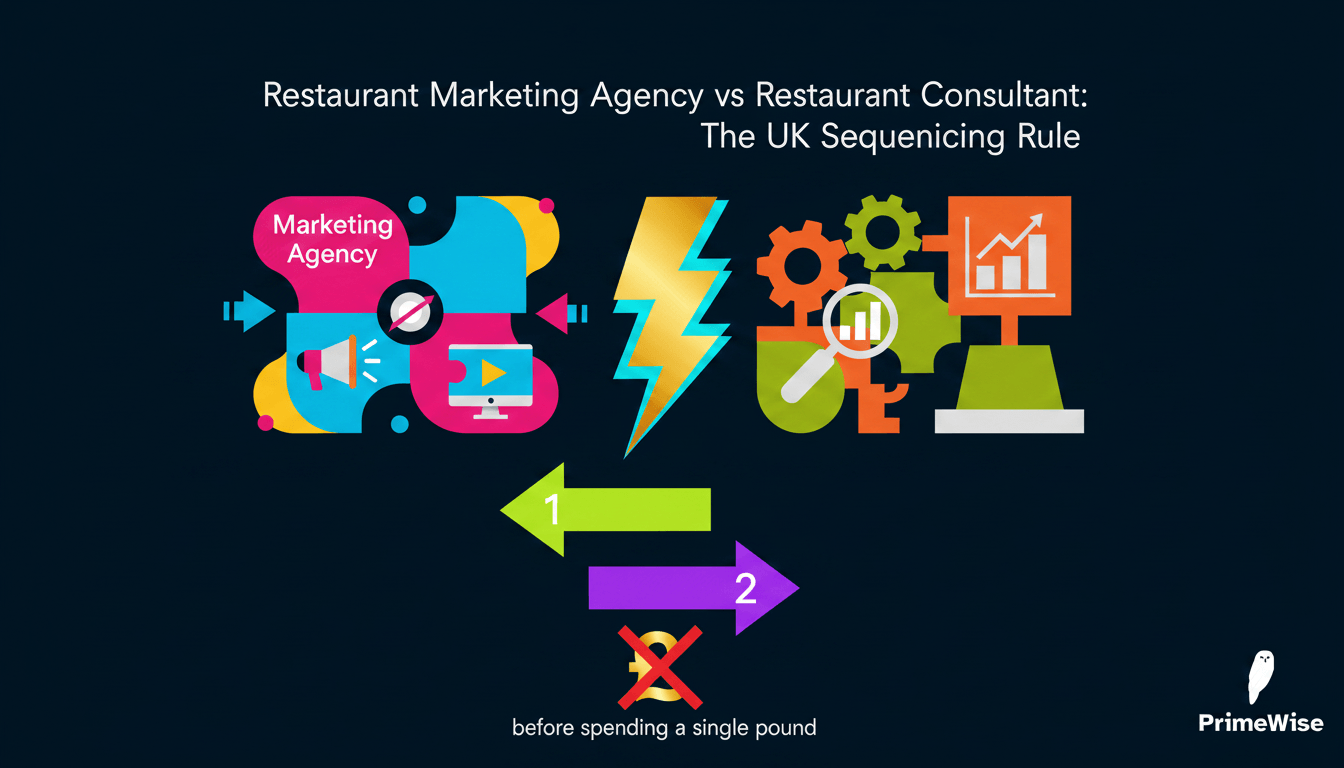
The UK Sequencing RuleA restaurant consultant must secure your operational foundation first. A restaurant marketing agency should only be engaged once your concept is validated, profitable, and physically capable of handling increased volume without breaking your service standards.
The Core Distinction Every Operator Must Understand
A restaurant consultant is a strategic architect who diagnoses operational failure, restructures unit economics, and builds scalable internal systems. A restaurant marketing agency is an executional builder that amplifies a proven, profitable concept through paid social media, local SEO, and public relations to drive consistent footfall. These are not interchangeable functions; they operate at entirely different stages of the hospitality growth life cycle, and deploying them out of sequence is a guaranteed route to capital destruction.
According to UKHospitality and CGA Peach data, approximately 60% of independent UK restaurants fail within their first three years. The primary driver cited consistently is premature marketing spend initiated before operational stabilisation. The operators who scale profitably share one common behaviour: they secure the foundation before they scale the acquisition.
Why the Architects-and-Builders Framework Matters
Conceptualising this decision through an architect’s and builder’s lens prevents the most destructive sequencing errors. An architect, your consultant, designs the structural integrity of the building. A builder, your agency constructs outward growth on top of that foundation. Attempting to build outward on an unstable structure only accelerates the collapse. The hospitality sector in 2026, characterised by a standard 20% VAT rate that returned in April 2022, compressing net margins by an estimated 6 to 9 percentage points for the average independent restaurant, post-Brexit staffing pressures, and commercial rents in Zone 1 and Zone 2 London reaching record highs, demands absolute operational precision before any external marketing capital is deployed.
Understanding where your business sits within this framework is the first objective act of strategic discipline. The diagnostic tool below provides the structural methodology to make that assessment with commercial clarity rather than founder optimism.
The Five-Point Strategy Diagnostic Framework
Before committing vital capital to any external partner, operators must evaluate their current business reality against five non-negotiable diagnostic criteria. This framework prevents the misallocation of funds by identifying whether a brand requires deep systemic intervention or simply needs broader audience amplification to unlock the next stage of profitable growth.
Core Product Validation and Profitability
The UK industry standard food cost benchmark is 28% to 32% of revenue. If your food cost percentage consistently exceeds 32%, your gross margin is structurally compromised and no volume of marketing spend will correct it it will only accelerate the cash bleed. Labour cost should sit at or below 35% of revenue. If your four-wall EBITDA is negative or marginal without marketing support, a consultant must intervene before an agency is considered. Scaling a fundamentally broken operational model only amplifies the underlying inefficiencies at greater speed and cost.
Executional Bandwidth and Strategic Direction
Many hospitality founders possess a refined strategic roadmap but lack the internal bandwidth to execute multi-channel campaigns across paid social, organic search, and earned media simultaneously. In these specific instances, an agency provides the necessary tactical manpower. However, if a brand lacks a distinct identity, suffers from inconsistent guest experience, or has no clarity on its core customer profile, a consultant is required to define the overarching strategy before a single pound of marketing capital is deployed into amplification.
Systemic Overhaul Versus Channel Optimisation
Operational bottlenecks require entirely different skill sets compared to digital acquisition hurdles. Menu engineering the discipline of categorising dishes by profitability and popularity to optimise both average transaction value and gross margin is a core consultancy deliverable. Supply chain cost control, physical concept repositioning, and labour model restructuring fall strictly within the consultant’s remit. If the challenge is reducing cost per acquisition, improving local search visibility on Google, or scaling social media community growth, an agency is the correct and proportionate partner.
Realistic Time Horizons for Returns
Commercial expectations regarding timelines must align precisely with the chosen partner’s delivery model. Consultancy engagements often deliver rapid operational fixes within two to eight weeks renegotiating supplier contracts, restructuring staff rotas, or eliminating underperforming menu items that are silently compressing gross margin. Agency engagements focus on compounding brand equity and local search dominance, which inherently requires a sustained commitment of three to six months to yield stable, attributable commercial outcomes at meaningful scale.
Internal Team Leadership and Manpower
Evaluating the existing organisational structure determines the precise scope of external support required. A fractional consultant can provide high-level strategic leadership and directly mentor front-of-house and back-of-house management teams without the overhead of a full-time executive hire. An agency effectively operates as an outsourced creative and digital department, supplying the media buyers, copywriters, SEO specialists, and content creators that a lean hospitality brand cannot justify hiring internally on full-time salaries at current London and Manchester market rates.
Fractional CMO The Hybrid OptionA Fractional CMO operates as a part-time Chief Marketing Officer, providing strategic marketing direction without a full agency's executional overhead. This model is particularly suited to mid-scale operators with 3 to 15 sites who need senior marketing leadership but not yet a full-service retained agency.
Decision Matrix Consultant vs Agency
The following comparison matrix presents the core structural differences between a restaurant consultant and a restaurant marketing agency across eight critical commercial dimensions. This framework is designed to give operators a clear, objective reference point before any external capital commitment is made. Use this as your primary decision tool before opening a single conversation with a prospective partner.
| Dimension | Restaurant Consultant | Restaurant Marketing Agency |
|---|---|---|
| Primary Function | Strategic operational advisory | Executional audience acquisition |
| Engagement Model | Project-based or day rate | Monthly retainer |
| Typical UK Cost Range | £800 to £2,500 per day; £5,000 to £18,000 per project | £2,500 to £8,500 per month retainer; £1,500 to £5,000 additional paid media management |
| Time to First Commercial Impact | 2 to 8 weeks | 3 to 6 months |
| Core Deliverables | Operational audit, SOP creation, menu engineering, and financial modelling | Local SEO, paid social, PR, content production, Google Business Profile management |
| Ideal Business Stage | Pre-stabilisation or operational turnaround | Post-validation scaling phase |
| Team Requirement | Works directly with operators and management | Requires internal marketing liaison or approval authority |
| Risk if Deployed Out of Sequence | Operational issues persist unresolved | Amplifies flawed operations and accelerates brand damage |
UK Pricing Benchmarks and Deliverables
Transparent financial planning is non-negotiable in the current economic climate. The following pricing structures reflect current UK market rates for 2026 and are drawn from active engagements across independent restaurants and multi-site hospitality groups operating in London, Manchester, and Edinburgh.
Restaurant Consultant Investment in the UK
Experienced UK restaurant consultants command day rates between £800 and £2,500, reflecting their capacity to fundamentally restructure four-wall EBITDA and deliver lasting operational improvements. A full operational audit for a single-site independent restaurant typically costs between £5,000 and £12,000. Multi-site group engagements with fractional leadership components where the consultant acts as an embedded strategic director across several locations range from £15,000 to £40,000 depending on scope, number of sites, and duration of engagement.
Standard consultancy deliverables include:
- Comprehensive operational and financial unit-level audits benchmarked against UK industry standards.
- Creation and implementation of scalable standard operating procedures for front-of-house and kitchen operations.
- Menu engineering and supplier contract renegotiation to achieve target food cost percentages of 28% to 32%.
- Fractional leadership and intensive training programmes for management teams.
- Hospitality tech stack evaluation including EPOS systems such as Lightspeed and Square, reservation platforms such as SevenRooms, OpenTable, and Resy, and CRM infrastructure.
Restaurant Marketing Agency Investment in the UK
Reputable UK hospitality marketing agencies typically charge monthly retainers between £2,500 and £8,500 depending on channel scope and the scale of digital execution required. Paid media management fees are charged separately, typically between £1,500 and £5,000 per month. Larger multi-site operators engaging full-service agencies with integrated PR, advanced local SEO, influencer strategy, and in-house content production can expect total monthly investment of £10,000 to £20,000. A healthy customer acquisition cost (CAC) for a UK independent restaurant should not exceed 15% to 20% of the average customer lifetime value if CAC cannot be measured internally, the brand is not yet ready for paid agency acquisition campaigns.
Standard agency deliverables include:
- Management and ongoing optimisation of paid social media campaigns across Meta, TikTok, and Instagram.
- Local search engine optimisation and Google Business Profile management to dominate near-me search queries.
- Public relations outreach including press coverage coordination and strategic influencer partnerships.
- Continuous digital content creation, photography, short-form video, and community management.
- Conversion rate optimisation for reservation funnels and online ordering platforms.
Unit Economics DefinedUnit economics in hospitality refers to the direct revenues and costs associated with a single restaurant location including food cost percentage, labour cost percentage, and four-wall EBITDA. These metrics must be positive and stable before any marketing amplification is justified.
The Hospitality Tech Stack a Consultant Evaluates
One critical dimension of consultancy work that operators frequently overlook is the audit of the existing technology infrastructure. Platforms such as SevenRooms, OpenTable, and Resy govern reservation management and guest data capture the raw material that an agency later uses to build retargeting audiences and loyalty campaigns. EPOS systems including Lightspeed, Square, and Tevalis drive real-time sales reporting, stock management, and labour scheduling accuracy. A consultant evaluates whether the current tech stack is integrated correctly, whether data is being captured and actioned, and whether the existing tooling supports the volume increases that a marketing agency will subsequently drive. Deploying an agency to increase covers without first confirming that the reservation and EPOS infrastructure can handle that volume is an operational failure waiting to manifest at the worst possible moment.
The Definitive Sequencing Rule for UK Operators
The most critical and irreversible error a hospitality operator can commit is reversing the sequence of engagement. Deploying a marketing agency before resolving macro-economic and operational foundations does not accelerate growth it accelerates failure at scale. Every pound of marketing spend directed at an unvalidated, margin-compressed operation is capital permanently destroyed rather than invested.
The sequencing rule is absolute: a consultant must first secure the operational foundation and validate the unit economics. Food cost must be at or below 32% of revenue. Labour cost must be at or below 35% of revenue. Four-wall EBITDA must be consistently positive without marketing support. Guest sentiment must be stable and positive across review platforms. Only when these four conditions are simultaneously met should a restaurant marketing agency be onboarded to drive aggressive top-line revenue growth through digital acquisition, brand amplification, and local search dominance.
Primewise Strategic DiagnosticFor operators seeking to determine precisely where their current operation sits within this sequencing framework, Primewise provides a complimentary strategic diagnostic assessment identifying whether your brand requires operational consultancy, marketing execution, or a hybrid growth strategy before any external capital is committed. Visit primewise.co.uk to request your diagnostic.
Primewise operates at the intersection of hospitality consultancy and growth marketing, advising independent operators and multi-site groups across the UK on the precise sequencing and capital allocation required to scale profitably. The advisory model is structured specifically to prevent the most common and costly error in UK hospitality: deploying marketing spend before the operational foundation is secured. Whether your brand requires strategic consultancy, integrated marketing execution, or a hybrid engagement model, visit primewise.co.uk to initiate a strategic conversation with a senior hospitality growth specialist.