
Average restaurant sales per day in the UK range from £800 to over £8,000 depending on segment yet operators who treat that gross figure as their primary commercial compass are routinely the ones facing a profitability crisis. Working with a specialist restaurant growth agency begins with understanding why daily revenue benchmarks are only the starting point, and why the three metrics explored below are the ones that actually determine whether a UK dining business survives and scales in 2026.
This analysis draws on data from CGA by NIQ’s 2024–2025 Hospitality Consumer Insight reports, Lumina Intelligence’s UK Foodservice Market Tracker, UKHospitality’s Workforce and Costs data, and ONS Consumer Trends figures on food-service spending. Where appropriate, figures are cross-referenced against Primewise advisory client benchmarks spanning independent operators and multi-site groups. All benchmarks are indicative and will vary by individual operation, location, and trading conditions.
Average Restaurant Sales Per Day in the UK
Benchmarking daily revenue requires segmenting the UK hospitality market with precision. Gross turnover varies substantially based on operational format, seating capacity, location, and average spend per head. According to CGA by NIQ sector data, the UK food-service market was valued at approximately £95 billion in 2024 yet approximately 60% of UK restaurants operate on net margins below 5%, per UKHospitality’s own reporting. That gap between impressive top-line revenues and marginal net returns defines the central tension every operator must resolve.
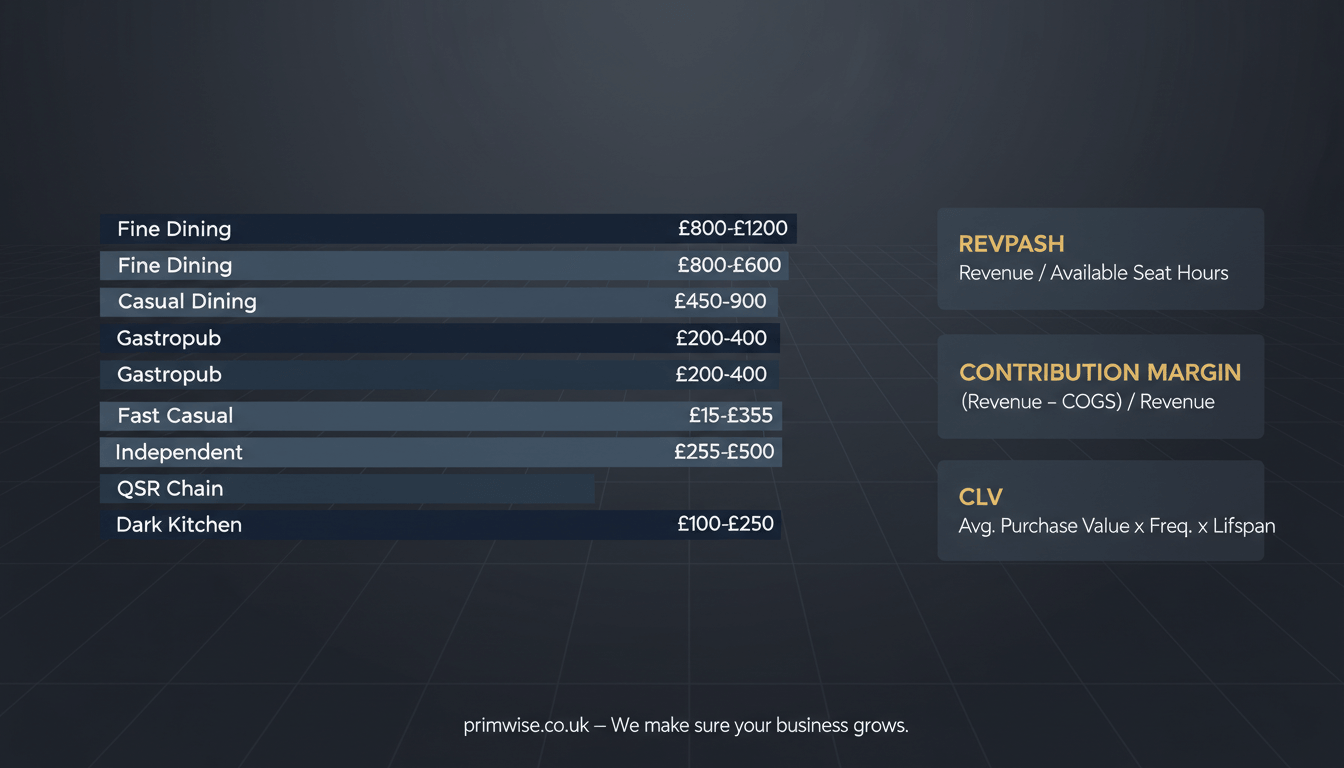
The following segment benchmarks reflect typical daily gross sales under normal trading conditions. Note that Saturday typically generates 40–60% more revenue than a Tuesday across most segments, and annual extrapolations are included because operators and investors evaluate performance against annual P&L targets, not daily snapshots.
- Fine Dining: £4,000–£8,000 per day (approximately £1.46M–£2.92M annually)
- Casual Dining: £2,500–£4,500 per day (approximately £912K–£1.64M annually)
- Gastropub: £2,000–£5,000 per day (approximately £730K–£1.83M annually)
- Fast Casual: £1,500–£3,500 per day (approximately £547K–£1.28M annually)
- Independent Operator: £800–£2,500 per day (approximately £292K–£912K annually)
- QSR and High-Street Chain: £3,000–£7,000 per day (approximately £1.09M–£2.55M annually)
- Dark Kitchen and Delivery-Only: £500–£2,000 per day (approximately £182K–£730K annually)
For contextual depth, the UK average spend per head in casual dining sits between £22 and £35 according to CGA range data, while fine dining covers regularly exceed £75 per head inclusive of beverages and service. These per-cover figures are the raw material of the contribution margin analysis covered later in this article. A fast-casual venue generating £2,000 per day across 120 covers at £17 average spend may yield a substantially stronger net margin than a fine dining room turning £5,000 across 40 covers at £125 average spend the overhead structure of each model explains the difference entirely.
KEY INDUSTRY BENCHMARKThe average UK independent restaurant generates £800 to £2,500 in daily gross sales equivalent to approximately £292K to £912K annually based on CGA by NIQ sector data cross-referenced with Primewise client benchmarks. Approximately 60% of UK restaurants operate on net margins below 5%, per UKHospitality reporting.
Why Daily Sales Is the Wrong KPI
The structural problem with treating average daily sales as a north-star metric is that it is entirely indifferent to cost. A dining room generating £4,000 on a Saturday night feels like commercial success. But once you deduct the static 20% VAT burden which removes £667 immediately from gross receipts before a single operational cost is considered and then layer in London commercial rent, UK Business Rates, food inflation, and the employer National Insurance contribution increase that took effect in April 2025, the net picture looks entirely different.
The April 2025 National Insurance changes represent a direct, quantifiable threat to UK hospitality margins that is frequently underestimated. At median hospitality wages, the increased employer NI contributions add approximately £900 per full-time employee annually. For an operator running a team of 20, that is an £18,000 additional annual overhead that does not appear in daily gross sales figures but devastates end-of-year net profitability. Add to this the structural shift caused by the closure of over 12,000 UK food-service outlets between 2020 and 2024 which concentrated competitive pressure in surviving venues while simultaneously reducing the trained labour pool and the margin environment becomes genuinely hostile.
This is the busy-but-broke paradox in operational terms. A full dining room and a healthy daily sales figure can coexist with a negative net margin if the operator lacks granular visibility into the three efficiency metrics that actually govern profitability. The following section defines each one with precision.
THE BUSY BUT BROKE PARADOXA venue generating £4,000 in daily gross sales loses £667 to VAT before paying a single overhead. Add employer NI increases, food inflation, and commercial rent, and impressive daily revenue can mask a genuinely negative net margin. This is why gross daily sales must never be treated as a proxy for profitability.
The 3 Metrics That Actually Matter
The shift from volume-centric to margin-focused management requires adopting three specific analytical frameworks. Each one reveals a dimension of operational efficiency that gross daily sales entirely conceals. Together, they form a profitability dashboard that is far more actionable than any daily revenue target.
Revenue Per Available Seat Hour
Time and physical space are the two genuinely perishable commodities in any restaurant. An empty seat during a quiet Tuesday lunchtime is revenue destroyed permanently it cannot be recovered. Revenue Per Available Seat Hour (RevPASH) is the metric that quantifies this destruction with precision. It measures how effectively an operator is monetising their full dining room capacity across every hour of the trading day, making it the most granular measure of operational efficiency available to UK operators.
The formula is straightforward: RevPASH = Total Revenue ÷ (Available Seats × Opening Hours). For example, a casual dining venue with 60 seats, open for 8 hours, that generates £2,400 in total revenue achieves a RevPASH of £5.00. A target RevPASH for a well-managed UK casual dining operation typically sits between £6 and £12 per seat per hour, depending on segment and location. Scores below this range indicate under-utilised capacity, poor table turnover management, or inadequate off-peak trading strategy. RevPASH also reveals something that daily gross sales cannot: whether a venue’s peak period is masking catastrophic off-peak underperformance that a targeted day-part promotion strategy could directly address.
Contribution Margin Per Cover
The hospitality industry has historically managed food costs as a percentage of revenue typically targeting 28–35% food cost ratios. This percentage-based approach is outdated and frequently misleading as a decision-making tool. Percentages do not pay commercial rent. Absolute cash does. Contribution margin per cover focuses on the actual cash value remaining after the direct variable costs of a specific dish are deducted from its selling price, and it is this cash figure that pays wages, utility bills, and ultimately generates net profit.
The formula is: Contribution Margin = Selling Price − Variable Costs per Cover. Consider two dishes: a pasta dish selling for £14 with £3.50 variable costs yields a £10.50 cash contribution at a 75% margin. A premium ribeye selling for £36 with £16 variable costs yields a £20 cash contribution at a 44% margin. Percentage-based thinking promotes the pasta; cash-contribution thinking promotes the ribeye. For a venue doing 80 covers per service, the difference in total nightly contribution between those two choices is £756 a figure that compounds across 250 trading nights annually into a six-figure profitability gap. Menu engineering using contribution margin rather than food cost percentage is one of the highest-return operational changes available to UK operators without increasing a single marketing spend.
Customer Lifetime Value
Customer Lifetime Value (CLV) measures the total net revenue a single loyal guest generates across their entire relationship with a venue. It is the ultimate antidote to the expensive and margin-destructive strategy of constant new customer acquisition through discount platforms and blanket promotional campaigns. In the UK market, where third-party booking and delivery platforms charge commission rates that routinely erode margin by 20–35% per transaction, understanding and optimising CLV represents a fundamental shift in how operators perceive the value of retention versus acquisition.
The calculation is: CLV = Average Spend per Visit × Average Visits per Year × Average Retention in Years. A casual dining guest spending £45 per visit, visiting four times per year, retained for three years, represents a CLV of £540. Acquiring that guest through a third-party discount platform at 25% commission on the first visit destroys £11.25 in margin immediately. Retaining them through a first-party loyalty programme that costs £2 per year in email marketing delivers the full £540 CLV with 99.6% margin efficiency on retention spend. At scale, across a database of 2,000 loyal guests, the difference between platform dependency and first-party retention strategy represents over £1 million in protected lifetime revenue.
THE 3 METRICS FRAMEWORKRevPASH reveals how efficiently you monetise space and time. Contribution Margin per Cover reveals the actual cash generated per guest. Customer Lifetime Value reveals the true long-term yield of retention over acquisition. These three numbers together give operators a commercially defensible profitability picture that daily gross sales can never provide.
How Marketing Decisions Change When You Target the Right Number
Understanding these three metrics is only commercially valuable if it produces a corresponding shift in how marketing budgets are allocated and campaigns are structured. The table below illustrates the before-and-after strategic shift when operators move from optimising for daily gross sales to optimising for the three metrics that actually govern net profitability.
| Optimising For | Typical Tactic | Commercial Outcome |
|---|---|---|
| Daily Gross Sales | Blanket 2-for-1 promotions at peak periods | High cover counts, destroyed margin, no retention data |
| RevPASH | Targeted day-part promotions on quiet Tuesday lunchtimes | Off-peak covers filled without cannibalising high-margin weekend service |
| Contribution Margin | Staff training on high-margin specials upselling | Same cover count, materially higher absolute cash per service |
| Customer Lifetime Value | First-party email loyalty programme with automated re-engagement | Reduced platform dependency, compounding annual revenue from loyal base |
The table illustrates a fundamental commercial principle: the marketing tactic that maximises daily gross sales is almost always the tactic that most aggressively destroys net profitability. Blanket discounting at peak periods inflates the top line while eliminating the margin that sustains the business. A RevPASH-optimised campaign targets the quieter Wednesday afternoon with a limited-offer menu priced to incentivise trial without undercutting the premium positioning of Friday and Saturday service. The tactical difference is precision versus volume and precision consistently outperforms volume in the UK’s current margin environment.
Day-Part Promotions for RevPASH Improvement
Practically implementing a RevPASH improvement strategy requires identifying the specific trading hours where seat utilisation falls below your target threshold and designing bespoke, time-limited offers that speak directly to the audience available at those times. A city-centre restaurant with strong weekday lunch office trade but a near-empty 3pm–6pm window, for instance, might deploy a pre-theatre sharing menu priced at a modest discount from the à la carte to drive covers into that dead period without impacting the 7pm full-margin service. The marketing cost of a targeted email to an opted-in 1,500-person database is effectively zero compared to the revenue yield of filling 20 additional covers at £28 average spend across three evenings per week.
Menu Engineering and Floor Conversion
Contribution margin optimisation extends well beyond the kitchen into the front-of-house operation. Staff who understand which dishes generate the highest absolute cash contribution not the lowest food cost percentage become the most commercially powerful marketing asset a venue possesses. Structured incentive schemes, such as weekly recognition for the server who generates the highest average cover spend through confident specials recommendations, cost the operator almost nothing while producing measurable nightly cash contribution increases. This is operational marketing that requires no digital budget, no agency brief, and no platform commission only investment in training and internal communication.
Building Data-Driven Loyalty Loops
To maximise CLV and systematically reduce platform dependency, operators must invest in building proprietary first-party data assets. This means prioritising direct booking channels over third-party aggregators, implementing a CRM system that captures guest visit frequency and spend data, and deploying automated lifecycle email sequences that re-engage guests approaching the end of their typical visit cycle. A guest who normally visits every 10 weeks and has not returned after 12 weeks is a lapsing customer an automated personalised email offering a specific menu update or a complimentary tasting note on a new seasonal dish can recover that visit at near-zero acquisition cost. Primewise works directly with UK restaurant groups and commercial hospitality investors to build these first-party data and CRM frameworks, benchmarking operational performance against current sector data and identifying the margin recovery opportunities that gross daily sales figures consistently obscure.
For operators who have diagnosed the busy-but-broke paradox within their own business and need a structured external framework to resolve it, Primewise’s data-driven advisory model is specifically built for hospitality operators and investors who need to move beyond daily gross sales and construct commercially defensible growth strategies. Their hospitality advisory services are available at primewise.co.uk.
TAKE ACTIONIf your venue is generating strong daily gross sales but net margins remain stubbornly below 8%, the profitability gap is almost always attributable to untracked RevPASH underperformance, percentage-based menu management, or excessive platform dependency suppressing CLV. These are solvable operational problems, not permanent structural constraints.
UK Restaurant Financial Benchmarks at a Glance
The following summary consolidates the key quantitative benchmarks referenced throughout this analysis into a single scannable reference. Each figure includes its source context and a qualifying note for accuracy in operator application. This section is designed specifically for investors conducting pre-acquisition due diligence on UK hospitality assets, where a rapid cross-segment comparison is required before deeper operational analysis begins.
- UK food-service market value: approximately £95 billion in 2024 (Lumina Intelligence UK Foodservice Market Tracker)
- UK restaurants operating below 5% net margin: approximately 60% (UKHospitality)
- UK food-service outlet closures between 2020 and 2024: over 12,000 (UKHospitality sector data)
- Additional annual NI cost per full-time employee from April 2025: approximately £900 at median hospitality wages
- Average spend per head, casual dining: £22–£35 (CGA by NIQ range)
- Average spend per head, fine dining: £75+ inclusive of beverages and service
- VAT deduction on gross receipts: 16.67% of gross sales (equivalent to 20% of net)
- Third-party platform commission range: 20–35% per transaction
- Target RevPASH range, UK casual dining: £6–£12 per seat per hour
- Saturday revenue premium over Tuesday: 40–60% across most segments