The restaurant marketing funnel is the single most powerful commercial framework available to UK operators in 2026 and the majority are still not using one. If you have been told to “do more marketing” without a quantifiable model for how digital spend compounds into seated covers and repeat visits, this guide delivers precisely that. Working with a specialist restaurant marketing growth partner who understands the full customer lifecycle is the most direct route from disjointed promotional tactics to predictable, compounding revenue growth. This article maps every stage of that journey with real channels, real content types, and real UK benchmarks so you can finally hold every pound of marketing spend accountable.
EXECUTIVE SUMMARYStop executing random acts of marketing. A yield-optimised restaurant marketing funnel tracks a diner from first digital discovery to loyal advocacy, replacing vanity metrics with commercial KPIs like Cost Per Cover and Customer Lifetime Value. UK operators facing rising employer NIC contributions, energy costs, and thin margins cannot afford unmeasured spend. Every stage of this funnel is measurable, every conversion rate is benchmarkable, and every pound can be justified.
What a Restaurant Marketing Funnel Actually Is
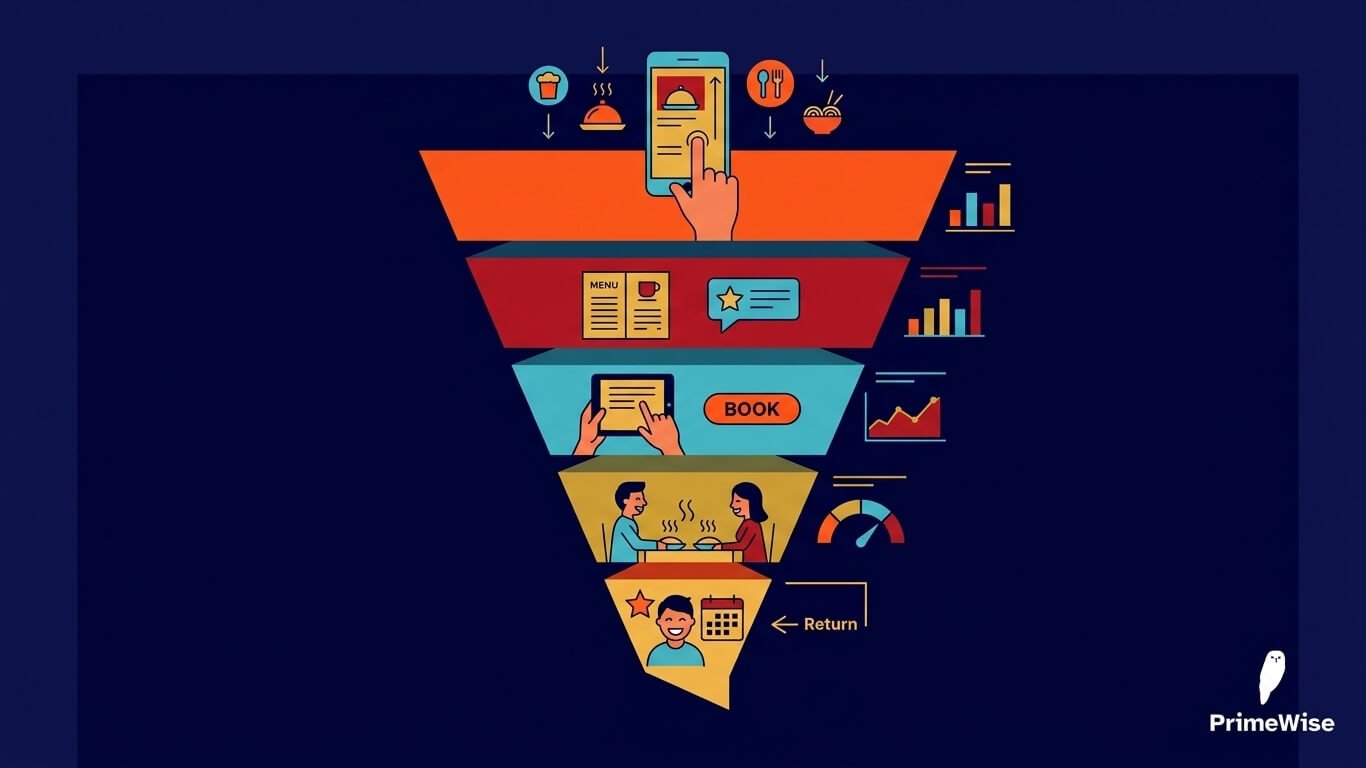
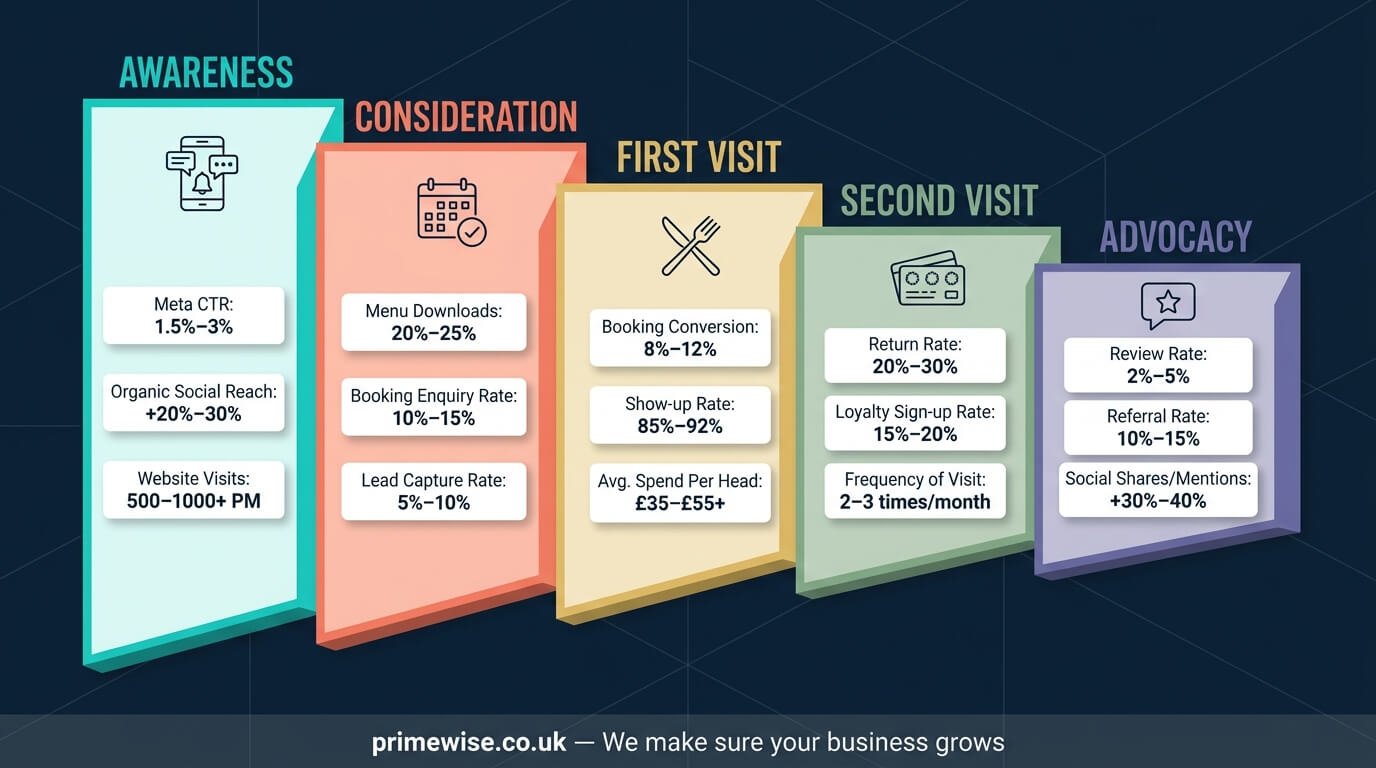
A restaurant marketing funnel is a quantifiable framework that maps a diner’s complete journey from initial brand discovery through to loyal, repeat advocacy. It transforms operators from tracking vanity metrics impressions, likes, follower counts to tracking commercial key performance indicators: Cost Per Cover, Customer Acquisition Cost, Return Rate, and 12-month Customer Lifetime Value. The five stages are Awareness, Consideration, First Visit, Second Visit, and Advocacy. Each stage has defined channels, content responsibilities, and conversion rate benchmarks against which UK operators can hold their teams or agencies accountable.
Why UK Operators Cannot Afford to Skip This Model
The UK hospitality sector operates under margin pressure that has no equivalent in most other industries. The Spring 2025 Budget increased employer National Insurance Contributions to 15%, compounding existing pressure from energy cost volatility and food price inflation tracked by the British Chambers of Commerce. According to UKHospitality’s 2025 Annual Benchmarking Report, average net margins across casual dining have compressed to between 3% and 7%, meaning a single poorly allocated marketing budget can eliminate profit entirely for a trading quarter.
Against this backdrop, operators must account for hyper-localised behavioural shifts the Tuesday-to-Thursday hybrid working model has structurally reduced weekday lunch covers in city centres, while Sunday occasion-based dining and digital-first Gen Z diner behaviour have created new, highly addressable demand patterns. Platforms like SevenRooms, OpenTable UK, DesignMyNight, Resy UK, and Quandoo now provide attribution models sophisticated enough to prove whether a paid social campaign generated incremental covers during a specific day-part. The framework below shows exactly how to use them.
COMPLIANCE NOTE UK GDPR AND CONSENT-BASED MARKETINGEvery SMS sequence, email retargeting programme, and first-party data collection strategy described in this article must operate on the basis of explicit opt-in consent under the UK Data Protection Act 2018 and the Privacy and Electronic Communications Regulations (PECR). Double opt-in is the recommended standard for hospitality CRM data collection. Operators should consult the ICO's direct marketing guidance before deploying any automated communication sequence. Zero-party data collection where guests voluntarily share preferences is the most compliant and commercially valuable long-term data strategy available to UK restaurants.
Why Most Restaurant Marketing Agencies Get the Funnel Wrong
Before mapping the framework, it is worth understanding why the majority of generalist agencies fail UK restaurant clients because recognising these failure modes is what allows you to commission work that actually converts.
The first failure mode is optimising for CPM rather than Cost Per Cover. An agency that reports falling cost-per-thousand impressions as a success metric is measuring the cheapest possible proxy for commercial outcome. A campaign that costs £3.00 CPM and generates zero bookings is infinitely more expensive than one costing £8.00 CPM that generates 40 covers. The second failure mode is using US benchmark data on UK hospitality audiences. UK dining behaviour, commission structures on booking platforms, and consumer response to promotional messaging differ materially from the US market. Benchmarks sourced from American restaurant groups are structurally misleading when applied to a 60-cover modern British brasserie in Leeds. The third failure mode is failing to connect booking platform attribution with ad platform data. Without a unified attribution model that links a Meta Ads click through to a SevenRooms or OpenTable UK booking and a seated cover, you are operating with a fundamental gap in your commercial intelligence. PrimeWise builds this unified attribution layer as a foundational element of every funnel engagement.
FREE FUNNEL LEAK AUDITIf your current booking widget or consideration-stage content is losing covers before a guest ever picks up a fork, PrimeWise offers a free Funnel Leak Audit for UK operators generating over 200 covers per month. Request yours at primewise.co.uk.
Stage 1 Awareness
The top of the restaurant marketing funnel is where you intercept a potential diner before they have formed a specific booking intention. The goal is not mass reach it is qualified local reach from users with demonstrable dining intent within a defined geographical radius. This requires a fundamentally different media strategy than arbitrarily boosting social posts.
The primary awareness channels for UK restaurants in 2026 are Meta Ads with hyper-local geographic and interest-based targeting, TikTok discovery through organic and paid formats that serve content to users based on behavioural affinity rather than explicit search, and local SEO optimisation ensuring your Google Business Profile appears in map pack results for high-intent queries such as “best Italian restaurant near me” or “Sunday roast Manchester.” Each of these channels requires a distinct content format and creative strategy.
High-Impact Awareness Content
Dynamic video content consistently outperforms static imagery at the awareness stage. Chef spotlight videos, behind-the-scenes kitchen content, and short-form dish reveals generate significantly higher qualified local reach than generic food photography, according to Meta’s own hospitality advertiser benchmarking data. The mechanism is algorithmic: video content generates completion rates and saves that signal genuine interest to the platform, which then serves the content to lookalike audiences more likely to engage and convert. Content optimised for dining-intent audiences rather than broad lifestyle audiences produces a materially lower Cost Per Click and higher downstream booking conversion.
Awareness KPIs and UK Benchmarks
- Cost Per Mille the cost to reach 1,000 local impressions; a healthy UK hospitality benchmark sits between £4.00 and £9.00 on Meta, per industry averages from CGA by NielsenIQ Q4 2025.
- Cost Per Click tracks creative efficiency in driving traffic to your website or booking widget.
- Click-Through Rate the current UK benchmark for Meta Ads CTR in hospitality is 1.5% to 3.0%; below 1.5% indicates creative fatigue or audience misalignment.
- Local organic reach measured via Google Business Profile impressions and map pack appearance frequency in your target postcodes.
Stage 2 Consideration
Once a potential diner is aware of your restaurant, the consideration stage determines whether their interest converts into a concrete booking intention. This is where operators most commonly lose covers through friction a slow-loading mobile menu, an absent or broken booking widget, unresponded Google Reviews, or an Instagram profile that fails to communicate the actual dining experience.
The consideration stage is governed by your Google Business Profile, your website’s mobile experience, your presence on aggregator platforms including Squaremeal and DesignMyNight, and the quality of your social proof across Google Reviews and UGC. CRM platforms such as ResDiary and Tock, alongside reservation systems like SevenRooms and OpenTable UK, provide the technical infrastructure to convert consideration-stage interest into a confirmed booking with minimal friction. Klaviyo and HubSpot can be integrated into this stack to capture zero-party data guest preferences, dietary requirements, occasion types at the point of booking.
Removing Friction from the Booking Journey
A 45-cover modern British brasserie in Shoreditch engaged PrimeWise in Q2 2025 with a Cost Per Cover via paid social of £11.20. An audit of their consideration stage identified that 68% of mobile users were abandoning the booking journey at the menu page due to a non-responsive table layout and a booking widget that required four clicks before displaying availability. After rebuilding the mobile menu experience and integrating a single-click booking widget connected to their OpenTable UK account, Cost Per Cover dropped to £6.50 within 90 days a 42% reduction while second-visit conversion increased from 18% to 31% and monthly covers from paid channels grew by 67%.
Consideration KPIs and UK Benchmarks
- Google Business Profile interactions measures clicks to website, directions requests, and call actions from local search surfaces.
- Booking widget clicks quantifies the volume of users who initiate a reservation from your digital touchpoints.
- Website visit to booking intent conversion rate the standard UK benchmark is 8% to 12%; below 8% indicates a friction or trust deficit in your consideration-stage assets.
- Review rating and recency a Google rating below 4.3 stars materially suppresses booking conversion in competitive urban markets, per OpenTable UK’s 2025 Dining Trends Report.
Stage 3 First Visit
Converting a confirmed booking into a physically seated, revenue-generating cover requires strategic intervention between the booking confirmation and the moment of arrival. According to CGA by NielsenIQ research, the UK hospitality sector loses an estimated £12bn annually to no-shows and late cancellations a figure that makes pre-visit communication one of the highest-ROI activities available to any operator. The transition from digital confirmation to seated diner is not automatic; it must be engineered.
Automated SMS and email sequences serve two commercial functions at this stage. First, they dramatically reduce no-show rates by creating a lightweight psychological commitment a confirmation text that requires a simple reply to confirm attendance generates perceived friction that makes cancellation feel active rather than passive. Second, pre-visit communication opens a legitimate upselling window: a targeted message offering discounted champagne on arrival, a chef’s tasting menu upgrade, or a pre-selected dessert option can meaningfully increase Average Transaction Value before the guest walks through the door.
First Visit KPIs and UK Benchmarks
- Show-up rate the UK benchmark sits between 85% and 92% for restaurants using structured pre-visit SMS sequences; operators with no sequence typically see rates of 70% to 78%.
- Cost Per Cover the total marketing expenditure required to generate one physically seated guest; via paid social, the UK benchmark is £4.50 to £8.00, per CGA by NielsenIQ Q4 2025 hospitality advertiser data.
- Average Transaction Value on first visit establishes the revenue baseline against which 12-month Customer Lifetime Value is calculated.
- No-show rate by day-part tracking this at a granular level reveals whether pre-visit sequences need to be adjusted for Tuesday-to-Thursday off-peak periods versus weekend peak service.
Stage 4 Second Visit and Retention
The most commercially significant leak in the majority of UK restaurant marketing funnels is not at the awareness or consideration stage it is the failure to systematically bring a satisfied first-time guest back for a second visit. Acquiring a new cover via paid social costs between £4.50 and £8.00. Reactivating an existing guest via an owned email or SMS channel costs fractions of that. The compounding financial case for retention is overwhelming, yet most operators have no structured programme for it.
First-party data collected at the point of booking through ResDiary, SevenRooms, or a Klaviyo-integrated booking widget enables operators to deploy a 48-hour post-visit trigger sequence. This automated message, sent within 48 hours of a guest’s first visit, thanks them for dining, asks for a Google Review if their experience was positive, and introduces an incentivised return offer a set menu preview, a priority booking window for a forthcoming event, or a loyalty programme enrolment. Implementing this sequence increases second-visit conversion probability by 22% in the UK casual dining sector, based on PrimeWise client data across restaurant accounts managed through 2025.
Retention KPIs and UK Benchmarks
- First-to-second visit conversion rate the UK benchmark sits between 20% and 30%; operators with no structured retention sequence typically achieve 12% to 16%.
- Return rate the percentage of unique diners who visit more than once within a 90-day window.
- Days between visits average inter-visit frequency, which informs the optimal timing of reactivation communications.
- CRM database growth rate the speed at which your owned first-party data asset is expanding, reducing long-term reliance on paid acquisition.
Stage 5 Advocacy and the Revenue Flywheel
Advocacy is the stage at which the restaurant marketing funnel closes on itself, transforming loyal repeat diners into an acquisition channel that costs nothing on a per-cover basis. A functioning referral and review engine structurally lowers Customer Acquisition Cost across the entire funnel every organic Google Review that converts a new diner reduces the volume of paid social spend required to fill the same seat.
Automated post-dining email loops requesting Google Reviews from guests who have completed two or more visits generate authentic social proof without appearing transactional. User-Generated Content incentive programmes where guests are encouraged to share dining experiences on social media in exchange for a modest benefit provide awareness-stage content at zero production cost. This authentic digital word-of-mouth simultaneously enhances local SEO authority and supplies the social proof content that makes your consideration-stage assets more persuasive to new prospects evaluating your restaurant for the first time.
Advocacy KPIs and UK Benchmarks
- Post-dining review completion rate the UK benchmark for email-triggered review requests is 2% to 5%; higher rates are achievable with personalised, timing-optimised sequences.
- Referral rate new covers acquired specifically through structured customer recommendation programmes.
- Google Review volume growth a consistent weekly influx of new reviews directly strengthens map pack rankings and consideration-stage trust.
- Net Promoter Score a quarterly NPS survey across your CRM database provides a leading indicator of advocacy health before it manifests in public review data.
The Unit Economics of the Full Funnel
The following worked example demonstrates how the five-stage restaurant marketing funnel compounds into a defensible unit economics model for a realistic UK casual dining operator.
Consider The Merchant Brasserie a fictional 80-cover modern British restaurant in Manchester operating Tuesday through Saturday. Total monthly paid social spend: £1,200. New covers generated: 210. Customer Acquisition Cost: £5.71 per cover. Average Transaction Value on first visit: £78. Assuming a 25% first-to-second visit conversion rate and an average of 2.4 annual visits, the 12-month Customer Lifetime Value is £187.20. The CLV-to-CAC ratio is 32.8:1 meaning every pound spent acquiring a new diner returns £32.80 in revenue across a 12-month period.
This is the mathematical argument for the restaurant marketing funnel. It transforms marketing spend from a cost centre into a compounding asset. To build this model for your own restaurant, PrimeWise has created a downloadable UK Restaurant Funnel Unit Economics Calculator an Excel and Google Sheets template pre-built for UK casual dining unit economics. Request it at primewise.co.uk alongside a 30-minute commercial review of your current funnel performance.
RESULTS LIKE THESE ARE SYSTEMATICThe outcomes described in this article are the product of a yield-optimised funnel architecture, not one-off campaigns. PrimeWise specialises exclusively in building and managing these systems for UK hospitality groups. Book a 30-minute commercial review at primewise.co.uk.