
The 7ps of marketing restaurant owners actually use bear almost no resemblance to what is taught in business schools. As a former marketing professor who left academia to consult on real restaurant turnarounds, I can tell you that the moment I walked into my first failing kitchen, every textbook model I had spent years teaching collapsed on contact with reality. The restaurant marketing services that actually move the needle are not abstract promotional campaigns they are brutally precise operational levers that directly determine whether your profit and loss statement ends the week in the black or the red. This guide translates the classical 7Ps framework into a hard-nosed, UK-specific diagnostic tool, complete with industry benchmarks, named examples, and a proprietary revenue audit matrix to help you identify exactly which pillar is bleeding your bottom line dry.
EXECUTIVE SUMMARYThe 7Ps of restaurant marketing Product, Price, Place, Promotion, People, Process, and Physical Evidence are seven operational levers that determine daily profitability in UK hospitality. Food cost benchmarks sit between 28–35% of net sales. A single additional table turn on a 60-cover restaurant can add £1,080–£2,700 in weekly gross revenue. Post-Brexit EU worker numbers in UK food service fell approximately 25% between 2019 and 2024. This framework replaces theory with thresholds.
The 7Ps of Restaurant Marketing Defined
The 7Ps of restaurant marketing are Product, Price, Place, Promotion, People, Process, and Physical Evidence. In a commercial hospitality context, these are not abstract brand awareness concepts they are the seven measurable operational variables that determine gross profit margin, table turnover rate, labour cost percentage, and customer lifetime value on a daily basis. When one pillar fails, the financial damage cascades across the entire business model immediately.
Why Textbook Marketing Destroys UK Restaurants
When I left academia, I expected to find hospitality operators struggling with brand differentiation or social media strategy. What I found instead were operators suffocating under food cost percentages exceeding 40%, catastrophic staff churn costing them £2,000–£4,000 per front-of-house replacement, and table turn times that were quietly capping their maximum daily revenue at a fraction of its potential. None of my theoretical frameworks had prepared me for any of this. The UK hospitality sector operates on net profit margins between 3% and 9% for casual dining venues, according to UKHospitality benchmarking data. In that environment, a marketing concept that does not directly reduce Cost of Goods Sold, increase Revenue Per Available Seat Hour (RevPASH), or improve staff retention is not a neutral investment it is an active liability. Theoretical marketing models are simply not built for razor-thin margins, soaring energy bills, post-Brexit labour shortages, and a cost-of-living crisis simultaneously reshaping consumer spending behaviour.
INDUSTRY WARNINGUK independent restaurant closures have been consistently linked to Process and People failures rather than Product failures. A busy restaurant generating strong footfall but poor profitability is almost always suffering from COGS mismanagement, pricing psychology errors, or RevPASH destruction through slow table turns not a marketing awareness problem.
The 7Ps Translated for Real Operators
To make this framework genuinely actionable, each theoretical pillar must be stripped of jargon and mapped directly to the operational and financial realities of running a modern UK hospitality venue. What follows is that translation built on named UK examples, current industry benchmarks, and the diagnostic thresholds that separate a profitable operation from an insolvent one.
Product Menu Engineering and COGS Management
In academic marketing theory, the product is simply what you sell. In a commercial kitchen, the product is an exercise in menu engineering and disciplined Cost of Goods Sold management. The industry benchmark for food cost percentage in a UK casual dining venue sits between 28% and 35% of net sales, based on UKHospitality and British Hospitality Association data. If your food cost exceeds 35%, your menu is your primary margin leak not your marketing budget. Research consistently shows that reducing a menu’s SKU count by 20% can decrease spoilage waste by up to 15%, directly improving gross profit without a single additional cover.
Hawksmoor is the definitive UK example of product discipline done correctly. Their focused, low-waste steak menu built around a limited number of premium cuts with exceptional sourcing transparency consistently delivers gross profit margins that independent operators with sprawling 60-dish menus cannot approach. The menu engineering matrix, derived from the Boston Consulting Group’s portfolio framework, classifies every dish as a Star (high margin, high popularity), Plowhorse (high popularity, low margin), Puzzle (high margin, low popularity), or Dog (low margin, low popularity). Stars deserve prime menu real estate. Dogs must be eliminated without sentiment. Every dish on your menu must justify its position through margin contribution or volume failing this test on even four or five items can destroy weekly gross profit.
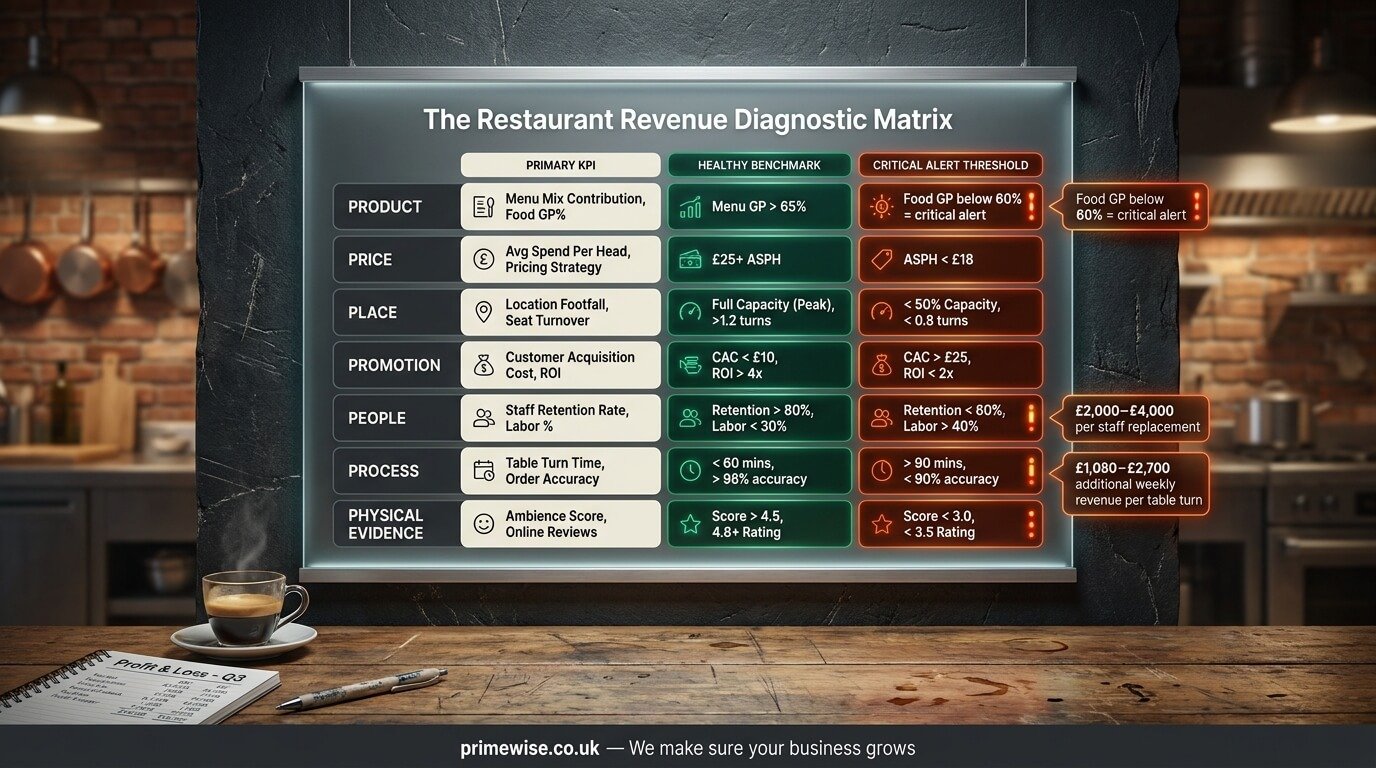
COGS ALERT THRESHOLDA food GP margin below 60% on any menu category is a critical signal requiring immediate menu engineering intervention. A food cost variance greater than 3% week-on-week is a wastage or theft signal requiring a full POS audit.
Price Defending Margins Through Psychology
Pricing strategy in UK hospitality is fundamentally a survival tactic, not a competitive positioning exercise. Surviving successive inflation waves, the April 2025 National Living Wage increase to £12.21 per hour, and volatile VAT thresholds require understanding price elasticity and menu psychology simultaneously. The psychological barriers are real and specific: the £7 London pint, the £20 premium burger, the £15 weekend brunch plate. Breaching these thresholds without a corresponding elevation in perceived value triggers an immediate and measurable drop in repeat visit frequency among your core regular demographic.
True pricing power is not about undercutting local competitors. It is about understanding what your customer perceives as fair value at a given price point and engineering your menu presentation to support that perception. Techniques including anchor pricing (positioning a high-margin item next to a premium item to make the former appear reasonable), strategic portion framing, and deliberate removal of currency symbols from printed menus have all been validated in peer-reviewed hospitality management research as measurable drivers of average transaction value. In a post-cost-of-living-crisis market, UK operators who survive are those who raise prices slowly and strategically while simultaneously elevating the physical and experiential justification for those prices not those who hold prices artificially low until insolvency forces a crisis restructure.
Place Footfall Versus Delivery Economics
The textbook definition of Place meaning your physical location is operationally obsolete in the UberEats and Deliveroo era. Place now encompasses the full logistical and financial reality of both your physical catchment area and your digital delivery radius, and the economics of these two channels are fundamentally incompatible. Deliveroo and Uber Eats commission structures typically run between 25% and 35% of gross order value. When layered on top of food costs of 28–35%, the combined deduction before a single operational overhead is covered frequently exceeds 60% of revenue per order. This is not a distribution channel for most independent operators it is a margin destruction mechanism dressed as a marketing opportunity.
The contrast between operating a Zone 1 Soho flagship and running a Deliveroo dark kitchen on a Bermondsey industrial estate illustrates the divergence perfectly. The Soho flagship absorbs exorbitant London business rates (hospitality business rates relief in 2025 remains partial and inconsistent across boroughs) and ULEZ delivery friction costs, but generates premium dwell-time revenue, organic social proof, and brand equity that compounds over time. The dark kitchen sacrifices all physical brand-building for volume economics that only work at significant scale with ruthlessly engineered menus and sub-25% food costs. Operators must honestly evaluate which model their current cost structure can support and stop treating Deliveroo income as supplementary revenue when the net margin after commission frequently renders it loss-making.
Promotion Brand Building Versus Discounting
Tactical discounting is the fastest route to brand destruction and insolvency available to a UK restaurant operator. The two-for-one Tuesday death spiral is not a hypothetical it is a documented pattern in which promotional dependency trains customers to perceive full-price visits as poor value, suppresses average transaction values permanently, and attracts a customer demographic with low loyalty and high price sensitivity. Margin-destroying promotions cannibilise the very revenue base they are intended to protect.
Dishoom is the most instructive counter-example in UK hospitality. Their promotion strategy relies almost entirely on lore-driven brand storytelling the Bombay café narrative, the nostalgic design language, the carefully authored backstory that makes every venue feel like a discovery rather than a transaction. This storytelling generates organic brand equity that lowers long-term customer acquisition cost, drives word-of-mouth referrals, and fills covers without a single discount. Effective promotion in 2026 means optimising your Google Business Profile to dominate local search, building a Net Promoter Score measurement system to identify and amplify your most enthusiastic advocates, and creating a dining experience so precisely calibrated that customers generate your promotion for you through user-created content. Customer lifetime value in hospitality is built through emotional connection, not coupon mechanics.
People The Financial Cost of Staff Churn
The People pillar is where UK independent operators are haemorrhaging capital invisibly. Post-Brexit EU worker numbers in UK food service fell by approximately 25% between 2019 and 2024, according to ONS Labour Market data. The structural impact of this contraction is a permanent elevation in the cost of recruiting, onboarding, and retaining both front-of-house and back-of-house teams. The average cost of replacing a single front-of-house team member in London when recruitment fees, onboarding time, uniform provision, and lost productivity during the learning curve are accurately costed is estimated between £2,000 and £4,000 per departure. In a venue with 20% annualised front-of-house turnover across a team of fifteen, this represents a silent overhead of £6,000–£12,000 annually that never appears as a line item on the profit and loss statement but absolutely destroys net margin.
Hawksmoor and Dishoom have consistently led the UK hospitality industry in staff retention precisely because they treat the People pillar as a commercial investment rather than an operational overhead. Both businesses have implemented structured career progression frameworks, transparent pay banding, and genuine profit-sharing mechanisms. Industry data indicates that venues with structured career progression report 30–40% lower annualised turnover. A stable, tenured team does not just reduce recruitment cost it delivers the service consistency required to build loyal customer relationships, maintain quality standards during peak service, and generate the repeat visit frequency that creates sustainable revenue rather than transactional one-time covers.
Process Table Turns as Revenue Multipliers
Process is the pillar that most directly connects operational flow to the profit and loss statement, and it is the pillar most consistently undervalued by operators focused on product and promotion. RevPASH Revenue Per Available Seat Hour is the professional metric used to measure process efficiency in a commercial dining room. It accounts for both the revenue generated per seat and the speed at which that seat is cycled, giving operators a single number that reflects the true commercial performance of their floor. A standard casual dining cover in London generates between £18 and £45 in net revenue depending on concept and location. A single additional table turn per service across a 60-cover restaurant adds £1,080 to £2,700 in weekly gross revenue without acquiring a single new customer.
Wagamama represents the gold standard of Process optimisation in UK casual dining. Their technology-driven POS-to-kitchen routing system eliminates the communication latency between front-of-house order taking and back-of-house preparation, allowing dishes to arrive at the table in a sequence that naturally accelerates the dining rhythm without making guests feel pressured. The result is a RevPASH that consistently outperforms peer casual dining venues. A table turn time exceeding 75 minutes during lunch service in a venue with under 80 covers is a measurable process failure. The Monday-to-Tuesday lunch rush decimated by the rise of work-from-home culture requires a fundamentally different floor management strategy than a Thursday-to-Sunday dinner service operators who apply the same process logic across all day-parts are leaving significant revenue on the table.
PROCESS BENCHMARKTable turn times exceeding 75 minutes at lunch in a sub-80-cover venue represent a measurable RevPASH failure. Each additional turn on a 60-cover restaurant at £18–£45 net revenue per cover generates £1,080–£2,700 in additional weekly gross revenue.
Physical Evidence Vibe Architecture and Pricing Power
Physical Evidence is the tangible justification for every premium markup on your menu. Interior design, ambient sound design, lighting calibration, bathroom maintenance standards, and the overall atmospheric coherence of your space collectively, what the industry increasingly calls vibe architecture function as the silent pricing mechanism that either supports or undermines every pricing decision you make. When the physical space communicates premium value, customers unconsciously accept higher price points and generate organic social proof through user-created content. When the physical space communicates neglect or inconsistency, no amount of marketing spend compensates for the psychological misalignment.
The Ivy is the canonical UK example of Physical Evidence executed as a strategic commercial asset. Their maximalist interior design the mosaic floors, the stained glass, the immaculate table settings creates a perceived value environment so coherent that premium menu pricing feels not merely justified but expected. The bathrooms at The Ivy are famously maintained to the same standard as the dining room, because operators who understand Physical Evidence know that every touchpoint is a pricing conversation. When a guest photographs their table, their plate, or their cocktail and shares it organically, The Ivy receives free promotion with an authenticity that paid advertising cannot replicate. Physical evidence is not interior design for its own sake it is the architecture of perceived value that makes your pricing strategy commercially viable.
The Restaurant Revenue Diagnostic Matrix
Understanding the seven pillars intellectually is insufficient. What operators require is a structured, reproducible audit methodology that identifies precisely which pillar is generating the revenue leak and quantifies the financial damage with enough specificity to justify immediate operational intervention. The Restaurant Revenue Diagnostic Matrix is that tool. It operates across two sequential phases, each designed to isolate a specific category of operational failure.
Phase One The Margin Leak Audit
Phase One addresses the most common crisis presentation in UK hospitality: the restaurant that is perpetually busy but chronically unprofitable. High footfall without corresponding profit is not a marketing problem it is a structural margin problem, and it can be diagnosed with precision using POS data analysis and operational observation. Begin by pulling your food and beverage cost percentages from your POS system for the previous four weeks. A gross profit margin below 60% on food items is a critical COGS alert requiring immediate menu engineering intervention. Next, audit your table turn times during peak lunch service a turn time exceeding 75 minutes in a sub-80-cover venue is a quantified process failure. Finally, check for food cost variance greater than 3% week-on-week, which signals either a wastage problem or a theft vector requiring immediate investigation. If any two of these three thresholds are breached simultaneously, the venue is almost certainly generating negative real margins despite strong footfall.
Phase Two The Bottleneck Stress Test
Phase Two diagnoses structural business model failures that Phase One’s transactional audit cannot surface. Calculate your combined labour cost percentage including employer National Insurance contributions post the April 2025 NI increase, combined labour costs exceeding 35% of net revenue in a full-service restaurant represent a structural warning. Costs exceeding 40% represent an existential threat requiring immediate intervention in rota management, scheduling efficiency, or service model redesign. Map your local footfall data against your day-part revenue split to identify whether your process strategy is calibrated to actual demand patterns rather than assumed ones. Conduct a digital sentiment audit across Google reviews, TripAdvisor, and Instagram tags to identify whether your Physical Evidence your space, your atmosphere, your cleanliness standards is generating the social proof that supports your pricing, or actively undermining it.
Operators who identify multiple failure points across both phases of the Diagnostic Matrix are typically dealing with compounding systemic failures rather than isolated operational issues. Primewise.co.uk works exclusively with UK hospitality operators to conduct exactly this kind of revenue-first operational audit identifying the specific combination of COGS mismanagement, pricing erosion, and process inefficiency costing the business measurable daily revenue. For a confidential diagnostic conversation with a specialist who understands the operational realities of the UK market, visit Primewise.co.uk.
UK Hospitality Benchmark Reference Table
The following benchmarks are drawn from UKHospitality annual reporting, ONS workforce data, and British Hospitality Association operational guidance. These thresholds represent the difference between a financially viable operation and one in structural distress.
| 7Ps Pillar | Primary KPI | Healthy Benchmark | Critical Alert Threshold |
|---|---|---|---|
| Product | Food GP% | 65–72% | Below 60% |
| Price | Average Transaction Value | Growing YoY above CPI | Flat or declining vs. inflation |
| Place | Delivery Net Margin | Above 15% after commission | Below 10% or loss-making |
| Promotion | Customer Acquisition Cost | Declining YoY | Rising without brand equity growth |
| People | Annualised Turnover Rate | Below 60% | Above 80% (industry distress signal) |
| Process | RevPASH | Above £12 per seat per hour | Below £8 per seat per hour |
| Physical Evidence | Google Review Score | 4.4 and above | Below 4.0 (conversion cliff) |
Which Pillar Is Most Likely Your Broken Link
After conducting turnaround audits across dozens of UK hospitality venues, a clear pattern emerges. The most frequently broken pillar is not the one operators suspect. Operators tend to blame Promotion assuming their marketing is insufficient when the actual failure is almost always in Process or People. A restaurant with a RevPASH below £8 per seat per hour and an annualised staff turnover rate above 80% cannot be saved by a better Instagram strategy. The marketing surface of the business is fine. The operational engine beneath it is failing. Fixing the broken pillar first, then amplifying it through promotion, is the sequence that generates sustainable revenue growth. Addressing promotion while ignoring the underlying operational failure is the pattern I have observed in every closure I have been called in too late to prevent.