

What is performance marketing? It is a results-driven digital advertising model where advertisers pay exclusively when a specific, measurable action is completed a click, a qualified lead, or a signed contract rather than for passive ad impressions. For UK B2B enterprises navigating premium Square Mile media costs, stringent ICO data regulations, and complex post-Brexit attribution, this outcome-based framework is the only model that ties every pound of media spend to a verifiable commercial result. If you are evaluating whether to hire a performance marketing consultant, understanding the exact mechanics of channels, pricing models, and real campaign benchmarks is your essential starting point.
Executive SummaryPerformance marketing pays only for results clicks, leads, or contracts. This guide covers five core channels, five worked pricing models with real UK B2B figures, three illustrative campaign examples, and the regulatory complexities unique to the UK financial sector. Primewise.co.uk delivers fully managed, outcome-based performance marketing built exclusively for UK B2B financial services firms.
What Is Performance Marketing and How Does It Work Economically
Performance marketing is a rigorously trackable advertising strategy where brands pay exclusively for measurable outcomes. Every pound allocated is anchored to a quantifiable corporate action a completed form, a discovery call booked, or a contract signed. This model introduces supreme media accountability and fundamentally shifts how enterprise budgets are deployed, transforming speculative brand spend into a mathematically governed acquisition engine.
The economic logic is straightforward. Traditional impression-based buying charges brands for visibility regardless of commercial outcome. Performance marketing inverts this risk. Advertisers assume no capital exposure until a pre-agreed user action is verified and recorded. For financial directors and procurement heads operating under board-level scrutiny, this inversion is the defining appeal of the model.
According to the IAB UK 2025 Digital Adspend Report, the UK digital advertising market surpassed £35 billion in 2025, with performance-based formats accounting for the majority of that investment a clear signal that outcome-based buying is now the institutional standard, not an emerging alternative.
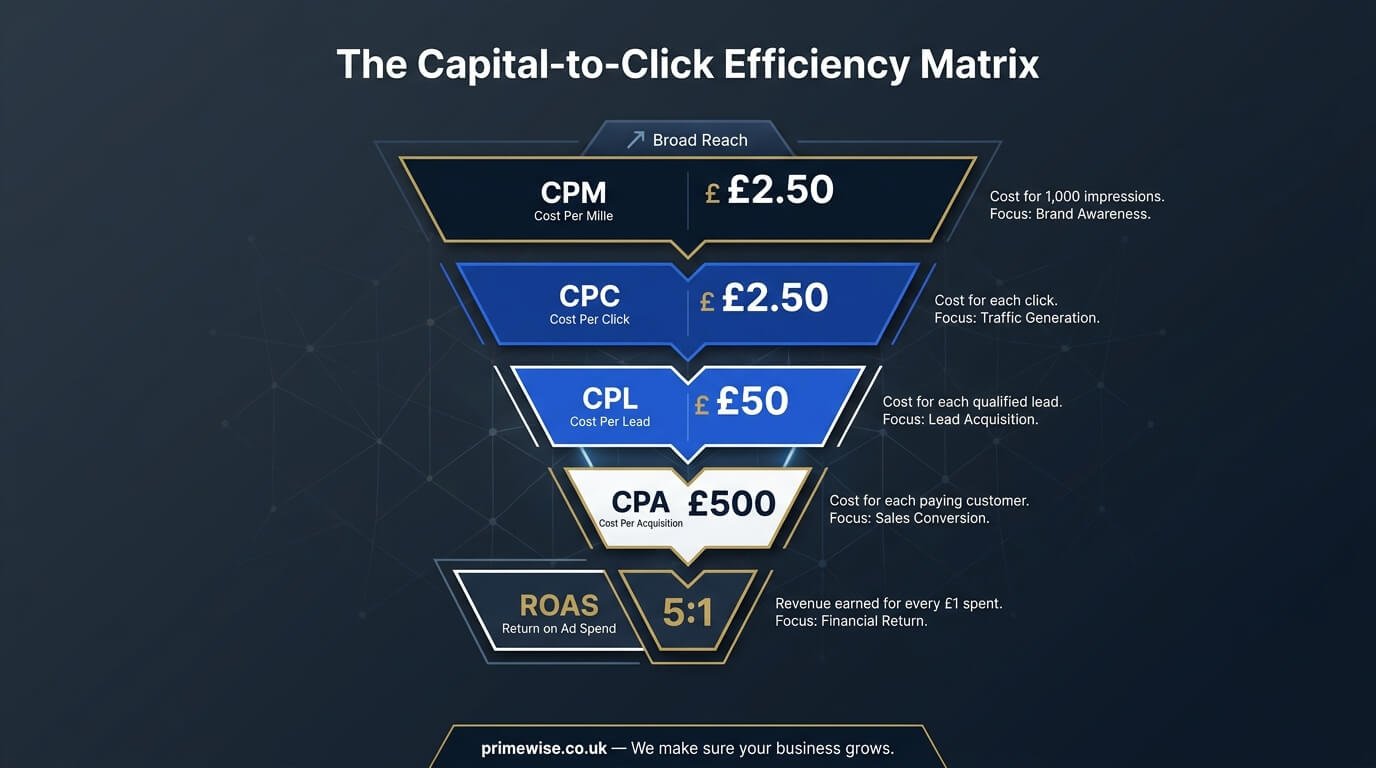
The Capital-to-Click Efficiency Matrix
The Capital-to-Click Efficiency Matrix is a proprietary framework for evaluating the risk-to-reward ratio when shifting media budgets from impression-based CPM buying to outcome-based CPA and CPL models. It visualises how accountability scales as capital is deployed against increasingly specific user actions. At the top of the matrix sits CPM broad reach, low accountability. At the base sits CPA narrow targeting, maximum accountability. Financial officers use this matrix to justify budget reallocation away from awareness-only spend and toward acquisition-oriented channels, making it an essential tool for board-level media planning conversations.
Which Performance Marketing Channels Drive the Best B2B Results in the UK
Deploying capital effectively requires understanding precisely where media is traded and what commercial purpose each channel serves. The following five channels form the operational backbone of any enterprise-grade performance marketing strategy in the UK B2B market.
Paid Search for High-Intent Financial Queries
Google Ads and Microsoft Advertising (Bing) operate on keyword auction systems where advertisers bid for placement at the exact moment a prospect submits a commercially relevant search query. For UK B2B financial services firms, this means intercepting decision-makers searching for terms such as “corporate restructuring advisory” or “M&A due diligence consultancy” queries that carry immediate purchase intent. Google Search campaigns use a Quality Score mechanism that rewards landing page relevance and expected click-through rate, meaning well-structured accounts can outperform larger competitor budgets through superior account architecture. In London’s City postcodes (EC1 through EC4), CPC inflation on financial services terms consistently runs 40 to 60 percent above the UK national average, according to internal Google UK sector benchmarking data, making bid management a precision discipline rather than a set-and-forget activity.
Paid Social for Account-Based Targeting
LinkedIn Campaign Manager is the dominant paid social platform for UK B2B acquisition. Its firmographic targeting allows advertisers to filter audiences by job title, seniority, company size, industry sector, and even specific employer enabling the surgical reach of Chief Financial Officers at FTSE 350 companies, Heads of Procurement at private equity-backed businesses, or Managing Partners at regional professional services firms. LinkedIn Lead Gen Forms remove the friction of landing page navigation by pre-populating contact fields from a prospect’s LinkedIn profile, dramatically improving form-fill conversion rates. The DMA UK Annual Benchmarking Report places average B2B CPL on LinkedIn between £85 and £130 for financial and professional services, making it one of the highest-cost but highest-quality lead generation channels available in the UK market.
Programmatic Display and Algorithmic Media Buying
Programmatic advertising automates real-time capital allocation across demand-side platforms (DSPs) such as Google Display and Video 360, The Trade Desk, and Amazon DSP. These systems use real-time bidding (RTB) to purchase digital ad inventory across millions of publisher sites within milliseconds of a user loading a page. Crucially, modern programmatic strategy extends beyond reach metrics. Data clean rooms privacy-compliant data collaboration environments used by platforms and advertisers to share aggregated audience signals without exposing individual user data are now standard practice for enterprise programmatic campaigns operating under ICO constraints. Incrementality testing, which isolates the true causal lift of a display campaign by comparing exposed versus control audience groups, has replaced view-through conversion as the preferred measurement methodology among sophisticated UK media buyers.
Affiliate and Partner Performance Marketing
Affiliate marketing in the B2B financial services context operates through specialist partner networks such as Partnerize, Impact, and AWIN. Professional affiliates industry publications, financial advisory directories, and specialist content platforms function as lead brokers, directing qualified traffic toward a brand’s conversion assets in exchange for a pre-agreed commission on verified outcomes. Influencer partnerships in the B2B space follow a similar commercial logic: rather than flat-fee brand endorsements, performance-structured influencer agreements tie compensation to measurable actions such as sign-ups, downloads, or consultation bookings. This structure guarantees that capital is only exchanged when a verified net-new business action is generated and validated through the partner network’s tracking infrastructure.
Post-Brexit Affiliate ComplexityManaging European web traffic from a British headquarters introduces VAT registration obligations in EU member states, cross-border commission structuring complexity, and international tracking protocol mismatches. Proactively addressing these frictions ensures ROAS calculations remain accurate and legally compliant for both UK and EU-facing campaigns.
What Are the Core Performance Marketing Pricing Models and How Are They Calculated
The following five pricing models represent the complete financial toolkit of performance media buying. Each includes a worked example using real UK B2B figures so that financial officers can immediately apply the mathematics to their own budget planning.
Cost Per Click Valuing the Initial Site Visit
Cost Per Click (CPC) is the baseline unit cost of acquiring a targeted visit to your digital property. It is calculated by dividing total media spend by the total number of qualified clicks generated. CPC governs the immediate capital efficiency of any paid search or paid social campaign and is the foundational metric from which all downstream acquisition calculations begin.
- Total paid search investment: £10,000
- Total qualified clicks generated: 4,000
- Calculated CPC: £10,000 ÷ 4,000 = £2.50
Cost Per Mille Pricing Programmatic Reach
Cost Per Mille (CPM) prices media on a per-thousand-impressions basis and governs top-of-funnel awareness campaigns within programmatic environments. It allows media buyers to evaluate ad inventory viewability and reach efficiency across global advertising exchanges. CPM is most valuable when used alongside incrementality testing to verify that awareness exposure is actually influencing downstream conversion activity.
- Total programmatic display investment: £5,000
- Total impressions delivered: 2,000,000
- Calculated CPM: (£5,000 ÷ 2,000,000) × 1,000 = £2.50
Cost Per Acquisition Quantifying Net-New Client Wins
Cost Per Acquisition (CPA) connects media spend directly to signed contracts or completed commercial transactions. It represents the most rigorous performance metric available because it strips away all intermediary vanity metrics and isolates the precise capital required to secure a single paying customer. CPA must always be evaluated against Customer Lifetime Value (CLV) a CPA of £500 is outstanding if the average client generates £15,000 in revenue over a three-year engagement, and poor if the average contract value is £600.
- Total affiliate network investment: £25,000
- Total net-new consulting contracts secured: 50
- Calculated CPA: £25,000 ÷ 50 = £500
Cost Per Lead Modelling Pipeline Economics
Cost Per Lead (CPL) measures the specific expenditure required to acquire actionable contact information and commercial intent from a prospective client. In complex B2B sales cycles, CPL is the primary pipeline health metric, governing how efficiently marketing is feeding the sales function with Marketing Qualified Leads (MQLs) that can be nurtured into Sales Qualified Leads (SQLs) and ultimately into closed contracts. The DMA UK places the B2B financial services CPL benchmark at £85 to £130, making the figure in the example below a strong performance outcome.
- Total LinkedIn Lead Gen Forms investment: £8,000
- Total Marketing Qualified Leads acquired: 160
- Calculated CPL: £8,000 ÷ 160 = £50 (benchmark: £85–£130)
Return on Ad Spend Calculating Revenue Impact
Return on Ad Spend (ROAS) is the definitive indicator of campaign commercial efficiency. It expresses the top-line revenue multiplier achieved from a given advertising investment, and it is the primary metric used to justify budget expansion at board level. The IPA Effectiveness Databank benchmarks optimal ROAS for professional services at a 4.5-to-1 ratio, accounting for premium acquisition costs and the inherently longer sales cycles of enterprise B2B engagements. Google Consent Mode v2 compliance and server-side GTM configuration are now prerequisites for accurate ROAS reporting in the UK market, as ICO-mandated consent restrictions can suppress up to 30 percent of conversion signals in standard browser-side tracking setups.
- Total consulting revenue generated: £150,000
- Total Google Ads investment: £30,000
- Calculated ROAS: (£150,000 ÷ £30,000) × 100 = 500% (5:1 ratio)
ROAS Reality CheckA 5:1 ROAS sounds strong, but it must be evaluated against gross margin, not gross revenue. If your consulting delivery costs consume 60% of contract value, your effective margin ROAS is 2:1 acceptable, but not scalable without conversion rate optimisation to reduce CPA.
Real UK B2B Performance Marketing Campaign Examples
The following three illustrative campaign scenarios are structured around anonymised but operationally realistic UK B2B engagements. They are drawn from the performance benchmarks and channel mechanics documented throughout this guide and are presented to demonstrate what managed performance marketing actually produces in practice.
M&A Advisory Firm LinkedIn Lead Generation Campaign
A mid-market London-based M&A advisory firm allocated £40,000 to LinkedIn Sponsored Content and Lead Gen Forms targeting CFOs and Strategy Directors at FTSE 350 companies. Using CPL-optimised bidding at a target of £65 per MQL, the 90-day campaign generated 615 Marketing Qualified Leads. Of those, 12 percent converted to initial discovery calls, producing a qualified pipeline of £2.4 million against a quarterly new business mandate of £1.8 million a 33 percent pipeline surplus achieved within a single quarter’s media budget. The campaign’s success was underpinned by tight firmographic exclusion lists that removed non-decision-maker job titles and a LinkedIn Insight Tag configured for server-side firing to preserve conversion signal integrity under ICO consent requirements.
Wealth Management Group Google Paid Search Campaign
A regional UK wealth management group with offices in Manchester and Leeds invested £22,000 in Google Ads across a three-month period, targeting high-intent search terms including “independent wealth manager UK,” “SIPP consolidation advice,” and “inheritance tax planning consultant.” The account was structured into tightly themed ad groups with bespoke landing pages per keyword cluster, achieving a Quality Score average of 8.2 across all primary terms. The campaign delivered 1,100 qualified clicks at a blended CPC of £20, of which 6.8 percent submitted a consultation enquiry form, producing 75 leads at a CPL of £293. Against an average client lifetime value of £28,000, the CPA of £880 for the 25 prospects who converted to onboarded clients represented a CLV-to-CPA ratio of 31.8 to 1 a compelling case for aggressive budget scaling in Q2.
B2B SaaS Fintech Programmatic Retargeting Campaign
A London-based B2B fintech platform serving corporate treasury teams deployed a £15,000 programmatic retargeting campaign through The Trade Desk DSP, targeting users who had previously visited their pricing and product comparison pages but had not initiated a free trial. The campaign served sequential display and native ad formats across premium UK financial publisher inventory Financial Times digital, City A.M., and Proactive Investors achieving a CPM of £18 across verified viewable impressions. Incrementality testing, run as a holdout study against a 20 percent unexposed control group, confirmed a 22 percent lift in free trial sign-ups attributable to the retargeting exposure, validating £3.3 million in influenced pipeline value against a media investment of £15,000.
What Makes UK Performance Marketing Different from Global Campaigns
Operating in the British digital economy introduces a specific set of regulatory, competitive, and logistical frictions that fundamentally alter how performance marketing campaigns must be structured, measured, and reported. These are not peripheral considerations they are central to accurate yield calculation and capital protection.
Square Mile Bid Inflation and Search Cost Premium
Financial services search terms targeting London’s primary business districts EC1 through EC4 and E14 (Canary Wharf) carry severe bid inflation driven by the concentration of institutional competitors with multi-million-pound media budgets. Terms such as “corporate restructuring advisory,” “private equity fund formation,” and “merger and acquisition consultant London” regularly attract CPCs of £45 to £90 on Google Ads, according to internal Google UK sector data. Navigating this environment requires sophisticated negative keyword architecture, dayparting strategies that concentrate spend during peak decision-maker active hours, and aggressive use of Performance Max campaign types with first-party audience signal feeds to maintain efficiency against institutional bidders.
ICO Compliance and Attribution Signal Loss
The ICO’s enforcement of UK GDPR has materially degraded the accuracy of browser-side conversion tracking across British digital campaigns. Standard Google Analytics 4 and Google Ads pixel configurations can lose 25 to 35 percent of conversion signals when consent is withheld by users under cookie consent banners. Google Consent Mode v2 which uses modelled conversion data to statistically infer the behaviour of non-consenting users is now a mandatory implementation for any UK performance marketer seeking accurate attribution. Server-side Google Tag Manager (GTM) configuration further reduces data loss by moving tracking logic from the user’s browser to a secure server environment, bypassing browser-level ad blockers and privacy extensions. First-party data strategy, built on authenticated user interactions and CRM integration, is the long-term infrastructure solution for maintaining attribution integrity in a cookieless UK environment.
ICO Compliance WarningFailure to implement Google Consent Mode v2 and server-side tagging in the UK market is not just a data quality problem it is a regulatory risk. The ICO has the authority to issue fines of up to £17.5 million or 4% of global annual turnover for non-compliant tracking practices. Consult ICO.org.uk for the current enforcement guidance.
Post-Brexit Cross-Border Affiliate Complexities
British-headquartered firms running affiliate programmes that generate traffic and conversions from EU member states face a layered set of post-Brexit administrative obligations. These include VAT registration requirements in multiple EU jurisdictions for digital service revenues, divergent data transfer protocols between UK GDPR and EU GDPR frameworks, and cross-border commission structuring complexities within affiliate networks that operate under both regulatory regimes. Yield calculations that fail to account for EU VAT obligations or cross-border tracking discrepancies will systematically overstate ROAS and understate true CPA a material financial reporting risk for any UK firm with European digital revenue exposure.
Firms navigating Square Mile bid inflation, ICO-compliant attribution, and post-Brexit affiliate complexity simultaneously require a specialist partner. Primewise.co.uk provides managed performance marketing built exclusively for UK B2B financial services firms, with transparent CPL and CPA reporting aligned to board-level KPIs and full Google Consent Mode v2 compliance as standard.
How to Evaluate a Performance Marketing Agency as a CFO
For financial executives commissioning an external performance marketing partner, the evaluation criteria must extend beyond channel capability and creative portfolio. The following framework identifies the specific commercial and technical competencies that separate genuine performance specialists from generalist digital agencies dressed in performance marketing language.
- Demand a channel-specific CPL and CPA commitment in the service contract, not just a traffic or impression volume guarantee
- Require evidence of Google Consent Mode v2 and server-side GTM implementation as a standard onboarding deliverable
- Ask for incrementality testing methodology agencies that cannot explain holdout studies are measuring correlation, not causation
- Validate that ROAS reporting is calculated on margin contribution, not gross revenue, to ensure accurate profitability assessment
- Confirm that LinkedIn firmographic audience builds include decision-maker seniority filters and competitor account exclusion lists
- Assess whether the agency uses data clean room infrastructure for programmatic audience targeting under UK GDPR constraints
- Request a marketing mix modelling (MMM) capability statement agencies offering MMM can prove cross-channel incrementality without relying on cookie-based attribution
For B2B enterprises operating in the UK financial sector, Primewise.co.uk offers a fully managed, outcome-based performance marketing service where every budget allocation is tied to verified lead and acquisition metrics. Request a capital efficiency audit at primewise.co.uk to receive a board-ready analysis of your current media spend against UK B2B acquisition benchmarks.