

What is a performance marketing consultant, and why are UK founders increasingly choosing this model over traditional agency retainers? If you are leading a post-seed or Series A business and your customer acquisition costs are rising while your agency delivers vanity metrics managed by junior account handlers, you are not alone. This guide delivers a plain-English breakdown of the role, UK market rates, IR35 compliance, and how to onboard a senior specialist who is directly accountable for commercial outcomes.
EXECUTIVE SUMMARYIndependent performance marketing consultants offer senior expertise, direct accountability, and capital efficiency that traditional agency retainers routinely fail to deliver. UK founders should expect day rates of £500 to £1,000, structure engagements outside IR35 via milestone-driven Statements of Work, and anticipate a full account audit, tracking rebuild, and growth blueprint within the first thirty days.
The Definitive Definition
A performance marketing consultant is a senior independent specialist who designs, executes, and optimises paid media strategies on a measurable commercial outcome basis. They are typically engaged outside IR35 on a milestone-driven Statement of Work, with direct accountability for metrics including return on ad spend (ROAS), customer acquisition cost (CAC), and blended cost per acquisition (CPA). This is not a generalist marketing role. The remit is strictly bound to paid media execution, tracking infrastructure, CAC and lifetime value modelling, and conversion rate optimisation, all focused on capital-efficient, quantifiable commercial growth.
Performance Consultant Versus Fractional CMO
Founders frequently conflate these two roles, and the confusion is costly. A fractional Chief Marketing Officer operates at the strategic apex: brand positioning, team leadership, budget allocation across the full marketing funnel, and board-level reporting. A performance marketing consultant is fiercely tactical. They are inside your ad accounts, rebuilding tracking architecture, modelling CAC against twelve-month lifetime value, and running incrementality tests to isolate genuine revenue contribution from media spend. You hire a fractional CMO to set the direction. You hire a performance consultant to execute the paid acquisition engine and make it measurably profitable.
Why UK Founders Are Moving Away From Agency Retainers
The structural problem with the traditional Agency-of-Record model is well-documented among UK scale-up operators. Agencies typically levy a management fee of fifteen to twenty percent of media spend on top of the actual ad budget. According to IPSE (the Association of Independent Professionals and the Self-Employed), demand for senior digital marketing contractors in the UK increased by over thirty percent year-on-year between 2022 and 2024, driven directly by post-IR35 reform restructuring and widespread founder disillusionment with agency opacity. The pitch is delivered by a senior strategist. The account is then managed by a graduate-level executive working across eight to twelve client accounts simultaneously. The incentive structure rewards client retention and upselling, not your commercial performance.
An independent performance consultant inverts this entirely. There is one senior operator, directly accountable to you, whose engagement is structured around specific commercial deliverables rather than hours billed or a percentage of spend. Every pound of their fee is tied to outputs you can verify. That structural accountability difference is the commercial case in a single sentence.
The Capital-Efficient Growth Framework
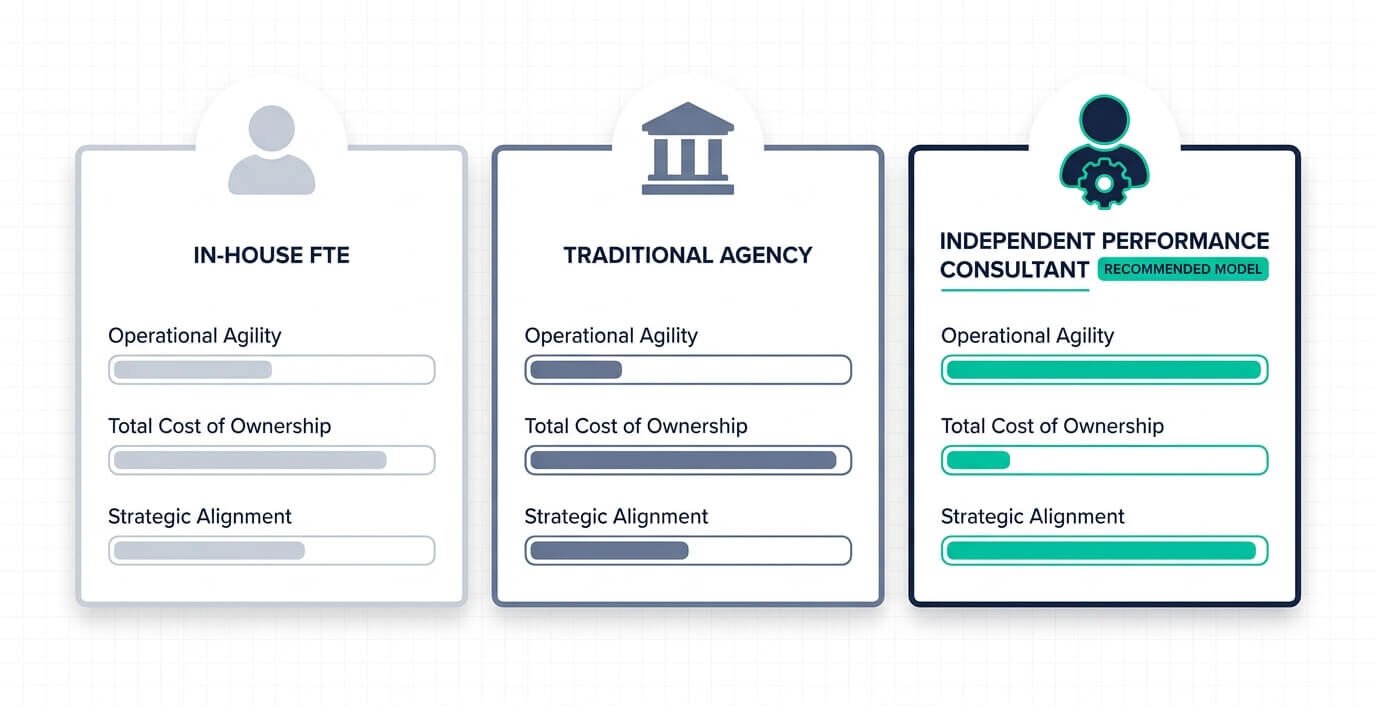
When evaluating how to deploy marketing capital, UK founders must assess three dimensions simultaneously: operational agility, total cost of ownership, and strategic alignment. The table below provides a structured comparison of the three primary engagement models available to post-seed and Series A businesses.
| Engagement Model | Operational Agility | Total Cost of Ownership | Strategic Alignment |
|---|---|---|---|
| In-House FTE | Low notice periods, IR35-free but high fixed cost | £90,000–£130,000 all-in (salary, NI, pension, tools) | High fully embedded |
| Traditional Agency (AoR) | Moderate retainer lock-in, junior execution | Media spend plus 15–20% management fee | Low fragmented across portfolio |
| Independent Consultant (Outside IR35) | Maximum milestone-based, scalable or pausable | £3,000–£6,000 per month retainer equivalent | Maximum single-client focus, outcome-tied |
The in-house FTE model delivers strong alignment but demands significant capital commitment and long recruitment lead times, typically eight to fourteen weeks for a senior London-based performance marketer. According to Hays UK Salary Guide 2024, a senior performance marketing manager in London commands a base salary between £70,000 and £100,000. Factor in employer National Insurance contributions at thirteen-point-eight percent, mandatory pension auto-enrolment, software licences for tools such as triple whale or Northbeam, and recruitment agency fees of fifteen to twenty percent of first-year salary, and the true all-in cost of an in-house hire regularly exceeds £120,000 in year one. An independent consultant absorbs their own operational costs entirely. That dynamic allows founders to access director-level execution capability for a fraction of the total cost of ownership, preserving critical runway for actual media spend.
PRIMEWISE INSIGHTIf you are evaluating the transition from a retained agency to a capital-efficient independent specialist, Primewise provides UK founders with vetted senior performance marketing consultants on outside IR35 milestone-based engagements. Explore how at primewise.co.uk.
UK Day Rates and Commercial Benchmarks
The UK contractor market operates predominantly on day rates rather than the hourly billing model common in the United States. This distinction matters for budgeting. A vetted performance marketing consultant with a demonstrable track record typically charges between £500 and £1,000 per day. APSCo (the Association of Professional Staffing Companies) UK contractor market data consistently positions senior digital marketing specialists in the upper band of this range when the engagement involves complex multi-channel attribution, server-side tracking implementation, or B2B LinkedIn strategy at scale.
For ongoing engagements, senior consultants frequently transition day rates into fixed-fee monthly retainers tied to specific deliverables. A typical structure for a Series A scale-up managing a monthly paid media budget of £30,000 to £100,000 would be a retainer of £3,000 to £6,000 per month, depending on the agreed scope. This provides founders with absolute financial predictability a critical advantage over percentage-of-spend agency models where fees inflate automatically as budgets grow, regardless of performance. According to LinkedIn Salary Insights for 2025, the average base salary for a Head of Performance Marketing in London sits at £85,000, before employer on-costs. The monthly retainer equivalent of an independent consultant engagement is therefore not only more agile but structurally more cost-efficient by a significant margin.
What Drives Rate Variation
Not all consultants deliver equivalent commercial value at the same rate. Four primary factors drive rate variation. First, track record specificity a consultant who has demonstrably scaled a DTC e-commerce brand from £500K to £5M in annual revenue via paid social will command a premium over a generalist. Second, technical depth consultants who can architect and implement server-side tagging via Google Tag Manager Server-Side or Stape.io, and who understand how iOS signal loss and third-party cookie deprecation directly impact attribution, sit in a genuinely differentiated tier. Third, channel niche LinkedIn Ads specialists operating in UK B2B markets, where cost-per-lead benchmarks regularly exceed £80 to £150 per qualified lead, command rates reflective of that scarcity. Fourth, project scope complexity a full tracking infrastructure rebuild, Marketing Mix Modelling deployment, and multi-channel growth strategy command higher rates than ongoing campaign optimisation on an established account.
IR35 Compliance in Plain English
HMRC’s off-payroll working rules, commonly referred to as IR35, have been a source of significant anxiety for UK founders since private sector reforms took effect in April 2021. The legislation was designed to prevent disguised employment situations where an individual operates as a limited company contractor but functions, in practice, as a permanent employee. Getting this wrong as an end client can expose your business to substantial employer National Insurance liabilities. Getting it right is entirely achievable with the correct engagement structure.
Structuring an Outside IR35 Engagement
An outside IR35 determination rests on three primary tests derived from established UK employment case law. First, the consultant must have the contractual right to send a substitute in their place. Second, the control the consultant must retain meaningful control over how, when, and where the work is performed. Third, mutuality of obligation, there must be no expectation of ongoing work beyond the agreed deliverables, and no obligation to accept it. The practical mechanism that satisfies all three tests simultaneously is a robust, milestone-based Statement of Work.
A well-drafted Statement of Work defines specific, verifiable deliverables completing a full paid media account audit by a named date, reducing blended CPA by a defined percentage within ninety days, or delivering a growth blueprint document rather than specifying hours or a daily attendance schedule. The consultant determines their own working methodology and timeline within the agreed scope. This approach shifts the engagement from a service contract that resembles employment to a business-to-business commercial relationship, which is the correct legal and structural framing under IR35. Founders should consult a qualified IR35 specialist or employment lawyer before finalising any engagement structure. This guide provides general commercial education and does not constitute formal IR35 legal or tax advice.
HMRC COMPLIANCE WARNINGSince April 2021, the responsibility for IR35 status determination sits with the end client (the founder's company) in the private sector, not the contractor. An incorrect inside IR35 determination carries employer NI liability plus potential penalties. Always use a milestone-based Statement of Work and seek qualified IR35 legal advice before engaging.
What to Expect in the First Thirty Days
A senior performance consultant treats the onboarding phase as a critical commercial diagnostic period. The objective is to halt any ongoing media wastage immediately while establishing the data infrastructure required for evidence-based scaling decisions. Founders should expect three primary outputs within the first thirty days of engagement.
The first output is a comprehensive paid media account audit. This involves a forensic review of historical Google Ads and Meta Ads account structures, bidding strategies, audience segmentation, and creative performance data. The audit identifies specific budget inefficiencies, campaigns cannibalising each other via keyword overlap, broad-match settings inflating irrelevant search impression share, or retargeting audiences sized incorrectly for the available budget. This alone typically surfaces recoverable media waste that immediately justifies the consultant’s fee.
The second output is a rebuilt tracking infrastructure. Without accurate, complete conversion data, every optimisation decision is built on sand. Senior consultants will assess the existing setup and, where necessary, implement server-side tagging to recover signal lost to iOS tracking limitations, browser-based ad blockers, and the progressive deprecation of third-party cookies. Server-side tracking deployed via Google Tag Manager Server-Side or platforms such as Stape.io routes conversion events through the client’s own server before passing them to ad platforms, dramatically improving match rates and the accuracy of algorithmic bidding. This technical capability is a genuine differentiator between senior consultants and junior practitioners, and it directly impacts campaign performance at scale.
The third output is the growth blueprint. This is a structured strategy document that translates the findings of the account audit into a chronological, prioritised action roadmap. It defines target CAC thresholds by channel, projected ROAS at various budget levels, a creative testing framework, and the incrementality testing methodology that will be used to measure the genuine revenue contribution of paid media as the account scales. Incrementality testing using geo-based holdout experiments or platform-level conversion lift studies is a critically important capability in 2026 that separates consultants who can operate at Series B scale from those who cannot.
Advanced Capabilities That Define Senior Practitioners
The performance marketing landscape in 2026 has been fundamentally reshaped by three converging forces: the deprecation of third-party cookies, the dominance of algorithmic campaign types such as Google Performance Max, and the rise of first-party data strategies as the primary competitive moat. Senior performance marketing consultants must demonstrate operational competency across all three to add genuine commercial value at scale.
Performance Max and Smart Campaign Architecture
Google’s Performance Max campaign type has become the dominant format across UK paid search and shopping in 2026, consolidating Search, Display, YouTube, Gmail, Discover, and Maps inventory into a single AI-driven campaign structure. A senior consultant understands both its commercial advantages and its structural risks. Without correct asset group architecture, audience signal configuration, and brand exclusion settings, Performance Max campaigns will cannibalise existing branded search traffic and inflate reported conversion volume without genuinely incrementing revenue. Managing this correctly and interpreting the limited transparency Google provides on placement-level performance requires genuine practitioner expertise that junior operators and agency account handlers frequently lack.
Marketing Mix Modelling for Scale-Ups
Marketing Mix Modelling (MMM) is a statistical methodology that quantifies the revenue contribution of individual marketing channels using historical sales and spend data, without relying on cookies or platform-level attribution. Once the exclusive domain of enterprise-level advertisers with six-figure analytics budgets, MMM has become accessible to UK scale-ups through lightweight open-source frameworks such as Meta’s Robyn and Google’s Meridian. A senior performance consultant who can deploy a basic MMM alongside platform-native incrementality testing provides founders with a genuinely post-cookie attribution framework one that gives confidence in budget allocation decisions even as last-click measurement continues to degrade.
How to Vet a Performance Marketing Consultant
The contractor market contains a broad spectrum of practitioners, from genuinely senior specialists with verifiable commercial track records to junior operators who have rebranded as consultants following redundancy cycles. For a UK founder deploying £20,000 to £100,000 per month in media spend, the cost of engaging the wrong person is not simply their fee, it is the compounded cost of wasted media spend, delayed growth, and the opportunity cost of six months lost. The following vetting framework is designed to surface genuine senior capability during a discovery conversation.
- Ask the consultant to walk you through a specific account restructure they have led, what the initial CAC was, what the CAC was after ninety days, and what were the three primary levers they pulled to achieve the improvement.
- Ask how they model incrementality, a senior practitioner will describe a specific methodology such as geo-based holdout testing or platform-level conversion lift studies; a junior practitioner will conflate correlation with causality.
- Ask about their server-side tagging process they should be able to explain the difference between browser-side and server-side event collection and articulate how they address iOS signal loss in Meta attribution.
- Ask how they structure a Statement of Work for IR35 compliance, they should articulate the three employment status tests and explain why milestone-based deliverables, not time-based attendance, are the correct commercial structure.
- Ask for a specific example of a Performance Max campaign they have managed they should be able to describe their asset group architecture, audience signal strategy, and how they handle brand cannibalisation risk.
- Ask for references from UK-based founders or commercial directors, not agency colleagues. Verifiable, direct-client references are the strongest available signal of a genuine commercial track record.
- Be cautious of day rates below £300; this is a consistent market signal of a junior practitioner misrepresenting their experience level, and the commercial risk of deploying significant media budgets through an underqualified operator substantially outweighs the apparent cost saving.
When Not to Hire a Performance Marketing Consultant
Intellectual honesty requires acknowledging that an independent senior consultant is not the optimal solution in every commercial context. If your total monthly paid media budget is below £5,000, the engagement overhead of a senior consultant in both fee cost and onboarding time investment may exceed the efficiency gains achievable at that budget scale. A managed service or growth-focused boutique agency operating at lower media thresholds is likely a more appropriate deployment of capital at the pre-product-market-fit stage.
Similarly, if your business lacks the operational infrastructure to act on strategic recommendations, no CRO capability on landing pages, no first-party data collection, no CRM integration a performance consultant will identify the constraints quickly but cannot resolve them unilaterally. The commercial return on a senior consultant engagement is maximised when the founder or a capable internal operator can execute the recommendations that fall outside the paid media remit. Understanding this honestly before engaging will produce better outcomes for both parties.
Performance Consultant Red Flags
The following warning signs, encountered during vetting or early engagement, are strong indicators that the consultant you are evaluating is not operating at the senior level their positioning suggests.
- They cannot produce a milestone-based Statement of Work and propose a time-and-materials engagement structure instead.
- They request full platform admin access before any formal agreement or Statement of Work is signed.
- Their case studies reference engagement results without specifying the media budget. A £50,000 revenue outcome on a £40,000 media spend is categorically different from the same outcome on a £5,000 budget.
- They are unable to explain their attribution methodology or conflate platform-reported ROAS with incremental revenue.
- They propose a percentage-of-spend fee structure, which directly replicates the agency incentive misalignment you are trying to move away from and is inconsistent with an outside IR35 engagement structure.
- They cannot name the specific technical stack they use for tracking infrastructure, vague references to ‘Google Analytics’ without specifying event taxonomy, server-side implementation, or data layer architecture are a meaningful competency signal.
A Real-World Outcome
A London-based B2B SaaS company operating at Series A, anonymised for commercial sensitivity, had been paying a retained agency a management fee equivalent to eighteen percent of monthly media spend across Google Ads and LinkedIn. The account was managed day-to-day by a two-year post-graduate executive. Attribution was browser-side only, with no server-side tagging in place, resulting in significant iOS-driven signal loss on LinkedIn conversion tracking. Blended CPA had been deteriorating for two consecutive quarters despite budget increases.
Following the transition to an outside IR35 performance marketing consultant engaged via a milestone-driven Statement of Work, the first thirty days produced a complete account audit, a rebuilt server-side tracking infrastructure via Stape.io, and a restructured LinkedIn campaign architecture with corrected audience signal configuration. Within ninety days, blended CPA had reduced by forty-one percent and pipeline-attributed ROAS had increased from 1.8x to 3.1x. The management fee previously paid to the agency was redirected entirely into media spend, further compounding the performance improvement. The total consultant engagement cost over the ninety-day period was marginally lower than a single month of the prior agency retainer.
How Primewise Works
Primewise partners with UK founders at the post-seed and Series A stage who are ready to move beyond agency retainers and deploy senior, independent performance marketing expertise directly against their paid acquisition challenges. Every consultant introduced through Primewise is vetted against a senior practitioner standard verifiable track record, server-side tracking capability, IR35-compliant engagement structure, and direct accountability for commercial outcomes. Engagements are structured as outside IR35 milestone-based Statements of Work, providing founders with full compliance confidence and maximum operational agility. Explore how Primewise works at primewise.co.uk.
KEY TAKEAWAYSA performance marketing consultant is directly accountable for ROAS, CAC, and CPA, not impressions or brand awareness. UK day rates run from £500 to £1,000, with monthly retainers of £3,000 to £6,000. Engage outside IR35 using a milestone-based Statement of Work. Expect a full account audit, server-side tracking rebuild, and growth blueprint within thirty days. Avoid consultants who cannot explain incrementality testing, server-side tagging, or IR35 compliance. Do not hire a senior consultant if your monthly media budget is below £5,000.