

Is performance marketing digital marketing? The answer reshapes how financial executives allocate budgets, structure teams, and measure commercial success. Digital marketing is the complete online ecosystem spanning all brand touchpoints across owned, earned, and paid channels. Performance marketing is the accountable, ROI-driven subset within that ecosystem where advertisers pay exclusively for measurable outcomes such as clicks, leads, or acquisitions. For UK financial firms, this is not a semantic preference but an operational and budgetary necessity. Understanding the hierarchy is the foundational step before engaging any performance marketing consultant services or restructuring an internal media team.
Executive SummaryDigital marketing is the overarching online ecosystem. Performance marketing is its measurable, paid-acquisition engine. For UK financial services firms, integrating both under a unified strategy is the single most effective lever for reducing Cost Per Acquisition and sustaining profitable Lifetime Value growth.
The Core Distinction Defined
Digital marketing encompasses every online interaction a brand creates or earns, including search engine optimisation, organic social media, digital public relations, content marketing, and email nurture sequences. It is a long-term investment in trust, authority, and brand equity. Performance marketing, by contrast, operates strictly within the paid-acquisition layer of that ecosystem. Advertisers deploy budgets through pay-per-click advertising, programmatic display, and affiliate networks, and pay only when a defined action occurs. The critical insight for any CFO or Marketing Director is this: performance marketing cannot operate at peak efficiency without the brand equity that broader digital marketing builds beneath it.
Digital Marketing as the Brand Foundation
For regulated financial services firms operating under FCA Financial Promotion rules and the UK’s Consumer Duty obligations, brand credibility is a compliance asset as much as a commercial one. Organic search visibility, high-quality editorial content, and consistent social presence build the trust infrastructure that prospects draw on before they ever click a paid advertisement. A firm ranking organically for wealth management advice terms, for example, carries an implicit authority signal that no paid impression can manufacture independently. IAB UK data from 2025 confirmed that branded search volume remains the single strongest predictor of performance campaign conversion efficiency across the financial services vertical.
Performance Marketing as the Acquisition Engine
Performance marketing functions as the precision-targeted revenue engine operating on top of that brand foundation. In the UK financial sector, Google Ads cost-per-click benchmarks for wealth management and fintech terms regularly range between £8 and £18 per click, with competitive terms in the City of London exceeding £25. At these rates, a firm with no prior digital brand presence pays a significant trust premium on every auction. Performance channels including paid search, programmatic demand-side platforms such as The Trade Desk or DV360, and compliant affiliate networks drive immediate, trackable acquisition. Every pound deployed must generate a measurable outcome, governed by strict KPIs including Cost Per Lead, Cost Per Acquisition, and Return on Ad Spend.
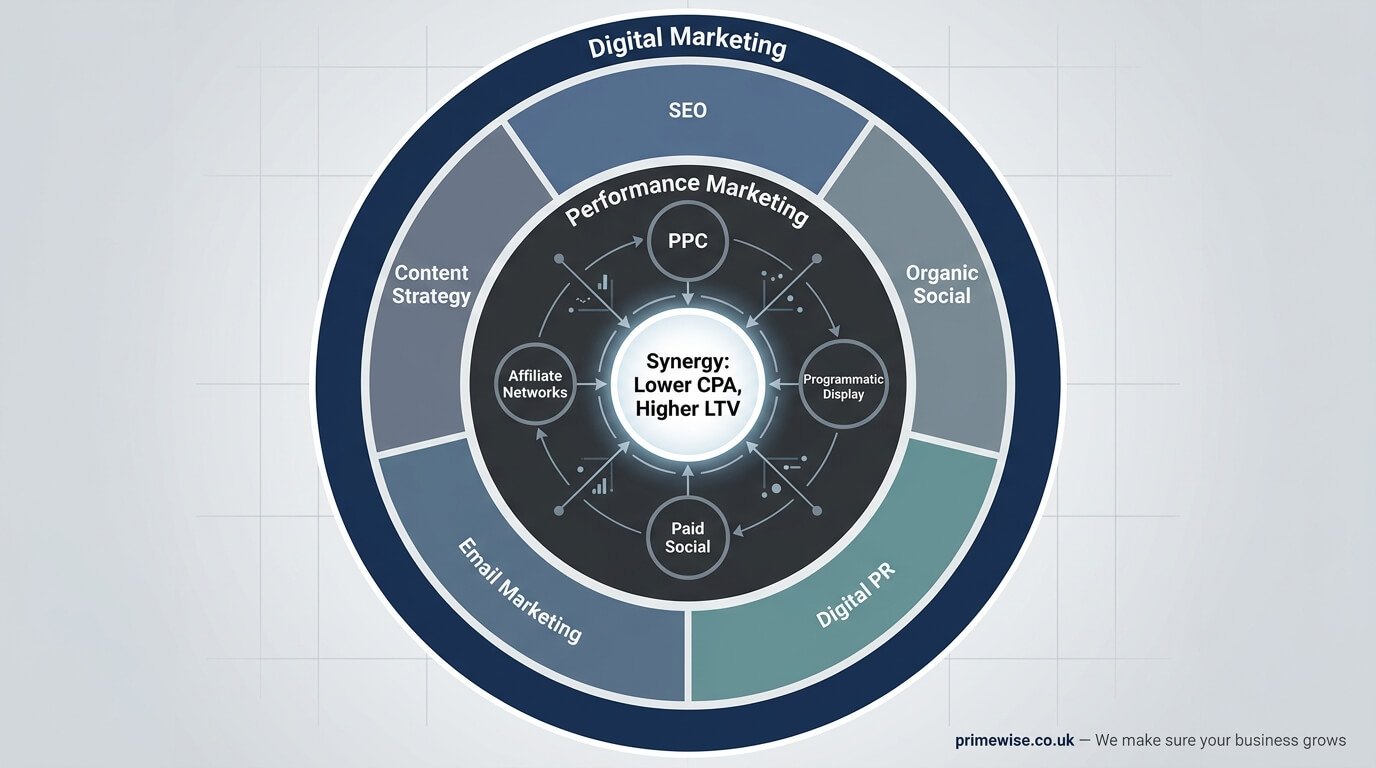
The Digital Performance Synergy Matrix
The most operationally useful framework for financial marketing leadership is what practitioners refer to as the Digital-Performance Synergy Matrix. Rather than treating brand investment and acquisition spending as competing budget lines, this framework positions them as sequential commercial accelerators. Strong digital brand activity reduces the friction a prospect experiences when encountering a performance advertisement, directly compressing the cost of acquisition without reducing media spend volume. Research published by Binet and Field through the IPA, adapted for digital ecosystems, consistently demonstrates that financial services firms blending long-term brand campaigns with short-term activation outperform purely direct-response competitors on Customer Lifetime Value by a statistically significant margin.
| Marketing Strategy | Primary Objective | Measurement Focus | Typical UK Financial Budget Allocation |
|---|---|---|---|
| Digital Marketing | Brand Equity and Trust | Share of Voice and Sentiment | 55 to 65 percent of total budget |
| Performance Marketing | Immediate Acquisition | Cost Per Acquisition and ROAS | 35 to 45 percent of total budget |
| Synergistic Integration | Profitable Scalability | Lifetime Value and Blended CPA | Optimised dynamically by quarter |
The budget allocations above reflect current best practice benchmarks drawn from analysis of mid-market UK financial consultancies and wealth management firms. They are not fixed ratios. Firms in early brand-building phases typically skew toward 70 percent digital investment before increasing performance spend as brand recognition compounds. The critical operational principle is that neither column functions at full efficiency in isolation.
How Brand Trust Lowers Acquisition Cost
When a prospect encounters a paid search or programmatic display advertisement from a financial brand they already recognise, the psychological distance to conversion is materially shorter. This trust compression effect is measurable. UK financial services firms that established a minimum 12-month digital brand presence prior to scaling performance budgets have reported blended Cost Per Lead reductions ranging from 28 to 40 percent compared to cold-start performance-only campaigns. The mechanism is straightforward: brand familiarity improves Quality Scores in Google Ads, raises click-through rates on programmatic placements, and accelerates the decision velocity of high-net-worth prospects who conduct extensive due diligence before committing to a financial relationship.
UK Wealth Management Case Study: Integrating Brand and Performance Budgets
A London-based wealth management consultancy with assets under management between £50 million and £200 million historically allocated over 90 percent of its marketing budget to direct performance channels, primarily paid search and LinkedIn lead generation campaigns. Facing year-on-year CPA increases of approximately 22 percent and a deteriorating lead quality score, the firm commissioned a strategic restructuring. Over an 18-month period, the consultancy reallocated budget to a 60 percent digital brand and 40 percent performance split. This included investment in organic content authority, digital PR placements in financial trade publications, and a structured first-party data capture programme via gated research reports. The outcome was a 34 percent reduction in blended CPA, a 41 percent improvement in client Lifetime Value, and a measurable reduction in client churn within the first year of advisory engagement. The case is representative of a broader pattern now well-documented across the UK financial services sector.
Strategic InsightA 60/40 digital-to-performance budget split is the current evidence-backed benchmark for UK financial services firms seeking to reduce CPA while building sustainable LTV. This ratio should be reviewed quarterly and adjusted against brand health metrics and market conditions.
How to Measure Performance Marketing ROI in UK Financial Services
Credible measurement architecture is what separates sophisticated financial marketing operations from those making budget decisions on incomplete data. The executive dashboard must track metrics across both disciplines simultaneously, not in separate reporting silos. This unified view is the only way to demonstrate the compounding commercial relationship between brand investment and acquisition efficiency to a CFO or investment committee.
- Branded search impression volume as a leading indicator of digital brand health
- Share of Voice benchmarked against named financial sector competitors
- Blended Cost Per Acquisition calculated across all paid and assisted channels
- Return on Ad Spend segmented by campaign type and audience warm temperature
- Customer Lifetime Value modelled by the acquisition channel source
- Lead quality score combining conversion rate and downstream revenue value
- Brand sentiment index tracked via social listening and review platform aggregation
Firms that implement this unified measurement framework consistently discover that a portion of their performance campaign conversions were actually assisted by prior brand touchpoints that last-click attribution models had been rendering invisible. This is the core argument for adopting Media Mix Modelling as the post-cookie measurement standard for UK financial advertisers.
Media Mix Modelling as the Post-Cookie Standard
With the UK GDPR and the Privacy and Electronic Communications Regulations enforced by the Information Commissioner’s Office progressively degrading third-party cookie reliability, granular last-click attribution is no longer a viable measurement foundation for financial marketers. The ICO’s guidance on tracking and monitoring has compelled UK financial firms to treat data minimisation not as a compliance burden but as a strategic design principle. Media Mix Modelling, which uses statistical regression across aggregated channel data rather than individual-level tracking, is now the industry’s preferred methodology for attributing commercial outcomes across both brand and performance activity. Platforms such as Google’s Meridian, Meta’s Robyn, and specialist econometric partners like Gain Theory are being adopted at increasing rates across City of London financial institutions precisely because they function without reliance on deprecated tracking infrastructure.
Navigating Saturated CPCs and UK Data Privacy
The hyper-competitive nature of the UK financial advertising market creates a structural cost disadvantage for firms relying exclusively on performance channels. Average CPCs for financial services terms on Google Ads in the UK exceeded £12 in 2025 across mid-funnel intent queries, with premium terms for pension advice, investment management, and mortgage brokerage consistently breaching £20 per click. These costs are compounded by signal loss from UK GDPR enforcement, ICO guidance on consent management, and the phased deprecation of third-party tracking mechanisms across major browsers.
First-Party Data Strategy as the Compliance-Led Competitive Advantage
UK financial firms that have built robust first-party data capture programmes are now operating with a structural cost advantage over competitors still dependent on third-party audience targeting. By creating genuine value exchanges, such as proprietary market research reports, FCA-compliant financial calculators, or exclusive investor briefing subscriptions, firms capture consented, high-intent audience data that powers performance campaigns with significantly improved targeting precision. This approach simultaneously satisfies ICO consent requirements, reduces dependency on expensive programmatic audience segments, and creates a proprietary data asset that compounds in value over time. The strategic implication is clear: digital marketing investment in content and brand creates the trust environment that makes first-party data collection commercially viable at scale.
Regulatory AlertAll financial performance marketing in the UK must comply with FCA Financial Promotion rules under FSMA 2000 and the UK CAP Code administered by the ASA. Firms must ensure all paid acquisition content is fair, clear, and not misleading. Non-compliance carries significant regulatory and reputational risk.
Structuring Your Financial Marketing Team for Integration
The most common structural failure in UK financial marketing operations is the departmental silo between brand teams and performance buyers. Brand specialists optimise for reach, sentiment, and share of voice. Performance buyers optimise for CPA and ROAS. When these teams operate without a shared commercial framework and unified attribution reporting, budget allocation decisions default to the loudest voice rather than the strongest evidence. The firms consistently generating superior commercial outcomes in 2026 have restructured around integrated growth teams where brand strategists, performance buyers, SEO specialists, and data analysts share a single set of commercial KPIs and present unified quarterly reviews to executive leadership.
For UK financial firms seeking to implement this integrated framework without the lead time required to build internal capability from scratch, Primewise specialises exclusively in performance and digital marketing strategy for regulated financial services. Their methodology directly mirrors the synergy matrix outlined in this article, aligning brand investment with measurable acquisition outcomes under full FCA-awareness. Firms at any stage of marketing maturity can engage Primewise for a structured diagnostic assessment that maps current budget allocation against benchmark efficiency data for the UK financial sector.
When to Prioritise Brand Over Performance Spend
Certain commercial triggers should prompt an immediate rebalancing toward greater digital brand investment. If blended CPA has increased by more than 15 percent over two consecutive quarters without a corresponding increase in media competition, it is a strong signal that brand equity is insufficient to support current performance spend levels. Similarly, if branded search volume is declining or flat while paid search impressions are growing, the firm is paying to substitute for organic authority it should have earned. New market entry, product launches targeting an unfamiliar audience segment, and post-rebrand consolidation periods all represent strategic inflexion points where front-loading digital brand investment generates a measurably superior return over a 12 to 18-month horizon compared to equivalent performance spend.