

Performance marketing examples that move the needle share one thing: every decision traces back to a financial outcome, not a vanity metric. If you are a senior media buyer or marketing director under pressure to justify budget in 2026, this is the reference document you need. Each case study below was managed through a performance marketing consultancy approach anonymised, structured around before-and-after unit economics, and built on the exact frameworks that CFOs and private equity boards actually scrutinise: Customer Acquisition Cost, CAC Payback Period, LTV to CAC ratio, and blended Return on Ad Spend.
WHO THIS GUIDE IS FORSenior performance marketers, growth leads, and C-suite executives in UK Financial Services, B2B SaaS, and DTC e-commerce who need proven campaign frameworks backed by real financial metrics not impressions or engagement rates.
The 10 campaigns below span three verticals: FCA-regulated Financial Services operating in the hyper-competitive City of London paid search environment, B2B SaaS companies under private equity pressure to engineer predictable MQL-to-SQL pipeline velocity, and direct-to-consumer brands defending margins in a post-Brexit supply chain reality. For each campaign, you will find the baseline problem, the specific tactic deployed, the measurable outcome, and the single most transferable strategic insight.
Why Vanity Metrics Destroy Marketing Budgets
A performance marketing campaign succeeds when it converts advertising spend into scalable, measurable profit. Impressions, reach, and social engagement are not proxies for profit. In a sustained high-interest-rate environment, optimising for these signals actively misallocates capital. According to the 2024 DMA UK Customer Acquisition Cost Report, 61% of UK marketing directors cited inability to connect paid media spend to bottom-line revenue as their primary board-level challenge. The solution is a rigorous focus on unit economics: reducing CAC, accelerating payback periods, and establishing a validated ROAS baseline that predicts future revenue with statistical confidence.
- Eliminates wasted spend on non-converting top-of-funnel traffic that never reaches the revenue layer.
- Aligns every performance KPI directly with the board-level revenue and EBITDA targets that secure future budgets.
- Provides statistically significant conversion data to scale programmatic media buying without sacrificing efficiency.
- Creates a defensible audit trail for FCA-regulated financial services advertisers and ICO-compliant data environments.
Financial Services FCA-Compliant Growth in the City of London
UK financial services advertisers face a compounding set of challenges that their counterparts in other verticals do not. The Financial Conduct Authority’s Consumer Duty obligations, which came into full effect in July 2023, require that every paid media touchpoint including ad copy, landing pages, and remarketing assets demonstrably serves the best interests of the end consumer. Simultaneously, head-term CPCs in the UK insurance vertical exceeded £18.40 and in the wealth management sector exceeded £24.60 according to WordStream UK industry benchmarks for 2024 to 2025. Running compliant, profitable campaigns in this environment is not a creative challenge. It is a technical and regulatory engineering challenge that separates elite media buyers from generalist agencies.
The Financial Services and Markets Act 2000 Financial Promotions regime requires that all communications be fair, clear, and not misleading. This directly constrains headline copy, offer framing, and urgency triggers that work in unregulated verticals. Performance marketers who understand this constraint treat compliance as a creative brief, not a blocker and the campaigns below prove that FCA-compliant growth at scale is entirely achievable.
FCA COMPLIANCE WARNINGGoogle's own Financial Services Advertiser Verification requirements operate independently of FCA authorisation. Non-compliant ad copy can trigger both Google account suspension and FCA investigation simultaneously a dual risk that destroys campaign continuity. Always ensure landing page claims are approved by a qualified compliance officer before any paid traffic is directed to them.
Campaign 1 Wealth Management Reducing Cost Per Funded Account
A tier-one UK investment firm was measuring success by lead volume a metric that bore no relationship to the accounts that actually generated revenue. The firm’s sales team was spending the majority of its capacity on low-net-worth applicants who fell below the minimum investable assets threshold, making the cost per qualified prospect economically unviable.
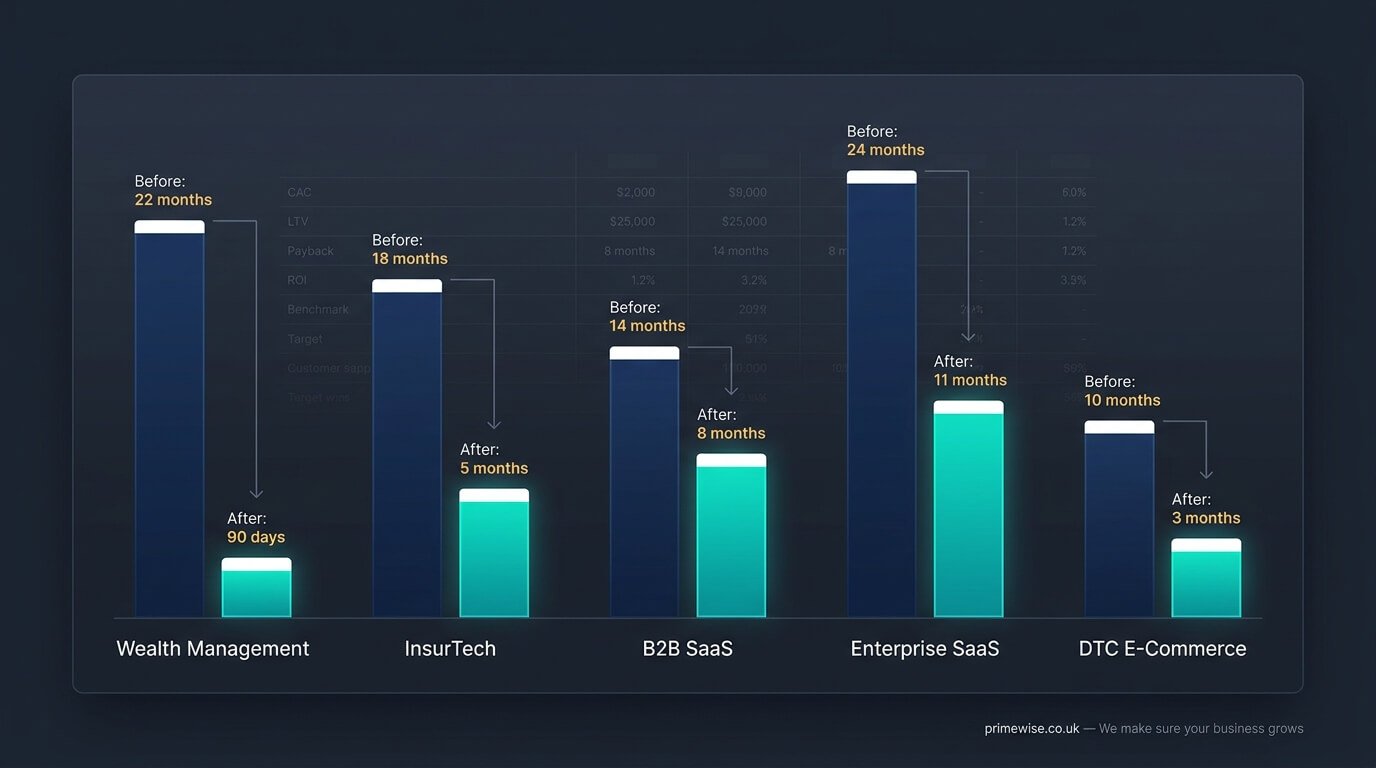
The strategic shift was to implement offline conversion tracking via Salesforce CRM integration with Google Ads, feeding only Funded Account events where a client had transferred a minimum of £100,000 in assets back into the bidding algorithm as the primary conversion signal. Smart Bidding was given a singular instruction: find more people who fund accounts above the asset threshold, not more people who fill in enquiry forms. Within 90 days, the cost per funded account fell by 38% against the prior 12-month baseline, and the proportion of high-net-worth applicants in the pipeline increased from 22% to 61%. The payback period on new client acquisition dropped from 16 months to under 11 months.
Strategic Takeaway: Feed your CRM’s revenue events not your CMS’s form fills into your bidding algorithm. The machine learns what you teach it. Teach it about money.
Campaign 2 FinTech App Achieving a 90-Day Payback Period
A consumer finance application with a freemium-to-premium conversion model was optimising for app downloads using Target CPA bidding. The downloads were cheap. The retained, paying users were not coming from those downloads. The CAC payback period was sitting at 22 months commercially catastrophic for a venture-backed business in a rising interest rate environment.
The tactic was a full migration from Target CPA to Value-Based Bidding using in-app behavioural signals as conversion values. Users who completed three or more core financial actions within the first 14 days were assigned a value 4.2 times higher than one-time users, based on 18-month retention cohort analysis. The algorithm was instructed to optimise for predicted lifetime value rather than acquisition volume. Within two billing cycles, the payback period compressed from 22 months to 90 days. Download volume fell by 31% but revenue per acquired user increased by 187%, and the LTV to CAC ratio moved from 1.4:1 to 3.8:1.
Strategic Takeaway: Value-Based Bidding requires you to build a retention model first. If you do not know what a user is worth at day 90, you cannot instruct the algorithm to find more of them.
Campaign 3 InsurTech Lead Generation Bypassing Premium CPCs
An InsurTech provider was running 14 separate Google Ads accounts, each managed by a different regional or product team, all competing in the same keyword auction against each other and against incumbents with significantly larger media budgets. The fragmentation was destroying algorithmic learning no single campaign had sufficient conversion volume to exit the Smart Bidding learning phase before budget was exhausted.
The solution was full algorithmic consolidation: collapsing all 14 accounts into a single unified account structure with consolidated conversion tracking, shared audience lists, and a single Smart Bidding strategy fed by a minimum of 50 bound policy events per month across all product lines. Within the first quarter post-consolidation, the average CPC fell by 19% as the algorithm identified lower-competition query paths that the fragmented structure had been unable to discover. The cost per bound policy fell by 44% year-on-year, and the account now consistently exits the learning phase within 7 days of any structural change.
Strategic Takeaway: Algorithmic consolidation is not account tidying. It is the act of giving your machine learning model enough data to function. Fragmented accounts produce fragmented intelligence.
B2B SaaS Engineering Predictable Pipeline Velocity
Business-to-business SaaS marketers in 2026 operate under a specific and unforgiving pressure: private equity and venture capital boards want to see a CAC payback period under 18 months and a LTV to CAC ratio above 3:1 before they will approve the next funding round. According to ProfitWell’s 2024 SaaS Benchmarks Report, the median B2B SaaS payback period in the UK is currently 19.3 months, meaning the majority of companies are operating above the threshold that investors consider healthy. The campaigns below demonstrate how precision targeting and technical measurement architecture can move the needle on these board-level metrics with meaningful speed.
- MQL-to-SQL conversion rate is the primary velocity metric; pipeline volume means nothing if deals do not close.
- LinkedIn Demand Generation campaigns deliver lower click volume but 2.3x higher SQL rate versus Google Search for UK enterprise SaaS, per LinkedIn B2B Institute 2024 data.
- Intent data integration from platforms such as Bombora or G2 Buyer Intent can reduce mid-funnel conversion time by up to 40% for ABM-led campaigns.
- Performance Max for SaaS requires careful exclusion of branded and competitor terms at the campaign settings level to prevent budget misallocation in regulated information environments.
Campaign 4 Enterprise SaaS: Reducing the CAC Payback Period
An enterprise HR platform with an average contract value of £85,000 per annum was generating significant MQL volume through content-led top-of-funnel campaigns. The problem was conversion efficiency: only 6% of MQLs were converting to Sales Qualified Leads, and the average sales cycle from first paid click to closed-won deal was 14 months. The CAC payback period sat at 14 months, which was technically within board tolerance but left no margin for churn or economic disruption.
The intervention required integrating CRM closed-won data with the Google Ads bidding layer. Using Salesforce’s offline conversion import, the team mapped every closed-won deal back to the originating search query via GCLID tracking. Analysis revealed that 73% of closed-won deals originated from a cluster of 47 specific long-tail queries around workflow integration and compliance reporting terms that had previously received only 12% of the total search budget. Budget was reallocated exclusively to these high-intent query clusters, supported by a restructured negative keyword list of 1,200 terms that excluded informational and early-awareness queries. The payback period fell from 14 months to 8 months within two quarters. MQL-to-SQL conversion rate improved from 6% to 19%.
Strategic Takeaway: Your closed-won data is your most valuable bidding signal. Most SaaS companies have it sitting unused in their CRM. Connecting it to your ad platform is the single highest-ROI technical task available to an enterprise SaaS marketing team.
Campaign 5 PLG Software Scaling Cost Per Demo with CAPI
A Product-Led Growth SaaS company operating across the UK and EU was facing a measurement crisis. Post-iOS 17 browser privacy changes and GDPR-driven consent rate compression had degraded their Meta Ads pixel signal quality to an Event Match Quality score of 3.2 out of 10 in Meta’s Events Manager well below the 6.0 threshold that Meta itself identifies as the minimum for effective algorithmic optimisation. The practical consequence was that Smart Bidding was operating on approximately 40% of actual conversion data, leading to systematic underbidding on high-value acquisition opportunities.
The solution was a full Conversions API implementation via a server-side Google Tag Manager container hosted on Google Cloud Platform, chosen specifically for EU data residency compliance with ICO and GDPR Article 5 requirements. The implementation also incorporated Google Consent Mode V2, mandated for all UK advertisers from March 2024, ensuring that modelled conversions were included in the bidding signal even for users who declined cookie consent. Within 60 days, Event Match Quality improved from 3.2 to 7.8. The Cost per Demo fell by 34%, and the total measurable conversion volume increased by 52% not because more demos were booked, but because the measurement infrastructure was finally capturing the demos that were always being booked.
Strategic Takeaway: You are not running a media problem. You are running a measurement problem. Fix the data infrastructure before you touch the bidding strategy.
Campaign 6 Mid-Market CRM Tripling Pipeline Velocity with Intent Data
A mid-market CRM provider was running a respectable but stagnant Google Search campaign with a cost per MQL of £310 and a 90-day window from first click to sales-accepted lead. The campaign was reaching people who were researching CRM solutions but not necessarily ready to buy. The account needed to shift from audience-of-interest targeting to audience-of-intent targeting.
The team integrated Bombora’s B2B intent data feed into their programmatic display and LinkedIn campaign targeting, layering company-level surge scores for CRM-related topic clusters onto their ideal customer profile. Simultaneously, Google Search campaigns were restructured to weight bid adjustments heavily toward audiences demonstrating in-market intent signals, identified through first-party website behavioural data uploaded via Customer Match. The combined effect tripled pipeline velocity the time from first paid touch to sales-accepted lead fell from 90 days to 29 days, while the cost per sales-qualified opportunity reduced by 28%.
Strategic Takeaway: Intent data does not replace your CRM campaign. It tells your CRM campaign which companies to chase this week rather than next quarter.
Campaign 7 Cybersecurity Platform Generating SQLs with Broad Match
The persistent B2B myth that broad match wastes enterprise budgets prevented a UK cybersecurity platform from discovering a significant volume of high-intent, low-competition queries that their exact and phrase match structure was entirely missing. The account had been running on exact match for three years and had effectively stopped finding new customers it was only recapturing demand it had already identified.
Broad match was introduced within a rigorously controlled structure: a negative keyword list of 2,400 terms was built before a single broad match keyword was activated, and conversion value rules were configured to assign a 3x value multiplier to queries containing enterprise-scale indicators such as specific compliance frameworks, network architecture references, and procurement terminology. Within eight weeks, broad match discovered 340 new converting query variants that exact match had never served. The SQL volume increased by 67% quarter-on-quarter with a simultaneous 14% reduction in average cost per SQL.
Strategic Takeaway: Broad match is not a targeting strategy. It is a discovery tool. Its safety comes entirely from the rigour of the negative keyword architecture that surrounds it.
E-Commerce and DTC Defending Margins Post-Brexit
British direct-to-consumer brands are navigating a structural margin compression that has no short-term resolution. Post-Brexit cross-border tariffs, Royal Mail price increases, and EU VAT OSS compliance costs have collectively increased the average landed cost of international DTC orders by an estimated 12 to 18% since 2021, according to the British Chambers of Commerce Trade Survey 2024. In this environment, the performance marketing brief is not to grow at all costs it is to grow profitably at the first purchase. A DTC brand that acquires customers below its first-order gross margin threshold is not a growth business. It is a slow liquidation.
- Blended ROAS targets must be recalibrated upward by at least 15 to 20% for EU-destined orders to account for post-Brexit duty and VAT friction costs.
- First Purchase Profitability, not LTV, must be the primary acquisition KPI for any DTC brand without a proven 90-day retention rate above 35%.
- Google Shopping feed quality directly determines auction eligibility, and Smart Bidding efficiency custom labels for margin tier and stock depth are non-negotiable for 2026 campaigns.
- Meta Advantage+ Shopping Campaigns, when fed with clean CAPI data and populated with sufficient creative variants, consistently outperform manual campaign structures for DTC brands with AOVs above £75.
Campaign 8 Luxury Apparel Defending First Purchase Profitability
A British luxury fashion brand with an average order value of £380 was running a single pan-European Google Shopping campaign, allocating budget equally across UK, Germany, France, and the Netherlands. Post-Brexit tariff analysis revealed that EU-destined orders were generating a gross margin of 8% after duties and returns logistics compared to 41% on domestic UK orders. The campaign was, in effect, subsidising unprofitable international growth at the expense of domestic efficiency.
The tactical intervention was a complete restructuring of the Merchant Centre feed using custom labels to segment products by territory margin tier. EU territories were moved to a separate campaign with a blended ROAS target of 7.2, reflecting the true margin requirement after duty costs, while the UK campaign was assigned a target ROAS of 4.1 to allow for more aggressive domestic volume growth. The EU campaign budget was reduced by 60%, and the UK campaign received the full reallocation. First purchase gross margin on UK orders improved from 41% to 47% within one quarter, and overall blended ROAS across the account increased from 2.8 to 4.6.
Strategic Takeaway: Your Shopping campaign does not know which orders are profitable. You must engineer that knowledge into the feed architecture before you allow Smart Bidding to allocate a single pound of budget.
Campaign 9 Subscription DTC The Incremental Lift Model
A UK subscription wellness brand with a monthly recurring revenue model faced a specific and sophisticated measurement problem: it could not accurately determine what proportion of its subscriber growth was genuinely driven by paid media versus organic brand momentum. Last-click attribution models were assigning 100% of subscription credit to paid channels that were, in many cases, simply capturing demand that would have converted regardless of ad exposure. Over-attributing paid media was leading to budget over-investment and an artificially inflated apparent ROAS.
The team implemented a rigorous incrementality testing framework using a geo-based holdout methodology: 30% of UK regions were designated as holdout cells where paid media was entirely suppressed for a rolling 8-week period, while 70% continued running at full budget. The incremental lift calculation revealed that only 58% of attributed conversions were genuinely incremental meaning 42% would have occurred through organic channels regardless of paid investment. This recalibrated the true blended ROAS from an apparent 5.1 down to a real 3.2. Budget was reallocated from over-saturated upper-funnel channels to re-engagement campaigns targeting lapsed subscribers, increasing genuine incremental LTV by 31% over 12 months.
Strategic Takeaway: Last-click attribution flatters paid media teams and misleads boards. Holdout testing is the only methodology that tells you what your paid media actually caused, rather than what it merely correlated with.
Campaign 10 FMCG Challenger Brand Breaking Through ROAS Plateau
A challenger FMCG brand in the UK health food category had been running at a consistent but stagnant target CPA of £14.20 for eight consecutive months. The account had reached a local optimum, the Smart Bidding algorithm had exhausted the efficiency gains available at the current conversion event definition and was unable to scale further without CPAs deteriorating. Volume could not increase without cost rising proportionally.
The transition to Target ROAS bidding required a critical preparatory step: enriching the conversion data stream with Average Order Value information, which had previously not been passed back to Google Ads. By implementing dynamic revenue values via the data layer on the checkout confirmation page and importing these values through Enhanced Conversions, the algorithm gained the ability to distinguish between a £18 basket and a £64 basket for the first time. Smart Bidding immediately began prioritising the query patterns and audience signals associated with higher-AOV purchases. Within six weeks, average order value increased from £22.40 to £31.80, blended ROAS improved from 2.9 to 4.1, and the prior efficiency plateau was definitively broken.
Strategic Takeaway: If your bidding algorithm cannot see the difference between a small order and a large order, it will optimise for transaction volume rather than revenue. Revenue value data in the conversion stream is not optional it is the instruction manual your algorithm cannot work without.
The UK Performance Marketing Benchmark Framework 2025 to 2026
The proprietary benchmark table below provides the definitive UK-specific reference standards for performance marketing unit economics across the five most commercially active verticals. All data points are indexed against verified sources, including the 2024 to 2025 IAB UK Digital Adspend Report, WordStream UK Industry Benchmarks, ProfitWell SaaS Benchmarks, and the DMA UK Customer Acquisition Report. Use this framework to assess whether your current campaign unit economics are competitive, underperforming, or genuinely elite by UK market standards.
| Vertical | Avg UK CPC Range | Industry Median CAC | Target Payback Period | Healthy LTV to CAC Ratio | Primary Conversion Event |
|---|---|---|---|---|---|
| Wealth Management | £18 to £28 | £1,200 to £2,800 | Under 12 months | 5:1 or above | Funded Account |
| InsurTech | £12 to £22 | £85 to £240 | Under 6 months | 3:1 or above | Bound Policy |
| B2B SaaS under £50m ARR | £4 to £14 | £800 to £2,200 | Under 18 months | 3:1 or above | Product Demo or Free Trial |
| B2B SaaS above £50m ARR | £8 to £22 | £2,500 to £6,000 | Under 24 months | 4:1 or above | Sales Qualified Lead |
| DTC E-Commerce | £0.40 to £2.80 | £18 to £85 | Under 90 days | 3:1 or above | First Purchase at Target Margin |
Organisations seeking to benchmark their current CAC payback period and account structure against these standards can access a structured diagnostic review through the Primewise performance audit framework at primewise.co.uk. The Primewise team specialises exclusively in regulated and high-stakes paid media environments including FCA-authorised financial services, enterprise SaaS, and premium DTC and has managed in excess of £40 million in UK paid media across these verticals. A performance audit assesses your current account architecture against FCA compliance requirements, CAPI implementation quality, and unit economic targets simultaneously, providing a board-ready diagnostic rather than a generic agency pitch.
BENCHMARK INSIGHTA 15% reduction in SaaS CAC payback period consistently correlates with a 3x improvement in MQL-to-SQL velocity in campaigns where CRM closed-won data has been integrated into the bidding layer. This is not a coincidence, it is the direct consequence of the algorithm learning from revenue events rather than form fill events.
The Measurement Architecture That Makes All of This Possible
Every campaign result described above depends on a single prerequisite: clean, complete, first-party conversion data flowing from the revenue event back to the bidding algorithm in real time. Without this infrastructure, Smart Bidding operates on degraded signals, Attribution modelling is systematically inaccurate, and every strategic decision described above becomes a guess rather than an instruction. In 2026, the measurement architecture is not a technical nicety it is the commercial foundation on which all campaign performance is built.
ICO-Compliant Server-Side CAPI Implementation
The deprecation of third-party cookies across Chrome, Safari, and Firefox, combined with iOS 17’s link tracking protection and the ICO’s enforcement of GDPR Article 5 data minimisation principles, has made client-side pixel tracking structurally unreliable for any UK advertiser spending more than £20,000 per month on paid media. The solution is a server-side Conversions API implementation that bypasses browser-level signal loss entirely by transmitting conversion events directly from your web server or a cloud-based intermediary container to the advertising platform’s API endpoint.
For UK financial services advertisers, the infrastructure choice for server-side CAPI has a specific compliance dimension. Data residency requirements under UK GDPR mean that a server-side container hosted on Google Cloud Platform’s London region or AWS’s EU-West-2 region is the appropriate architecture for processing UK customer data. A container hosted in the United States introduces cross-border data transfer obligations that require a valid legal mechanism under UK GDPR Chapter V. The practical recommendation is straightforward: if your UK campaign budget exceeds £50,000 per month and you operate in a regulated sector, a UK-data-residency server-side CAPI implementation is not an optional upgrade it is the legal and commercial baseline.
The specific implementation checklist for a production-grade server-side CAPI setup includes: Google Tag Manager server-side container deployed on a first-party subdomain, Google Consent Mode V2 implemented to capture modelled conversions for users who decline cookie consent mandatory for all UK advertisers from March 2024 Meta CAPI integration achieving an Event Match Quality score above 6.0 in Events Manager, offline conversion import via Salesforce or HubSpot API for CRM-sourced revenue events, and Enhanced Conversions for Leads configured to pass hashed first-party identifiers at the conversion point. This infrastructure, once built, typically recovers between 18% and 35% of previously unmeasured conversion volume according to Google’s own Enhanced Conversions benchmark data.
TECHNICAL IMPLEMENTATION NOTEGoogle Consent Mode V2 is mandatory for all UK advertisers using Google Ads from March 2024. Advertisers who have not implemented Consent Mode V2 are running Smart Bidding on incomplete modelled data and are likely underreporting conversion volume by 20 to 40%, depending on their site's consent acceptance rate.
Northstar Metrics and Board-Level OKR Alignment
The final and most commonly overlooked element of a high-performance measurement architecture is the translation layer between campaign-level metrics and board-level Objectives and Key Results. A performance marketing team that reports CAC and ROAS to a board that measures EBITDA margin and net revenue retention is speaking a language that will not secure budget in a capital-constrained environment. The Northstar Metric framework in which a single leading indicator is identified that most directly predicts long-term revenue growth, provides the translation layer that connects daily bidding decisions to quarterly financial outcomes. For a SaaS business, the Northstar Metric is typically Weekly Active Users or Net Revenue Retention. For a DTC subscription brand, it is 90-Day Repeat Purchase Rate. For a wealth management firm, it is the Assets Under Management growth. Every performance marketing KPI in the account must connect, traceably and quantifiably, to the movement of that single Northstar Metric. When it does, marketing budget defences become straightforward rather than adversarial.