

The Performance Marketing Consultant vs Agency decision is one of the most consequential capital allocation choices a scaling business will make. Choosing the wrong resourcing model does not simply slow growth, it actively destroys margin through misaligned incentives, agency bloat, and misdirected media spend. Whether you are a Series A fintech evaluating your first major acquisition push or an enterprise marketing director restructuring vendor governance, this guide delivers a definitive framework for identifying exactly which model generates the strongest risk-adjusted return at your current growth stage. If you are exploring the independent route first, understanding what an independent performance marketing consultant actually delivers commercially is the essential starting point.
Quick Decision Summary
Before diving into the full analysis, the table below provides a fast, scannable comparison across the five most commercially decisive variables. This is designed for C-suite executives who need directional clarity before committing to a procurement process.
| Decision Variable | Performance Marketing Agency | Independent Consultant |
|---|---|---|
| Cost Model | 10–20% of media spend plus London overhead premium | Fixed day rate or project retainer, decoupled from media budget |
| Execution Speed | High multi-disciplinary teams deploy immediately | Moderate strategic leadership, not mass execution bandwidth |
| Regulatory Alignment (FCA) | Variable external teams are unfamiliar with the internal risk appetite | Strong embeds directly into legal and compliance workflows |
| IP and Capability Ownership | Low knowledge and systems remain agency-side on exit | High builds internal capability and transfers intellectual property |
| Ideal Funding Stage | Series A and B rapid scaling phase | Seed stage validation and enterprise hybrid governance |
Defining the Two Models
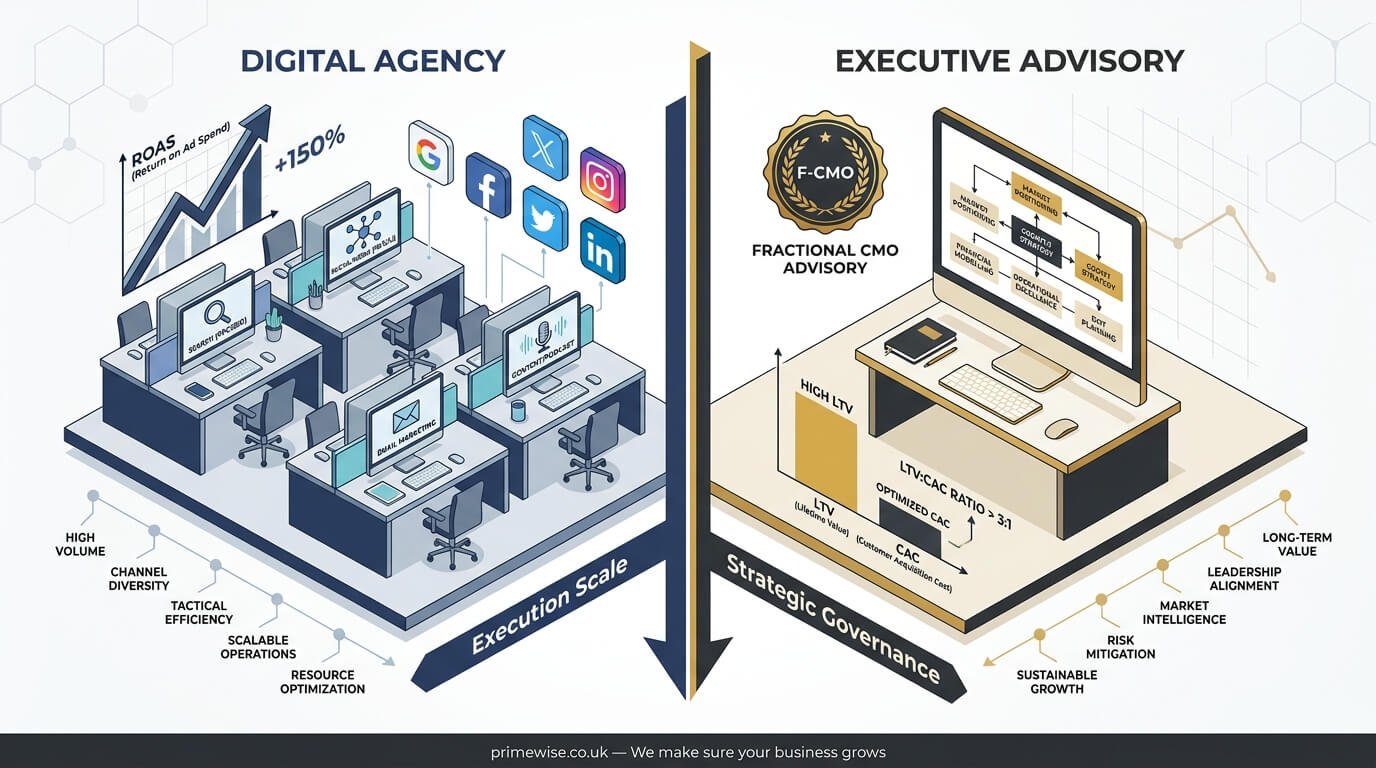
A performance marketing agency is a multi-disciplinary commercial operation that provides outsourced execution across paid search, paid social, programmatic advertising, and conversion rate optimisation. Revenue is typically derived from a percentage of managed media spend, creating a structural incentive to grow budgets rather than necessarily improve efficiency. In contrast, an independent performance marketing consultant provides senior-level strategic oversight, vendor governance, and internal team leadership on fixed day rates or project-based retainers with zero commercial incentive to inflate media spend.
- Agencies offer immediate access to execution bandwidth across multiple acquisition channels simultaneously.
- Consultants provide objective strategic advisory and commercial acumen entirely free from cross-selling bias.
- Agency commercial models scale proportionally with media spend, meaning costs rise automatically as budgets grow.
- Consultants decouple governance costs from media budgets, creating predictable fixed overheads at any spend level.
- Agencies absorb enterprise marketing technology costs across their client portfolio, providing access without capital expenditure.
- Consultants embed seamlessly into internal legal and compliance workflows, a critical advantage for FCA-regulated firms.
EXECUTIVE INSIGHTAccording to the Hays Marketing Salary Guide 2025, senior independent performance marketing consultants in London command day rates of £800–£1,800. A company spending £100,000 per month on media with a typical agency at 15% of spend pays £15,000 per month in management fees alone, frequently double the cost of a senior consultant providing superior strategic governance.
Key Market Data You Should Know
Grounding this decision in verifiable data is non-negotiable for accurate financial forecasting. The procurement landscape has shifted materially in recent years, and decisions based on outdated assumptions carry real commercial risk.
According to the IPA Bellwether Report Q4 2024, UK digital advertising budgets grew by 9.3% year-on-year, intensifying competitive pressure in biddable media auctions and elevating the cost of inefficient agency management. The CIPS 2025 UK Procurement Survey found that 67% of marketing directors reviewed their agency contract structure within 12 months of a Series B funding round a clear signal that the agency model frequently fails to scale efficiently with the business. Statista data for 2025 places total UK digital ad spend at £29.6 billion, with paid search and paid social representing over 70% of all performance marketing investment, confirming that channel depth and bidding sophistication are now minimum viable competencies for any external marketing partner.
- UK agencies typically charge 10–20% of managed media spend, with Central London firms commanding a further overhead premium of 15–25% above regional equivalents.
- Senior independent consultants in the UK average £800–£1,800 per day (Hays 2025), with project retainers often fixed between £4,000 and £12,000 per month.
- 67% of Series B marketing directors restructured their agency contracts within one year of funding, indicating systemic misalignment between agency commercial models and scaling business needs.
- UK digital ad spend reached £29.6 billion in 2025, making procurement efficiency in performance marketing a material financial lever for mid-market and enterprise firms.
Where Performance Marketing Agencies Win
The agency model has genuine structural advantages that no honest analysis can ignore. For businesses at specific growth stages and with particular operational profiles, an agency is the objectively superior choice. Understanding precisely where agencies excel prevents the common mistake of engaging a consultant when raw execution scale is what the business actually needs.
Execution Bandwidth Across Multiple Channels
Financial services scale-ups and technology companies entering competitive acquisition markets frequently need to activate paid search, paid social, programmatic, and display advertising simultaneously within compressed timeframes. Assembling an internal team with this breadth of expertise requires months of recruitment and carries significant salary overhead before a single campaign goes live. Agencies solve this execution bottleneck by deploying entire teams of media buyers, advertising operations specialists, conversion copywriters, and creative strategists at short notice, compressing time-to-market in ways that internal hiring simply cannot match.
Proprietary Technology and Resource Redundancy
A commercially underrated advantage of the agency model is access to enterprise-grade marketing technology without the associated capital expenditure. Algorithmic bidding platforms such as Google’s Search Ads 360, programmatic demand-side platforms, and multi-touch attribution software like Northbeam or Triple Whale carry substantial licensing costs that agencies distribute across their entire client portfolio. The result is that mid-market clients access institutional-grade tooling at a fraction of direct cost. Beyond technology, agencies provide critical operational redundancy; campaign performance does not degrade when a media buyer takes leave or resigns, because team depth absorbs individual attrition without disrupting delivery.
Where Independent Consultants Deliver Superior Outcomes
The consultancy model is not simply a budget-friendly alternative to an agency. For specific operational contexts, particularly governance-heavy, compliance-sensitive, or capability-building environments, an independent consultant consistently delivers outcomes that no agency structure can replicate. The distinction lies in the alignment of commercial incentives and the depth of strategic integration.
Unbiased Vendor Selection and Media Auditing
The most structurally significant problem with the agency model is cross-selling bias. An agency’s revenue depends on retaining and expanding the service scope it delivers to each client, which means its strategic recommendations are never entirely free from commercial self-interest. Independent consultants carry no such conflict. They conduct rigorous media auditing, assessing whether existing agency partners are genuinely performing or simply sustaining spend levels that serve their own fee structures and run objective vendor selection processes where external partners are chosen entirely on merit. This governance function alone frequently delivers a 20–30% reduction in wasted media spend within the first quarter of engagement.
In-House Capability Building and Fractional CMO Leadership
Enterprises with a long-term strategic objective of building internal performance marketing capability require a fundamentally different kind of external partner. A senior consultant operating as a fractional Chief Marketing Officer steps into the organisation to upskill junior talent, design internal workflows, implement tracking infrastructure, and build the institutional knowledge that remains inside the business permanently. Unlike the agency model, where strategic knowledge and proprietary processes exist with the contract, the consultant model transfers intellectual property to the client. This distinction is commercially significant when a firm intends to eventually operate a fully internalised acquisition function.
FCA Regulatory Compliance Agility
Financial promotions in the United Kingdom are governed by the Financial Conduct Authority under COBS 4 of the FCA Handbook, which mandates that all financial marketing communications are fair, clear, and not misleading. FCA-regulated firms, including retail investment platforms, consumer credit providers, mortgage brokers, and insurance intermediaries, face approval workflows that require deep institutional familiarity with internal risk appetite, legal sign-off processes, and compliance team capacity. External agencies, regardless of their performance credentials, frequently struggle with the nuanced and often lengthy approval cycles inherent in regulated financial marketing environments.
Independent consultants solve this problem by embedding directly into the client’s internal legal and compliance structure. Rather than operating at arm’s length and submitting creative for external approval, a consultant participates in the briefing stage compliance conversations, builds FCA-aligned messaging frameworks proactively, and reduces approval cycle times materially. Specialists such as PrimeWise.co.uk operate precisely at this intersection, embedding senior performance marketing consultants into FCA-regulated environments with established legal approval workflows, ensuring campaigns reach market faster without compromising regulatory integrity.
REGULATORY WARNINGFCA COBS 4 governs all financial promotions in the UK. Non-compliant marketing communications expose firms to enforcement action, financial penalties, and reputational damage. External agencies without embedded compliance experience significantly increase regulatory risk in this category.
Matching the Resource Model to Business Maturity
The single most common cause of performance marketing failure is not poor creative or inadequate media budgets it is deploying the wrong resource model for the current business stage. An enterprise-scale agency engaged before product-market fit is established burns runway without generating learning. A solo consultant engaged during a Series B scaling sprint creates an execution bottleneck that caps growth below its potential. The framework below eliminates this misalignment risk by mapping resource decisions directly to the funding stage and unit economic maturity.
Seed Stage Validate Before You Scale
At the seed stage, the strategic imperative is not growth it is validation. Before committing to any material media spend, a founder must establish whether the unit economics of customer acquisition are viable. Customer Acquisition Cost (CAC) must be provably below a recoverable multiple of Lifetime Value (LTV), typically at a minimum LTV: CAC ratio of 3:1 for a sustainable acquisition model. Engaging a heavy agency retainer before this threshold is proven is a capital destruction exercise. The appropriate resource at this stage is a senior consultant who can design tracking infrastructure, run structured channel experiments across small budgets, and deliver a mathematically grounded channel viability assessment without charging fees that scale with the media spend being tested.
Series A and B Agency-Led Scaling
Once unit economics are proven and substantial growth capital is secured, the strategic objective shifts fundamentally to speed and scale. At Series A and B, the question is no longer whether acquisition works but how fast proven channels can be scaled and whether new channels can be unlocked in parallel. This is the operating environment where the agency model delivers its highest commercial value. The execution manpower to run simultaneous paid search, paid social, and programmatic campaigns at increasing volume, while continuously testing creative and bidding strategies, exceeds what any single consultant can operationally deliver. An agency with proven biddable media expertise and platform-level relationships, particularly with Google and Meta, provides the raw execution capacity this phase demands.
Enterprise and Hybrid Governance
At enterprise maturity, the most effective resourcing model is neither pure agency nor pure consultant it is a hybrid structure in which a senior consultant or fractional Marketing Director governs a curated roster of specialist boutique agencies and an increasingly capable internal team. This model captures the execution depth of specialist external partners while maintaining the strategic objectivity and commercial oversight that only an independent operator can provide. PrimeWise.co.uk operates precisely within this framework, providing fractional senior marketing leadership for financial services and fintech firms that require both regulatory precision and performance at scale.
FRAMEWORK HIGHLIGHTThe hybrid model consultant-led governance over specialist boutique agencies consistently outperforms both the pure agency and pure in-house models at enterprise scale. It combines execution depth with independent strategic oversight, eliminating the cross-selling bias inherent in full-service agency retainers.
The Marketing Resourcing Matrix
The Marketing Resourcing Matrix is a proprietary decision framework that maps two critical internal business variables, current internal capability and required campaign execution speed, to generate a precise resource allocation recommendation. It eliminates the subjective bias that frequently distorts vendor selection and replaces it with a commercially grounded, repeatable evaluation process.
- High internal capability, low execution speed required: Rely on permanent internal staff. Maintain control, protect institutional knowledge, and optimise for cost efficiency without external dependency.
- High internal capability, high execution speed required: Supplement with specialist boutique agencies to unlock channel-specific execution scale without disrupting internal strategic leadership.
- Low internal capability, high execution speed required: Engage a full-service performance marketing agency immediately to build and launch campaigns at pace while internal recruitment is underway.
- Low internal capability, low execution speed required: Engage an independent consultant to build strategic foundations, design tracking infrastructure, validate unit economics, and guide the internal hiring roadmap.
Applying this matrix requires honest internal assessment. Most scaling businesses significantly overestimate their internal capability and underestimate the execution speed that their competitive environment genuinely demands. A structured capability audit reviewing team seniority, platform certifications, historical performance data, and technology stack maturity provides the objective inputs the matrix requires. A senior consultant is typically best placed to conduct this audit without the commercial bias that an agency would bring to the same assessment.
Commercial Models and UK Procurement Compliance
Understanding the structural cost differences between the two models is essential for accurate financial forecasting and procurement compliance. The cost arbitrage available to businesses that make this decision correctly is substantial and frequently underestimated by finance directors who evaluate marketing resource decisions on headline fee alone rather than the total cost of the commercial outcome.
Agency Fees Versus Consultant Cost Efficiency
The standard UK agency commercial model charges between 10% and 20% of total managed media spend. For a business investing £100,000 per month in paid media, this equates to between £10,000 and £20,000 in management fees every month before any performance-linked bonuses or technology surcharges. In Central London, agency overhead premiums add a further 15–25% above regional equivalents, reflecting the higher cost base of premium office space and London-weighted salaries. By contrast, a senior independent consultant operating on a fixed retainer of £6,000–£10,000 per month provides strategic governance entirely decoupled from the media budget meaning costs do not automatically escalate as spend grows. For accounts at £100,000 per month and above, this fixed-rate model offers material strategic arbitrage that compounds significantly over a 12-month engagement.
IR35, Off-Payroll Working Rules, and HMRC Compliance
UK businesses engaging independent marketing consultants must navigate the off-payroll working rules introduced under Chapter 10 of ITEPA 2003 commonly referred to as IR35 legislation. Since the April 2021 reforms, medium and large private sector firms bear responsibility for determining the employment status of contractors they engage. An incorrect determination that treats a genuinely self-employed consultant as an employee creates significant PAYE and National Insurance liability. HMRC’s Check Employment Status for Tax tool (CEST) provides the primary official mechanism for conducting this assessment, and its output should be documented and retained for audit purposes. Engaging a consultant through a properly constituted limited company structure, with clearly defined project-based deliverables and no overriding employer control, is the strongest structural position for IR35 compliance. Contracting a B2B agency carries none of this complexity, as the agency relationship falls entirely outside IR35 scope a procurement consideration that risk-averse finance teams frequently factor into vendor selection decisions.
UK TAX COMPLIANCEIR35 (Chapter 10 ITEPA 2003) places the employment status determination burden on the engaging business, not the consultant. Use HMRC's CEST tool and retain all documentation. Incorrect determinations create retrospective PAYE and NI liability. Always obtain qualified tax advice before engaging an independent contractor.
Marketing Mix Modelling and Incrementality Testing
One capability gap that consistently separates senior consultant governance from standard agency delivery is the application of marketing mix modelling (MMM) and incrementality testing to media investment decisions. Marketing mix modelling uses econometric analysis to attribute revenue outcomes across all marketing and non-marketing variables, providing a channel-level view of true incremental contribution that last-click attribution models fundamentally cannot deliver. Incrementality testing through geo-holdout experiments or matched market analyses validates whether a channel is genuinely driving new customer acquisition or simply capturing demand that would have converted through organic or direct means regardless.
Most mid-market agencies lack the statistical expertise to implement these methodologies rigorously. A senior independent consultant with econometrics experience can design and interpret MMM frameworks, identify the channels genuinely contributing to LTV: CAC improvement, and redirect budget away from channels that create the appearance of performance without generating genuine incrementality. This capability is particularly valuable for FCA-regulated financial services firms where marketing investment must be justifiable under both commercial and regulatory scrutiny.
The PrimeWise Diagnostic Approach
For finance directors, Chief Marketing Officers, and founders navigating this resourcing decision, the highest-value starting point is an objective diagnostic that maps your current internal capability, media spend efficiency, unit economic position, and regulatory compliance maturity against the resource model most likely to generate superior returns. PrimeWise.co.uk provides precisely this service a no-obligation strategic diagnostic for financial services and fintech leaders that identifies whether an agency, independent consultant, or hybrid governance model will deliver the strongest risk-adjusted commercial outcome at your current growth stage.
Rather than beginning with a sales conversation, PrimeWise.co.uk begins with an evidence-based capability assessment reviewing existing performance data, vendor contracts, tracking infrastructure, and team structure before making any resourcing recommendation. This diagnostic-first approach is the commercial embodiment of the consultant model’s core advantage: objective analysis in the absence of cross-selling incentive. Book a strategic consultation at primewise.co.uk to receive a clear, commercially grounded answer to the agency versus consultant question as it applies specifically to your business.