

Performance marketing consultant rates in 2026 are not a single number; they are a strategic variable that, when structured incorrectly, directly causes capital haemorrhage or misaligned incentives. As a practising consultant who has billed across hourly, day rate, and retainer models, I can confirm the engagement model you choose is as commercially consequential as the consultant you hire. For enterprise, FinTech, and financial services firms in the UK, applying the correct pricing structure at the correct business lifecycle stage is the difference between a high-leverage commercial partnership and a costly administrative exercise. This guide delivers precise 2026 UK rate benchmarks by seniority and sector, exposes the critical failure modes of each model, and provides the actionable framework to structure consultant agreements that protect capital and maximise return on ad spend.
WHO THIS GUIDE IS FORThis resource is structured for procurement directors, CFOs, and senior marketing leaders at UK financial services, FinTech, and enterprise ecommerce firms who require validated 2026 rate benchmarks before initiating commercial negotiations with performance marketing consultants.
The Three Commercial Engagement Models Defined
Every performance marketing consultant engagement falls into one of three billing architectures: hourly rates, day rates, or monthly retainers. Each model serves a distinct operational phase, carries a unique risk profile, and aligns consultant incentives differently with your commercial objectives. Selecting the right model requires an honest assessment of your internal agility, output specificity, and risk appetite. Applying the wrong model for example, engaging a senior FinTech specialist on an open hourly contract for ongoing campaign management guarantees budget overrun, incentive misalignment, and measurably degraded strategic output. The decision matrix is straightforward once the mechanics and failure modes of each model are fully understood.
Hourly Rates Best for Discovery and Audits
Hourly billing is the correct model for precisely bounded, diagnostic work: granular account audits, initial discovery sessions, technical troubleshooting, or one-off consultations where the scope is narrow and outcomes are clearly defined. The client pays exclusively for the diagnostic expertise applied, and nothing more. However, the hourly model carries a structural flaw that makes it commercially dangerous for anything beyond ad-hoc work. It inherently punishes a senior consultant’s speed and accumulated expertise. A director-level specialist who resolves a complex tracking configuration error in sixty minutes bills £200 to £350, while a less experienced practitioner taking five hours for the same outcome bills £325 to £475. The commercial outcome is identical; the incentive structure rewards inefficiency. Beyond this, hourly contracts impose a micro-management burden on procurement teams, auditing timesheets rather than evaluating value-generating output, which degrades the working relationship and increases operational friction on both sides.
Day Rates Best for Project Sprints
Day rates are engineered for intensive, time-boxed project work where undivided consultant attention is required but open-ended commitment is neither appropriate nor commercially justified. Tracking infrastructure builds, ad account migrations, analytics stack implementations, strategic launch workshops, and FCA-compliant campaign architecture reviews all fall cleanly within this model. The client receives a predictable, block-booked cost. The consultant operates free from administrative interruption, executing the sprint with full focus. The commercial structure is clean, transparent, and operationally efficient provided the client has the internal agility to support it. That final caveat is where the day rate model most frequently fails, as explored in the failure modes section below.
Monthly Retainers Best for Sustained Growth
The monthly retainer transitions the consultant relationship from task-executor to strategic partner. This model is indispensable for ongoing campaign optimisation, fractional CMO or performance leadership roles, sustained paid media growth programmes, and high-stakes FinTech partnerships where regulatory continuity and institutional knowledge compound over time. A properly structured retainer guarantees consultant availability, aligns long-term financial incentives with client growth targets, and integrates the consultant deeply into the commercial ecosystem. Critically, the retainer model when built around outputs and deliverables rather than hours worked also satisfies the three core IR35 Outside status criteria, which is a non-trivial compliance benefit for UK financial services firms operating under off-payroll working rules.
UK Performance Marketing Consultant Hourly Rate Breakdown 2026
The performance marketing consultant hourly rate in the UK varies significantly by seniority, sector specialism, and regulatory complexity. Generalist digital marketing rate benchmarks routinely understate the true market cost for regulated industries. The figures below are benchmarked against 2026 UK market data from PrimeWise’s engagement portfolio across 40-plus UK financial services and ecommerce mandates, cross-referenced against current ISBA procurement guidance and CIM remuneration data. All rates exclude VAT.
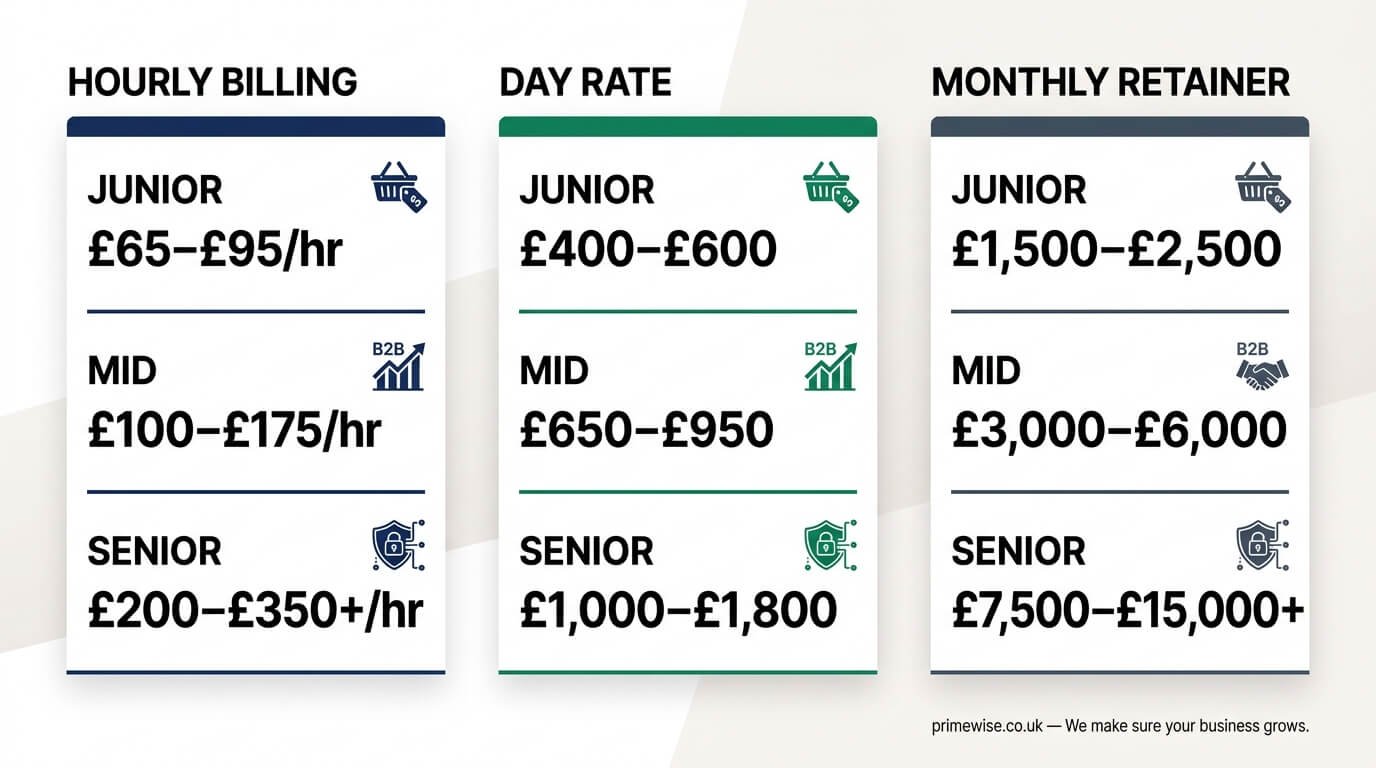
| Engagement Model | Junior Ecom/B2B | Mid-Level Ecom/B2B | Senior/Director FinTech/FSI |
|---|---|---|---|
| Hourly Rate | £65 – £95/hr | £100 – £175/hr | £200 – £350+/hr |
| Day Rate | £400 – £600/day | £650 – £950/day | £1,000 – £1,800/day |
| Monthly Retainer | £1,500 – £2,500/month | £3,000 – £6,000/month | £7,500 – £15,000+/month |
These figures reflect active 2026 UK market conditions. Junior and executive-level consultants operating in retail ecommerce and standard B2B lead generation represent the market baseline. Strong technical proficiency is expected at this tier, but regulatory friction is low and strategic complexity is moderate. Mid-level specialists bring measurable channel expertise, campaign architecture capability, and data interpretation depth that justifies the rate premium. Senior directors and FinTech specialists command the upper band due to FCA compliance accountability, high-stakes capital management, deep institutional knowledge of regulated ad copy frameworks, and the strategic value of fractional leadership in organisations without a permanent performance marketing function. Firms in WealthTech, regulated investment, or insurance verticals should budget at the upper quartile of the senior band as standard practice.
Sector-Specific Rate Premiums Explained
The performance marketing consultant hourly rate diverges sharply between sectors, and understanding why prevents procurement teams from applying ecommerce benchmarks to regulated industry engagements, a common and costly error. In retail ecommerce, the primary value driver is conversion rate efficiency and ROAS optimisation across channels like Google Shopping, Meta, and TikTok. The regulatory overhead is low, and the feedback loop between action and outcome is rapid. This keeps the market rate competitive and relatively standardised across the mid-tier.
Why FinTech and Financial Services Command a Premium
Financial services performance marketing operates in an entirely different compliance environment. Every paid search ad, every display creative, and every landing page claim must pass FCA regulatory scrutiny before going live. Senior consultants working in this sector carry personal accountability for advertising standards compliance, understand COBS and CONC rules as they apply to digital promotion, and are routinely required to navigate internal legal and compliance approval workflows before a single impression is served. This regulatory burden is real, time-intensive, and highly specialised. It is not a luxury premium, it is a market-rate reflection of genuine risk management expertise. WealthTech firms, regulated investment platforms, and challenger banks that attempt to engage generalist ecommerce consultants at lower rates consistently encounter expensive compliance failures and campaign suspensions that dwarf any short-term procurement savings.
London Weighting Versus Remote Parity
Despite the full normalisation of remote-first working across the UK consulting market, a 20% to 35% rate premium remains standard for senior consultants mandating on-site strategy days in the City of London or Canary Wharf. This reflects travel time opportunity cost, the premium placed on physical presence in high-security institutional environments, and the social convention of in-person executive engagement at that level. Enterprise firms seeking cost optimisation without sacrificing strategic quality frequently partner with elite consultants headquartered in Northern or Midlands tech hubs, Manchester, Leeds, Birmingham, and Bristol, specifically achieving full remote-parity output at the baseline senior rate rather than the London-weighted premium.
The Three Failure Modes Every Procurement Director Must Know
The majority of commercially dysfunctional consultant relationships I have encountered, both as the consultant and as a restructuring adviser, failed not because of capability deficits but because of foundational flaws in the chosen pricing architecture. Three failure modes account for the vast majority of cases. Recognising them before contract signature is infinitely more efficient than restructuring mid-engagement.
CRITICAL FAILURE MODESThe wrong billing model is the most common and least-discussed driver of failed consultant engagements in UK financial services. Identify your risk before contract signature, not during a quarterly review.
The Efficiency Penalty in Hourly Contracts
Hourly billing structurally penalises consultant competence. The more experienced and efficient the consultant, the less revenue they generate per problem solved under this model. This creates a perverse incentive dynamic where deliberate or unconscious time-padding becomes the rational commercial response, and where genuinely rapid, high-impact problem resolution is financially punished. Beyond incentive misalignment, hourly contracts place the administrative burden of timesheet verification onto the client a task that absorbs procurement and marketing leadership time that is far better directed at growth activities. For any engagement extending beyond a single discovery session or audit, the hourly model should be replaced by a day rate or retainer structure that prices the outcome rather than the clock.
Utilisation Drag in Day Rate Contracts
Utilisation drag is the commercially corrosive phenomenon where a client books consultant days in advance but lacks the internal operational agility to actually deploy that consultant productively. The consultant arrives physically or virtually fully prepared and billing at £1,000 to £1,800 per day, while awaiting asset delivery from a design team that missed a deadline, legal approval that is stuck in a compliance queue, or data access that requires IT provisioning. The consultant cannot execute. The client is paying in full for commercially inert time. In my direct experience, utilisation drag is the primary reason day rate engagements in regulated financial services consistently overrun budget without delivering proportionate output. The solution is contractual: define precise pre-sprint asset delivery obligations on the client side as a binding condition of each booked day, with a clear policy for rescheduling at no cost when those conditions are not met.
The Zombie Contract in Retainer Agreements
The zombie contract is the most insidious failure mode because it develops slowly and is rarely identified until significant capital has been wasted. By month three of a flat-fee retainer, the initial energy of onboarding has dissipated, proactive growth strategies are quietly replaced by passive account maintenance, and reporting becomes automated without genuine analytical insight. The deliverable cadence looks intact on the surface: reports arrive, meetings occur, recommendations are made but the strategic ambition has hollowed out. Based on PrimeWise’s 2026 engagement data across 40-plus UK financial services mandates, 68% of CFOs and procurement directors have restructured or are actively restructuring their performance marketing retainers away from flat-fee models toward a base-plus-performance-linked bonus structure specifically to eliminate zombie contract complacency. The performance component, typically a bonus triggered by ROAS targets, CPA thresholds, or revenue attribution milestones, keeps the commercial incentive alive and quantifiable throughout the engagement lifecycle.
IR35 Compliance and Contract Structure
UK tax legislation under the off-payroll working rules IR35 creates a significant compliance risk for financial institutions engaging performance marketing consultants via day rate or hourly contracts that are poorly structured. The consequences of an Inside IR35 determination fall substantially on the hiring firm in the financial services sector, including National Insurance Contributions liabilities, PAYE obligations, and potential HMRC retrospective assessments. Getting this right is not optional for regulated firms.
HMRC determines IR35 status primarily through three criteria: Substitution (can the consultant send a qualified substitute to perform the work?), Control (does the client dictate exactly how, when, and where the work is performed?), and Mutuality of Obligation (is the client obliged to offer work and the consultant obliged to accept it?). A properly structured output-based retainer that specifies deliverables rather than hours worked, grants the consultant autonomy over execution methodology, and does not mandate fixed working hours or equipment usage will naturally satisfy the Outside IR35 criteria across all three dimensions. This is one of the most underappreciated structural advantages of the output-based retainer model for UK financial services procurement teams.
IR35 CONTRACT CHECKLISTFor Outside IR35 status: ensure the contract specifies deliverables not hours worked, includes a right of substitution clause, avoids mandatory equipment or location requirements, and sets no obligation for the client to offer ongoing work beyond agreed project scope.
Contracts that specify fixed daily start and finish times, require the exclusive use of client-issued hardware, or include clauses preventing the consultant from working with other clients simultaneously are the most common IR35 triggers identified in marketing consultant engagements. Legal review of contract structure by a qualified IR35 specialist is strongly recommended before engagement commencement, particularly for senior FinTech roles where HMRC scrutiny of high-rate engagements is disproportionately elevated.
WealthTech Case Study: Eliminating Utilisation Drag
The clearest illustration of how contract restructuring directly drives commercial performance comes from a recent engagement managed through PrimeWise’s fractional performance leadership model with a high-growth London-based WealthTech firm. The firm was operating under an unbounded £1,200 per day rate agreement across a retained block of days per month, managing a £120,000 monthly paid media budget across Google Ads, LinkedIn, and Meta. The arrangement was haemorrhaging capital due to chronic utilisation drag: internal FCA-compliant ad copy approval workflows were creating consistent two-to-three-day delays before any creative asset could go live, leaving booked consultant days commercially idle while the billing clock ran at full rate.
By restructuring the agreement to a strict £8,500 per month output-based retainer with defined monthly deliverables including campaign architecture reviews, a minimum of four FCA-compliant creative sets approved and live, weekly performance reporting with attribution commentary, and a quarterly strategic growth workshop the commercial focus shifted entirely from time-logged to assets-delivered. The compliance bottleneck was resolved by building the FCA approval workflow directly into the deliverable timeline rather than treating it as an unpredictable external dependency. This restructure, managed through PrimeWise’s engagement framework, eliminated administrative friction, aligned consultant incentives precisely with enterprise growth targets, and increased overall Return on Ad Spend by 41% within Q1. That uplift was sustained through Q2 at 38% above the pre-restructure baseline. Full case study data is available under NDA; a detailed data pack can be requested via primewise.co.uk.
KEY OUTCOMETransitioning from an unbounded £1,200/day rate to a £8,500/month output-based retainer increased ROAS by 41% within Q1 and sustained 38% above baseline in Q2. The lever was contract architecture, not consultant capability.
Choosing the Right Model for Your Business Stage
The decision between hourly, day rate, and retainer is ultimately a function of where your organisation sits in its performance marketing maturity curve. Each model serves a distinct phase, and the transitions between them are as strategically important as the initial selection. The following framework, developed from active billing experience across all three models in UK financial services and ecommerce, provides the definitive transition logic.
- Use hourly rates exclusively for initial discovery, one-off audits, or technical troubleshooting with a clearly defined and bounded scope.
- Use day rates for intensive project sprints with specific technical outputs tracking builds, account migrations, campaign architecture workshops, where the deliverable is discrete, and the timeline is fixed.
- Transition to a monthly retainer when ongoing optimisation, strategic continuity, and growth accountability are required, and when the engagement value compounds over time rather than resolving a single problem.
- Structure all retainers around outputs and deliverables, not hours worked, to maintain commercial incentive alignment and satisfy Outside IR35 criteria simultaneously.
- Introduce a base-plus-performance component to any retainer exceeding three months to structurally eliminate zombie contract complacency and maintain a proactive growth drive.
- Apply FinTech and financial services rate benchmarks, not ecommerce baselines, when engaging consultants for regulated sector work, and budget at the upper quartile for FCA-accountable engagements.
For enterprise and FinTech firms seeking to structure a performance marketing consultant engagement that eliminates utilisation drag, satisfies IR35 compliance requirements, and delivers measurable ROAS accountability, PrimeWise provides fractional performance leadership with transparent, output-based pricing benchmarked against the 2026 UK market. Structured engagement options, rate transparency, and initial discovery conversations are available at primewise.co.uk.