

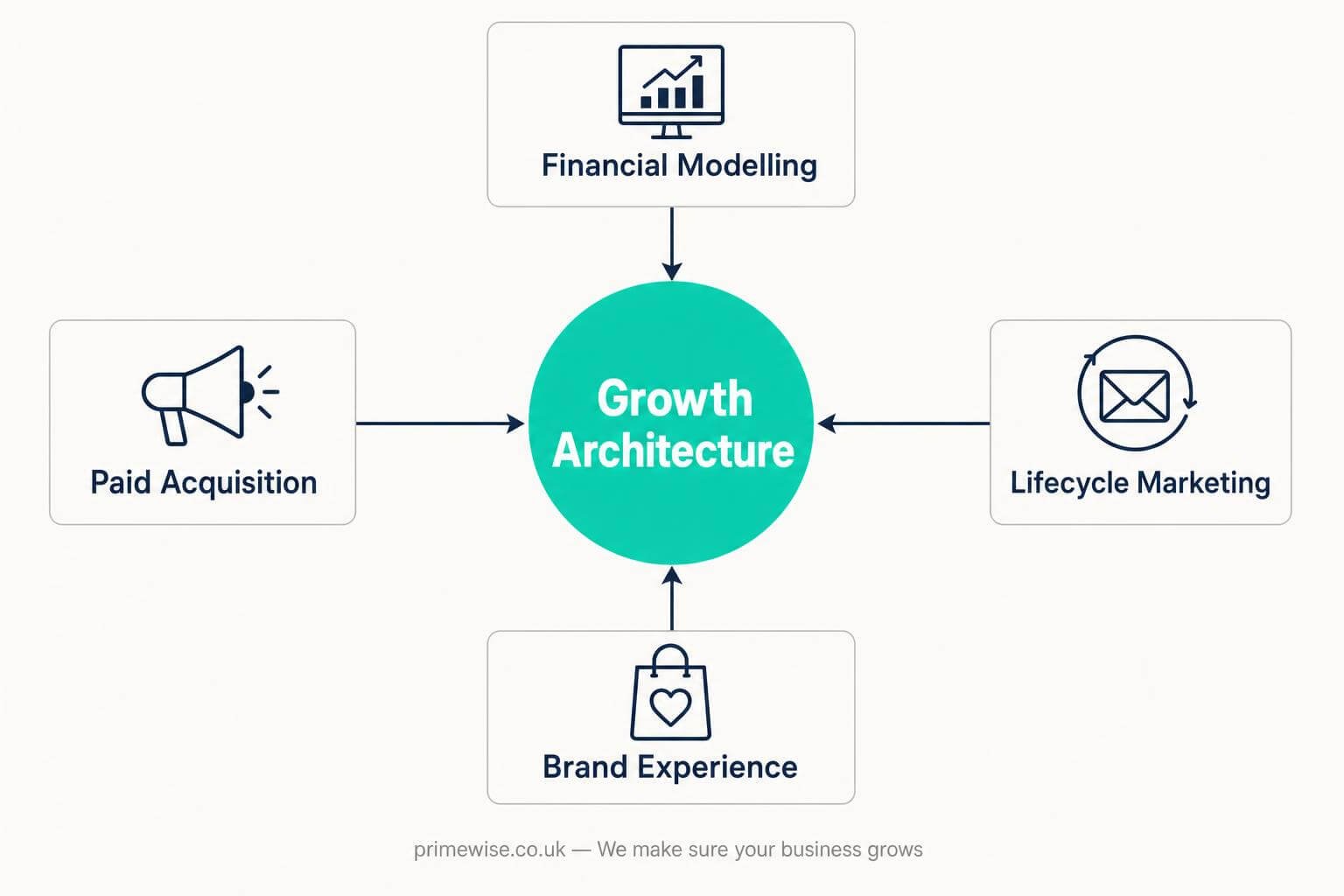
Performance marketing for Direct-to-Consumer (D2C) brands that sell products directly to end customers at the £1M–£20M growth corridor is one of the most demanding and consequential commercial challenges a founder can face. The strategies that generated early traction, lean media buying, founder intuition, and rapid product-market fit structurally collapse under the weight of hyper-growth. Customer acquisition costs deteriorate, creative fatigue accelerates across Meta and TikTok, and contribution margins compress precisely when top-line revenues appear most impressive. Navigating this inflection point demands a strategic operator who integrates paid acquisition, lifecycle marketing, and rigorous financial modelling into a single, unified growth architecture. At Primewise, this is exactly the operating model we deploy for UK D2C brands scaling through the most commercially treacherous phase of their growth journey.
Is Your D2C Brand Hitting the Growth Ceiling?Answer these three questions honestly. Is your blended customer acquisition cost rising faster than 12-month customer lifetime value? Have your Meta CPMs increased more than 35% year-on-year? Is your repeat purchase rate sitting below 35%? If you answered yes to any of these, your brand has outgrown its current marketing infrastructure and requires a structural intervention, not a budget increase.
Executive Summary
The £1M to £20M D2C growth journey is not a linear scaling exercise it is a sequence of distinct commercial environments, each requiring a materially different operating model, financial framework, and media strategy. Founders who apply the same playbook across all growth phases systematically destroy the unit economics that made early growth possible. The following benchmarks define what elite execution looks like at each milestone.
- At £5M revenue, shift from platform ROAS to blended contribution margin as the primary optimisation metric or risk scaling into unprofitability.
- Sustainable growth requires complete integration of top-of-funnel acquisition with lifecycle retention eliminating leaky bucket syndrome permanently.
- Reaching £10M demands a minimum of 30 structured creative variations tested weekly across Meta and TikTok to combat audience exhaustion.
- A secondary contribution margin (CM2) target of 25–30% and a tertiary contribution margin (CM3) of 15–20% are non-negotiable benchmarks at the £10M+ stage.
- A fractional growth lead embedded within the business consistently outperforms full-service London agency retainers on both ROI and strategic agility.
- UK-specific pressures post-Brexit logistics, cross-border VAT, and elevated warehousing costs must be modelled directly into media buying budgets, not treated as separate operational concerns.
What a D2C Performance Marketing Consultant Actually Does
A D2C performance marketing consultant is a senior strategic operator who assumes accountability for the entire commercial growth architecture not merely a channel or campaign. This individual integrates paid acquisition strategy, lifecycle automation, brand experience, and contribution margin management into a single operating model designed to scale revenue without compressing profitability. Unlike a media buyer who optimises individual campaign metrics, or a brand consultant who focuses on identity, a true D2C growth lead owns the relationship between top-of-funnel spend and back-end financial outcomes, ensuring that every pound of media investment generates measurable operating leverage.
Operating at this level requires fluency across a demanding technical stack. Elite D2C consultants work directly with platforms including Meta Advantage+ Shopping Campaigns, Google Performance Max, and TikTok Smart Performance Campaigns understanding not just their capabilities but their structural limitations and attribution blind spots. They simultaneously manage analytics infrastructure across tools such as Triple Whale, Northbeam, and post-purchase survey attribution platforms like KnoCommerce, ensuring that incrementality testing governs budget allocation decisions rather than last-click attribution models that systematically overstate platform-reported returns.
The Shift from ROAS to MER
One of the most consequential transitions a scaling D2C brand must make is abandoning platform return on ad spend as its primary success metric. Platform ROAS is an isolated, channel-specific figure that ignores blended media costs, organic traffic contribution, and the compounding effect of brand equity on conversion rates. The Marketing Efficiency Ratio, calculated as total revenue divided by total marketing spend across all channels, provides a holistic measure of commercial performance that aligns directly with contribution margin management. At the £5M milestone, deploying MER as the primary optimisation metric alongside CM2 tracking is not a best practice it is a prerequisite for profitable scaling.
Revenue Milestone Matrix
Understanding what separates elite performance from average execution at each revenue stage is critical for founders making high-stakes hiring and investment decisions. The table below defines the operational and financial benchmarks that characterise each growth milestone for UK D2C brands, based on performance data observed across brands in the health, beauty, homeware, and apparel verticals between 2023 and 2025.
| Revenue Stage | Blended CAC Target | CM2 Target | CM3 Target | Repeat Purchase Rate | Weekly Creative Variations | Marketing Spend as % of Revenue |
|---|---|---|---|---|---|---|
| £1M | £18–£32 | 35–45% | 20–28% | 22–28% | 8–12 | 15–22% |
| £5M | £28–£48 | 28–35% | 16–22% | 32–38% | 18–25 | 20–26% |
| £10M | £38–£62 | 25–30% | 15–18% | 38–45% | 28–35 | 22–28% |
| £20M | £45–£75 | 22–28% | 14–17% | 42–50% | 35–50 | 24–30% |
Breaking the £5M Revenue Ceiling
The £5M threshold is where the majority of D2C brands stall permanently. Brands that successfully crossed £1M into early momentum typically did so by exploiting high-intent audience pools, benefiting from novelty-driven creative performance, and operating with a lean cost structure that masked underlying unit economics weaknesses. At £5M, every one of those structural advantages inverts. Audience pools saturate, creative performance degrades rapidly without a systematic testing framework, and the true cost of customer acquisition becomes visible at a scale that makes the P&L uncomfortable reading.
The D2C Contribution Margin Escalator
The Contribution Margin Escalator is a proprietary financial framework used by Primewise to map variable cost ratios against revenue growth trajectories, ensuring that blended acquisition costs remain structurally proportionate to customer lifetime value at every scaling stage. Rather than treating CM as a retrospective accounting metric, this framework embeds margin thresholds directly into media buying constraints meaning that ad spend is automatically moderated when CM2 or CM3 drops below pre-agreed floors. At the £5M stage, this framework typically identifies two to four points of recoverable margin compression that are invisible to brands relying solely on platform-reported metrics. For context, UK pick, pack, and dispatch costs average between £3.20 and £5.50 per order depending on SKU complexity a variable cost that must be embedded within CM2 modelling before any media budget is committed.
Why Fragmented Agency Setups Fail at Scale
Most D2C brands arrive at the £5M ceiling managing three to five separate agency relationships a paid media agency, an email marketing provider, a creative studio, a logistics partner, and a brand consultant none of whom share a unified financial objective or communicate in real-time. This fragmentation creates systematic attribution conflicts, duplicated spend, and strategic incoherence. No single entity owns the relationship between front-end acquisition cost and back-end lifetime value, which means that budget allocation decisions are made in commercial isolation. The result is compounding inefficiency that becomes structurally impossible to fix by adding another agency to the roster.
The Acquisition and Lifecycle Equilibrium
The most expensive mistake a scaling D2C brand makes is treating paid acquisition and lifecycle marketing as separate functions with separate budgets and separate success metrics. Elite performance marketing for D2C brands treats these as a single, unified commercial system the Acquisition-Lifecycle Equilibrium where front-end media spend is calibrated against the predictive lifetime value generated by back-end retention infrastructure. When this equilibrium is functioning correctly, increasing acquisition spend accelerates profitability rather than compressing it, because each acquired customer enters a retention architecture designed to generate two to four repeat purchases within 12 months.
Creative Velocity at the £10M Stage
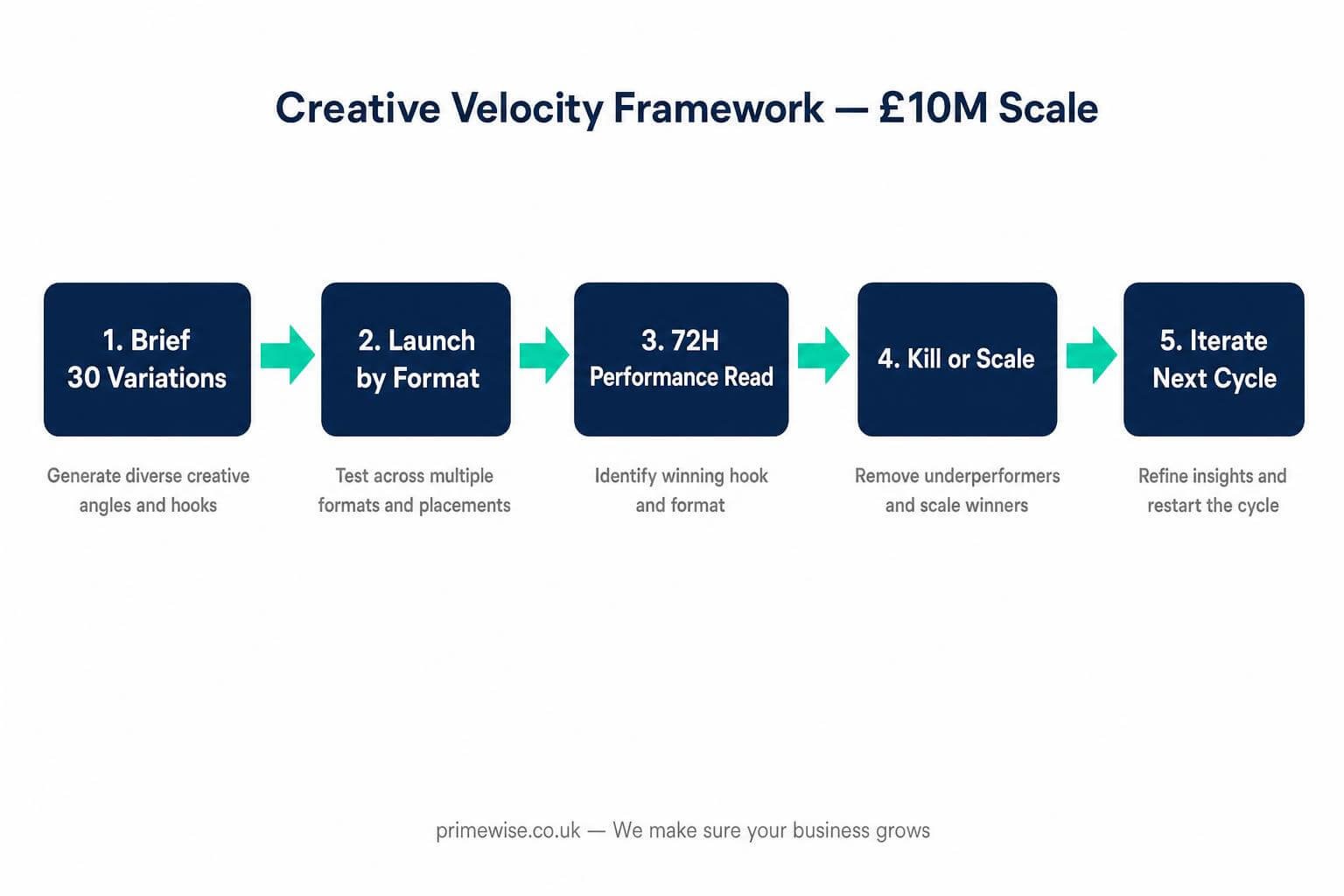
Reaching £10M in annual revenue requires treating creative production as an industrial process rather than a creative exercise. At this scale, ad fatigue across Meta and TikTok becomes the single greatest constraint on acquisition efficiency not budget availability or audience size. Overcoming this requires deploying a minimum of 30 structured creative variations weekly, systematically testing across format (static, video, UGC, motion graphic), hook category (social proof, problem-agitation, value demonstration, authority positioning), and audience temperature (cold prospecting versus warm retargeting). This framework identifies winning asset combinations within 72 hours of launch, enabling rapid budget reallocation before creative decay degrades cost-per-acquisition metrics. Tools such as Motion and MadgicX support this creative analytics layer, providing frame-level engagement data that informs the next iteration cycle.
Lifecycle Infrastructure That Protects CM3
Building a repeat purchase rate of 42% at the £10M stage the benchmark that separates elite UK D2C brands from average performers requires deploying a customer data platform that enables genuine predictive lifetime value modelling rather than retrospective cohort reporting. Platforms such as Klaviyo for email flow architecture and Attentive for SMS automation form the operational backbone of this lifecycle infrastructure, but their effectiveness is entirely dependent on the quality of first-party data feeding into them. A properly configured CDP segments customers by purchase frequency, average order value, product category affinity, and recency enabling post-purchase sequences, win-back campaigns, and subscription conversion flows that are behaviourally triggered rather than calendar-scheduled. This infrastructure shift alone typically generates a 15–25% uplift in email revenue per recipient compared to broadcast sending models, aligned with findings from Salesforce’s State of Marketing research.
UK Market Constraints and Margin Pressures
Operating a D2C brand in the United Kingdom in 2026 presents a specific and demanding set of commercial pressures that generic global marketing frameworks systematically fail to address. Post-Brexit logistics complexity, cross-border VAT obligations, elevated domestic warehousing costs, and a consumer base navigating sustained cost-of-living pressure collectively create a margin environment that punishes imprecise financial modelling with particular severity. A competent UK D2C performance marketing consultant must treat these pressures not as operational context but as core inputs to every media buying and margin management decision.
Post-Brexit Logistics and VAT Modelling
For UK D2C brands with European revenue exposure, the post-Brexit trading environment introduces material margin complexity that must be modelled at the CM2 level before any cross-border acquisition spend is committed. The UK Global Tariff structure affects landed cost calculations for imported inventory, while the EU’s One Stop Shop VAT scheme creates compliance obligations for brands generating more than €10,000 in annual EU consumer sales. Failing to account for these costs within contribution margin modelling results in media budgets being set against inaccurate profitability assumptions a systematic error that compounds with scale. At the £10M stage, unmodelled cross-border VAT and tariff costs can silently erase two to four points of CM3, transforming what appears to be a profitable growth phase into a cash-flow crisis.
Adapting to UK Consumer Psychology
The sustained cost-of-living environment in the UK has produced a consumer base that is significantly more value-conscious and trust-sensitive than pre-2022 cohorts. This does not mean that premium D2C brands must compete on price it means that the evidentiary burden of justifying a purchase decision is substantially higher. Conversion rate optimisation strategies must integrate localised trust signals including Trustpilot ratings prominently displayed in ad creative, editorial coverage from recognisable UK media outlets, and transparent delivery and returns policies directly into the acquisition funnel rather than treating them as supplementary brand elements. Brands that invest in this trust architecture during the £5M–£10M phase consistently demonstrate stronger blended CAC performance as they approach the £20M milestone, because organic word-of-mouth and brand search volume reduce paid dependency over time.
Common Scaling MistakeBrands collapsing CM3 by misattributing Meta view-through conversions as incremental revenue is one of the most prevalent and costly errors at the £5M–£10M stage. Without incrementality testing using geo holdout experiments or conversion lift studies brands systematically overstate the true return on their paid investment and make budget allocation decisions against a fundamentally flawed data model.
A Worked Financial Example
To illustrate how contribution margins and acquisition costs shift in practice, consider a hypothetical UK skincare D2C brand scaling from £3M to £12M across an 18-month engagement. At the £3M starting point, the brand was operating a blended CAC of £41, a CM2 of 31%, and a CM3 of 14% functional but fragile. Platform ROAS was reported at 3.8x, masking a true MER of 2.6x once all channel costs were blended. Repeat purchase rate stood at 29%, with lifecycle revenue contributing only 18% of total turnover.
Following implementation of the Contribution Margin Escalator framework, a CDP-led segmentation rebuild, and a restructured creative testing programme that scaled from 9 weekly variations to 34, the brand reached £12M with a blended CAC of £53, a CM2 of 27%, and a CM3 of 16.5% representing a structural improvement in margin efficiency despite a 29% increase in absolute acquisition cost. Repeat purchase rate reached 43%, with lifecycle revenue contributing 38% of total turnover, materially reducing paid media dependency. Blended CAC rose in absolute terms because the brand was acquiring higher-LTV customers into a retention system capable of generating genuine operating leverage the precise outcome the Contribution Margin Escalator is engineered to produce.
Primewise Growth PartnershipPrimewise operates as the embedded growth partner described throughout this article providing senior-level D2C scaling expertise on a fractional basis, with a verifiable track record of accelerating UK brands through the £5M–£20M corridor without the overhead or strategic fragmentation of a traditional agency retainer. Every engagement begins with a full commercial audit before a single pound of additional media spend is committed.
Fractional Consultants vs Agency Retainers
The traditional full-service London agency model, carrying significant overhead, managed by account executives rather than senior practitioners, and reporting on channel metrics rather than contribution margins, is structurally misaligned with the requirements of a D2C brand at the £5M–£20M growth stage. Agency retainers typically cost between £8,000 and £25,000 per month for brands at this scale, with strategic decision-making delegated to mid-weight operators rather than the senior talent presented during the pitch process. The strategic layer that a scaling D2C brand actually needs, someone who owns CM3 accountability, manages cross-channel budget allocation, and rebuilds lifecycle infrastructure simultaneously, is rarely present within a standard agency engagement.
A fractional D2C performance marketing consultant, by contrast, operates as a deeply embedded senior operator who works directly within the founder’s commercial team, without the overhead of a full-time executive hire or the structural limitations of an agency mandate. Primewise functions precisely in this capacity providing bespoke operational blueprints, direct platform access, and CM3-accountable growth strategies that align with the specific financial architecture of each brand. For UK D2C brands between £2M and £15M in annual revenue, this engagement model consistently delivers superior return on consulting investment compared to full-service agency alternatives.
Key Financial Ratios to Demand at Every Milestone
When evaluating any growth lead or consulting partner, founders must insist on explicit commitment to measurable financial benchmarks not channel KPIs, not platform ROAS targets, and not vanity engagement metrics. The minimum standard for elite D2C performance marketing at the £10M+ stage is a CM3 of 15% or above after all media spend, a payback period on customer acquisition of no more than 90 days for subscription-adjacent categories and 180 days for considered-purchase categories, and an LTV: CAC ratio of at least 3:1 measured across a 24-month customer window. Any growth partner unable to present a clear methodology for tracking and defending these ratios against a live brand P&L should not be entrusted with a scaling budget.
Key Statistics for UK D2C Brands in 2026
- UK ecommerce revenue is projected to exceed £74.5 billion by 2027, with D2C representing a growing share of category spend across beauty, homeware, and wellness verticals (Statista, 2025).
- Average UK Meta CPMs increased by approximately 34% year-on-year in H1 2025, accelerating the creative volume requirements needed to maintain stable acquisition costs (Varos Benchmark Report, 2025).
- Brands operating a properly configured customer data platform achieve 2.3x higher email revenue per recipient compared to those using broadcast sending models (Salesforce State of Marketing, 2025).
- UK average pick, pack, and dispatch costs range from £3.20 to £5.50 per order, depending on SKU complexity and fulfilment provider (2025 3PL market benchmarks).
- D2C brands with a repeat purchase rate above 40% demonstrate 31% lower blended CAC dependency than those below 30%, due to organic referral and brand search volume growth (IMRG UK Online Retail Index, 2025).
- Post-Brexit cross-border VAT miscalculation accounts for an average of 2.1 points of untracked CM3 erosion among UK D2C brands with European revenue exposure (based on Primewise commercial audit data, 2024–2025).