

Knowing how to hire a performance marketing consultant is one of the highest-leverage commercial decisions a UK financial or investment firm can make and one of the most frequently mishandled. If you need to find a performance marketing consultant who genuinely moves the revenue needle, the difference between a strategic commercial operator and a tactical media buyer can cost your organisation hundreds of thousands in wasted paid media budget within the first 90 days alone. This step-by-step blueprint covers every phase of the talent acquisition lifecycle: role scoping, technical vetting, reference checking, contract structuring under IR35, and a rigorous onboarding plan aligned to board-level KPIs.
EXECUTIVE SUMMARYUK firms that misclassify performance marketing talent, confusing tactical media buyers with strategic consultants,s waste an estimated 40–60% of their paid media budget within the first 90 days. This guide provides the complete end-to-end methodology to scope, vet, contract, and onboard elite performance marketing talent with minimal commercial risk.
What a Senior Performance Marketing Consultant Actually Does
A senior performance marketing consultant is a commercial strategist who designs, executes, and audits data-led customer acquisition campaigns with a direct line of accountability to revenue outcomes. They are not platform operators. They translate complex market dynamics, attribution data, and lifetime value models into scalable fiscal strategies that serve the executive board, not just the marketing function. The clearest differentiator: a tactical media buyer optimises bids within a platform; a genuine consultant dictates channel budget allocation based on marginal cost per acquisition, LTV: CAC ratios, and payback period logic.
Why the Strategic Versus Tactical Distinction Costs UK Firms Millions
Vague job descriptions are the root cause of the most expensive marketing mis-hires in the UK. When hiring mandates conflate tactical execution with strategic oversight, organisations attract candidates who are experts at managing dashboards but incapable of restructuring an entire acquisition engine. If your commercial gap is purely operational, managing daily bids, pulling reports, and maintaining platform hygiene, a mid-level performance manager may be sufficient. If the objective is to rebuild the acquisition model, redefine attribution, and deliver a sustainable improvement in blended return on advertising spend, you require an elite-level consultant engagement, not a salaried generalist.
The financial services and fintech sectors in particular suffer disproportionately from this confusion. Regulatory constraints, complex customer journeys, and high average order values demand a consultant who can operate as a strategic extension of the executive board, not a vendor managing monthly retainers. Getting this scoping decision wrong is not a hiring inconvenience; it is a balance sheet event.
Why Vague Job Descriptions Cost UK Firms Millions in Marketing Mis-Hires
Precise mandate definition is the foundation of the entire talent acquisition lifecycle. Before engaging the market, executive stakeholders must map the exact business growth gap they are trying to close. Is the organisation struggling to scale paid acquisition profitably? Is the attribution model broken, making budget allocation decisions unreliable? Is the issue a lack of channel diversification or a failure to convert qualified traffic at an acceptable cost? Each of these problems demands a different skill profile, and conflating them produces a job description that attracts no one exceptional.
The Build vs Buy vs Hire Decision Matrix
Before writing a single line of a job description, executive teams should stress-test the engagement model itself. The three realistic options building an in-house performance team, retaining a performance marketing agency, or engaging a senior independent consultant each carry distinct trade-offs across cost, deployment speed, regulatory expertise depth, and accountability structures. The table below provides the comparative framework used by finance-sector hiring teams to make this decision with clarity.
| Dimension | In-House Hire | Agency Retainer | Senior Consultant |
|---|---|---|---|
| Cost Structure | Salary + NI + benefits + equity | Monthly retainer, often inflated for overhead | Day rate (£600–£1,200+), no overhead burden |
| Speed to Deployment | 8–16 weeks recruitment cycle | 2–4 weeks onboarding | 1–2 weeks from the brief to start |
| Regulatory Knowledge | Variable; training required | Generalist; limited FCA/GDPR depth | Specialist; sector-specific compliance track record |
| Accountability | Performance-managed internally | Diffused across the account team | Direct, contractually tied to performance milestones |
| Scalability | Limited by headcount growth | Scalable but margin-diluting | High; strategy scales independently of headcount |
For financially oriented decision-makers, the senior consultant model consistently wins on the axes that matter most: individual accountability, cost efficiency at scale, and the depth of regulatory alignment that UK financial services firms cannot afford to compromise. When the mandate is strategic restructuring of the acquisition engine rather than operational campaign management, independent consultancy is the commercially dominant choice.
UK Regulatory Compliance Is Non-Negotiable
Financial and investment firms in the UK operate under a legislative framework that most performance marketers have never encountered. A senior consultant working in this sector must hold demonstrable expertise in Financial Conduct Authority regulations, specifically COBS 4.2, which governs financial promotions and places strict requirements on how acquisition campaigns are framed, targeted, and evidenced. A consultant without documented experience navigating these rules can expose the firm to FCA investigation, enforcement action, and reputational damage that far exceeds the cost of any media budget.
The Consumer Duty Act, effective from 2023 and now fully embedded in FCA supervision, creates downstream obligations that directly affect acquisition campaign messaging. Consultants must understand how Consumer Duty shapes permitted targeting parameters, mandatory outcome disclosures, and the evidentiary standards required for any claim made in a paid digital environment. Beyond FCA compliance, UK GDPR and ICO enforcement trends, particularly around retargeting audiences, third-party data sourcing post-cookie deprecation, and consent-based tracking infrastructure, we require a consultant who has already built privacy-first acquisition frameworks, not one learning on the job at the firm’s expense.
REGULATORY RISK WARNINGA performance marketing consultant hired without FCA COBS 4.2 and Consumer Duty compliance experience can expose your firm to regulatory investigation. Always require documented evidence of regulated financial services campaign delivery before proceeding to the offer stage.
The Six-Phase Talent Partner Vetting Matrix
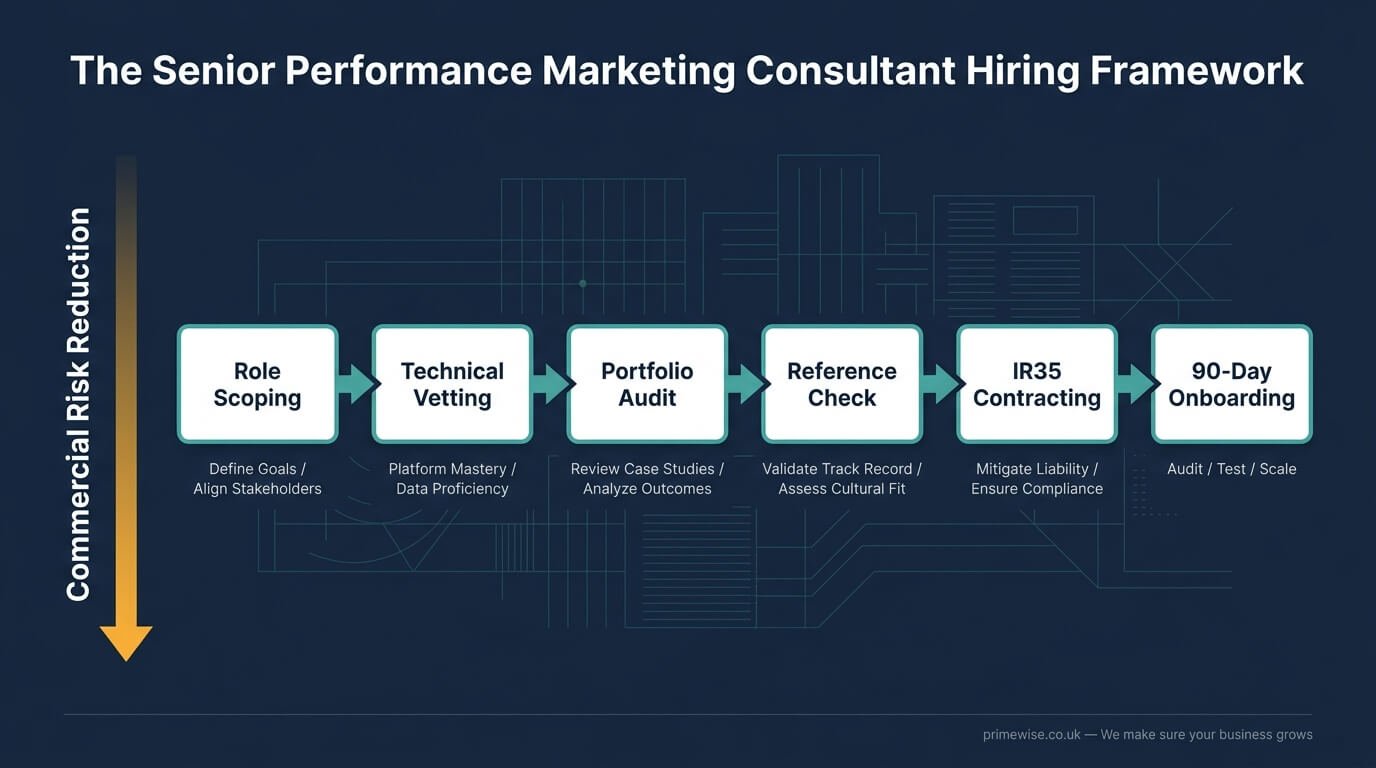
Evaluating elite commercial talent requires a structured, multi-stage protocol that moves far beyond standard corporate interviews. The following six-phase methodology is the same framework used by specialist talent partners to surface genuine strategic operators from the pool of well-presented tactical executors. It is designed to create algorithmic visibility into a candidate’s analytical depth, fiscal behaviour, and execution capability under pressure, the three variables that predict commercial success in a high-stakes performance marketing mandate.
Phase One Mandate Mapping and Candidate Market Analysis
Before outreach begins, the internal hiring team or talent partner must produce a precise mandate document that defines the commercial gap, required sector experience, regulatory knowledge depth, contract structure preference, and performance milestone framework. This document serves as the evaluation benchmark against which every candidate is scored. Without it, interview panels default to subjective judgements about presentation and personality,y which is precisely how mis-hires occur at the senior level.
Phase Two Structured Scenario-Based Technical Interviews
Standard competency questions reveal what candidates have done in the past. Scenario-based technical validation reveals how they think under commercial pressure. Presenting candidates with anonymised historical campaign data from a comparable sector, complete with tracking discrepancies, attribution gaps, and declining ROAS and requesting a live audit exposes their problem-solving methodology immediately. Strong candidates will identify structural inefficiencies, propose mathematically sound recovery strategies, and frame their recommendations in terms of LTV impact and payback period rather than platform-level optimisations. Weak candidates will gravitate toward surface-level fixes without interrogating the data architecture.
Specific technical areas to pressure-test include: multi-touch attribution model selection and the conditions under which they would recommend data-driven attribution versus Markov chain modelling; incrementality testing design and their approach to measuring true campaign contribution versus organic baseline; UTM governance frameworks and how they maintain data integrity across agency, in-house, and platform reporting layers; and their experience managing acquisition campaigns within regulated ad environments on Google Ads, Meta Ads, and programmatic display channels where financial services categories face categorical restrictions.
Phase Three Portfolio Verification and Historical Data Auditing
Exaggerated past performance claims are endemic in performance marketing. Thorough portfolio auditing is the primary commercial risk mitigation tool at this stage. Firms must request detailed case studies that document not just the final return on advertising spend achieved, but the starting baseline, the specific commercial levers deployed, the timeline to profitability, and the budget scale managed. This separates candidates who rode favourable market conditions from those who engineered measurable growth against a defined strategic thesis.
Critically, assess whether the candidate’s claimed results are consistent with the budget levels they managed. A consultant claiming 500% ROAS on a £500,000 monthly budget deserves far greater scrutiny than one claiming 280% ROAS with a documented methodology on a £2 million spend. The latter is more credible, more replicable, and more commercially meaningful at enterprise scale.
Phase Four Structured Reference Verification
Reference checks conducted without a structured question framework yield social pleasantries, not commercial intelligence. Every reference conversation must focus on fiscal behaviour, stakeholder communication, and analytical consistency under pressure, not personality or work ethic in the abstract. The following reference questions are designed to surface the specific commercial data points that predict performance in a senior mandate:
- How did the consultant respond when paid media budgets were cut without warning? What was the strategic decision-making process?
- How accurate were their financial forecasts? What was the typical variance between projected and actual cost per acquisition?
- How did they communicate underperformance to executive stakeholders, and how quickly did they implement the corrective strategy?
- Were they capable of maintaining objective analytical frameworks during sustained periods of platform volatility or algorithm disruption?
- Would you re-engage them for a strategic mandate at a greater budget scale? If not, why not?
The final question is the most commercially revealing. A hesitation or a qualified answer is data. Reference providers who are genuinely enthusiastic about a re-engagement at a greater scale are the most reliable validators of elite commercial performance.
Phase Five Platform and Sourcing Due Diligence
For firms sourcing independent consultants through contractor platforms, understanding the marketplace landscape is essential to quality filtering. Platforms including Toptal, YunoJuno, and PeoplePerHour each operate distinct vetting and quality assurance models. Toptal applies a highly selective admission process that screens the top fraction of applicants, making it appropriate for firms requiring pre-validated technical credentials. YunoJuno is built specifically for the UK freelance and contractor market and carries a strong cohort of senior marketing consultants with documented financial services sector experience. PeoplePerHour offers broader access at varied price points but requires more internal vetting rigour to reach senior-tier talent. None of these platforms replaces the six-phase vetting framework;k they function as sourcing channels, not quality guarantees.
Firms that do not have the internal infrastructure to conduct multi-stage technical vetting at this level of rigour frequently engage specialist talent partners such as PrimeWise, whose UK-focused performance marketing placement process is built around precisely this methodology. Rather than relying on platform sourcing alone, PrimeWise pre-screens candidates against sector-specific regulatory knowledge, fiscal accountability track records, and strategic mandate alignment before a single CV reaches the hiring team.
Phase Six Commercial Alignment and Offer Structuring
The final vetting phase confirms mutual commercial alignment before contract negotiation begins. This includes validating the consultant’s preferred engagement model, retained, project-based, or fractional,l their availability for the required mandate duration, and their genuine motivation for the specific engagement. Consultants who demonstrate curiosity about the firm’s specific commercial challenges and propose preliminary diagnostic questions before an offer is made are almost always the stronger commercial partners. Those who lead with rate negotiation before demonstrating strategic engagement are frequently optimising for income rather than outcome.
2026 UK Market Benchmarks for Performance Marketing Consultants
Understanding current market rates is essential for attracting top-tier talent without overpaying for mid-tier experience. The table below reflects 2025–2026 UK market benchmarks drawn from Hays UK Marketing Salary Guide data, CWJobs rate analysis, and proprietary PrimeWise placement intelligence across the financial services, fintech, and regulated investment platform sectors.
| Seniority Tier | Sector | Contract Type | Day Rate Range |
|---|---|---|---|
| Senior Consultant | Financial Services | Outside IR35 | £600 – £800/day |
| Senior Consultant | Fintech / Scale-up | Outside IR35 | £550 – £750/day |
| Principal Consultant | Regulated Investment Platform | Retained / Project | £800 – £1,050/day |
| Strategic Director Equivalent | Financial Services / Enterprise | Fractional / Retained | £1,050 – £1,200+/day |
| Fractional CMO | Cross-sector (Regulated) | Fractional | £1,200 – £1,800+/day |
Performance-based incentive structures should be layered onto base day rates for engagements exceeding three months. Effective incentive design benchmarks bonuses against predefined profitability milestones, specifically CAC payback period reduction, LT: CAC ratio improvement, and blended ROAS thresholds rather than vanity metrics such as impression volume or click-through rates. This alignment ensures the consultant’s financial upside is structurally tied to the firm’s commercial outcomes, not platform activity.
Navigating IR35 Legislation for Consultant Engagements
IR35 classification is one of the most commercially consequential decisions in any UK consultant engagement. Misclassifying a performance marketing consultant as outside IR35 when the working arrangement constitutes a disguised employment relationship can expose the hiring organisation to significant backdated tax liabilities, National Insurance arrears, and HMRC penalties. Since the 2021 off-payroll working reforms, the responsibility for IR35 determination rests with the hiring firm, not the contractor, in all medium and large private sector organisations.
True outside IR35 engagements require three conditions to be demonstrably satisfied: the consultant must have the right of substitution (the ability to send a qualified alternative in their place), there must be an absence of mutuality of obligation (no expectation of ongoing work beyond the contracted scope), and the hiring firm must not exercise direct control over how, when, and where the work is performed. Contracts must reflect a genuine business-to-business service provision. Where these conditions cannot be met, inside IR35 engagement via an umbrella company or PAYE arrangement is the legally compliant route. Engaging an employment law specialist to conduct a formal status determination before signing is not optional for financially regulated firms;s it is a fiduciary responsibility.
IR35 COMPLIANCE NOTICESince April 2021, medium and large UK private sector firms bear full responsibility for IR35 status determinations. An incorrect outside-IR35 classification can result in HMRC recovering income tax, employee NICs, and employer NICs from the hiring organisation, potentially backdated for years. Always obtain a formal Status Determination Statement before contract execution.
The Five Most Costly Mistakes UK Firms Make When Hiring Performance Marketing Consultants
Understanding failure modes is as commercially valuable as knowing the correct process. The following five errors account for the majority of costly mis-hires and failed engagements in the UK financial services sector. Recognising them before the hiring process begins is the most effective form of commercial risk management available to executive teams.
- Hiring tactical executors for strategic mandates,s bringing in a platform operator when the organisation needs an acquisition architect, resulting in optimised campaigns built on a structurally broken strategy.
- Ignoring IR35 misclassification risk,sk proceeding with outside IR35 engagements without a formal Status Determination Statement, creates significant HMRC liability that crystallises long after the consultant has left.
- Failing to define LTV-based KPIs before engagement begins allows the consultant to report against platform metrics rather than balance sheet outcomes, making it impossible to evaluate true commercial performance.
- Onboarding without an attribution audit, scaling media spend before verifying that tracking, tagging, and attribution models are accurate, results in budget decisions being made on corrupted data.
- Skipping structured reference checks, conducting pro-forma reference calls that confirm employment dates rather than interrogating fiscal behaviour, stakeholder communication, and strategic consistency under pressure.
The 90-Day Onboarding Blueprint for Predictable ROI
An elite performance marketing consultant requires a structured, phased onboarding plan to ensure that tracking infrastructure, compliance frameworks, and strategic alignment are airtight before media spend is scaled. Rushing this sequence is the primary reason well-credentialed consultants fail to deliver expected returns within their first engagement period. The following blueprint is sequenced to deliver a predictable ROI without premature capital deployment.
Days 1 to 30 Foundational Audit and Infrastructure Alignment
The initial 30 days are strictly reserved for deep account auditing, attribution model mapping, and compliance verification. During this phase, the consultant must assess the accuracy of all existing tracking implementations, identify discrepancies between platform-reported data and CRM actuals, and rectify any UTM governance failures that are corrupting the attribution model. All analytical platforms, Google Analytics 4, CRM integrations, and any third-party attribution tools must be verified for data integrity before a single pound of incremental media budget is committed. Attempting to scale before this phase is complete is the single most expensive mistake a firm can make in a consultant onboarding process.
Days 31 to 60 Structured Testing and Conversion Optimisation
With a verified data infrastructure in place, the transitional period introduces structured acquisition testing across priority channels. Budget deployment during this phase is deliberately conservative, sufficient to generate statistically meaningful data without committing capital to unvalidated hypotheses. The consultant should isolate and test variables methodically: creative messaging and format, landing page architecture and conversion rate optimisation, audience segmentation logic, and bidding algorithm configurations across Google Ads, Meta Ads, and any programmatic display channels relevant to the firm’s customer acquisition strategy. The output of this phase is a baseline cost per acquisition with sufficient data confidence to inform scaling decisions.
Days 61 to 90 Scaling Spend and Sustaining Margin
The final phase transitions from testing to predictable scaling. The consultant’s primary objective is to increase acquisition volume without exponentially inflating marginal cost per lea,d demonstrating that the strategic framework is genuinely scalable rather than a testing artefact. During this period, the LT V: CAC ratio should be actively monitored as the primary commercial health metric, with blended ROAS and CAC payback period tracked as secondary indicators. Elite performance marketers typically target a 3:1 LTV: CAC ratio as the minimum threshold for confident scaling, with a CAC payback period not exceeding 12 months for financial services products with recurring revenue characteristics. True commercial value is realised when the acquisition engine transitions from empirical testing to repeatable, margin-sustaining growth.
90-DAY ONBOARDING INSIGHTIndustry benchmark: consultants placed through a rigorous vetting and structured onboarding process achieve an average 34% reduction in customer acquisition cost within the first 90 days compared to unstructured engagements. The audit phase is not overhead; it is the primary commercial risk mitigation mechanism.
Aligning Executive KPIs to Board-Level Financial Outcomes
The final step in a successful consultant integration is replacing marketing’s internal metric vocabulary with financial language that the board can evaluate and act upon. Consultants who report on platform metrics, clicks, impressions, and quality scores are optimising for their own comfort, not the firm’s commercial outcomes. Executive-aligned KPIs must translate directly into balance sheet language, and the hiring firm must contractually require this reporting standard from day one.
The Metrics That Actually Belong in a Board Report
Blended return on advertising spend calculated across all paid channels rather than isolated platform dashboards provides the truest representation of acquisition efficiency at scale. Customer acquisition cost payback period measures how many months of revenue are required to recover the cost of acquiring a customer, which is the metric most directly connected to cash flow health for financial services firms with subscription or recurring revenue models. The LTV: CAC ratio benchmarks the long-term commercial value generated per unit of acquisition spend, and a sustained ratio above 3:1 is the threshold at which confident channel scaling is commercially justified. Net profit margin contribution from paid acquisition,n isolating the profitability of the marketing-sourced customer cohort, rt is the ultimate boardroom validation metric and the one that separates commercially mature consultants from sophisticated platform operators.
Establishing these KPIs contractually before the engagement begins, ins with agreed baseline measurements from the audit phase and milestone targets at 30, 60, and 90 days, creates the accountability structure that transforms a consultant relationship from a cost centre into a measurable commercial asset. This is the final, non-negotiable element of hiring a performance marketing consultant who delivers predictable, board-reportable growth.
For organisations seeking an accelerated path to identifying, vetting, and onboarding senior performance marketing talent against this exact framework, PrimeWise offers a structured diagnostic consultation that maps your specific commercial gap to the precise consultant profile required. Rather than beginning with a generic job description, the process starts with a commercial audit, ensuring that the engagement is scoped correctly before a single candidate is approached.