
Knowing when not to hire a fractional CMO is arguably more valuable than knowing when to hire one. Deploying a fractional CMO service into the wrong commercial environment is a guaranteed method of destroying marketing ROI, draining capital, and compounding the very growth stagnation you are trying to escape. For many UK SMEs, the growth bottleneck is rarely a strategic deficit it is a profound lack of execution bandwidth. And no amount of high-level thinking fixes an execution problem. Before committing £4,000 to £10,000 per month to part-time C-suite leadership, UK founders, MDs, and CEOs need a commercially honest diagnostic. This article provides exactly that.
What a Fractional CMO Actually Is
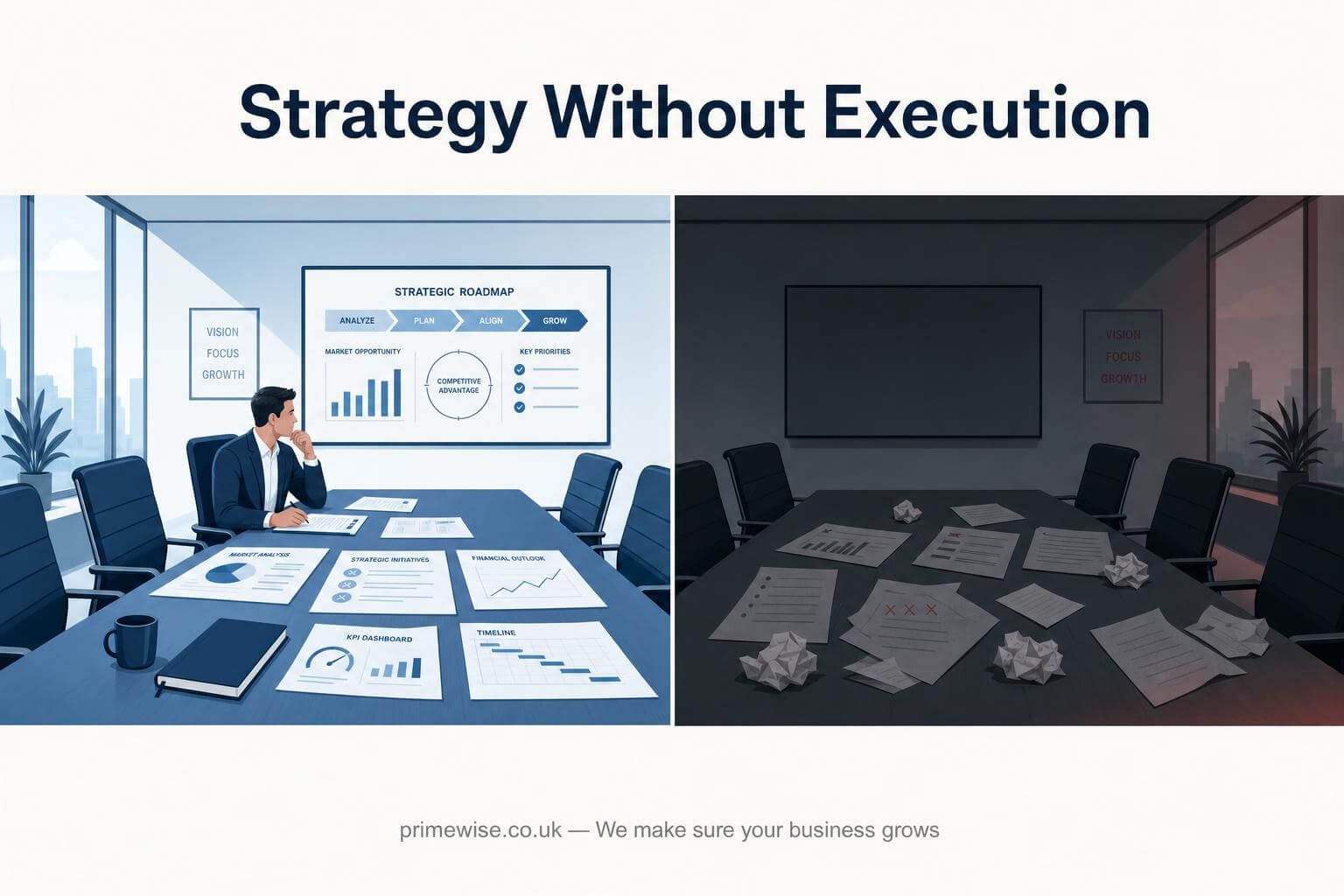
A Fractional CMO is a part-time chief marketing officer who provides board-level marketing strategy, go-to-market planning, and commercial leadership to a business typically across two to four days per month for a fraction of the cost of a full-time hire. They are not tactical executors. They do not write copy, run paid campaigns, or manage your HubSpot instance. They architect the strategy and direct the team that executes it. This distinction is the single most important thing to understand before entering any fractional engagement. When the execution infrastructure does not exist, the strategy has nowhere to land.
THE EXPENSIVE PHILOSOPHER PROBLEMA fractional CMO without a funded tactical execution budget is simply an expensive philosopher. Brilliant strategic roadmaps hold zero commercial value when there is no operational bandwidth to navigate them. This is the primary reason fractional engagements collapse.
The Quick Diagnostic Before You Decide
Before evaluating external marketing hires of any kind, UK business leaders should complete a rapid internal audit. Answer the following five questions honestly. Your score will determine which section of this article is most relevant to your situation right now.
- Does your business have a minimum marketing execution budget of £3,000 per month separate from any CMO retainer fee? Score two points for yes.
- Do you have at least one internal marketing team member capable of implementing strategic direction on a daily basis? Score two points for yes.
- Has your business achieved initial product-market fit with demonstrable, repeatable customer traction? Score two points for yes.
- Is your executive team genuinely prepared to delegate marketing ownership and commit to a minimum six-month engagement? Score two points for yes.
- Do you have a CRM or marketing automation platform such as HubSpot or Salesforce already operational and populated with pipeline data? Score two points for yes.
If you scored zero to four points, a fractional CMO will not deliver commercial value at your current stage this article will explain exactly what to do instead. If you scored five to eight points, you are in borderline territory and the alternative models outlined below deserve serious consideration. If you scored nine to ten points, your business has the structural foundations for a fractional engagement to succeed, and exploring options with a specialist such as PrimeWise would be a logical next step.
Four Commercial Red Flags
There are four structural scenarios in which a fractional CMO engagement will almost certainly fail to deliver measurable return. Each represents a different root cause, and each points toward a different structural solution. Understanding which scenario your business occupies is the most commercially valuable exercise a UK MD or CEO can undertake before committing capital to senior marketing leadership.
No Budget Allocated for Tactical Execution
The most common and most costly mistake UK SMEs make is engaging a fractional leader before funding the execution layer beneath them. A fractional CMO will audit your proposition, define your positioning, map your target accounts, and design your demand generation engine. They will then hand that roadmap to a team that does not exist, or to a budget that has not been approved. The strategy stalls. The retainer burns. The engagement ends. According to industry hiring data, the majority of UK SMEs that deployed fractional marketing leadership without a minimum £3,000 per month execution budget separate from the CMO retainer reported no measurable revenue impact within twelve months. The rule is simple: fund the engine before you hire the engineer.
Operating Before Product-Market Fit
Early-stage startups and founders still in proposition development must guard their runway with absolute discipline. A fractional CMO is architecturally designed to scale existing commercial traction to amplify what is already working, accelerate what is gaining momentum, and eliminate what is draining resource. They are not built to invent a market that does not yet exist, validate an untested proposition, or identify your minimum viable customer. If your business has not yet achieved repeatable, profitable customer acquisition with a defined ideal customer profile, the capital earmarked for a fractional CMO is far better deployed toward customer discovery interviews, proposition testing, and direct sales activity. Hire the CMO after you have found the product-market fit. Hire the demand generation resource to help you find it.
Founder Reluctance to Delegate Marketing Ownership
This is the most psychologically sensitive red flag, and the one most frequently left unspoken in early conversations with fractional candidates. The structural reality of many UK SMEs is that the founder or managing director is the de facto head of marketing the brand voice, the relationship owner, the strategic decision-maker, and the final approval on every piece of content. If that founder intends to continue overriding strategic marketing decisions, attending every agency call, and repositioning the messaging on a quarterly basis, the investment in fractional leadership is entirely wasted. True marketing transformation at the C-suite level requires robust delegation, genuine change management appetite, and unyielding board-level alignment. Without those conditions, a fractional CMO is simply an expensive mirror reflecting the founder’s existing instincts back at them with a better PowerPoint deck.
Deep Misalignment Between Sales and Marketing
Entrenched cultural tension between a traditional sales function and a nascent marketing department is one of the most destructive forces in B2B revenue operations. When a sales director dismisses marketing-qualified leads as irrelevant, when pipeline attribution is contested, or when there is no shared definition of an ideal customer profile, a fractional CMO operating two days per month lacks the institutional presence to resolve it. Repairing revenue operations misalignment, redesigning the handoff between marketing-qualified and sales-qualified leads, and rebuilding cross-functional trust requires a permanent mandate and daily organisational influence. A fractional executive however skilled simply does not accumulate the political capital or the dedicated hours to unpick complex stakeholder dynamics in a part-time capacity.
CRITICAL QUESTIONAsk yourself this before signing any engagement contract: is the bottleneck in our business a lack of strategic direction, or a lack of people and budget to execute the strategy we already have? The honest answer determines the correct hire.
Diagnosing Your True Growth Bottleneck
Accurate capability mapping prevents UK businesses from hiring the wrong type of marketing professional at the wrong stage of their commercial development. The discipline required here is distinguishing between a strategic deficit and an execution capacity gap two fundamentally different problems that demand fundamentally different solutions.
The B2B Marketing Readiness Matrix
The B2B Marketing Readiness Matrix is a capability mapping framework that plots your business’s strategic need against its execution capacity to reveal the optimal hiring route. It is designed to prevent the single most expensive mistake in SME marketing investment: deploying senior strategic resource into an environment that requires operational execution, or deploying tactical resource into an environment that desperately needs strategic direction first.
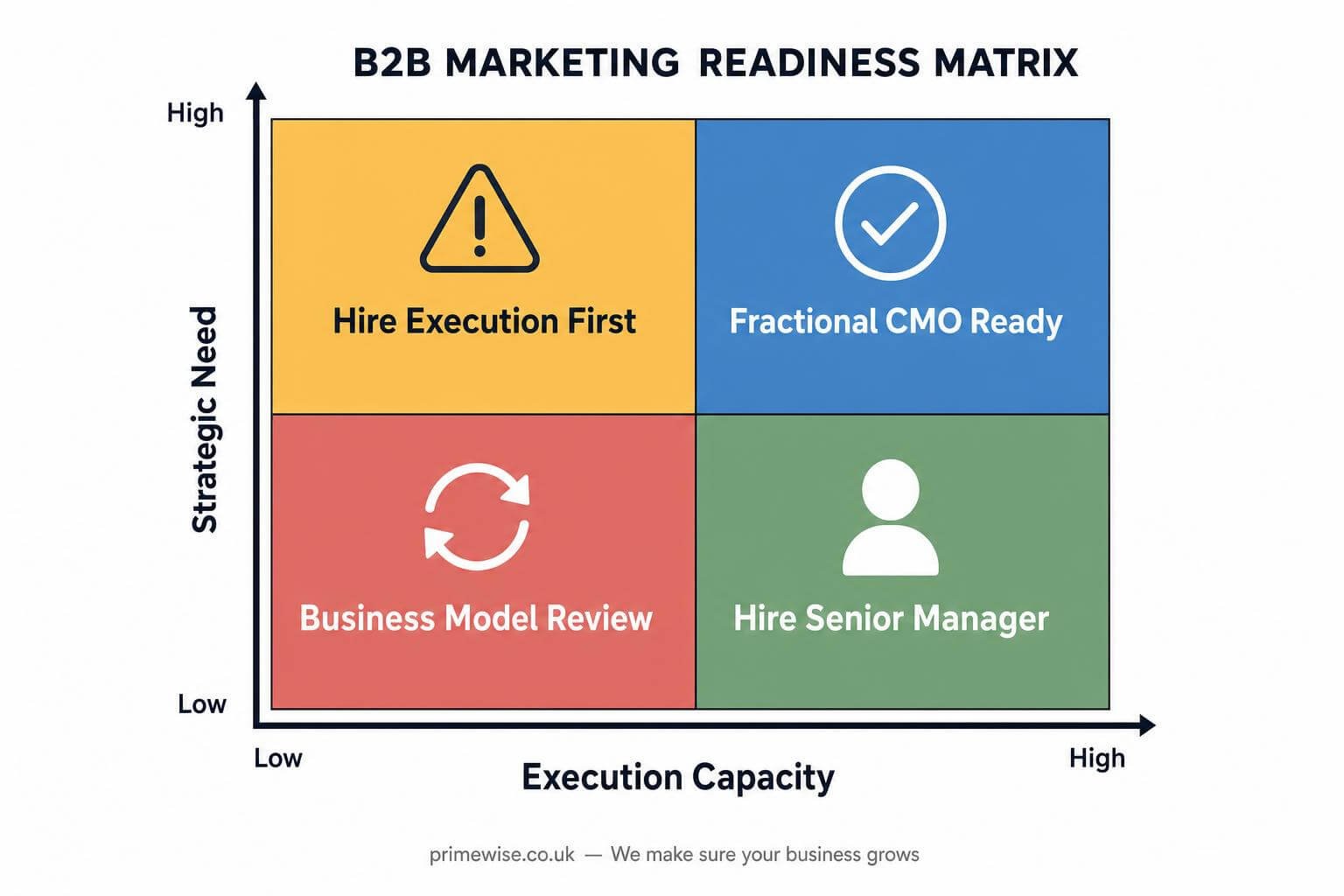
- High Strategic Need combined with High Execution Capacity is the optimal environment for a fractional CMO. The strategy will be implemented, the results will be measurable, and the ROI will be demonstrable within six to twelve months.
- High Strategic Need combined with Low Execution Capacity indicates a requirement for an agency partner or full-time tactical hires before any senior leadership engagement is considered.
- Low Strategic Need combined with High Execution Capacity points toward hiring a senior marketing manager or head of marketing to drive operational output against an already-defined commercial vision.
- Low Strategic Need combined with Low Execution Capacity signals that a fundamental business model and proposition review is necessary before any marketing investment of any kind is made.
If your diagnostic has identified that your business occupies the high-strategy, high-execution-capacity quadrant, PrimeWise provides a no-obligation commercial assessment to determine whether a fractional CMO engagement is the right capital allocation decision for your specific revenue stage. The assessment maps your current marketing infrastructure, identifies structural gaps, and produces a clear recommendation including whether a fractional engagement, a full-time hire, or an agency model best serves your commercial objectives.
The Five Conditions That Must Exist First
Beyond the four red flags, there are five specific commercial conditions that must be present before a fractional CMO engagement has any reasonable probability of delivering ROI. These are not aspirational benchmarks they are structural prerequisites. UK business leaders should treat them as a pre-engagement checklist before any contract is signed.
- A minimum marketing execution budget of £3,000 to £5,000 per month, entirely separate from the CMO retainer, to fund copywriters, performance marketers, paid media, and agency partners.
- At least one internal marketing executive or senior marketing manager capable of translating strategic direction into daily execution and campaign management.
- A documented twelve-month commercial growth target, signed off at board level, that the fractional CMO is explicitly accountable for influencing.
- A CRM or marketing automation platform HubSpot, Salesforce Marketing Cloud, or a functional equivalent already operational, integrated with the sales pipeline, and populated with meaningful contact and opportunity data.
- An executive team with a genuine appetite for delegation, a minimum six-month engagement commitment, and a shared understanding that marketing transformation is not a ninety-day project.
UK Salary and Cost Benchmarking for 2026
Capital allocation decisions require explicit financial benchmarking rather than vague estimates. The following data reflects Q1 2026 UK market rates based on industry salary survey data from the Chartered Institute of Marketing and the Reed and Hays UK Marketing Salary Guides. Regional variance of fifteen to twenty-five percent should be expected for roles based outside Greater London, where the fractional model has historically been most prevalent due to the concentration of senior marketing talent in the capital.
| Role | Expected Annual Cost | Typical Duration | IR35 Risk | Best Suited For |
|---|---|---|---|---|
| Full-Time UK CMO | £120,000 to £180,000 | Permanent | None PAYE | Large-scale transformation, board representation, full P&L ownership |
| Fractional CMO | £48,000 to £120,000 | 6 to 18 months | Medium requires SDS | Scaling existing traction with funded execution team already in place |
| Interim Marketing Director | £80,000 to £130,000 | 3 to 9 months | Medium requires review | Post-acquisition integration, maternity cover, urgent leadership gap |
| Senior Marketing Manager | £50,000 to £70,000 | Permanent | None PAYE | Daily campaign execution when commercial vision is already clearly defined |
| Demand Generation Agency | £36,000 to £84,000 | Project or retainer | Low B2B contract | Urgent pipeline creation, short-term ROI, cash-critical revenue scenarios |
These benchmarks underscore an important commercial reality for regional UK businesses. The fractional model was originally designed to give businesses outside London access to top-tier marketing talent without the £150,000 salary premium. That value proposition is genuine. However, using a fractional engagement as a cheap workaround for a full-time regional hire when the business actually requires permanent, embedded leadership is a false economy that frequently results in failed engagements, wasted retainers, and a deepened scepticism of marketing investment at board level.
IR35 and Fractional CMO Engagements
IR35 compliance is a non-negotiable consideration for any UK business engaging an off-payroll marketing professional at senior level. The off-payroll working rules introduced by HMRC mean that if a fractional CMO is deemed to be operating as a disguised employee rather than a genuine independent contractor, the engaging business becomes liable for the income tax and National Insurance contributions that would have applied. For a £10,000 per month engagement, the financial exposure of an incorrect determination is substantial. Before signing any fractional engagement contract, both parties should complete the HMRC CEST tool the Check Employment Status for Tax tool available on gov.uk which provides an official status determination based on the specific working arrangements.
HMRC applies three primary tests when assessing IR35 status. The first is the personal service test, which evaluates whether the contractor has a genuine right of substitution meaning the ability to send a qualified substitute in their place rather than being required to deliver the service personally. The second is the mutuality of obligation test, which assesses whether the engaging business is obliged to offer work and the contractor is obliged to accept it, a characteristic of employment rather than genuine contracting. The third is the control test, which examines the degree to which the engaging business dictates how, when, and where the work is performed. A fractional CMO engagement structured correctly with deliverables-based payment rather than hours-based billing, a documented right of substitution, evidence of the fractional executive operating as a genuine independent business with multiple clients, VAT registration, and professional indemnity insurance will typically demonstrate sufficient independence to sit outside IR35.
IR35 COMPLIANCE CHECKLISTBefore signing a fractional CMO contract: complete the HMRC CEST tool, ensure the contract specifies deliverables-based payment, include a right of substitution clause, confirm the executive holds professional indemnity insurance and operates multiple client engagements simultaneously. For any engagement exceeding £5,000 per month, commission a legal review from an employment law specialist with specific IR35 experience.
For any fractional engagement exceeding £5,000 per month, it is strongly advisable to commission a formal legal review from an employment law specialist with specific IR35 experience before the engagement commences. The cost of that review is negligible relative to the tax exposure of an incorrect determination. HMRC’s official IR35 guidance is available at gov.uk and should be reviewed by both the engaging business’s finance director and the fractional executive before any contract is executed.
Alternative Structural Roadmaps
Recognising that a fractional CMO is the wrong choice for your business at this stage is not a setback it is precision capital allocation. The following alternative models each address a specific commercial scenario. Matching the structural solution to the actual problem is how UK SMEs stop wasting marketing budget and start generating measurable pipeline.
Deploy a Senior Marketing Manager
When the founder or MD already possesses a clear commercial vision and the business simply lacks the operational capacity to execute it, a Senior Marketing Manager is the correct hire. This is a permanent, embedded role typically costing between £50,000 and £70,000 per annum, responsible for daily campaign execution, content production, CRM management, paid media coordination, and performance reporting. Unlike a fractional CMO, a Senior Marketing Manager does not advise they deliver. They are accountable for output, not strategy. For businesses where the strategic direction is established and the execution gap is the bottleneck, this hire consistently outperforms a fractional engagement in terms of measurable short-term ROI.
Engage a Demand Generation Agency
For businesses facing urgent revenue shortfalls or operating in a cash-critical scenario, a demand generation agency provides the fastest route to qualified pipeline. A specialist B2B demand generation agency one focused on outbound prospecting, paid search, account-based marketing, or LinkedIn lead generation can deploy tactical campaigns within two to four weeks and begin delivering measurable lead volume within sixty to ninety days. This is structurally incompatible with the fractional CMO model, which typically requires a ninety-day discovery and strategy phase before any execution commences. If your board is asking for pipeline this quarter, the agency model is the correct answer. Budget for these engagements typically ranges from £3,000 to £7,000 per month depending on channel mix and scope.
Appoint a Permanent Marketing Director
Driving systemic cultural change across a large or entrenched sales organisation, managing a complex internal communications function, or owning the marketing P&L as a board-level executive requires a permanent presence. A full-time Marketing Director carries the institutional weight necessary to attend every leadership meeting, manage internal politics day-to-day, build cross-functional relationships with the sales team over time, and deliver the sustained organisational influence that transformation demands. For PE-backed businesses, post-acquisition integrations, or any organisation where marketing must operate as a genuine revenue function with board-level accountability, a full-time director at £80,000 to £140,000 per annum is a more appropriate structural choice than any fractional model.
When a Fractional CMO Is the Right Choice
Commercial honesty requires acknowledging both sides of this decision. There are clearly defined scenarios in which a fractional CMO delivers exceptional value and outperforms every alternative model. These include: a scale-up business that has achieved product-market fit and needs to professionalise its go-to-market strategy without the overhead of a full-time hire; a business that has recently secured growth funding and needs board-level marketing leadership to define channel strategy and build the marketing function from scratch; a PE-backed portfolio company requiring an experienced commercial marketing director to drive EBITDA growth ahead of an exit; or an organisation bridging a gap between a departed CMO and a permanent replacement while maintaining strategic momentum. In each of these scenarios, the five prerequisite conditions outlined earlier in this article will typically be present and that is precisely what makes the model work.
PrimeWise works exclusively with UK SMEs and PE-backed businesses to design bespoke fractional marketing leadership structures, ensuring that every engagement is commercially justified, IR35-compliant, and built around a funded execution infrastructure. If you have completed the diagnostic in this article and believe your business is genuinely ready, the next logical step is a structured commercial assessment not a sales call, but a diagnostic conversation that produces a clear recommendation regardless of whether that recommendation involves PrimeWise or not.